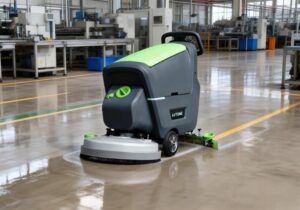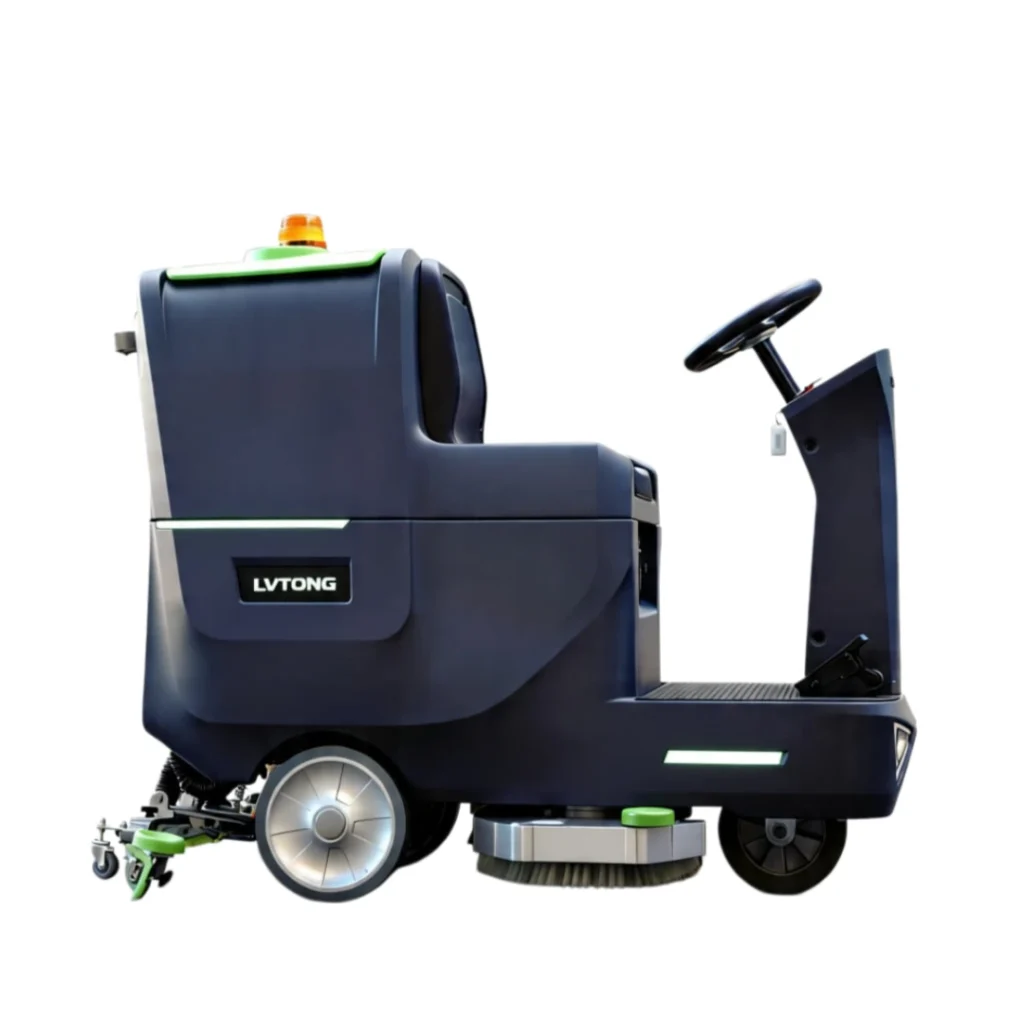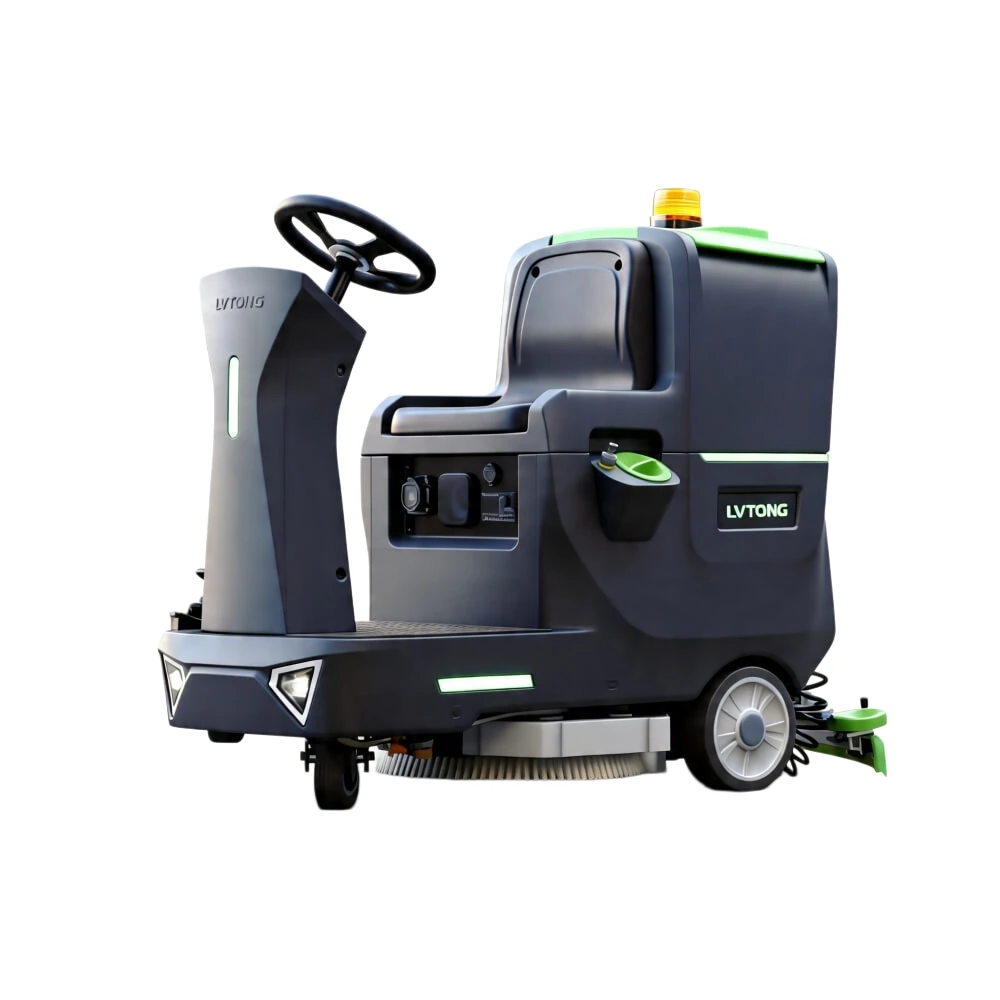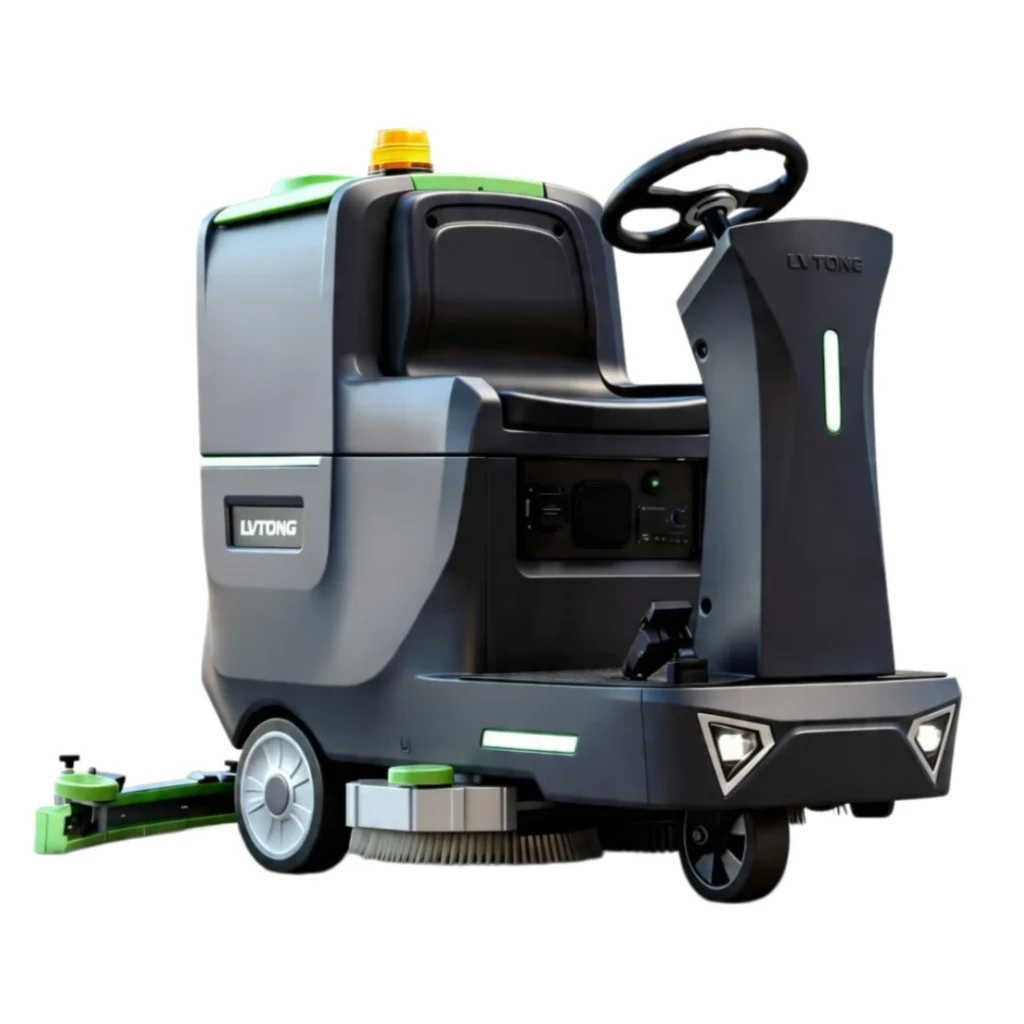
Choosing the right industrial floor cleaner is not simply a matter of selecting the largest machine or comparing purchase prices. The right choice depends on your cleaning area, floor condition, aisle width, cleaning frequency, battery runtime, tank capacity, maintenance requirements, and operating costs.
In this guide, industrial floor cleaner refers to powered industrial floor cleaning machines such as floor scrubbers and scrubber dryers, rather than chemical floor-cleaning products.
For factories, warehouses, logistics centers, workshops, and other large facilities, matching the machine to the actual cleaning environment can improve productivity, reduce unnecessary labor, and deliver more consistent cleaning results.
Quick Answer: How to Choose an Industrial Floor Cleaner
Choose an industrial floor cleaner based on your cleaning area, facility layout, floor type, cleaning width, tank capacity, battery runtime, maneuverability, maintenance needs, and total cost of ownership. Walk-behind machines are generally better for narrow aisles and smaller areas, while ride-on floor scrubbers are more efficient for large factories and warehouses. The right machine should match your actual cleaning route, operating hours, and floor conditions rather than simply offering the largest size or lowest purchase price.

How Do You Choose an Industrial Floor Cleaner?
The best industrial floor cleaner should match the way your facility is actually cleaned.
Before comparing models, consider these seven factors:
- Cleaning area and facility layout
- Floor type and type of dirt
- Cleaning width and maneuverability
- Tank capacity
- Power source and battery runtime
- Durability and maintenance requirements
- After-sales support and total cost of ownership
A large ride-on machine may be efficient in an open warehouse but inconvenient in narrow production aisles. A compact machine may maneuver easily but require too many passes and water refills in a large facility.
The goal is therefore to find the best balance between cleaning productivity, machine size, runtime, maneuverability, and operating cost.
What Is an Industrial Floor Cleaner?
An industrial floor cleaner is a powered machine designed to clean large or demanding floor areas more efficiently than conventional manual cleaning.
Industrial floor scrubbers typically apply cleaning solution to the floor, agitate dirt with brushes or pads, recover dirty water through a vacuum system, and leave the surface relatively dry in a single cleaning process.
Compared with equipment intended for light-duty environments, industrial floor cleaning machines generally feature:
- More durable construction
- Larger solution and recovery tanks
- Greater cleaning width
- Higher cleaning productivity
- Stronger brush systems
- Longer operating periods
- Components designed for frequent use
They are commonly used in factories, warehouses, workshops, logistics facilities, parking areas, shopping centers, and other locations where large floor areas require regular cleaning.
Walk-Behind vs. Ride-On Industrial Floor Cleaners
One of the first decisions is whether your facility needs a walk-behind or ride-on machine.
| Type | Best Suited For | Main Advantages | Main Considerations |
|---|---|---|---|
| Walk-behind floor cleaner | Smaller areas, narrow aisles, workshops and congested spaces | Compact, maneuverable, easier to store | Lower productivity over very large areas |
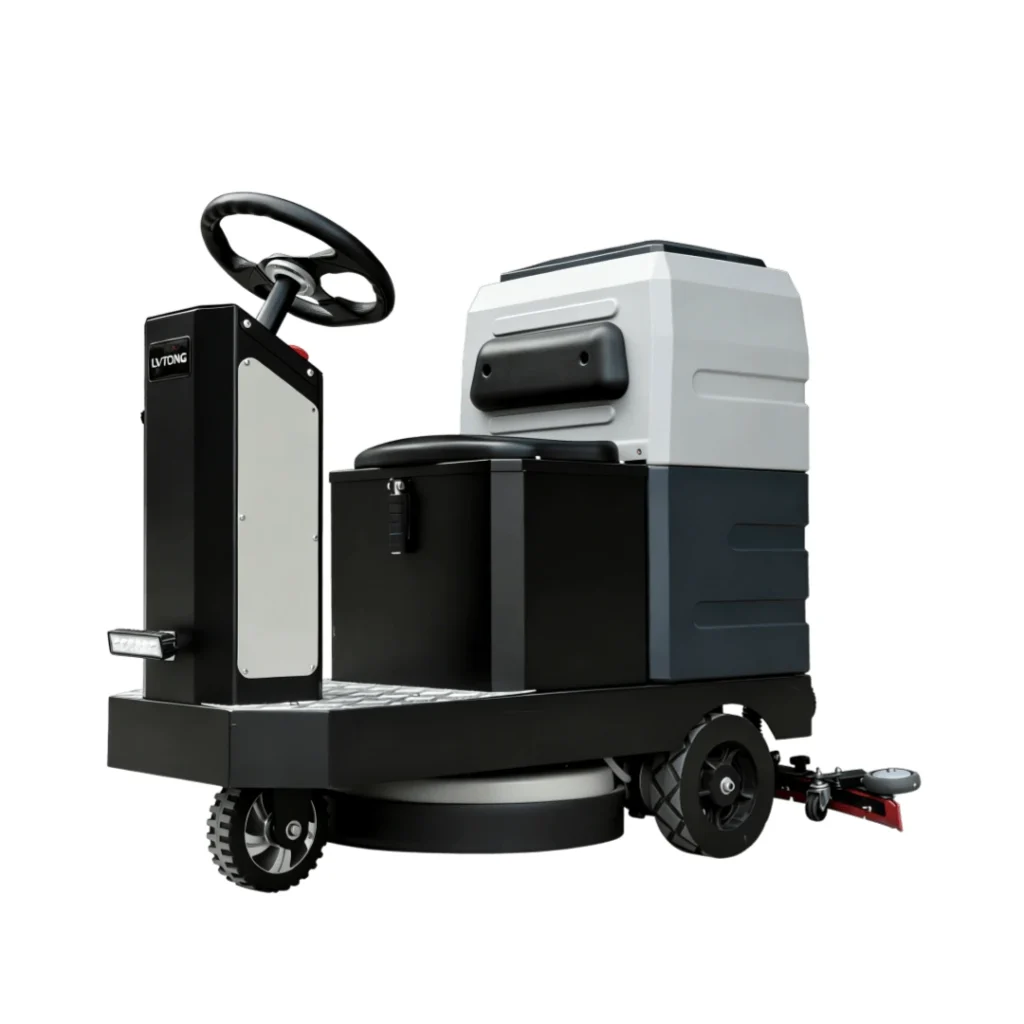
| Ride-on floor cleaner | Factories, warehouses and large open areas | Higher productivity, larger tanks, less operator walking | Requires more maneuvering and storage space |
| Battery-powered model | Facilities requiring cordless operation | Flexible movement, no power cord during cleaning | Runtime and charging must match the work schedule |
| Corded model | Smaller areas with easy access to power | Continuous operation without battery charging | Power cord can restrict cleaning range |
For facilities with narrow aisles, frequent turns, equipment, racks, or other obstacles, maneuverability may be more important than maximum cleaning width.
For facilities with narrow aisles, frequent turns, equipment, racks, or other obstacles, walk-behind floor scrubber machines provide greater maneuverability and easier access to confined cleaning routes.
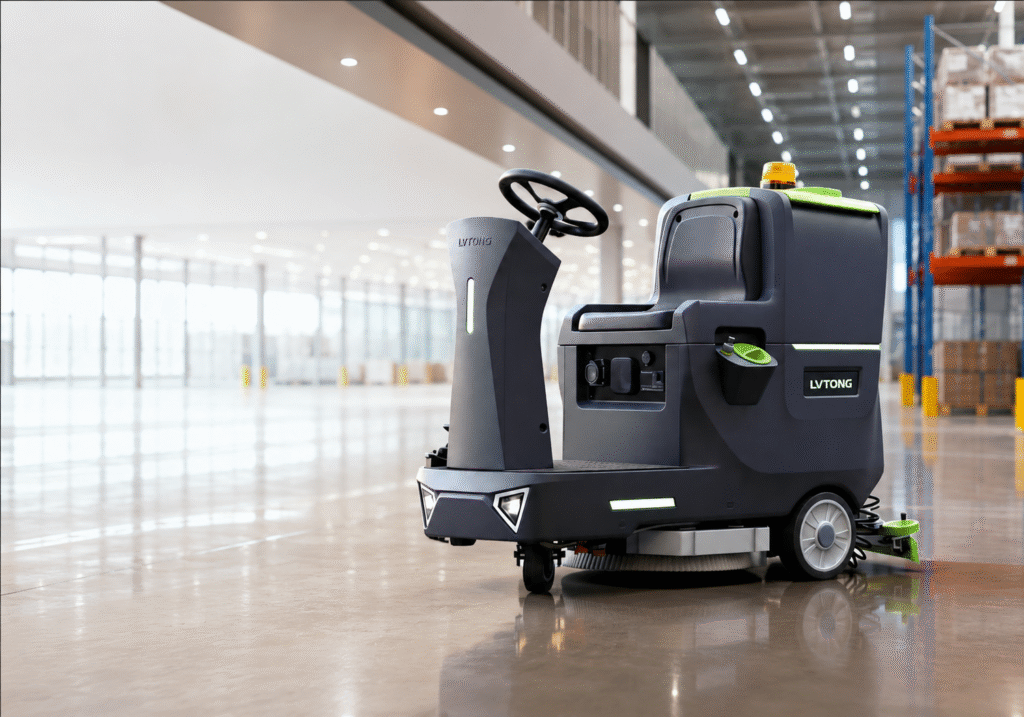
For large open areas, ride-on floor scrubber machines can reduce the number of passes required and allow the operator to clean a larger area during the same shift.

7 Key Factors When Choosing an Industrial Floor Cleaner
1. Start With Cleaning Area and Facility Layout
Cleaning area is an important selection factor, but total floor area alone does not tell you which machine to buy.
You should also evaluate the actual cleaning route.
Ask:
- How much floor area needs daily cleaning?
- Are there narrow aisles?
- What is the narrowest doorway?
- Are there storage racks, machinery, pillars, or fixed obstacles?
- Does the operator need to enter elevators or different rooms?
- How frequently must the machine turn?
- Is most of the floor open or congested?
For narrow production areas and facilities with many obstacles, a compact walk-behind industrial floor cleaner is usually easier to control.
For large, relatively open factory floors or facilities that require warehouse and logistics cleaning, ride-on equipment generally provides higher productivity and reduces operator fatigue.
Do Not Choose a Machine by Floor Area Alone
Two warehouses with the same total area may require completely different machines.
A 10,000 m² open warehouse and a 10,000 m² production facility divided into narrow aisles do not create the same cleaning conditions.
Machine dimensions, turning radius, cleaning width, doorway clearance, and route layout should therefore be considered together.
2. Match the Machine to the Floor and Dirt Type
The surface and type of contamination determine how aggressively the machine needs to clean.
Common industrial floor surfaces include:
- Concrete
- Polished concrete
- Epoxy-coated floors
- Tile
- Stone
- Sealed industrial flooring
Common contaminants may include:
- Dust
- Tire marks
- Mud
- Light oil residue
- Production residue
- Small debris
- Spilled liquids
A smooth floor with light daily dirt does not require the same brush configuration as a rough industrial floor exposed to heavier contamination.
Disc Brush or Cylindrical Brush?
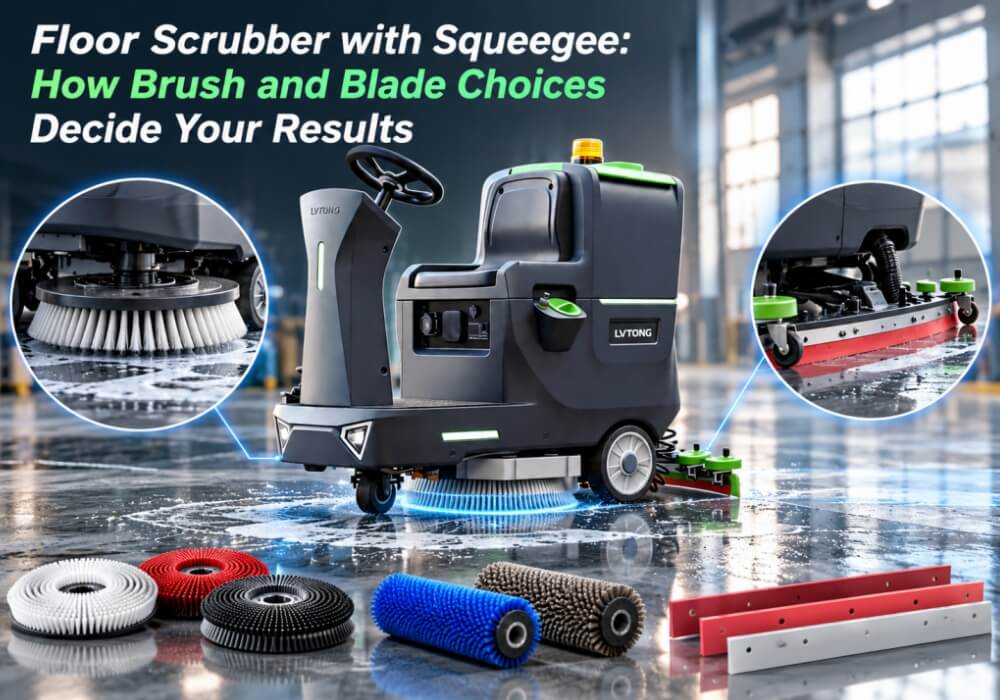
Disc brushes are widely used for routine scrubbing on many relatively smooth hard floors.
Cylindrical or roller-style systems can be useful where the floor has joints, uneven textures, or small loose debris that must be handled during cleaning.
Brush material and pad selection also matter. An aggressive brush may improve cleaning on a resistant industrial surface but could be unsuitable for more sensitive flooring.
Before purchasing an industrial floor cleaner, provide the supplier with information about both floor material and contamination type.
For difficult applications, requesting an on-site or sample-floor cleaning test is often more useful than comparing specifications alone.
3. Choose the Right Cleaning Width and Maneuverability
Cleaning width directly affects how much floor the machine can cover in each pass.
A wider industrial floor cleaning machine can reduce the number of passes required in large open spaces. However, increasing machine width also increases the space required for turning, transportation, storage, and access.
Therefore, the widest machine is not automatically the best machine.
When comparing cleaning width, check:
- Brush or scrubbing width
- Overall machine width
- Squeegee width
- Turning radius
- Narrowest aisle
- Doorway dimensions
- Space around machinery and racks
Theoretical vs. Real Cleaning Productivity
Manufacturer specifications often state a theoretical cleaning capacity.
Actual productivity is normally lower because the operator must:
- Turn the machine
- Slow down around obstacles
- Refill clean water
- Empty the recovery tank
- Move between cleaning zones
- Stop for traffic or production activity
When evaluating an industrial floor cleaner, calculate productivity according to the real cleaning route rather than relying only on the maximum theoretical figure in the catalogue.
This is especially important in warehouses and production facilities with frequent turns or obstacles.
4. Select a Tank Capacity That Matches the Cleaning Cycle
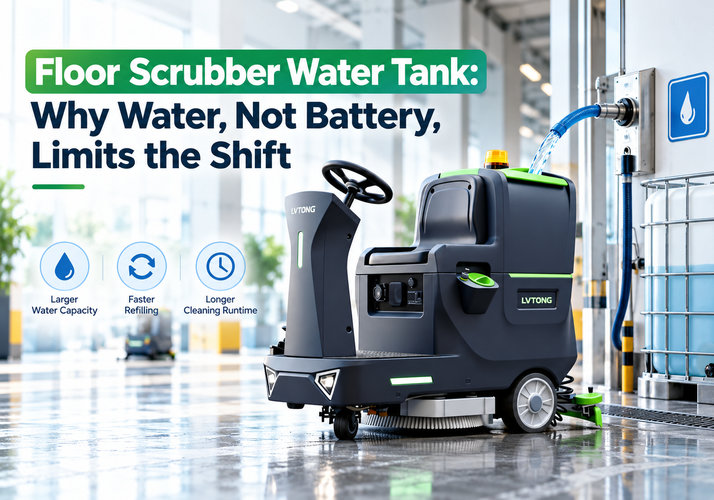
Industrial floor scrubbers normally have separate tanks for clean solution and recovered dirty water.
Larger tanks allow the machine to operate longer between refilling and draining, which can improve productivity in large facilities.
However, larger tanks also increase machine size and weight.
Instead of choosing tank capacity by a fixed rule, consider:
- Size of the cleaning area
- Distance to the water filling point
- Distance to the drainage point
- Cleaning frequency
- Amount of water required for the floor condition
- Space available for machine operation
A smaller machine may be more suitable when water access is convenient and maneuverability is the main concern.
A larger-tank industrial floor cleaner becomes more valuable when the operator needs to clean large areas continuously and frequent refilling would create significant downtime.
5. Compare Battery Power, Runtime and Charging
Battery-powered industrial floor cleaners are widely used because the operator can move through the facility without managing a power cable.
They are particularly useful in:
- Warehouses
- Factories
- Logistics centers
- Shopping facilities
- Large indoor spaces
- Areas with limited convenient power outlets
Because the machine produces no engine exhaust during operation, battery-powered equipment is also suitable for many indoor cleaning environments.
However, the correct battery system depends on the work schedule. Because floor scrubber battery life directly affects runtime, charging frequency, downtime, and long-term operating cost, buyers should evaluate the battery system separately from the machine’s headline specifications.
Before choosing a machine, ask:
- How many hours must it operate per shift?
- Can it complete the cleaning route on one charge?
- How long does charging take?
- Is opportunity charging required?
- Can the battery be charged during breaks?
- What type of battery is used?
- What maintenance does the battery require?
- What is the expected replacement cycle?
A machine with excellent specifications is still a poor choice if its actual runtime cannot complete the required cleaning route.
Battery vs. Corded Industrial Floor Cleaner
Battery-powered machines offer greater movement flexibility and eliminate the need to manage a cable during cleaning.
Corded machines can still be practical for smaller areas where electrical outlets are readily available and continuous operation is more important than unrestricted movement.
The correct choice depends on the facility rather than on the power system alone.
6. Evaluate Durability and Maintenance Before Buying
Industrial cleaning equipment may operate every day in environments containing dust, moisture, vibration, and repeated contact with obstacles.
Durability therefore affects long-term ownership cost.
When comparing industrial floor cleaners, inspect or ask about:
- Machine frame and body construction
- Brush motors
- Vacuum motor
- Squeegee system
- Hoses and seals
- Wheels and drive system
- Recovery tank access
- Brush replacement
- Squeegee blade replacement
- Battery access
- Availability of consumable parts
Daily maintenance should also be simple enough for operators to perform correctly.
Brushes, tanks, filters, squeegees, and recovery systems need regular inspection and cleaning. A machine that is difficult to maintain may create unnecessary downtime even if its purchase price is attractive.
For procurement teams, serviceability should be evaluated alongside machine performance.
7. Compare After-Sales Support and Total Cost of Ownership
Purchase price is only one part of the cost of an industrial floor cleaner.
The total cost of ownership can also include:
- Labor
- Electricity
- Water
- Cleaning pads and brushes
- Squeegee blades
- Batteries
- Routine maintenance
- Replacement parts
- Repairs
- Equipment downtime
A cheaper machine may become more expensive over time if replacement parts are difficult to obtain or the equipment frequently stops working.
Before placing an order, ask the supplier:
- What warranty is included?
- Which spare parts are normally stocked?
- How quickly can replacement parts be supplied?
- Are technical manuals available?
- Is remote technical support available?
- Which consumable parts require regular replacement?
- What is the expected battery replacement cost?
- What maintenance can the customer perform internally?
- Which repairs require professional service?
For industrial users, reliable spare-parts support and professional cleaning equipment maintenance and service can be as important as the original machine specification.

Industrial Floor Cleaner Selection Checklist
Before requesting a quotation, prepare the following information.
| Question | Information to Provide |
|---|---|
| Cleaning area | Total daily cleaning area |
| Facility layout | Open space, narrow aisles or mixed |
| Narrowest access | Doorway and aisle dimensions |
| Floor type | Concrete, epoxy, tile, stone, etc. |
| Main contamination | Dust, mud, oil residue, tire marks, debris, etc. |
| Cleaning frequency | Daily, multiple times per day or periodic |
| Required operating time | Hours per cleaning shift |
| Water access | Location of filling and drainage points |
| Preferred machine | Walk-behind, ride-on or undecided |
| Power requirement | Battery or corded |
| Service requirements | Parts, warranty and technical support |
Providing these details allows the supplier to recommend a machine based on the cleaning application rather than simply recommending a larger model.
Example: Industrial Floor Cleaner for a Manufacturing Plant
In one LVTONG project, a precision-parts manufacturing facility in Malaysia needed to improve the cleaning of a workshop affected by dust and oily contamination. Similar factory floor cleaning equipment should be selected according to floor contamination, production layout, aisle width, and daily cleaning requirements.
Manual cleaning required several employees and approximately four hours of work per day.
LVTONG supplied an S7 ride-on battery-powered floor scrubber with dual brushes and a large recovery tank.
According to the project records, the new cleaning process reduced the daily cleaning time from approximately four hours to about 1.5 hours while reducing the labor required for routine floor cleaning.
The important lesson from this project is not simply that a larger machine cleans faster.
The facility had a sufficiently large cleaning area and operating route to benefit from a ride-on machine with larger tanks and greater cleaning productivity.
Example: Industrial Floor Cleaner for a Shopping Facility
A large shopping mall in Dubai required an industrial floor cleaner for marble flooring.
The machine needed to operate efficiently while remaining suitable for an environment where customers could still be present.
LVTONG supplied an S5 walk-behind battery-powered floor scrubber with a low-noise design.
In this application, maneuverability, noise level, cordless operation, and suitability for the floor surface were more important than choosing the largest available machine.
This illustrates why industrial floor cleaner selection should be based on operating conditions rather than machine size alone.

When Is a Battery-Powered Industrial Floor Cleaner a Good Choice?
Battery-powered machines are particularly useful when the cleaning route covers multiple areas or when power cords would restrict movement.
Their main advantages include:
- Cordless operation
- Greater freedom of movement
- No engine exhaust during use
- Easier cleaning across large indoor areas
- Reduced risk of a power cable interfering with the cleaning route
The main limitation is that battery runtime and charging must be planned around the cleaning schedule.
For this reason, buyers should compare usable runtime, charging time, battery type, replacement cost, and shift requirements before making a decision.
Common Industrial Floor Cleaner Buying Mistakes
Choosing Only by Purchase Price
A lower initial price does not necessarily mean lower long-term cost.
Consider maintenance, battery replacement, consumables, spare parts, downtime, and labor requirements.
Choosing the Largest Machine Available
A larger machine may deliver higher theoretical productivity but perform poorly in narrow aisles or congested production areas.
Ignoring the Actual Cleaning Route
Catalogue productivity figures cannot show how much time the operator will spend turning, refilling tanks, avoiding obstacles, and moving between areas.
Ignoring Floor and Dirt Conditions
The same brush and machine configuration will not perform equally well on every surface or type of contamination.
Focusing on Battery Capacity but Ignoring Charging
Runtime matters, but charging time and the facility’s shift pattern are equally important.
Buying Without Checking Spare-Parts Support
Industrial cleaning equipment contains consumable and wear components. Reliable access to replacement parts helps reduce future downtime.
Frequently Asked Questions
What should I look for when buying an industrial floor cleaner?
Start with cleaning area, facility layout, floor type, contamination, cleaning width, tank capacity, battery runtime, maintenance requirements, spare-parts availability, and total operating cost.
The best machine is the one that can complete the real cleaning route efficiently without being unnecessarily large or difficult to maintain.
What size industrial floor cleaner do I need?
Machine size should be based on both floor area and facility layout.
Compact walk-behind machines are generally better for smaller or congested areas, while ride-on machines are more suitable for large open floors. Check aisle width, doorway size, turning space, cleaning width, and tank capacity before deciding.
Is a walk-behind or ride-on industrial floor cleaner better?
Neither type is universally better.
Walk-behind machines offer better maneuverability in narrow or obstacle-filled areas. Ride-on machines provide higher productivity and reduce operator walking in larger facilities.
The correct choice depends on the cleaning route.
Is a battery-powered industrial floor cleaner better than a corded machine?
Battery-powered machines provide greater movement flexibility and are usually more convenient for large or multi-zone facilities.
Corded machines can still be suitable for smaller areas where power outlets are readily available and battery charging is unnecessary.
Can an industrial floor cleaner clean concrete floors?
Yes, industrial floor cleaning machines are commonly used on concrete and other hard floor surfaces.
However, brush type, pad material, brush pressure, cleaning solution, and machine configuration should match the condition and finish of the concrete.
How important is cleaning width?
Cleaning width affects the number of passes required to cover a floor.
A wider machine can improve productivity in open spaces, but it may reduce maneuverability in narrow aisles. Cleaning width should therefore be considered together with overall machine dimensions and turning radius.
How should I compare two industrial floor cleaners?
Do not compare only price or theoretical productivity.
Compare:
- Cleaning width
- Actual route productivity
- Tank capacity
- Battery runtime
- Charging time
- Maneuverability
- Brush system
- Maintenance requirements
- Spare-parts support
- Warranty
- Total ownership cost
A side-by-side comparison based on your actual facility conditions provides a more useful result than comparing catalogue specifications alone.
Conclusion
Choosing the right industrial floor cleaner starts with understanding the facility, not the machine catalogue.
Cleaning area, layout, floor condition, dirt type, cleaning width, tank capacity, battery runtime, maintenance, and after-sales support all influence which machine will perform best.
For narrow or obstacle-filled environments, a compact walk-behind model may provide the best balance of flexibility and cleaning performance. For large factories, warehouses, and logistics facilities, a ride-on industrial floor cleaning machine can provide higher productivity and reduce operator workload.
Before making a purchase, document your cleaning area, floor type, narrowest aisle, operating hours, contamination, water access, and service requirements.
LVTONG can evaluate these operating conditions and recommend an industrial floor cleaner based on your actual cleaning route and application requirements.