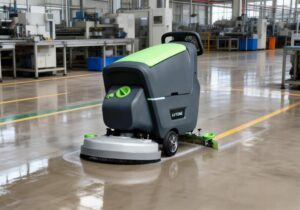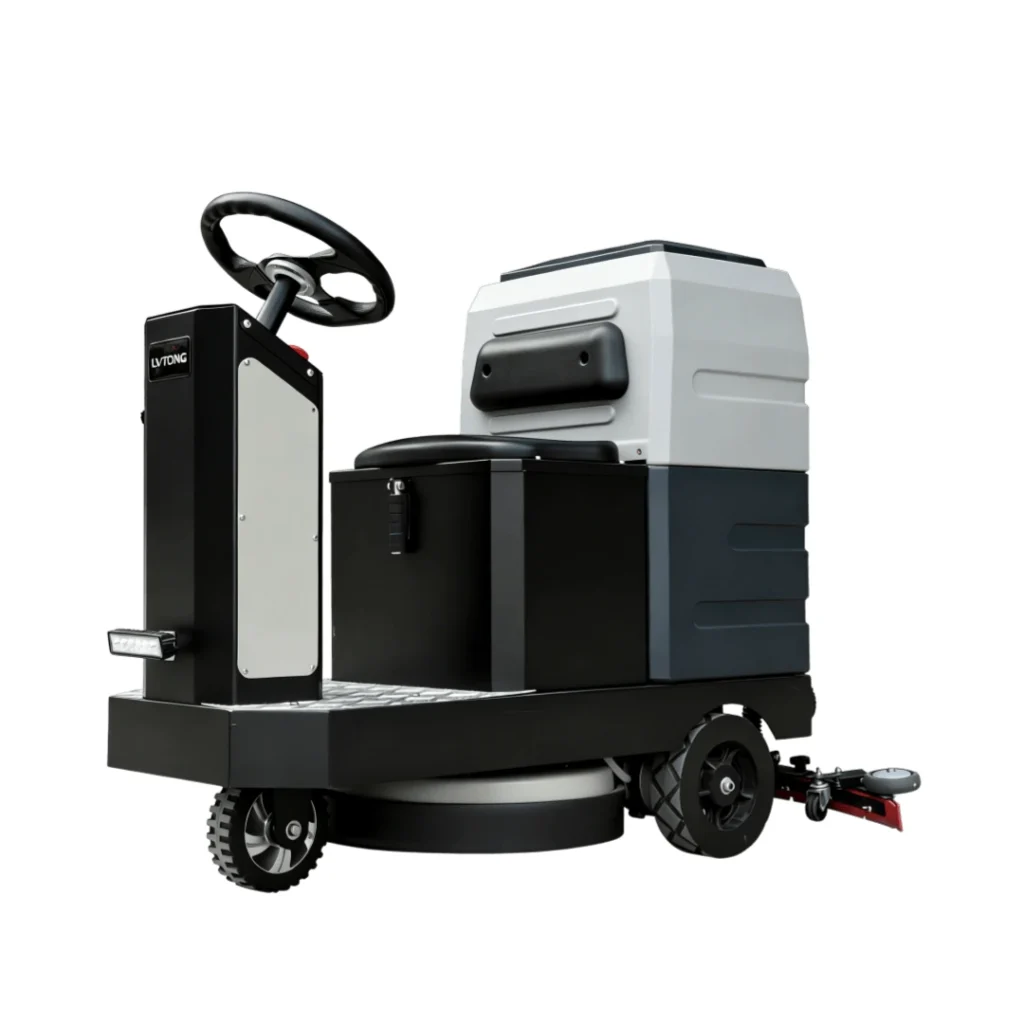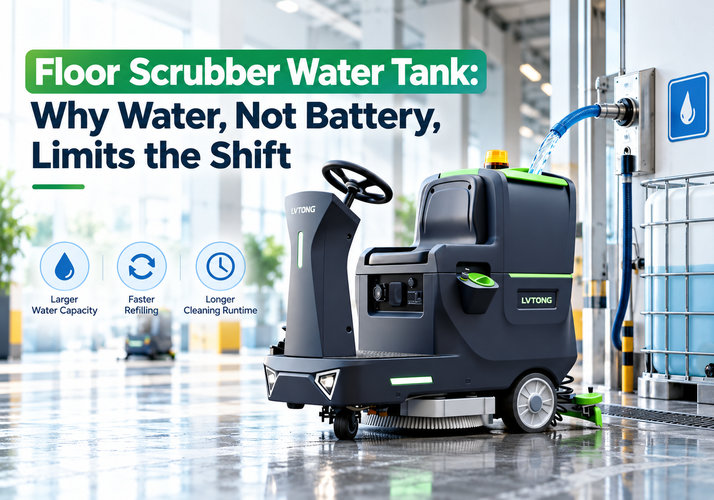



A floor scrubber is sold on battery runtime and coverage rate, yet most machines stop cleaning productively long before either figure is exhausted: the solution tank runs dry first, and somebody walks the machine to a tap four to eight times a shift.
KURZE ANTWORT
On most battery scrubbers the floor scrubber water tank, not the battery, sets the length of a working stretch. A 50–85 L tank holds roughly 20–60 minutes of continuous scrubbing at typical water rates, while the same machine is rated for 3–5 hours on a charge.
- Tank range is calculable: usable litres ÷ water rate (typically 0.04–0.08 L/m²) ÷ coverage rate.
- Refill time is real cost: a fill-and-dump cycle takes 8–20 minutes; six cycles absorb over an hour.
- Water quality matters: hard water scales nozzles and float valves, and drives streaks and soap scum.
- Disposal is regulated: recovery water is wastewater bound for a sanitary sewer, never a storm drain.
Below: tank range, refill economics, water quality, tank hygiene, legal disposal, and the water-side specs to confirm before ordering.
Is the Water Tank or the Battery the Real Limit on a Shift?
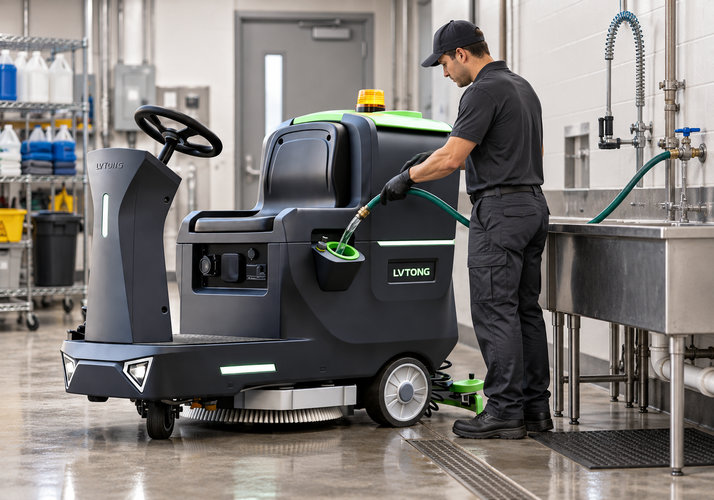
The tank is the binding constraint on most mid-size scrubbers: 62 L holds roughly 22–44 minutes of scrubbing, against a battery rated 3–5 hours.
The mismatch is structural: battery capacity grew faster than tank volume, because lithium packs got cheaper per kilowatt-hour while tank size stays fixed by footprint, weight distribution and step height. A walk-behind unit that must still pass a 0.8 m aisle cannot carry an arbitrarily large tank. Runtime describes the ceiling; tank volume describes the rhythm, and a supervisor who plans from the battery number schedules one machine for a floor it cannot finish.
How Much Floor Does One Tank Actually Clean?
Usable water divided by water rate gives square metres per tank; dividing that by coverage rate gives minutes of continuous scrubbing.
Area per tank (m²) = usable litres ÷ water rate (L/m²)Minutes per tank = area ÷ coverage rate (m²/h) × 60
Water rate you establish locally: about 0.04 L/m² on sealed floors at a low setting, toward 0.08 L/m² on rough concrete, porous tile or heavy soil. The table applies that range at a constant 2,100 m²/h, so the comparison of floor scrubber water tank sizes stays honest.
| Modell | Tank | Area per tank @ 0.04–0.08 L/m² | Continuous scrubbing |
|---|---|---|---|
| Q5 walk-behind | 50 L | 625–1,250 m² | ≈18–36 min |
| LT-S530X Aufsitzmäher | 62 L | 775–1,550 m² | ≈22–44 min |
| LT-S560X ride-on | 85 L | 1,063–2,125 m² | ≈30–60 min |
Illustrative calculations, not tested runtimes.
Hier befindet sich der Ort floor scrubber tank capacity becomes a staffing decision: a 6,000 m² sealed floor means four to eight refills a shift on the 62 L machine, two to four on the 85 L ride-on. The larger tank is not a luxury upgrade, it removes trips.
What Does a Fill-and-Dump Cycle Cost in Time?
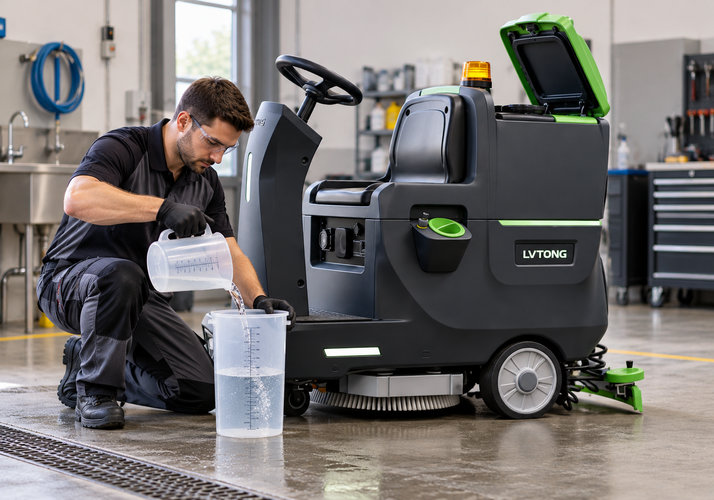
One fill-and-dump cycle costs 8–20 minutes end to end, so four to eight cycles remove 30–160 minutes from a shift — usually more than the gap between two machine classes.
The stopwatch usually starts only at the tap. The cycle has five segments, and most are walking.
| Segment | Time | Driven by |
|---|---|---|
| Move to fill point | 2–5 min | Distance, doors, lifts, traffic |
| Fill tank | 2–4 min | Tap flow, filler neck diameter |
| Move to dump point | 2–5 min | Whether fill and dump are co-located |
| Empty tank, rinse filter | 4–6 min | Drain bore, debris load, filter access |
| Return to the working line | 2–5 min | Distance back, re-orientation |
The leverage sits in rows one, three and five — layout decisions, not machine decisions. Moving a fill point from a plant room five minutes away to a closet one minute away saves about eight minutes per cycle: at six cycles a shift and 250 shifts a year, roughly 200 hours, or five working weeks returned to cleaning.
Two layout rules follow. Co-locate fill and dump on the working level — if the tap and drain sit in different rooms, every cycle doubles its walking, and a service sink with a threaded spout solves both. Then protect the floor around the point: spills there are a leading slip site, which is why anti-slip measures and a Nationales Institut für Bodensicherheit walkway audit belong in the same plan.
This is the water-side counterpart to charging discipline: a floor scrubber charging routine protects the battery; a refill routine protects the shift.
When Should You Change the Water?
Change on condition, not the clock: cloudy water, grit, persistent foam or a floating oil film tells you what the hour hand cannot.
Emptying every tank every hour is safe but wasteful on clean sealed floors and too slow on soiled ones. Reading the recovery tank is more accurate and doubles as a diagnostic.
| What you see | What it means | Aktion |
|---|---|---|
| Clear to hazy, no grit | Normal soil load | Continue to the planned interval |
| Cloudy with grit | Heavy soil, or squeegee not recovering | Dump; check blade and hose |
| Foam that will not collapse | Over-dosed or high-foam chemistry | Dump, reduce dose |
| Floating oil film | Kitchen, workshop or car-park soil | Pre-sweep or degrease first |
| Foul smell on opening | Biofilm established | Deep clean, then change the routine |
For planning, most facilities land two to four hours between changes regardless of tank size, because soil load rather than volume forces the decision. The answer to how often to change water in floor scrubber work is a rule per zone: a rule of thumb for clean areas, a condition check for food, workshop and outdoor-transfer areas.
What Does Hard Water Do to a Scrubber?
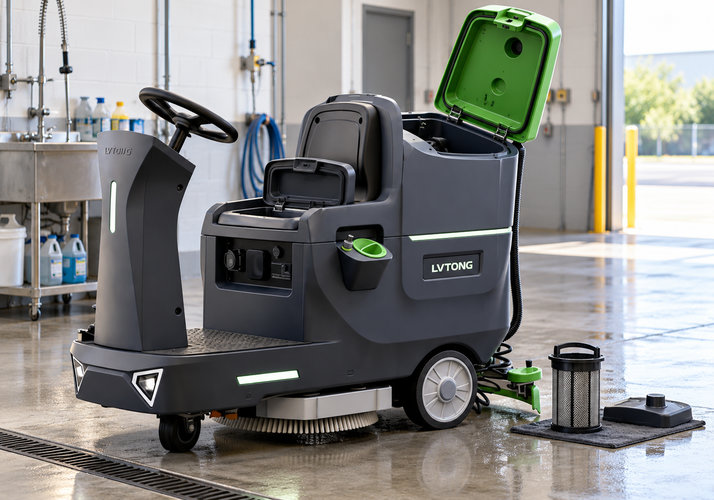
Hard water leaves calcium and magnesium scale in nozzles, filters and float valves, and reacts with chemistry to produce soap scum and streaks.
Hardness is measured as calcium carbonate equivalent: below about 60 mg/L is soft, above about 180 mg/L causes daily problems. Symptoms arrive in a predictable order.
- Streaks and a dull haze first, as dissolved minerals dry behind the squeegee.
- Falling nozzle flow as scale narrows outlets, so operators raise flow and burn the tank faster.
- Sticking float valves, showing up as overfilling or a tank that will not fill.
- Faster scaling of pumps and heaters on hot-water machines.
The fix is cheap: get a water report, descale on a schedule proportional to hardness, and confirm with your chemical supplier that the dose suits the water. Persistent hard water floor scrubber residue is usually a water problem treated as a chemistry problem, which is why the dose climbs without the streaks going away. Product selection belongs to the cleaning solution guide.
How Do You Stop the Recovery Tank Going Sour?
A recovery tank is a warm, dark, nutrient-rich container — a biofilm incubator. Emptying is not enough; it has to be dried open after every shift.
Recovery water carries soil, skin cells, food residue and chemistry at room temperature, so bacteria colonise the walls and hose bore overnight. A biofilm then survives ordinary rinsing and keeps seeding odour into every fill.
- Empty completely each shift — a partly full tank is worse, because the film sits at the waterline.
- Rinse tank, filter and float cage, then leave the lid open to air-dry.
- Weekly, brush the interior including corners and lid underside; monthly, flush the recovery hose, where odour usually hides.
If a recovery tank biofilm smell has taken hold, one deep clean will not hold. Replace the weekly routine, check the hose interior for a rough surface that re-seeds growth, and confirm the machine is not stored wet over weekends — the usual cause where the problem returns monthly.
Where Can You Legally Dump Scrubber Water?
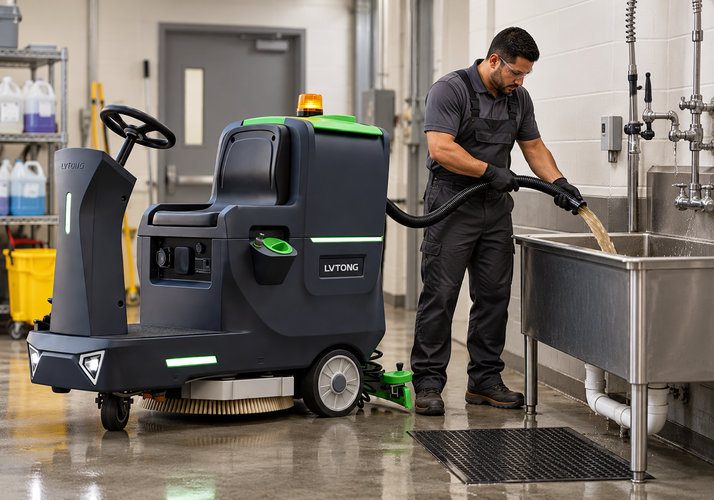
Recovery water is industrial wastewater: it goes to a sanitary sewer connection such as a service sink, never to a storm drain, yard gully or open ground.
The two systems are legally different. Storm drains discharge to waterways under the EPA National Pollutant Discharge Elimination System, and detergent-laden water entering one is an illicit discharge in most jurisdictions. Sanitary sewers lead to treatment, where this water belongs.
Where a site discharges commercial wastewater to sewer, the local authority usually applies pretreatment limits under 40 CFR Part 403 — pH, suspended solids, oils and grease. Three rules follow.
- Use a service or mop sink as the default dump point; it is sewer-connected and sized for this volume.
- Route food-area water through a grease interceptor where one exists.
- Never use a storm drain or yard gully, even at 2 a.m. — the most common violation in floor scrubber water disposal.
When deciding where to dump floor scrubber water, check whether the building has enough service sinks along the route. One sink on the ground floor and six floors of hard floor will end in the wrong drain eventually.
How Do You Protect the Water System in Winter?
Freezing damages pumps, valves and sensors rather than tanks, so the winter routine clears the water path behind the floor scrubber water tank.
- Empty both tanks whenever the machine is stored unheated, and run the pump briefly to clear the line and spray bar.
- Drain the recovery hose and store with lids open; let the machine reach room temperature before refilling, since thermal shock on a cold pump body is a needless failure.
What Water-Side Specs Should You Confirm Before Ordering?
Ten water-side details decide daily cost, and none appear in a headline spec sheet — request them in writing.
| # | Spezifikation | Warum es wichtig ist |
|---|---|---|
| 1 | Usable solution and recovery litres | Sets tank range and refill frequency |
| 2 | Headroom above the shut-off float | Usable capacity is below nominal |
| 3 | Filler neck diameter, hose compatibility | Decides fill time at a standard tap |
| 4 | Abflussbohrung und Auslaufhöhe | Decides whether gravity dump into a sink works |
| 5 | Lid opening size for cleaning | Decides whether biofilm can be removed |
| 6 | Solution flow settings and range | Water rate is the biggest lever on range |
| 7 | Filter and float cage removability | Daily rinse vs weekly struggle |
| 8 | Low-water indication or cut-off | Protects the pump from dry running |
| 9 | Hinweise des Herstellers zur Wasserqualität | Hard-water limits and descaling advice |
| 10 | Dimensions against door and closet widths | A fill point you cannot enter is not one |
A machine with a larger floor scrubber water tank and a drain hose that suits your service sink will out-clean a nominally faster one needing a lift trip every forty minutes. The floor scrubber maintenance schedule covers daily, weekly and monthly care across every component; this guide adds the water-side economics that decides how much of a shift reaches the floor.
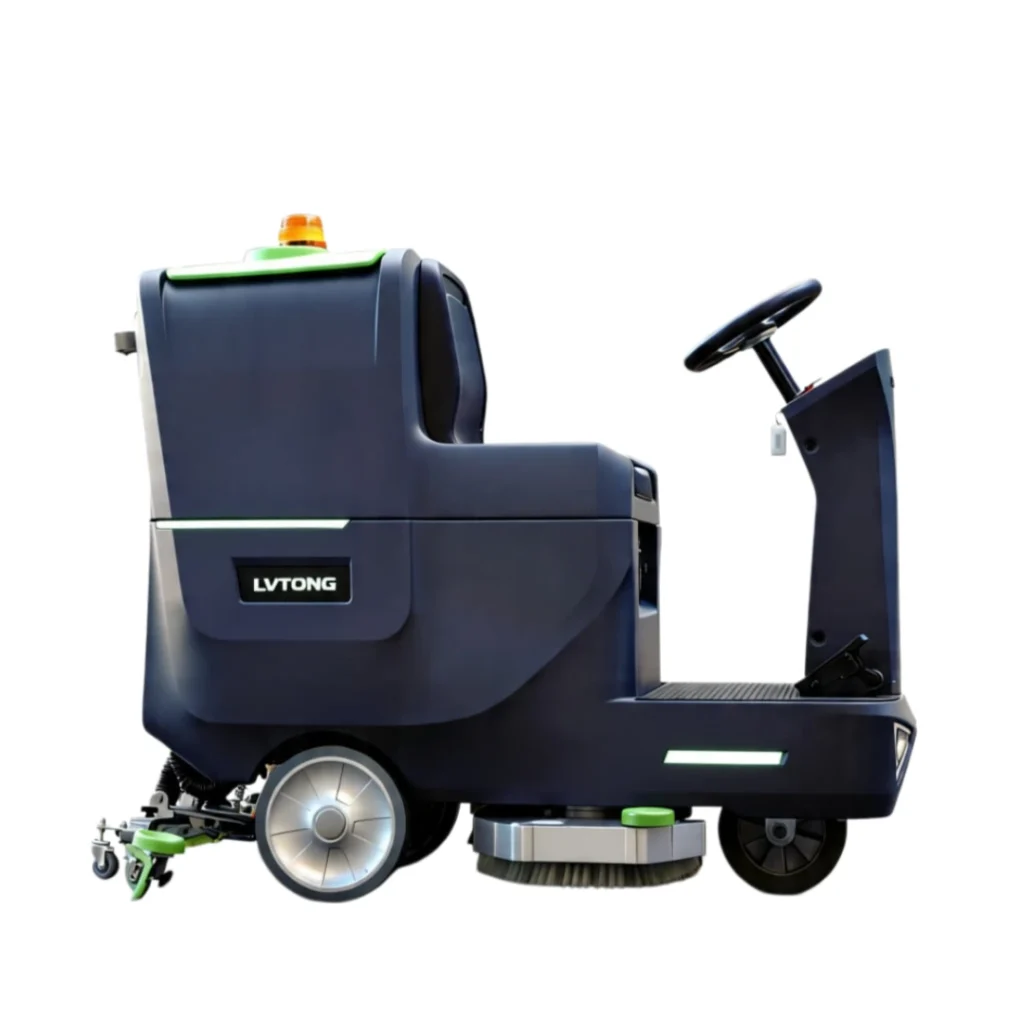
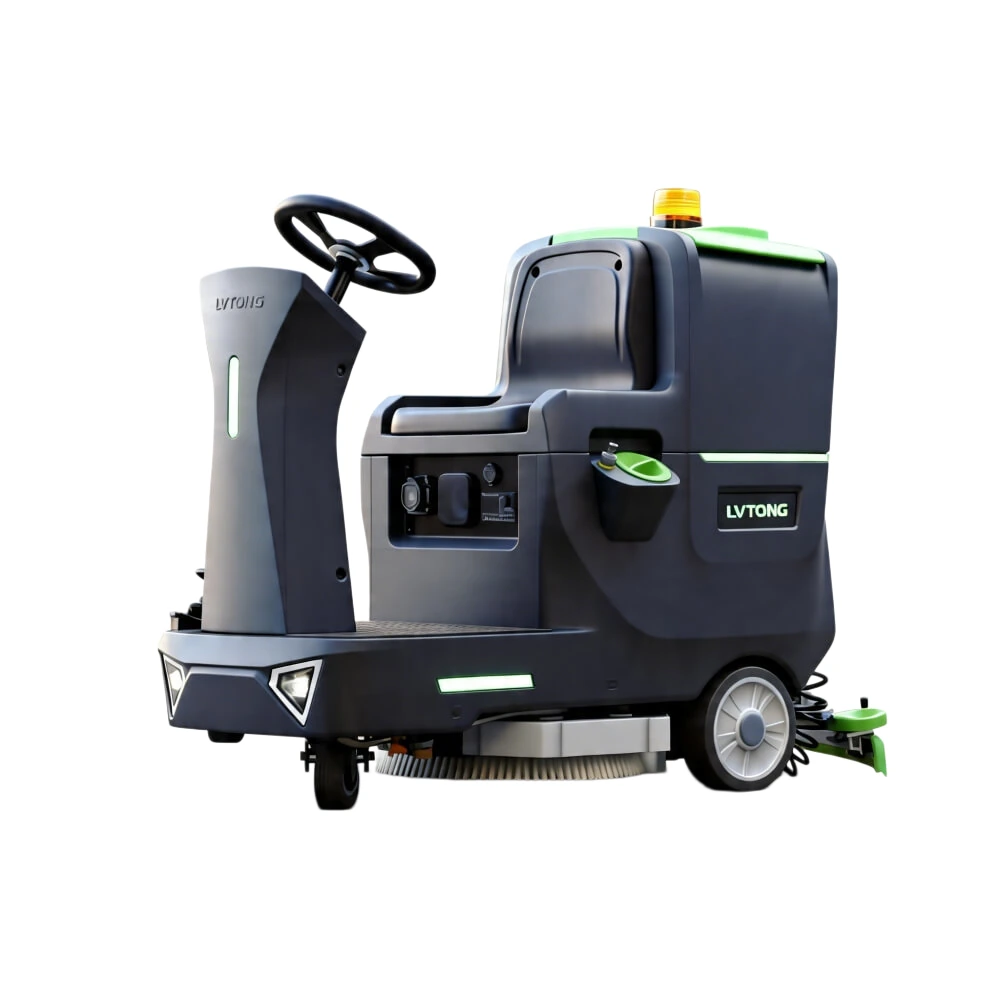
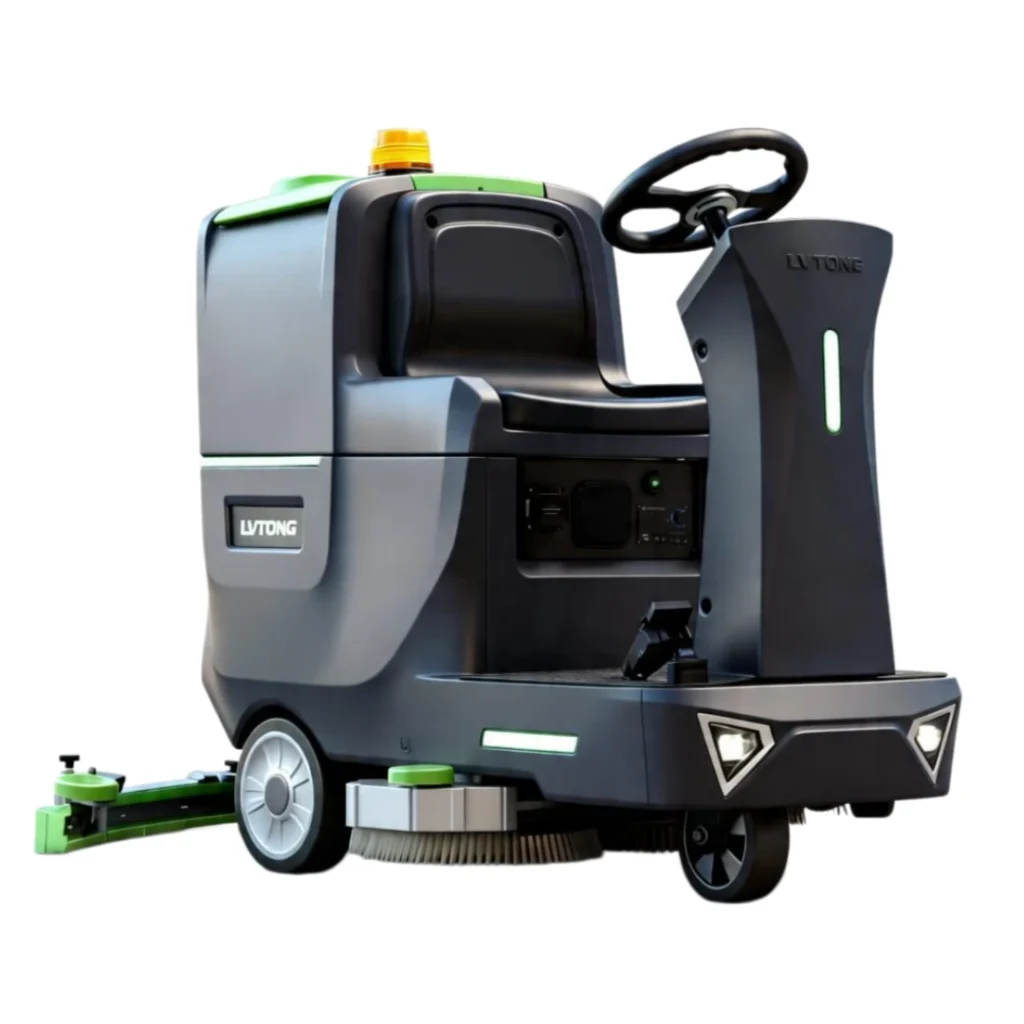
LVTONG builds battery walk-behind and ride-on scrubbers with published tank volumes from 50 L to 90 L, including the LT-S530X Aufsitzmäher und die LT-S560X ride-on. To size a fleet against your floor area and refill points, send us the site details.
Figures here are illustrative planning estimates. Water quality limits, discharge rules and pretreatment requirements are set locally — confirm them with the site’s water utility or environmental regulator. Scrubber safety requirements: IEC 60335-2-72.
Häufig gestellte Fragen
Wie viele Liter Wasser verbraucht eine Scheuersaugmaschine pro Quadratmeter?
Bei geringem Durchfluss auf versiegelten Böden liegt der Verbrauch bei etwa 0,04 l/m², auf rauem Beton, porösen Fliesen oder schwerem Boden steigt er auf etwa 0,08 l/m². Messen Sie den Verbrauch einmalig, indem Sie die Literzahl auf eine bekannte Fläche beziehen; dieser Wert ist die Grundlage für alle hier beschriebenen Tankberechnungen.
Kann ich das Wasser aus der Bodenreinigungsmaschine in einen normalen Abfluss gießen?
Only into a sanitary sewer connection such as a service sink, mop sink or approved floor drain. Never into a storm drain or yard gully, which discharge untreated. Food-area water should pass through a grease interceptor where one exists.
Is a bigger tank always better?
For large open floors, usually yes, because it removes trips. On a small site with tight storage, a large tank adds weight and footprint for capacity that never gets used. Size it against area per shift and distance to the fill point.