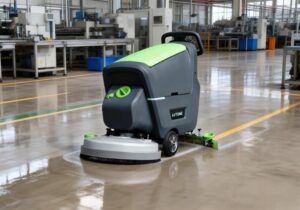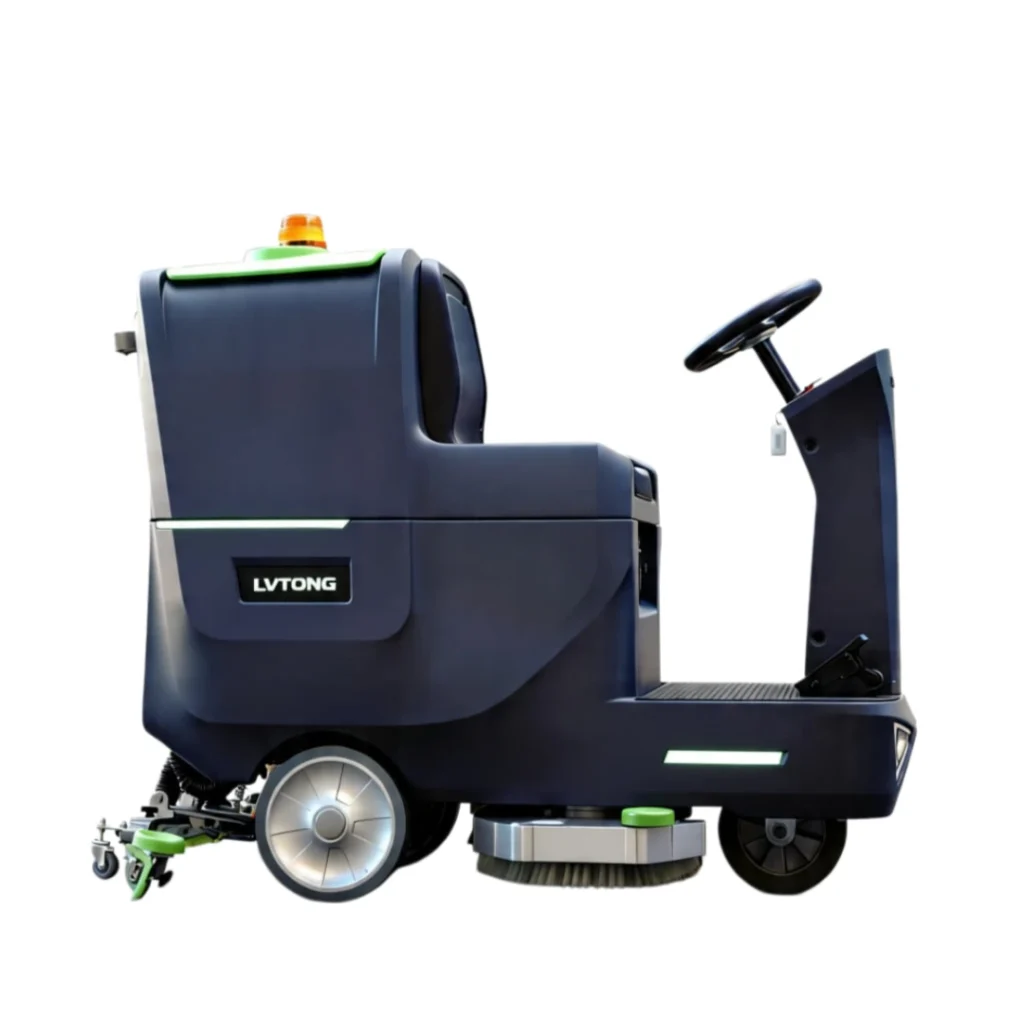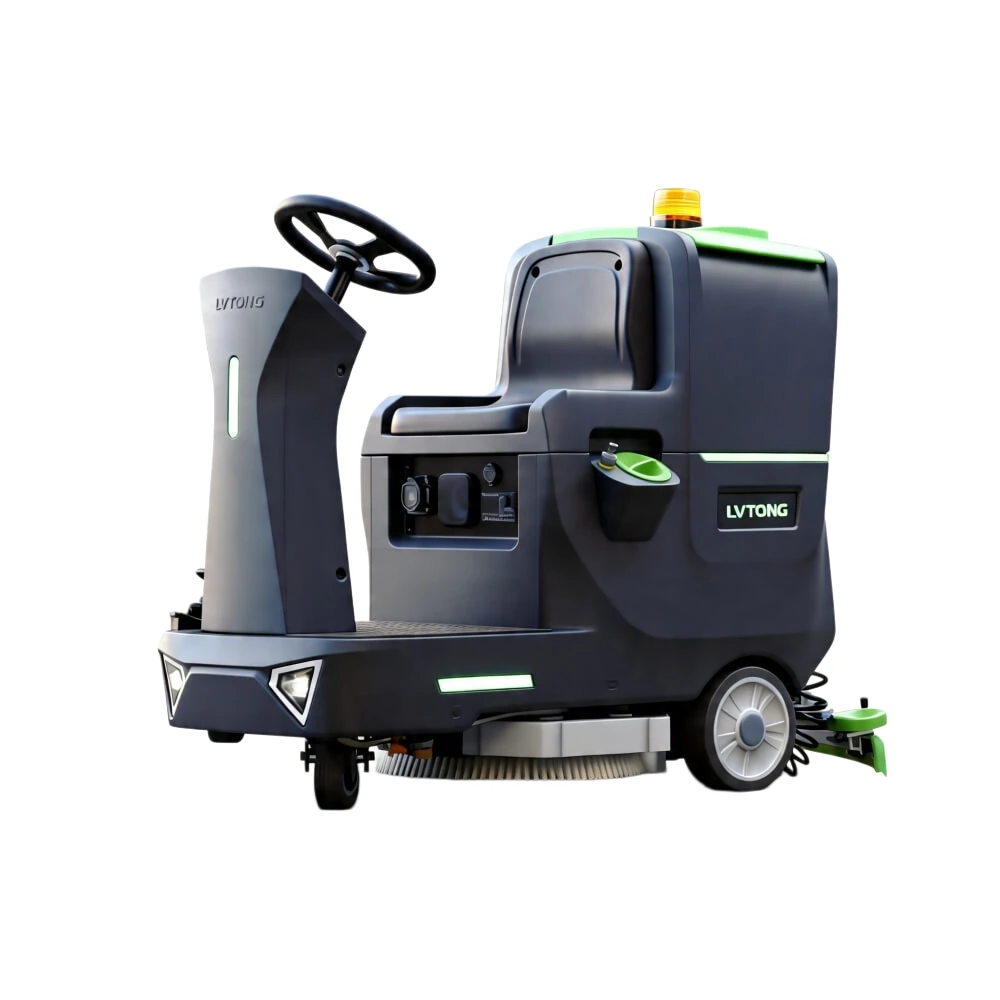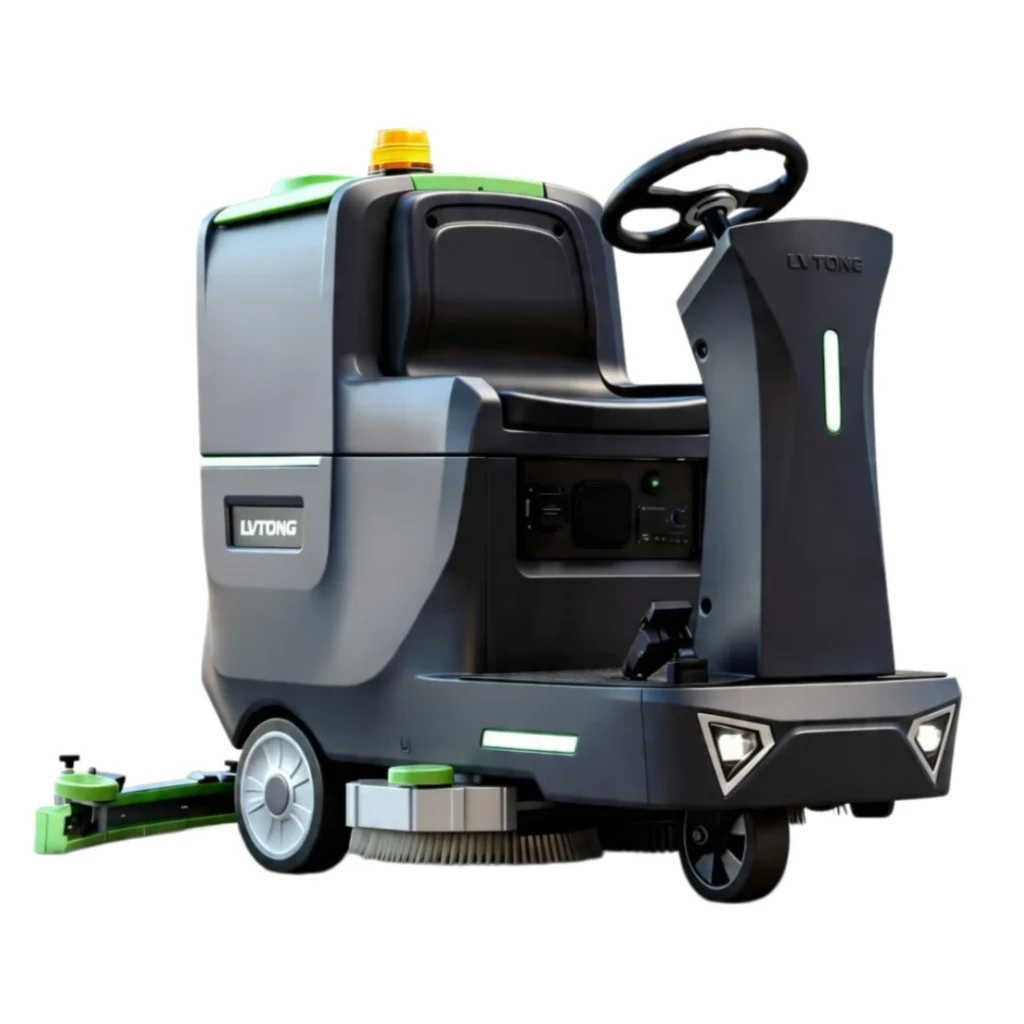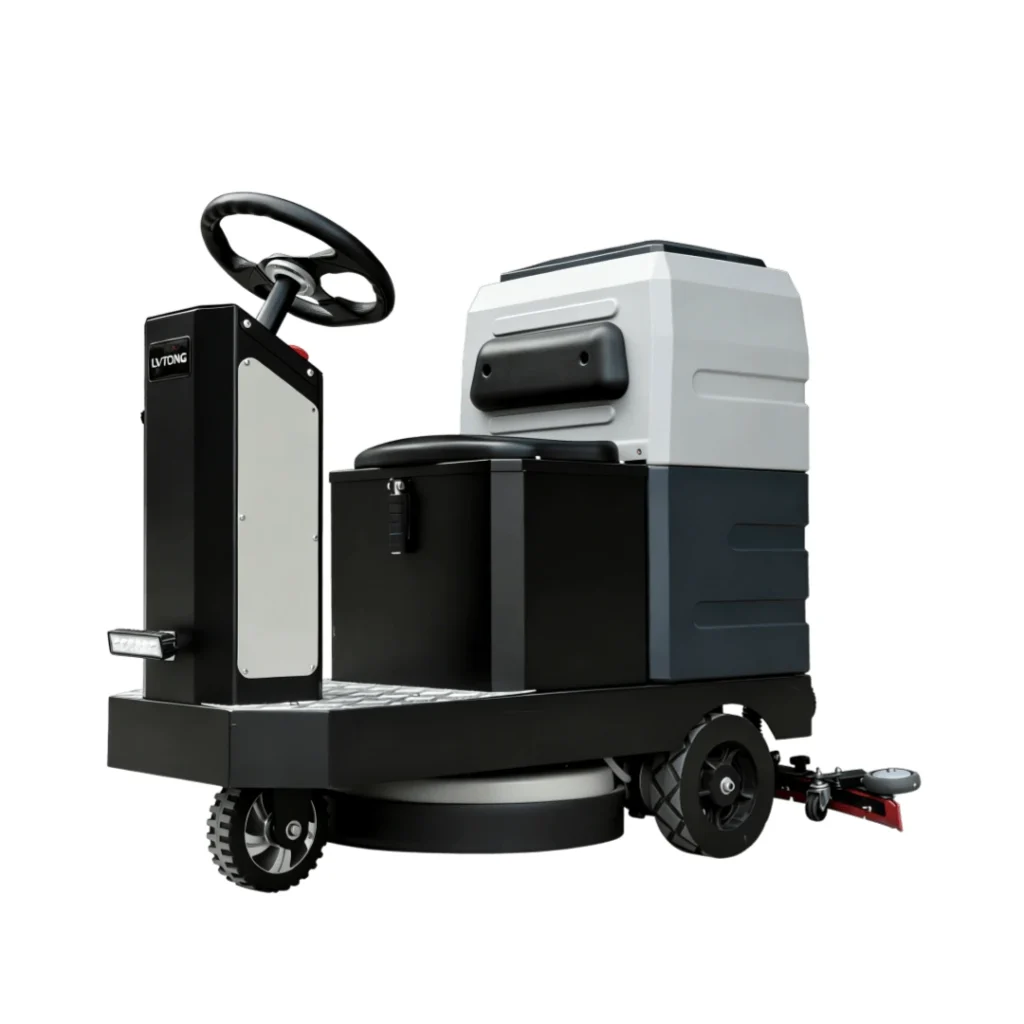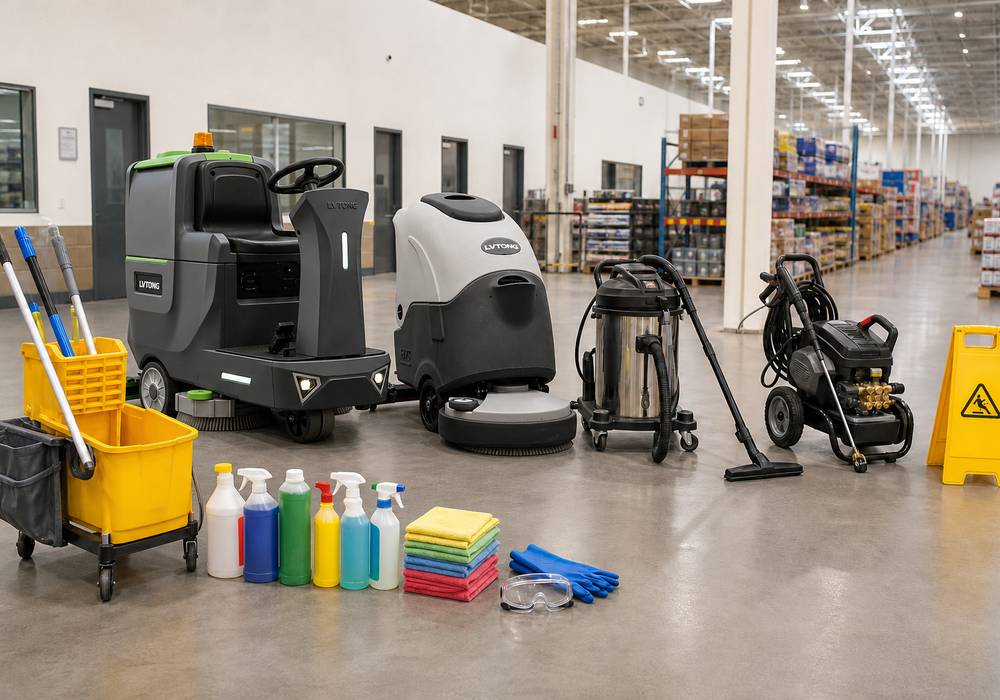
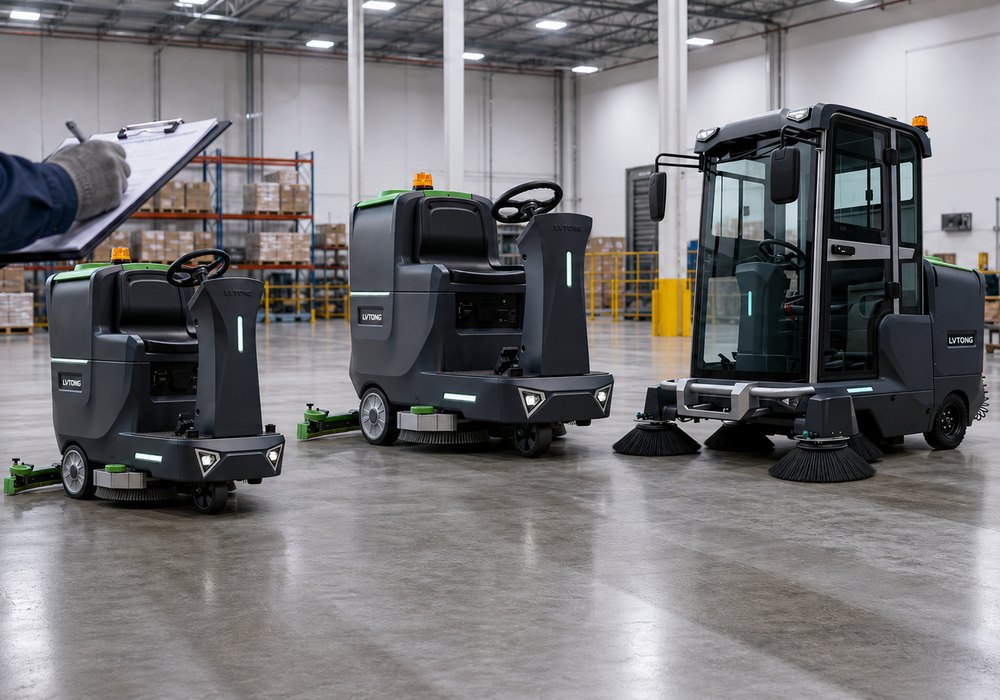
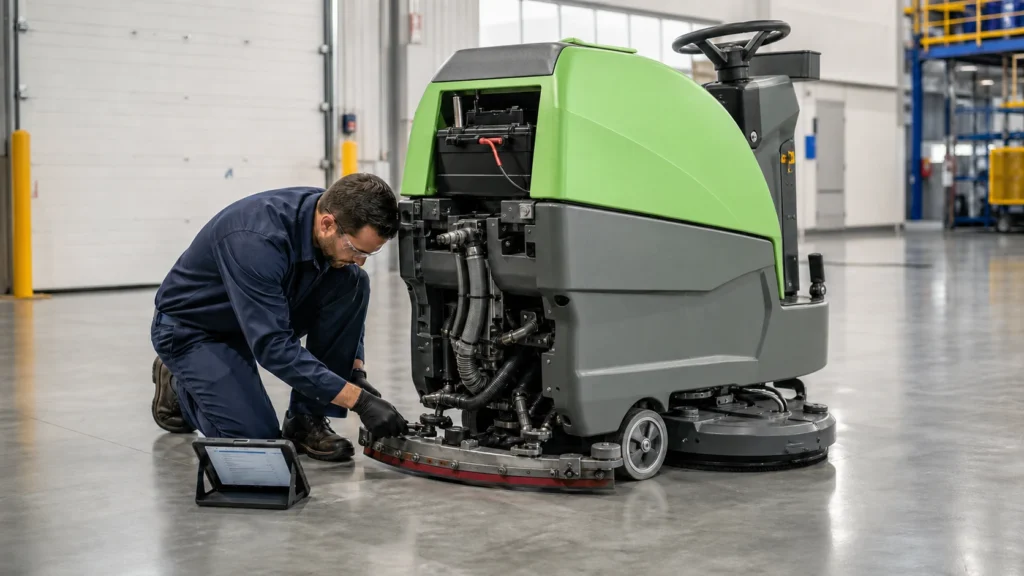
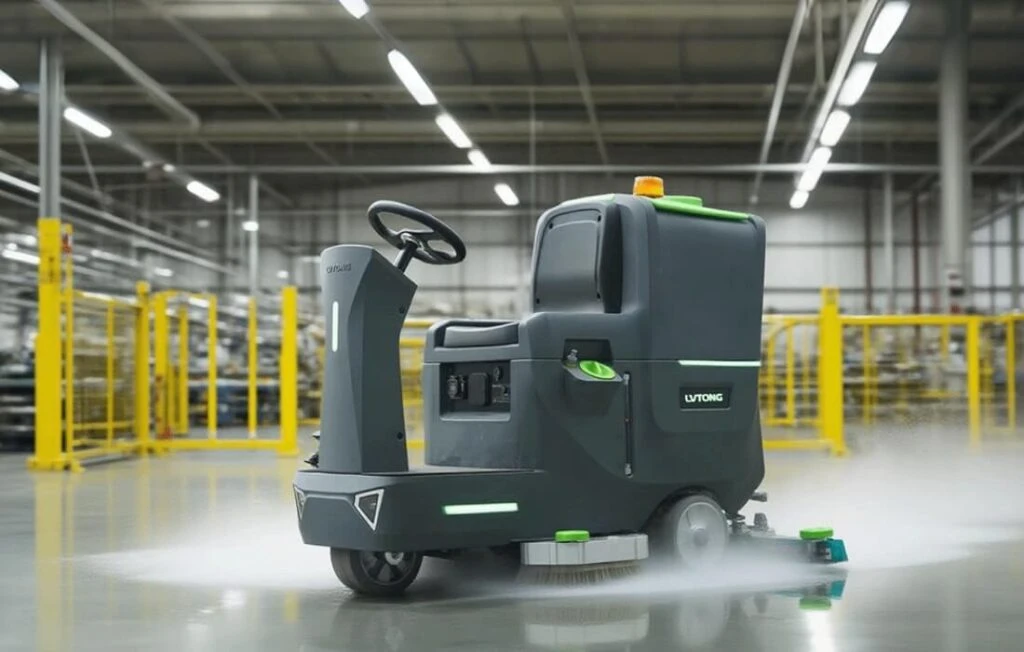
A 50,000-square-foot warehouse takes 6 hours to clean with walk-behind scrubbers and 2 hours with a ride-on. Labor cost per cleaning cycle drops by two-thirds. On paper, every ride-on scrubber dispenses, scrubs, and recovers water the same way. In practice, the difference between a well-matched machine and a wrong-sized one shows up in three places that matter to the P&L: labor hours per shift, floors that pass audit the first time, and capital that doesn’t sit idle in the equipment room. This guide covers what facility managers and procurement teams need to make the right purchase: productivity benchmarks, total cost of ownership, and machines that hold up in real industrial conditions.
Benefits of Ride-On Floor Scrubbers
Ride-on floor scrubbers earn their place in industrial facilities through measurable returns on four fronts.
Throughput. A 26-inch ride-on machine cleans 25,000–28,000 square feet per hour. Walk-behind units average 8,000–12,000. Manual mopping covers under 3,000. The gap widens with facility size. The ISSA Official Cleaning Times standards confirm these benchmarks across most commercial flooring types.
Operator retention. Seated operation cuts physical strain, so crews stay longer and recruitment costs drop.
Labor cost reduction. One ride-on operator replaces 2–3 manual cleaners covering the same area. A 30,000-square-foot facility cleaned daily saves $25,000–$40,000 annually in direct labor. The savings compound once overtime premiums, weekend differentials, and turnover-related rehiring costs enter the calculation. Facilities running second or third shifts frequently see total labor displacement closer to $50,000 per year, since off-hours manual crews typically command 15–25% premium wages. In multi-site operations, standardized ride-on equipment further reduces training overhead, since one operating procedure works across every facility in the portfolio.
Cleaning consistency. Constant brush pressure and overlapping squeegee passes deliver uniform results across every cycle. Streaks, missed spots, and re-wet zones disappear from quality audits. Floors hold up to hygiene inspections in food processing, pharmaceutical, and electronics manufacturing environments.
The benefits compress at smaller scales. Below 15,000 square feet of daily cleaning area, the capital cost extends payback past 12 months. A walk-behind unit suits those facilities.
The Operation Mode of Ride-On Floor Scrubber
A ride-on floor scrubber completes four operations in a single pass: dispense, scrub, squeegee, and recover.

1. Dispense. The solution tank releases a metered mix of water and detergent through valves onto the floor ahead of the brush. Modern machines auto-adjust dispensing based on soil level, cutting water use by 30–50%.
2. Scrub. Rotating brushes or pads agitate the solution against the floor. Disc brushes spin at 175–300 RPM and apply 30–120+ lbs of downward pressure, making them the standard choice for smooth, sealed surfaces like vinyl, polished concrete, and ceramic tile. Cylindrical brushes spin at 600–800 RPM and work better on uneven surfaces such as textured concrete, grouted tile, and warehouse aisle joints — the higher RPM lets bristles flick debris into a built-in hopper rather than push it forward, which matters in environments with mixed wet and dry soil. Brush material also affects chemical compatibility: nylon bristles handle neutral and mildly alkaline solutions, while polypropylene bristles tolerate the more aggressive degreasers used in automotive and food manufacturing.
3. Squeegee. A rubber blade trailing behind the brush deck scrapes the dirty solution into a narrow channel. Blade angle and downforce determine pickup quality. Worn or misaligned squeegees leave streaks and re-wet zones.
4. Recover. A vacuum motor (0.5–2 HP ) pulls the dirty water through the squeegee channel into the recovery tank. The floor dries within 2–3 minutes, ready for foot or forklift traffic. Recovery tanks include filter screens to trap debris and protect the vacuum motor.
The four operations run simultaneously while the machine moves forward at 3–4 mph. This is the productivity advantage over manual mopping: one pass replaces sweep, mop, rinse, and dry — four separate steps that leave wet floors and require drying time before the area reopens. For complete operating procedures, including pre-shift inspection and post-shift cleaning, thestep-by-step ride-on scrubber operating guide walks through each stage.
Key Performance Factors When Choosing a Ride-On Floor Scrubber
The performance determines your final machine selection. These factors directly impact cleaning quality, labor cost, and equipment ROI (Return on Investment).
Reinigungspfadbreite
Measure every doorway, hallway, and aisle in your facility. The smallest dimension caps your maximum cleaning width.
| Path width | Optimale Passform |
|---|---|
| 20–24 inches | Multi-floor buildings, retail with tight aisles |
| 26–32 inches | Open warehouse layouts, distribution centers, and supermarkets |
| 36+ inches | Large warehouses, airports, and manufacturing halls |
A 40,000-square-foot warehouse with 32-inch doorways needs a 26–30-inch deck. TheLT-S710X industrial ride-on floor scrubber at 710mm (28 inches) handles this profile and clears 32-inch doorways with margin. A 36-inch deck in the same facility forces slow aisle work and three-point turns, lowering effective throughput.
Brush Pressure and RPM
Brush pressure measures how hard the brush presses against the floor. RPM (revolutions per minute) measures how fast the brush spins.
| Bodenart | Druck | RPM |
|---|---|---|
| Smooth tile, vinyl | 30–50 lbs | 150-180 |
| Epoxy, sealed concrete | 50–80 lbs | 180-220 |
| Unfinished concrete, heavy soiling | 80–120+ lbs | 200-250 |

Buy machines with adjustable pressure. Fixed-pressure equipment fails when conditions shift between zones or seasons. Insufficient pressure leaves soil and forces a second pass. Excessive pressure damages delicate floors and breaks brushes faster, raising replacement costs.
Tank Capacity and Cleaning Range
The solution tank holds the cleaning liquid. The recovery tank holds the dirty water. Tank size determines how long your machine operates before requiring a refill.
| Lösungstank | Auffangbehälter | Tägliche Reinigung des Bereichs |
|---|---|---|
| 15–20 gallons (60–75 L) | 18–24 gallons (70–90 L) | Unter 15.000 Quadratfuß |
| 30–40 gallons (115–150 L) | 35–45 gallons (130–170 L) | 15,000–50,000 sq ft |
| 50+ gallons (190 L+) | 55+ gallons (210 L+) | Over 50,000 sq ft |
Match tank size to your actual route, plus a 20% buffer. Oversized tanks add 800–1,500 lbs of weight, slowing the machine in tight spaces and accelerating component wear. A 50-gallon tank in a 12,000-square-foot facility is just expensive capital sitting in the equipment room half the day. For facilities exceeding 10,000 m², theLT-S860X Aufsitz-Scheuersaugmaschine carries a 135L tank with 5-hour runtime and 6,800 m²/h cleaning capacity—sized for that scale.
Battery Type: Lead-Acid vs. Lithium-Ion
This decision drives the 5-year total cost of ownership more than any other spec.
| Spezifikation | Lead-Acid | Lithium-Ionen |
|---|---|---|
| Cost per battery | 2,000-3,500 | 6,000-8,500 |
| Wartung | Checking every 1-2 weeks for the water level | No water checks needed |
| Lebensdauer | 2-3 Jahre | 5-7 years |
| Standard charging | 8-10 Stunden | 2-3 Stunden |
| Fast charging | 4-6 Stunden | N / A |
| Cold performance | Significantly reduced below 40°F | Retains ~70% capacity at 14°F |
| Disposal | Requires certified recycling | Standard electronic recycling |

Lithium-ion pays back within 18–24 months for multi-shift or daily-use operations. Fast charging eliminates shift-to-shift downtime, which matters most in 24/7 logistics centers and manufacturing plants. Lead-acid keeps upfront costs lower for single-shift use under 3 sessions per week. Detailedbattery selection criteria across voltage, cycle life, and chemistry help refine the choice for specific operating profiles.
Recovery System: Water Pickup and Drying Speed
The recovery system includes a vacuum motor, a squeegee blade, and a water discharge path. This system removes dirty water from the floor.
Quality recovery systems have:
- Squeegee blade width 31–40 inches (wider than brush path for overlap)
- Vacuum motor 2–4 HP rated
- Anti-streaking blade design
- Clean water discharge path preventing re-contamination
Test the recovery system before purchase. Run the machine on a test floor section. Check drying speed. Verify that no water streaking occurs. Good recovery systems dry floors within 2–3 minutes.
Operator Controls and Training Time
OSHA (Occupational Safety and Health Administration) does not classify ride-on scrubbers as powered industrial trucks; employers must still ensure operator safety under the General Duty Clause.
Essential control features:
- Finger-touch buttons (no force required)
- LCD showing battery level, brush pressure, and solution level
- Clear sightlines without blind spots
- Turning radius under 10 feet
- Intuitive button layout matching user expectations
Brand Availability and Parts Supply
Downtime costs more than parts. A failed brush disc with a 3-week replacement lead time stops cleaning operations across the facility. Choose manufacturers with established North American distribution.
Annual budget guidelines:
- Brush and squeegee replacement: $800–1,500
- Service calls: $300–800 each
Verify parts’ lead time before purchase. Established manufacturers hold ride-on scrubber components in regional warehouses. Routine charging practices and component checks extend battery and machine lifespan, reducing replacement frequency and unplanned downtime.

How to Spec a Ride-On Scrubber: A Practical Framework
Start from the facility, not from the catalog. The four questions below usually surface the right machine before any spec sheet enters the conversation.
What does your tightest passage actually measure?
Record doorway widths, hallway widths, and aisle widths. Find the minimum one. This is your maximum cleaning path width.
How many square feet must you clean per available hour?
Measure total square footage. Estimate the time available for cleaning. Calculate the required cleaning speed in square feet per hour. For example, 40,000 square feet, 3 hours available = 13,333 square feet per hour required. A 26-inch ride-on floor scrubber at 25,000 square feet per hour capability meets this requirement with 50% safety margin.
Does your cleaning route fit one full tank, with margin?
Simulate your cleaning route. Determine actual cleaning time per full tank. Choose a tank size that completes your typical route with 20% buffer remaining.
Does your shift pattern justify lithium-ion?
Single-shift, light-use operations favor lead-acid. Multi-shift or demanding schedules favor lithium-ion. Calculate your 5-year total cost of ownership.
Regional Distribution Center Conversion
A 78,000-square-foot regional distribution center in the U.S. Midwest replaced its three-person manual mopping crew with a single 28-inch lithium-ion ride-on scrubber in early 2024.
Net first-year labor savings reached $58,200, and full payback on the machine, charger, and operator training landed at 5.2 months. The lithium-ion battery completed two full cleaning cycles per shift with a 25-minute fast-charge in between, which also kept the unit available for ad-hoc spill response during peak inbound hours.
| Metrisch | Before (manual crew) | After (ride-on scrubber) |
|---|---|---|
| Cleaning time per shift | 5,5 Stunden | 1.75 hours |
| Annual direct labor cost | $87,400 | $29,200 |
| Water consumption per shift | 142 gallons | 88 gallons |
| Quality audit failures | 11 per quarter | 1 per quarter |
| Floor re-cleaning incidents | 6–8 per month | Under 1 per month |
Häufig gestellte Fragen
1. Can I use a ride-on floor scrubber on different floor types?
Yes. Most modern ride-on scrubbers feature adjustable brush pressure (30–120+ lbs) and accommodate both brush and pad configurations.
2. Are ride-on floor scrubbers suitable for multi-story office buildings?
Technically, yes, but operationally challenging. Ride-on machines require freight-elevator access and dedicated storage space per floor. Most office buildings use compact walk-behind or stand-on scrubbers on each floor and reserve ride-on machines for ground-level expansive spaces (lobbies, common areas).
3. What’s the average payback period for investing in a ride-on floor scrubber?
For facilities cleaning 30,000+ square feet daily, payback occurs within 3–6 months from labor savings alone. Additional ROI comes from reduced floor maintenance costs and extended equipment lifespan.
4. What is the typical ride-on scrubber lifespan with maintenance?
Properly maintained ride-on scrubbers last 8–10 years. Equipment without maintenance typically requires replacement after 5–7 years.
5. How do I calculate the correct tank size for my facility?
Measure your typical cleaning route, ensuring the time it takes to complete. Choose a tank that runs 20% longer than your typical route time.
6. Can ride-on scrubbers handle uneven floors?
Most ride-on machines work on level concrete and tile floors. Uneven surfaces, gravel, or outdoor terrain can cause stability issues. Verify your floor is smooth and sealed before purchasing. If your facility has uneven sections, use a smaller walk-behind machine for those areas.
Abschluss
The right ride-on floor scrubber matches your facility layout, cleaning schedule, and operating budget. Specifications drive the decision: cleaning path width that fits your tightest passage, tank capacity sized to actual routes, battery chemistry matched to shift patterns, and adjustable brush pressure for the floors you actually clean. Walk your space, measure your constraints, calculate your cleaning load, then match the machine to the work. Labor cost savings will return the procurement effort within the first year of operation.