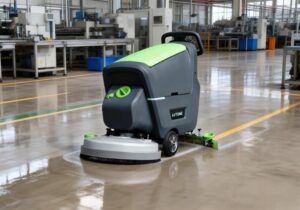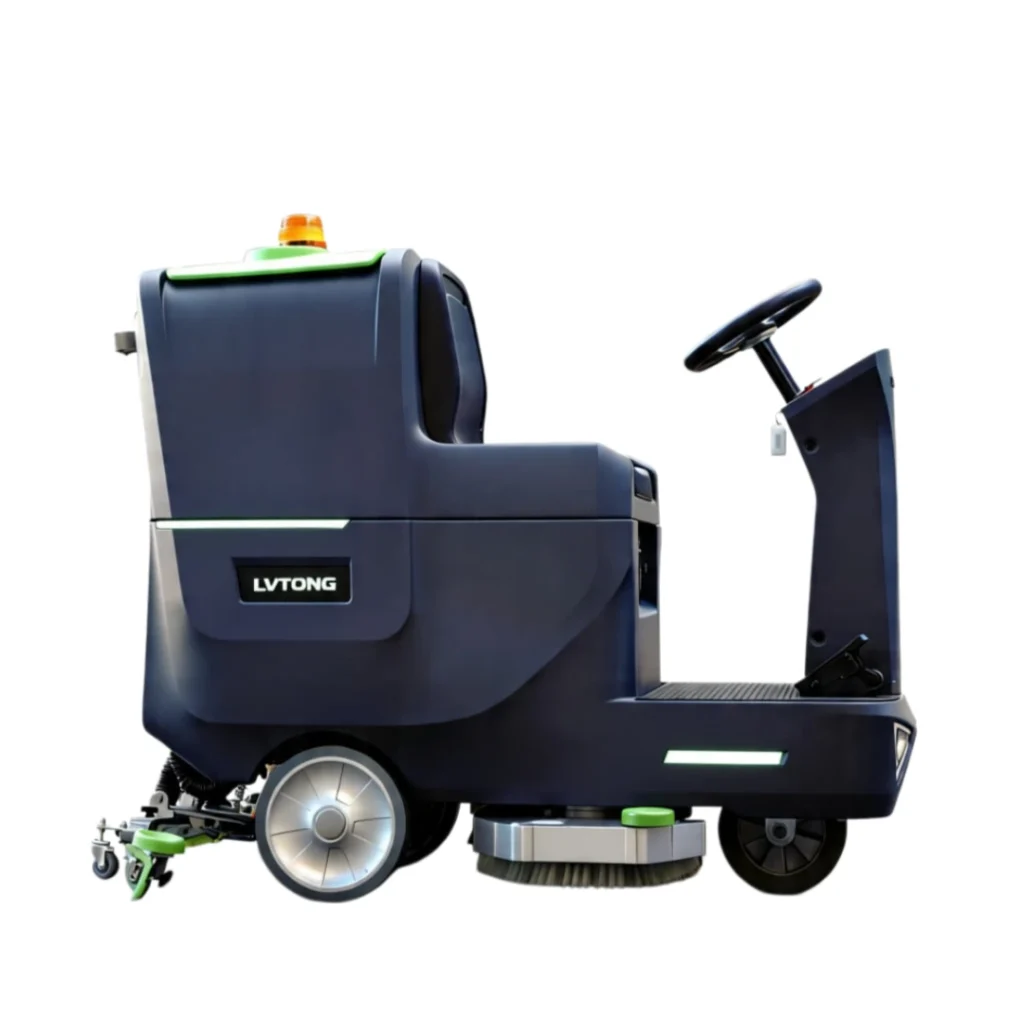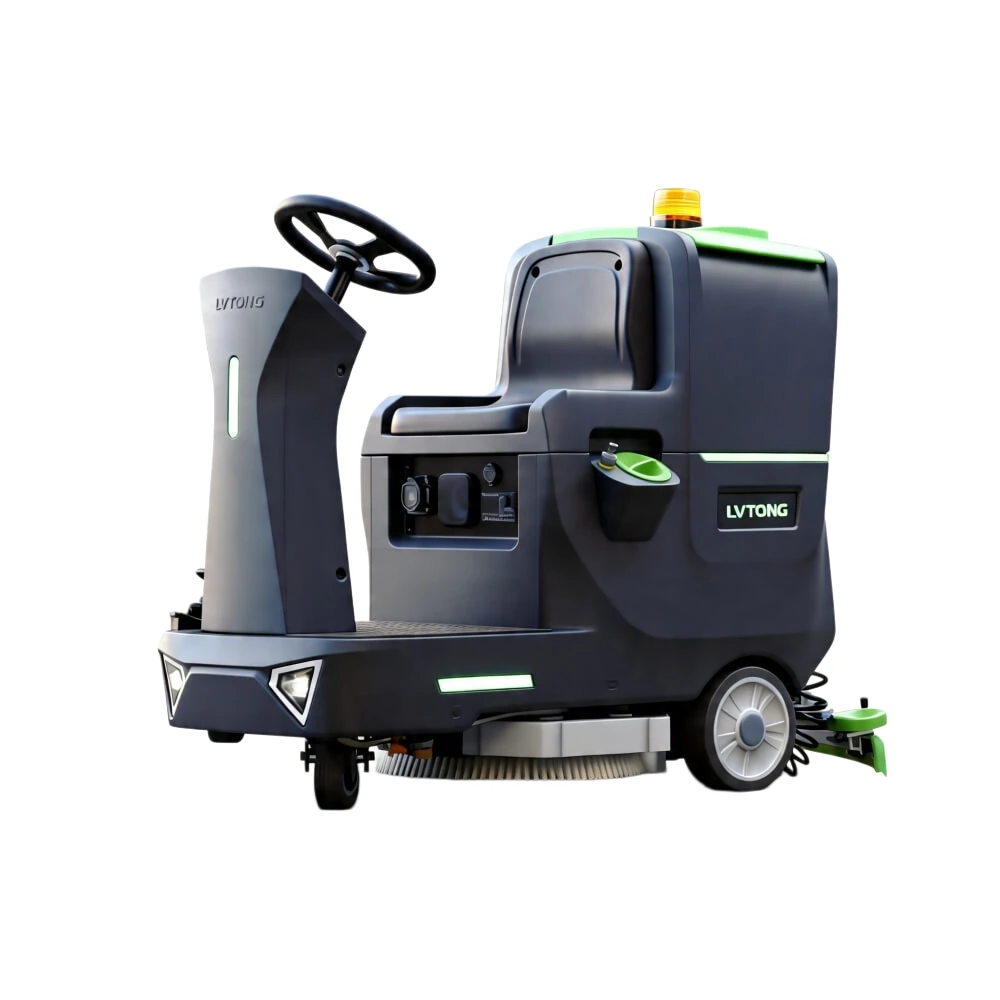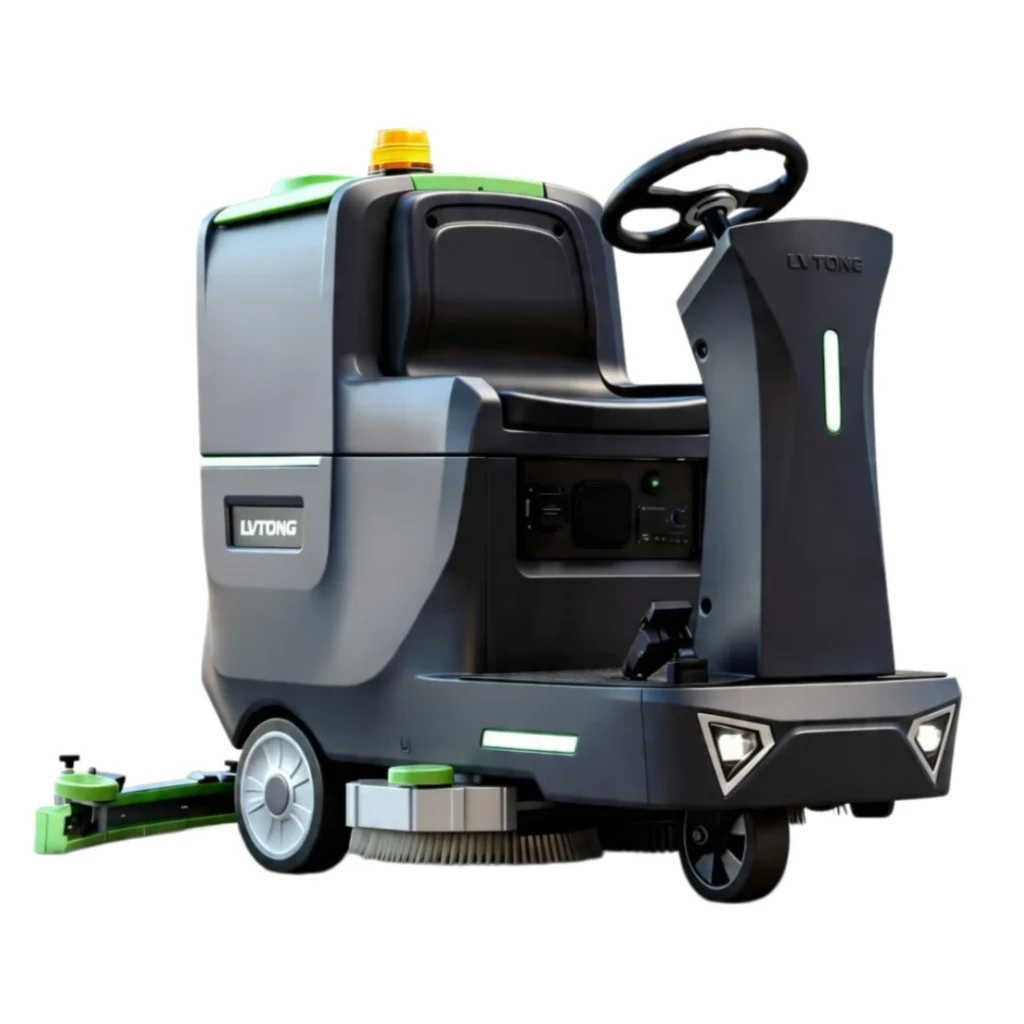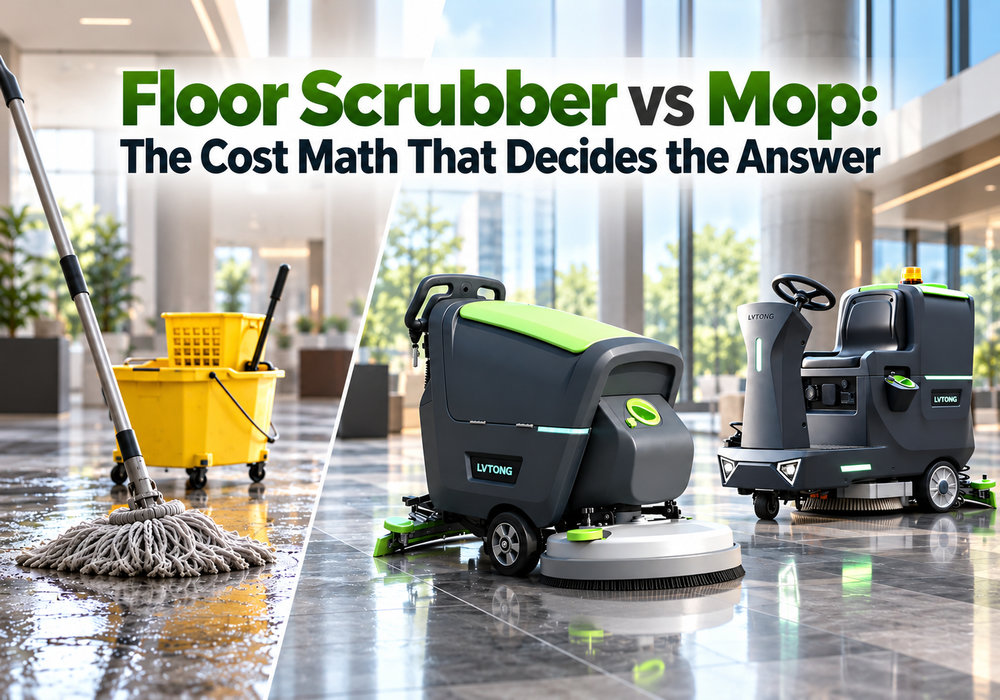
Most floor scrubber vs mop comparisons start with the wrong two numbers: the price of a machine on one side, the price of a bucket on the other. Neither is the cost of cleaning a floor. Manual mopping is almost entirely labour, and labour grows with area and never depreciates. This guide treats it as a ledger: four cost buckets, a break-even area from your own route, and the jobs a mop still does better.
БЫСТРЫЙ ОТВЕТ
Below roughly 200 m² of hard floor per cleaning shift, mopping is usually the cheaper method. Above it, labour time dominates and a scrubber-dryer costs less per square metre — so the decision hinges on a break-even area, not a purchase price.
- Labour decides it, not equipment price. Mopping cost is almost all labour hours; a machine trades capital for time.
- Compare four buckets. Labour, water and chemical, consumables, and equipment with its energy and service.
- Calculate the break-even area. Annual machine cost divided by the labour rate times the productivity gap.
- The mop keeps real work. Spills, edges, upper floors and low-frequency rooms stay manual in hybrid programmes.
The sections below cover the four buckets, the calculation, the costs that never reach the budget, and where mopping still wins.
Is Mopping Cheaper Than a Floor Scrubber?
For small floors cleaned occasionally, yes. For anything cleaned daily across a few hundred square metres, no — mopping costs more per square metre.
A machine price and a bucket price are not the same kind of number. A mop and bucket is a cheap tool that consumes labour for as long as you clean; a scrubber-dryer is a capital item that consumes labour far more slowly.
The fair comparison is cost per square metre over a period long enough to include battery replacement and service — the logic in our guide to comparing floor scrubber machine cost and long-term value. Machine selection itself is covered in our walk-behind scrubber selection guide; this article stays on the arithmetic.
The Four Cost Buckets in a Fair Comparison
Split both methods into labour, water and chemical, consumables, and equipment. Mopping loses the labour bucket so heavily that the other three rarely change the outcome.
| Bucket | Manual mopping | Scrubber-dryer |
|---|---|---|
| Labour time | Dominant cost; scales with area and with every repeat pass | Reduced but not removed — filling, dumping, charging and moving the machine still cost hours |
| Water and chemical | Bucket refills; dosing by eye; hot water often used | Metered flow and measured dilution; one tank change per route |
| Расходные материалы | Mop heads, laundering, buckets, wringers | Brush or pad, squeegee blade, filters |
| Equipment and upkeep | Low capital, short service life | Higher capital, amortised; battery, service, electricity |
Only one bucket is decisive in a normal commercial building. A bucket and wringer costs less than a brush set; a mop head costs less than a squeegee blade, and those differences largely cancel. Labour separates the two methods by an order of magnitude, not by a few percent.
Why Labour Decides the Result
Both methods use an operator. The difference is how much floor that operator covers in an hour, and that ratio sets the answer.
A scrubber-dryer does not remove the operator, and the hours around the machine are easy to forget: filling, dumping and rinsing tanks, charging, and moving the machine between zones. A fair study counts total labour time rather than machine run time, the discipline described in how ISSA 540 cleaning times are used to calculate real machine productivity. Any honest mopping vs machine scrubbing comparison counts both sides the same way.
Two measurements decide it, and both come from your building: area mopped per labour-hour, refills included, and effective machine productivity — the rated figure reduced by route losses. A walk-behind listed at 2,100 m²/h does not deliver 2,100 m²/h among turns, obstacles and traffic.
How to Calculate Your Break-Even Area
Break-even area equals annualised machine cost divided by the labour rate times the difference in hours per square metre. Below that area mopping costs less; above it the machine costs less.
Written as cost per square metre: mopping is the labour rate divided by mopping productivity; the machine adds its annualised cost to labour divided by effective machine productivity. Set the two equal and solve for area.
Break-even area (m² per year) = Annualised machine cost ÷ [ Labour rate × ( 1 ÷ mopping productivity − 1 ÷ effective machine productivity ) ]
| Input | Illustrative value |
|---|---|
| Loaded labour rate (wage, benefits, supervision) | $22 per hour |
| Mopping productivity, measured on route | 250 m² per labour-hour |
| Machine effective productivity | 1,260 m² per hour (2,100 m²/h rated × 60% route efficiency) |
| Annualised machine cost (amortisation, energy, service, consumables) | $4,500 |
| Break-even area | about 63,800 m² per year |
| Equivalent daily area over 300 cleaning days | about 210 m² per shift |
The last row is the figure a buyer needs: around 210 m² of hard floor per shift is where the ledger turns. Every input is illustrative — substitute your own labour rate and measured mop rate and the answer moves. A higher labour rate pulls the break-even area down; an existing machine makes the marginal case easier.
The same arithmetic sets a floor as well as a ceiling. If total hard floor sits well under the break-even area and is cleaned a few times a week rather than daily, a scrubber-dryer is capital you do not need yet.
The Costs Missing From Most Mopping Budgets
Manual mopping cost is not the mop and the bucket. Hot water, over-dosed chemical, mop-head laundering and the repeat pass after a poor one are all paid for, and none appear as a budget line.
- Chemical dosed by eye. A bucket has no metering: over-dilution wastes product, under-dilution triggers a second pass and doubles that section’s labour.
- Hot water. Heating it for mopping is an energy cost that lands in the utility bill, not the cleaning budget.
- Mop heads. Rotation, laundering or replacement, plus the labour of both.
- Cross-contamination. Dirty water is carried across clean areas and re-deposited; a scrubber-dryer lifts it into a recovery tank instead.
- Rework. A mop leaves a film that dries unevenly, and a pass that dries streaked has been paid for twice.
None is large alone. Together they are why the labour line is rarely the whole manual cost — and why careful studies push the break-even area down rather than up.
Water Disposal and Slip Risk: The Compliance Side of the Ledger
Mopping produces wastewater and leaves a wet film. Both have consequences a machine with a recovery tank reduces, and neither is optional.
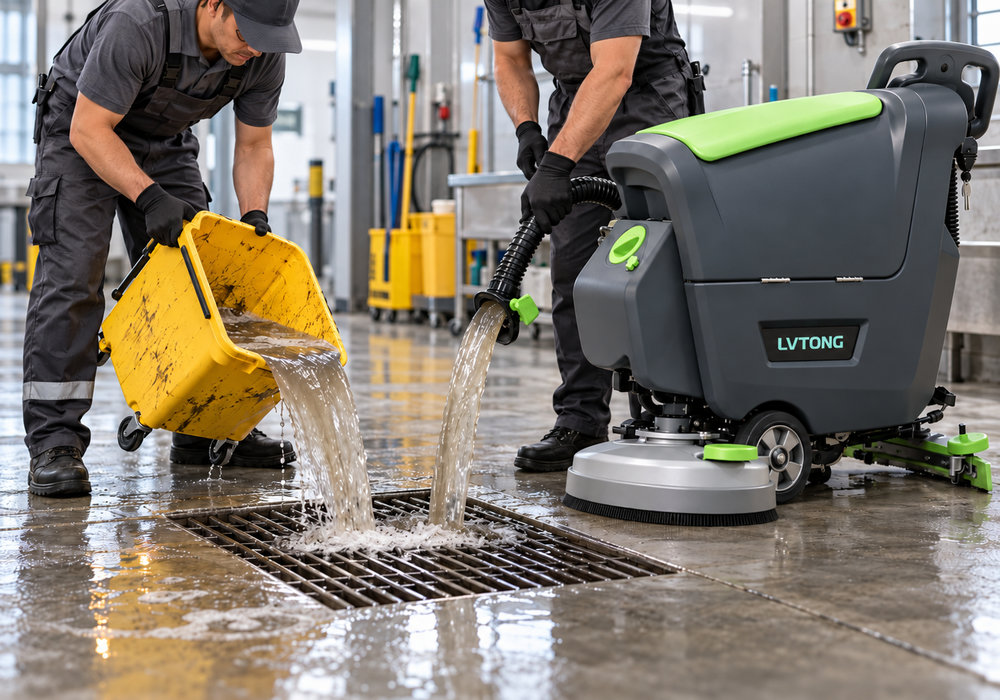
Where the water goes. Cleaning wastewater normally belongs in the sanitary sewer through a janitorial sink or an approved drain point, and discharge to a storm drain or open ground is restricted in many jurisdictions. Sites handling industrial activities outdoors should check their obligations under the Программа EPA по управлению ливневыми стоками and confirm the local requirement with their water authority.
What the floor looks like when you finish. US workplace walking-surface rules require floors to be kept clean and, so far as possible, dry — see 29 CFR 1910 Subpart D. A mop leaves a film that traffic re-wets; a scrubber-dryer recovers water on the same pass, shortening the drying window.
Neither point is a claim about certification or product compliance.
When Mopping Still Wins
Small, infrequent, awkward or spill-driven cleaning stays manual — a permanent answer, not a temporary one.
- Total hard floor well below the break-even area, cleaned a few times a week.
- Spill and spot response, where a flat mop reaches the spill before a machine is filled.
- Upper floors without lift access, and buildings with nowhere to store a machine.
- Edges, corners, stairwells, under fixtures and between racking legs.
- Food-handling and clinical zones where a dedicated, separately laundered tool is preferred.
The Hybrid Model: Scrubber for Runs, Mop for Edges
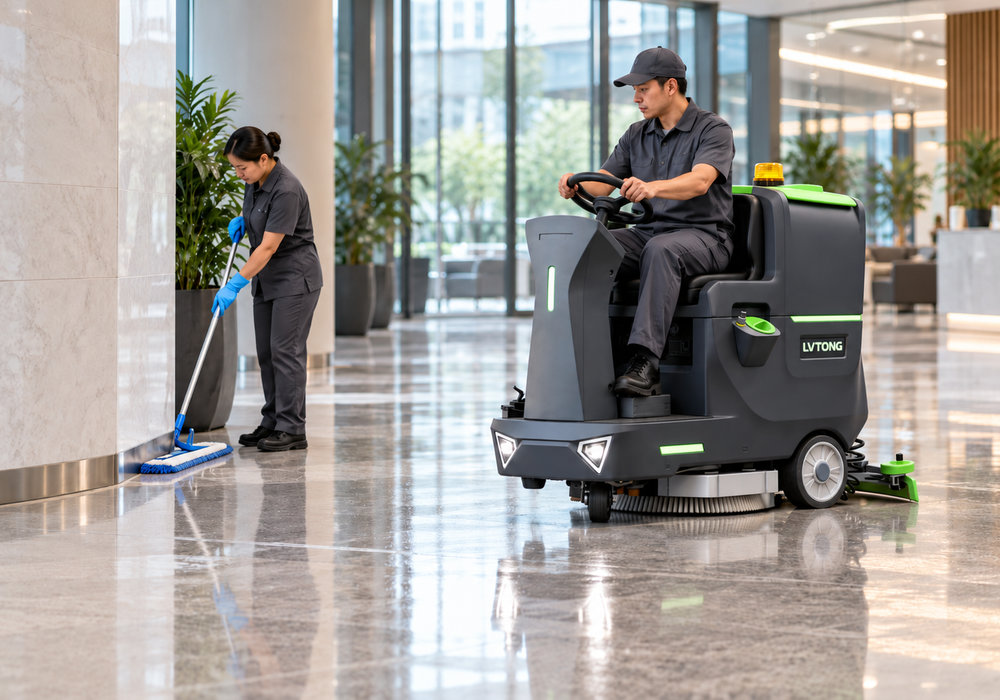
In most buildings the answer is both: a scrubber-dryer for open runs and main routes, a flat mop for edges, spills and small rooms.
This is where the labour saving is realised. A machine covering most of the route area at several times the manual rate releases hours; the remainder stays manual, and those hours go where no machine reaches. A smaller headcount is rarely the goal — reallocating hours to detail work is where the money shows up, and where the floor scrubber mop split in a route plan is decided.
If the manual side stays in the programme, replace string mops with flat mops wherever the floor allows: less water, easier control at the edge of a machine’s path, and cheaper to launder.
Sizing the Machine to the Route Before You Compare Cost
Rated productivity is a marketing number and effective productivity is a route number. Size the machine on the second one, or the break-even calculation will not survive contact with the building.
Rated output assumes a clean straight run; subtract turning loss, obstacle handling, refill intervals and traffic. On a tight interrupted route, the Поломоечная машина Q5 с ручным управлением uses a 50 cm cleaning width to work the whole route. On one long run, the Поломоечная машина LT-S530X с ручным управлением pairs the same 50 cm body class with a 62 L solution and 65 L recovery tank.
| Hard floor per shift | Practical answer |
|---|---|
| Under about 200 m², cleaned weekly | Stay manual; a flat mop programme is enough |
| About 200–800 m², cleaned daily | Walk-behind scrubber-dryer on main runs, manual on edges |
| Over about 800 m², or long continuous routes | Walk-behind with larger tanks, or a ride-on class machine |
| Multi-zone site with lifts | One machine per zone beats one machine moved all day |
Whatever the size, ask for machines built to the safety standard covering floor treatment appliances, МЕК 60335-2-72, when you request quotations.
Часто задаваемые вопросы
Is a floor scrubber cheaper than mopping?
Per square metre, usually yes once a floor is cleaned daily across a few hundred square metres. Below that, mopping is normally cheaper, because there is no machine cost to amortise. The decisive figure is the break-even area, not either purchase price.
How do I work out whether a scrubber-dryer is worth it?
Measure how much floor one person mops per labour-hour on a normal shift, then divide the machine’s annualised cost by the labour rate times the gap between mop rate and effective machine rate. Clean more than the resulting area and the machine costs less.
How much floor can one person mop in an hour?
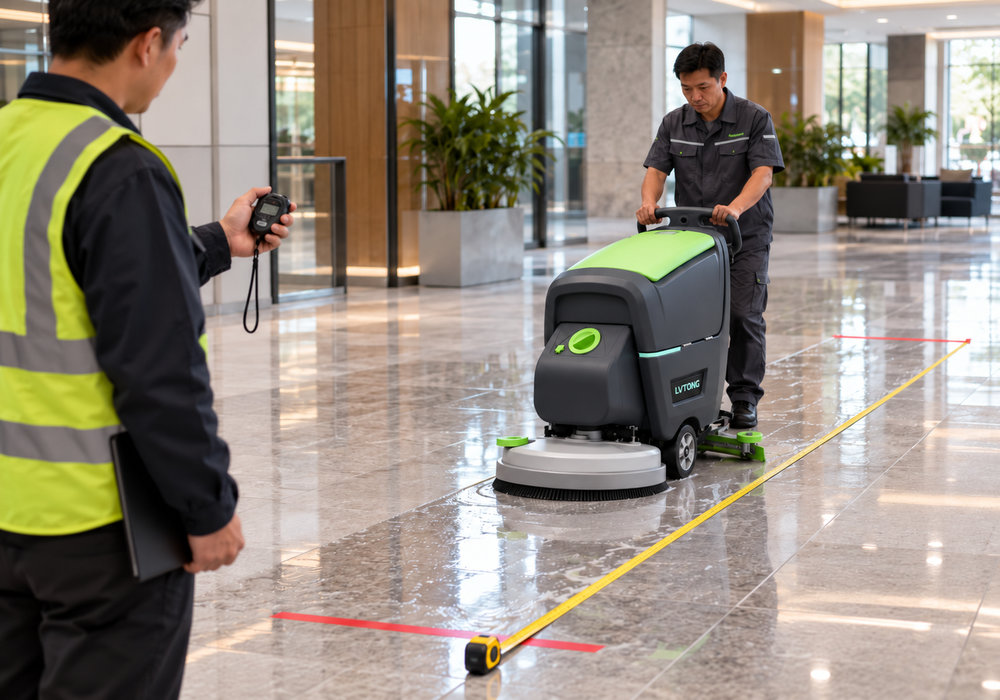
It varies too much by building to quote a standard figure — layout, soil level, refill distance and equipment all move it. Measure it on a defined route with a stopwatch, refills and dumping included, and use your own number.
Can a scrubber-dryer replace mopping completely?
Rarely. Edges, corners, stairwells, upper floors and spill response stay manual in most programmes. What changes is the share: the machine takes the open runs and manual hours move to detail work rather than disappearing.
Where should mop water and recovery tank water be emptied?
Into the sanitary sewer through a janitorial sink or an approved drain point in most cases, subject to local rules; discharge to storm drains or open ground is restricted in many jurisdictions. Confirm with your local water authority.
Next Step: Send Us Your Route Numbers
Send four things: total cleanable hard floor, cleaning frequency, your loaded labour rate, and the mop productivity you measure on a normal shift. We will run the break-even against a walk-behind scrubber-dryer sized to your longest route. Machines for hard and resilient floors are listed on the страница поставщика поломоечных машин.