The modern airport is a non-stop, complex ecosystem. As an Airport Facility Manager, you're responsible for more than just vast spaces; you're managing a 24/7 operation under constant pressure for "zero-mistake" safety and impeccable public perception.
When you're sourcing airport cleaning equipment, you're looking for a genuine solution. How do you clean hundreds of thousands of square feet without disrupting operations? How do you fundamentally mitigate the high cost of slip-and-fall risks?
This guide moves beyond generic "five reasons" templates. We dive into the quantifiable data, linking auto-scrubber performance directly to your key operational metrics—labor costs, safety compliance, and passenger satisfaction. This is how you build a powerful ROI business case.
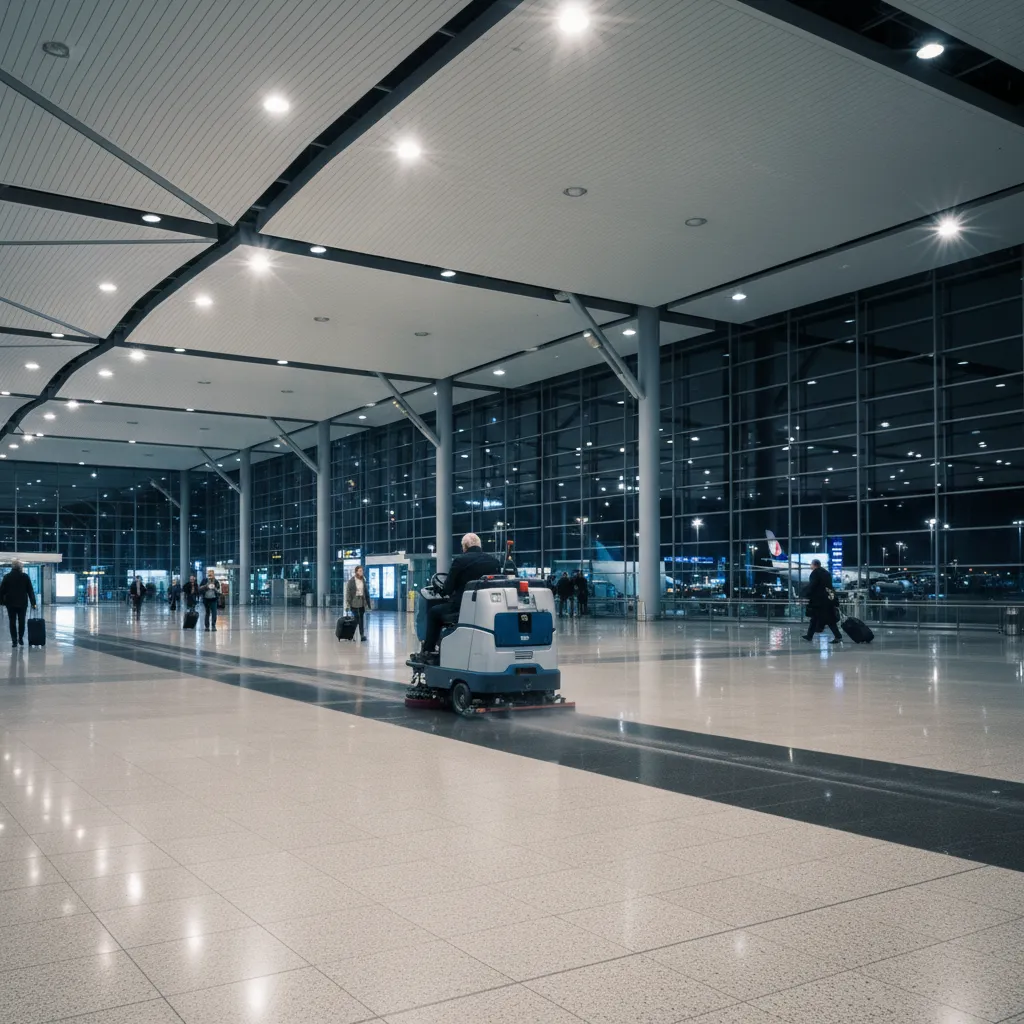
The Unique Cleaning Challenge of an Airport Environment
Picture a major hub: concourses, terminals, and baggage claims can easily exceed 100,000 square meters (over 1 million sq. ft.). Foot traffic is relentless, bringing in outdoor soil, while food courts and baggage handling add spills and tire marks.
You're managing a complex portfolio of floor types:
- Terminals & Concourses: High-gloss terrazzo or polished concrete that must maintain its shine.
- Restrooms & Food Courts: High-risk ceramic tile with difficult-to-clean grout lines.
- Baggage Areas & Ramps: Epoxy or vinyl flooring subject to heavy rubber tire marks and grime.
Traditional mopping fails in this environment. It's inefficient, but more importantly, it creates a persistent slip hazard and leaves behind a film of soil and detergent that dulls high-value flooring.
An industrial floor scrubber (whether ride-on or walk-behind) is engineered for this. Its core value is the one-pass "scrub, rinse, and dry" closed-loop process—an operational necessity for a modern airport.
Reason 1: Drastically Enhance Safety Compliance & Reduce Liability
For any airport operations director, slip-and-fall accidents are a primary liability concern. According to the National Floor Safety Institute (NFSI), these incidents are a leading cause of emergency room visits. In an airport, a single incident can result in significant legal claims and severe brand damage.
The Problem: A mopped floor remains wet, often failing to meet the American National Standards Institute (ANSI) standard for Dynamic Coefficient of Friction (DCOF) on wet surfaces.
The Professional Solution: A modern commercial floor scrubber helps your facility meet and exceed the ANSI A326.3 standard, which is promoted by the Tile Council of North America (TCNA). This standard specifies that indoor, wet-prone surfaces must have a Dynamic Coefficient of Friction (DCOF) of ≥0.42
This value is measured in the field using a specialized testing device, the BOT-3000E tribometer. Unlike mopping—which often leaves behind soil and detergent residues that lower the DCOF—a professional scrubber's high-agitation and instant-recovery system restores the floor's "clean" coefficient of friction, providing you with a measurable, data-backed component for your facility's safety and compliance program.
- Immediate Dry Times: A high-performance recovery system means the floor is safe for foot traffic almost immediately after the machine passes, eliminating the need for extensive coning-off or area closures.
- Improved Traction: Unlike a mop, which can spread a thin film of soil, a scrubber's agitation lifts and extracts deep-seated grime. This restores the floor's original traction, helping your facility meet or exceed ANSI A137.1 DCOF standards.
This is a direct shift from reactive incident management to proactive risk prevention.
Reason 2: Quantifiable Operational Efficiency & Labor Cost Reduction
Under tight budgets, every capital expenditure demands a clear payback. The most compelling argument for an industrial scrubber is the disruptive optimization of your largest budget item: labor.
Industry-standard cleaning rates are published by ISSA, the Worldwide Cleaning Industry Association, in their "Official Cleaning Times" guide. This data distinguishes between "Theoretical Rates" (machine width x speed) and "Practical Rates" (which account for time spent dumping/refilling, turning, and navigating obstacles).
Consider this conservative efficiency comparison for a 100,000 sq. ft. open area:
| Cleaning Method | Actual Cleaning Rate (Est.) | Time to Clean 100,000 Sq. Ft. | Key Operational Impact |
| Traditional Mop Team | ~4,000 sq. ft. per hour | ~25.0 man-hours | Extremely inefficient, high slip hazard, and inconsistent results. |
| Best Walk-Behind Floor Scrubber | ~20,000 sq. ft. per hour | ~5.0 hours | 5x efficiency gain; controlled, consistent clean. |
| Best Ride-On Floor Scrubber | ~45,000 sq. ft. per hour | ~2.2 hours | >10x efficiency gain; low operator fatigue; maximum coverage. |
The ROI Analysis:
As the table shows, one ride-on scrubber can accomplish the work of 10-11 employees using mops. This allows you to:
- Reallocate Staff: Move team members from low-efficiency mopping to high-value tasks like detailed disinfection, high-touchpoint cleaning, or restroom stocking.
- Optimize Shifts: Complete your entire floor care program in a shorter overnight window with a smaller, more effective team.
Furthermore, large solution and recovery tanks minimize time spent on "dump and refill" cycles, maximizing time on the floor. The labor savings alone can often deliver a full payback on the equipment investment within 12-24 months.
Reason 3: Uphold a World-Class Brand Image & Passenger Experience
An airport's cleanliness is the first impression of its operational excellence. It's a critical metric in the Airport Council International (ACI) Airport Service Quality (ASQ) rankings.
- The Mop Problem: Mops spread soil and detergent residue, leaving streaks and a dulling film that actively degrades the appearance of polished floors.
- The Scrubber Advantage: Industrial scrubbers use high-speed brush agitation or orbital vibration to "lift" and "extract" embedded grime from the floor's microscopic pores. The result is a visibly higher, more consistent level of gloss that communicates efficiency, safety, and care to passengers.
A gleaming, non-streaky terminal directly boosts passenger satisfaction, improves ASQ scores, and strengthens your reputation with airline partners.
Reason 4: Meet Sustainability Goals (Green Initiatives)
Airports are under increasing pressure to meet ambitious sustainability targets. Reducing water consumption, chemical usage, and carbon emissions are key KPIs.
- Traditional Mopping: Is resource-intensive, using excessive water and uncontrolled chemical dilution.
- Modern Technology:
- Water-Saving Tech: Traditional cleaning guzzles resources. However, modern flow-control and precision-scrubbing technologies allow professional machines to reduce solution consumption by over 70% compared to conventional systems. This figure is documented in numerous third-party validated case studies detailing water consumption rates under the U.S. Green Building Council (USGBC) LEED certification criteria.
- Chemical-Free Cleaning: Specific technologies electrically activate plain water into a powerful cleaning solution, eliminating chemical use in many areas—ideal for a 24/7 public space.
- Battery Power: Most modern industrial scrubbers, like LVTONG's floor scrubbers, utilize high-capacity batteries (including new lithium-ion options) for zero-emission, low-noise operation, helping you comply with standards like the ISSA CIMS-GB (Green Building) certification.
Reason 5: Superior, Consistent Cleaning on Diverse Floor Types
An airport isn't one floor; it's many. You need the right cleaning methodology for each surface.
The Problem: A mop can't adapt. A "one-size-fits-all" scrubber can be ineffective or, worse, damage expensive flooring.
The Solution: The Right Technology for the Job
Professional-grade machines offer flexibility to ensure optimal, safe results on every surface:
- Terrazzo/Polished Concrete (Concourses): Use Orbital / Vibrating Pads. These use high-frequency micro-vibrations to clean and polish with minimal water, restoring gloss without the "swirl marks" left by traditional disk brushes.
- Tile/Grout (Restrooms, Food Courts): Use Cylindrical Brushes. Their high-speed, counter-rotating brushes not only clean the tile surface but also dig deep into grout lines to remove built-up grime and bacteria, something flat pads cannot do. LVTONG's tile floor scrubbers excel here for bacteria-prone areas.
- Vinyl/Epoxy (Baggage Areas): Standard Disk Brushes with adjustable down-pressure provide the aggressive agitation needed to remove stubborn soils and tire marks effectively.
By deploying the right machine configuration to the right area, you ensure a consistent, high standard of cleanliness from the VIP lounge to the baggage claim.
Application Analysis: The Right Scrubber Fleet for Your Airport
There is no "one machine" solution. An efficient airport cleaning program relies on a strategic combination of ride-on and walk-behind units.
Scenario 1: Terminal 1 Departures (Long Runs, High Traffic, Terrazzo)
- Challenge: Massive open areas, non-stop traffic, high-gloss finish required.
- Solution: Large Ride-On Scrubber (e.g., 40"+ path).
- Key Config: Lithium-ion batteries (for daytime opportunity charging), Orbital pad deck (for polishing & water savings), low-noise design.
Scenario 2: Gate Areas, Food Courts, Concourses (Congested, Multiple Obstacles)
- Challenge: Flexibility needed to navigate around seating, pillars, and passenger lines.
- Solution: Mid-Size Walk-Behind Scrubber (e.g., 28"-32" path).
- Key Config: Self-propelled (traction drive), tight turning radius, superior squeegee performance.
Scenario 3: Restrooms & Elevator Lobbies (Tight Quarters, Heavy Grime, Tile)
- Challenge: Narrow spaces, grout line soils, high-bacteria-load areas.
- Solution: Small Walk-Behind or Vertical Scrubber (e.g., 17"-20" path).
- Key Config: Cylindrical brush deck (for grout cleaning), compact, maneuverable body.
Building Your Return on Investment (ROI) Business Case
When you request capital expenditure, you need to present a financial case, not just a cleaning one.
Step 1: Calculate Your Current Total Cost of Ownership (TCO)
- [Current Cleaning Staff] x [Daily Hours on Floors] x [Hourly Wage (incl. benefits)] x 365 = Annual Labor Cost
- [Monthly Cost of Mops, Buckets, Chemicals] x 12 = Annual Consumable Cost
- (Advanced) [Average Annual Cost of Slip-and-Fall Claims/Insurance]
Step 2: Estimate the New TCO with Scrubbers
- [New Staff Hours Required (see Reason 2)] x [Hourly Wage] x 365 = New Labor Cost
- [Annual Machine Maintenance & Consumables (pads, squeegees)]
- [Cost of Equipment (amortized over 5-7 years)]
Step 3: Calculate the Payback Period
- [Initial Equipment Cost] / ([Current Annual Cost] - [New Annual Cost]) = Payback Period in Years
The resulting number—often under 24 months—transforms this from an "expense" into a self-funding "investment" in safety and efficiency.
Take the Next Step
Ready to build a data-driven case for transforming your airport's operations?
Contact LVTONG's industrial cleaning specialists today for a custom analysis. We can provide a detailed ROI calculation based on your airport's unique square footage, floor types, and current labor costs.