Introduction
Restaurant kitchens, commercial food areas and food-processing facilities create floor-cleaning challenges that are very different from those in ordinary offices or low-traffic buildings.
Grease, food residue, liquids, soil tracked in by staff, frequent traffic and limited cleaning windows can make floors difficult to maintain. In these environments, floor cleaning is not only about appearance. Cleaning procedures also need to support slip-risk control, soil removal and the facility’s broader hygiene and sanitation program.
A suitable restaurant floor scrubber combines mechanical scrubbing with solution application and dirty-water recovery. This can help operators remove soil more consistently than basic manual mopping while recovering contaminated cleaning solution during the cleaning pass.
However, not every scrubber is suitable for every restaurant or food facility.
Machine size, floor type, grease level, brush or pad selection, maneuverability, water recovery, cleanability, chemical compatibility, battery requirements and after-sales support should all be evaluated before purchasing.
This guide explains how to choose a restaurant floor scrubber for commercial kitchens, dining areas and other hygiene-sensitive food environments.
Quick Answer: What Should You Look for in a Restaurant Floor Scrubber?
A restaurant floor scrubber should be selected according to the actual floor and cleaning process rather than only machine size or theoretical productivity.
For most buyers, the key factors are:
- Floor area and layout;
- Kitchen aisle width;
- Type of grease and food residue;
- Floor material and texture;
- Brush or pad compatibility;
- Effective dirty-water recovery;
- Clean and recovery tank design;
- Ease of cleaning the machine after use;
- Battery runtime;
- Charger location;
- Chemical compatibility;
- Maneuverability around kitchen equipment;
- Spare-parts availability;
- Technical support.
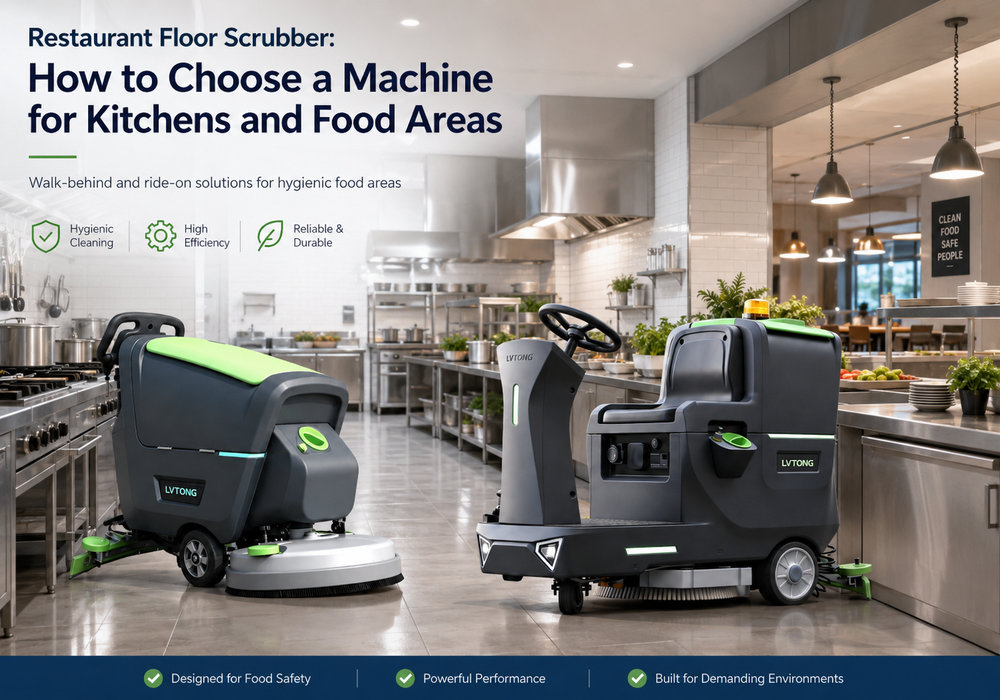
For compact kitchens with narrow passages and frequent obstacles, a small walk-behind scrubber is often more practical.
For larger restaurants, central kitchens, food-production facilities or open back-of-house areas, a larger walk-behind or ride-on machine may provide better productivity.
The best machine is the one that fits the actual cleaning route and sanitation procedure.
Why Are Restaurant and Commercial Kitchen Floors Difficult to Clean?
Restaurant floors are exposed to a combination of contamination that can be difficult to remove with a single manual cleaning method.
Common challenges include:
Grease and Oil
Cooking oil, animal fats and greasy residues can create a slippery film on kitchen floors.
Removing grease effectively may require a combination of:
- Suitable cleaning chemistry;
- Mechanical agitation;
- Appropriate brush or pad;
- Adequate contact time;
- Effective recovery of dirty solution.
Simply spreading detergent across the floor without recovering the contaminated water can redistribute soil rather than remove it.
Food Residue
Food particles, sauces, powders and organic residues may accumulate around:
- Preparation equipment;
- Cooking stations;
- Dishwashing areas;
- Storage areas;
- Waste-handling zones.
Larger loose debris should normally be removed before wet scrubbing.
Water and Wet Floors
Commercial kitchens frequently experience water from cleaning, food preparation and equipment operations.
Residual water can delay reopening and contribute to slip risk.
For this reason, water recovery is an important consideration when selecting a restaurant floor scrubber.
Tight Spaces and Obstacles
Restaurant kitchens often contain:
- Preparation tables;
- Cooking equipment;
- Refrigerators;
- Shelving;
- Columns;
- Narrow aisles;
- Door thresholds.
A machine that looks highly productive on a specification sheet may perform poorly if it cannot maneuver around these obstacles.
How Does a Restaurant Floor Scrubber Work?
A scrubber dryer typically performs several cleaning functions during one cleaning pass:
- Cleaning solution is applied to the floor.
- A brush or pad mechanically agitates the surface.
- Soil is suspended in the cleaning solution.
- A rear squeegee collects the dirty solution.
- A vacuum system transfers the recovered solution into a recovery tank.
This process is different from traditional mopping, where the same mop or water may repeatedly contact multiple sections of floor.
A scrubber with separate solution and recovery tanks allows fresh cleaning solution and recovered wastewater to remain physically separated during normal operation.

Can a Floor Scrubber Improve Hygiene in a Restaurant?
A floor scrubber can support a restaurant’s hygiene program by improving soil removal and recovering dirty cleaning solution.
However, an important distinction should be made:
A floor scrubber is a cleaning machine, not automatically a sanitizing or disinfecting system.
Its primary functions are mechanical soil removal and dirty-water recovery.
Whether a sanitation or disinfection objective is achieved depends on additional factors such as:
- Approved cleaning or sanitizing chemicals;
- Correct chemical concentration;
- Required contact time;
- Floor compatibility;
- Cleaning frequency;
- Staff procedures;
- Equipment cleaning;
- Verification practices.
Therefore, restaurants should integrate the scrubber into their established cleaning and sanitation procedures rather than treating the machine itself as a guarantee of hygiene compliance.
Are Industrial-Grade Floor Machines Safe for Food Processing Areas?
Industrial-grade floor scrubbers can be suitable for food-processing areas when the machine and cleaning process match the facility’s requirements.
Buyers should evaluate:
- Where the machine will be used;
- Whether floors are routinely wet;
- Type of food residue;
- Chemical exposure;
- Floor material;
- Machine cleanability;
- Tank and hose accessibility;
- Brush and squeegee cleaning;
- Electrical and battery requirements;
- Local facility and regulatory requirements.
A machine being described as “industrial” does not automatically make it appropriate for every food-production environment.
Likewise, a scrubber should not automatically be described as “food-grade” unless a specific claim is supported by applicable documentation.
For professional buyers, the better question is:
Can this machine be incorporated into our documented cleaning and sanitation procedure for this specific area?
What Makes a Floor Scrubber Suitable for Food and Restaurant Areas?
Several machine characteristics deserve particular attention.
| Factor | Why It Matters |
|---|---|
| Separate solution and recovery tanks | Keeps fresh solution separate from recovered dirty water |
| Effective water recovery | Helps remove contaminated solution and reduce residual water |
| Accessible recovery tank | Makes routine cleaning and inspection easier |
| Accessible squeegee | Helps operators remove trapped soil and residue |
| Accessible hoses | Helps prevent residue accumulation in difficult-to-reach areas |
| Chemical compatibility | Helps avoid damage from the approved cleaning chemistry |
| Corrosion resistance | Important where equipment is exposed to moisture and chemicals |
| Suitable brush or pad | Helps match grease, residue and floor texture |
| Compact dimensions | Important in narrow kitchens and food preparation areas |
| Battery configuration | Must fit shift length and charging arrangements |
| Easy maintenance | Supports consistent equipment care |
Machine design should be evaluated together with the facility’s sanitation procedure.
Choose the Right Brush or Pad for the Floor
A restaurant floor scrubber is only as effective as the cleaning configuration attached to it.
For a deeper comparison of brush materials, scrubbing pads and floor compatibility, review our floor scrubber brush types guide before selecting the final cleaning configuration.
Smooth Tile Floors
Smooth tile may require moderate mechanical agitation rather than an extremely aggressive brush.
The objective is to remove grease and soil without unnecessarily damaging the surface.
Textured or Anti-Slip Floors
Textured kitchen flooring can be more difficult because contamination may settle into surface recesses.
These applications may require:
- A suitable brush rather than a flat pad;
- Appropriate bristle stiffness;
- Adequate brush pressure;
- Slower cleaning where heavily soiled.
Epoxy or Coated Floors
Coated floors should be cleaned with a brush or pad compatible with the surface finish.
Excessively aggressive materials can contribute to premature wear.
Grout Lines
Where tile and grout are present, buyers should consider whether the selected brush can reach recessed areas effectively. Compare tile floor scrubber machines on a representative section before choosing brush type and pressure.
The correct setup depends on both floor construction and contamination.

How Should a Restaurant Floor Scrubber Handle Grease?
Grease is one of the most important cleaning challenges in commercial kitchens.
Effective grease removal usually depends on several variables working together.
Cleaning Chemistry
Use a cleaning product that is compatible with:
- The floor;
- The machine;
- The contamination;
- The facility’s cleaning procedure.
When grease, oil or food residue requires chemical assistance, see our floor scrubber cleaning solution guide for low-foam detergents, degreasers, dilution, foam control and machine compatibility.
More chemical is not automatically better.
Follow the chemical manufacturer’s instructions for dilution, application and safety.
Mechanical Agitation
The brush or pad needs enough mechanical action to loosen the greasy film.
If the cleaning setup is too mild, the operator may need repeated passes.
Contact Time
Some greasy contamination may require cleaning solution to remain on the floor long enough to loosen the soil before recovery.
The appropriate process depends on the cleaning chemistry being used.
Dirty-Water Recovery
After grease and soil are suspended in solution, the dirty solution should be recovered rather than left to dry or spread to another section of floor.
This is one reason squeegee and vacuum performance matter in restaurant applications.
Reduce the Redistribution of Dirty Water
One advantage of a scrubber dryer is its ability to recover dirty solution during the cleaning process.
This can help reduce the repeated redistribution of contaminated water across different floor areas.
However, the benefit depends on machine condition.
Operators should regularly inspect:
- Squeegee blades;
- Recovery hoses;
- Vacuum system;
- Recovery tank;
- Filters;
- Seals.
Poorly maintained recovery components may leave streaks or excessive residual water.
Clean and Recovery Tank Design
Separate clean-solution and dirty-water recovery tanks are common on professional scrubber dryers.
For hygiene-sensitive environments, buyers should go further and consider how easily those tanks can be cleaned.
Questions to ask include:
- Can the recovery tank be accessed easily?
- Is the tank easy to rinse?
- Are there difficult internal corners where residue can collect?
- Can filters be removed for cleaning?
- Can hoses be flushed?
- Is the tank drain easy to access?
- Can the squeegee assembly be removed and cleaned?
A sophisticated machine that is difficult to clean may create unnecessary maintenance challenges.

Walk-Behind or Ride-On Restaurant Floor Scrubber?
Machine type should be determined by layout and cleaning workload.
Walk-Behind Floor Scrubber
A walk-behind model is usually the first option to consider for:
- Restaurant kitchens;
- Food preparation rooms;
- Narrow aisles;
- Dining areas;
- Small storage rooms;
- Equipment-dense environments.
Its main advantage is maneuverability.
A compact machine can often clean close to walls, equipment and narrow passages more effectively than a larger ride-on unit.
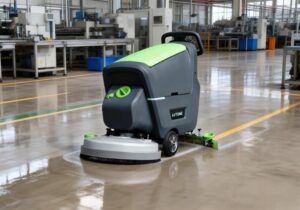
Buyers working with compact kitchens, narrow aisles or equipment-dense layouts can compare LVTONG’s walk-behind floor scrubber machines to evaluate different machine sizes and configurations.
Ride-On Floor Scrubber
A ride-on floor scrubber may be more appropriate for:
- Large central kitchens;
- Food-production plants;
- Distribution centers;
- Large storage areas;
- Open processing halls;
- Large food-service facilities.
The main advantage is greater productivity over large open areas and lower operator walking requirements.
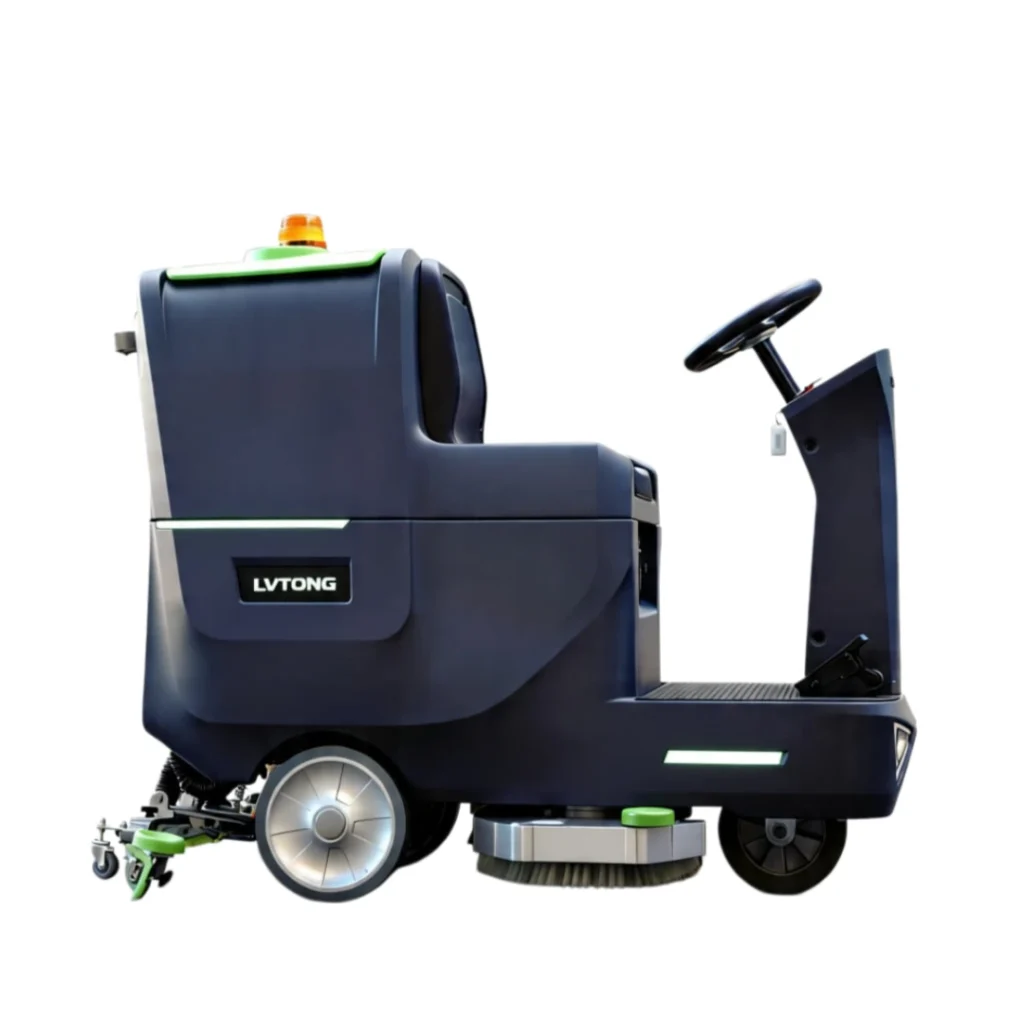
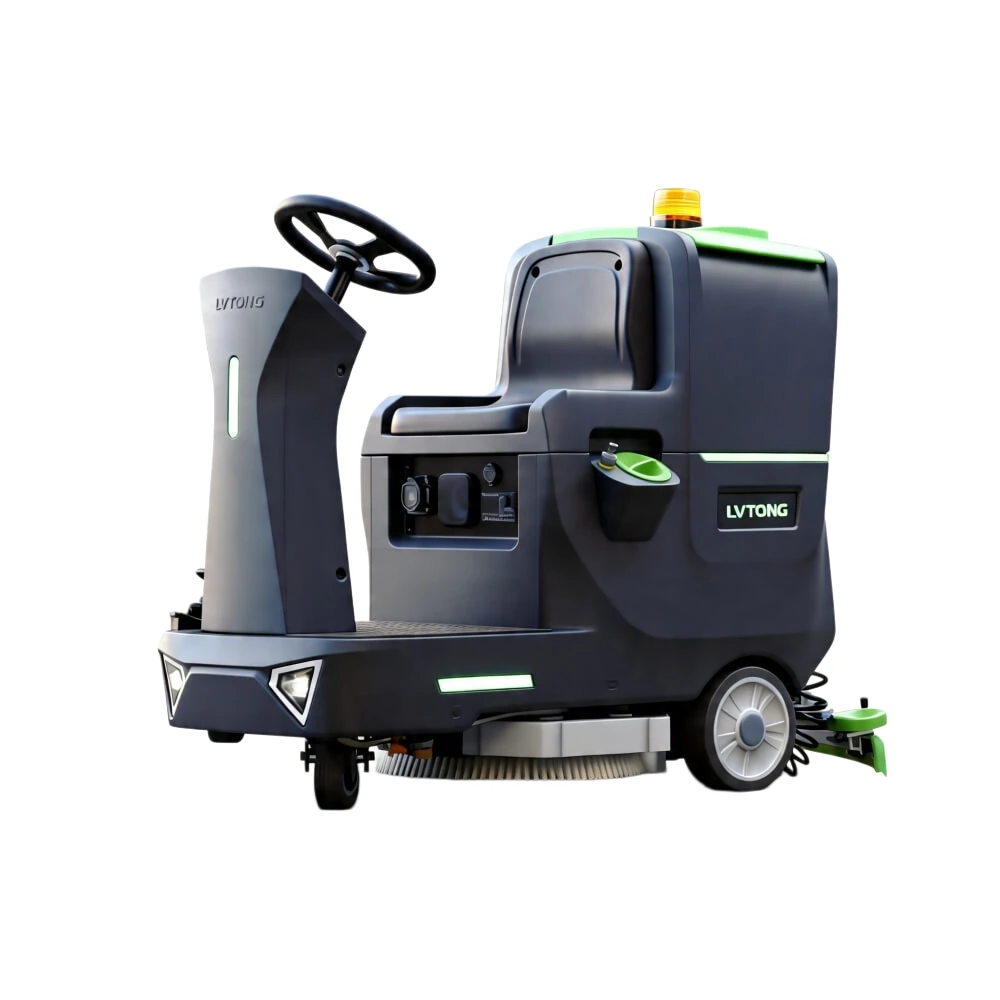
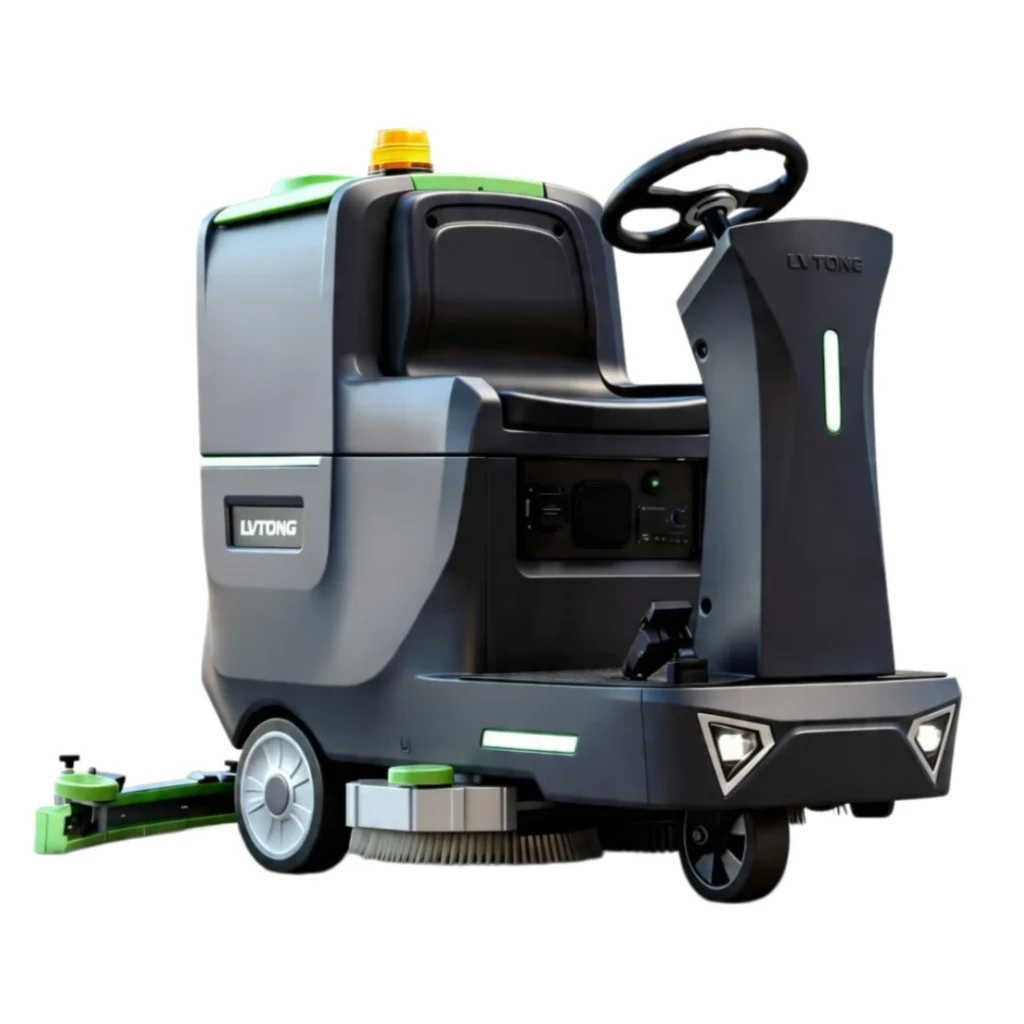
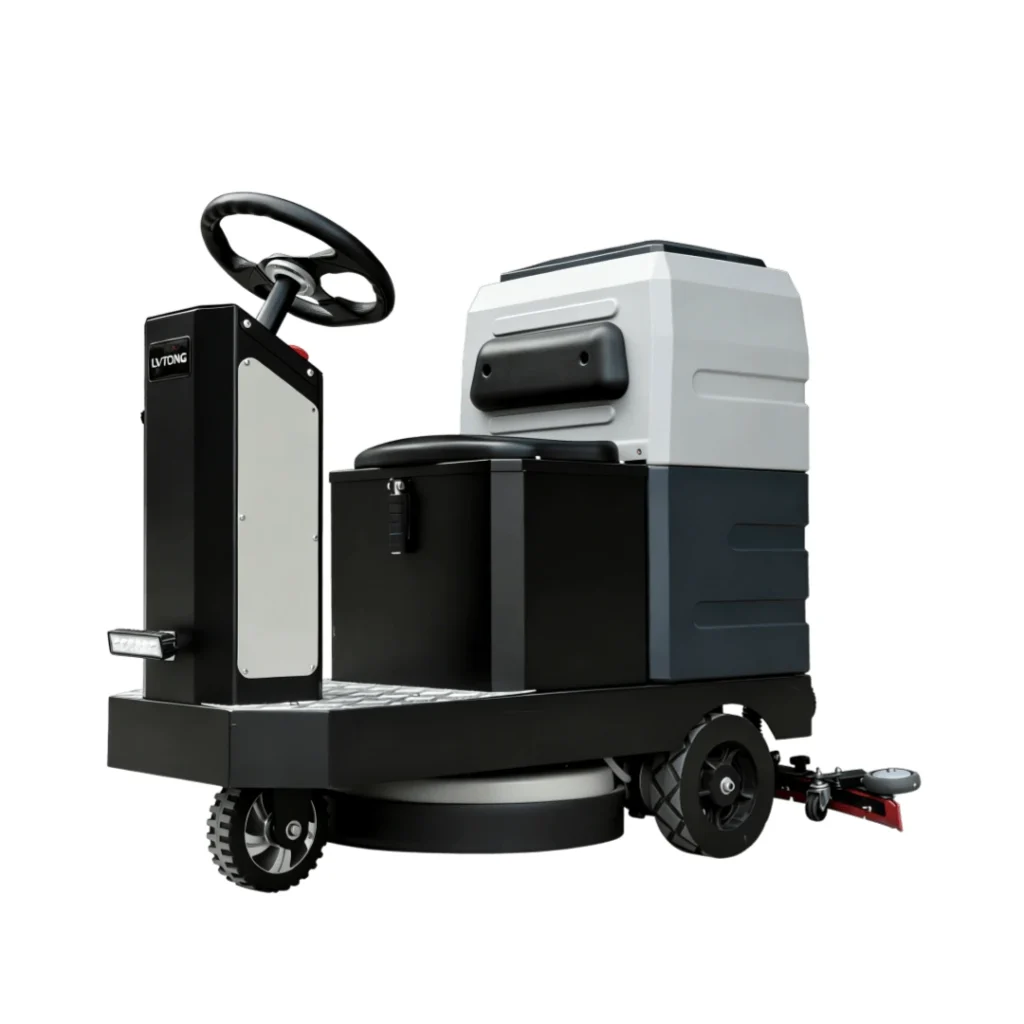
For large central kitchens, food-production halls and other open facilities, buyers can compare LVTONG’s ride-on floor scrubber machines by cleaning width, tank capacity, runtime and facility requirements.
However, buyers should verify turning radius, aisle width and access before selecting a large machine.
Which Restaurant Floor Scrubber Should You Choose?
Use the following table as an initial selection guide.
| Cleaning Situation | Start by Evaluating |
| Small restaurant kitchen | Compact walk-behind scrubber |
| Narrow aisles and equipment-dense layout | Highly maneuverable walk-behind model |
| Dining and front-of-house floor | Compact low-noise machine with good water recovery |
| Large central kitchen | Larger walk-behind or compact ride-on |
| Large food-processing hall | Ride-on scrubber where layout permits |
| Heavy grease | Suitable brush/pad + compatible cleaning chemistry |
| Textured anti-slip floor | Brush suited to the floor texture |
| Smooth coated floor | Less aggressive compatible brush or pad |
| Frequent wet conditions | Strong water recovery and easy-to-clean components |
| Multiple cleaning shifts | Battery runtime and charging strategy |
| Large loose food debris | Remove debris before wet scrubbing |
These are starting points rather than universal rules.
A site assessment should determine the final configuration.
Battery and Charging Considerations
Battery type matters, but a hygiene-focused article should not assume that one battery technology is automatically suitable for every user.
Instead, evaluate the operating schedule.
Ask:
- How many hours per day will the machine operate?
- How long is each cleaning window?
- Is the machine used in multiple shifts?
- Where will charging take place?
- How much charging downtime is available?
- What maintenance does the battery require?
- Are replacement batteries available?
- Is the charger suitable for the local electrical supply?
Lithium battery systems can provide operational advantages in some applications, particularly where flexible charging and lower battery-maintenance requirements are valuable.
However, final selection should be based on the actual machine, battery configuration and operating schedule.
Chemical Compatibility Matters
Restaurant and food-processing facilities may use different detergents, degreasers and sanitation chemicals.
Before adding any product to a scrubber dryer:
- Confirm that the chemical is suitable for machine application.
- Check compatibility with the floor.
- Follow the chemical manufacturer’s dilution instructions.
- Verify compatibility with machine tanks, hoses, seals and related components.
- Follow the facility’s safety and sanitation procedures.
Avoid assuming that any cleaning chemical can be added to the machine.
Some formulations may create excessive foam or affect machine components.
Can a Restaurant Floor Scrubber Prevent Cross-Contamination?
A scrubber can help reduce opportunities for contaminated cleaning solution to be redistributed by separating fresh solution from recovered wastewater and removing dirty solution from the floor.
But the machine cannot prevent cross-contamination by itself.
Cross-contamination control also depends on:
- Where the machine is used;
- Whether equipment is shared between hygiene zones;
- Cleaning sequence;
- Brush and squeegee sanitation;
- Tank cleaning;
- Chemical procedures;
- Staff training;
- Storage practices.
For facilities with separated hygiene zones, consider whether brushes, pads or machines should be dedicated to specific areas according to the site’s sanitation plan.
Can a Floor Scrubber Make a Restaurant or Food Facility HACCP Compliant?
No.
A floor scrubber does not make a restaurant or food-processing facility HACCP compliant by itself.
Instead, the machine can support a facility’s sanitation program by helping provide repeatable mechanical floor cleaning and dirty-water recovery.
The facility must still determine appropriate:
- Cleaning procedures;
- Cleaning frequency;
- Chemicals;
- Concentrations;
- Contact times where applicable;
- Equipment sanitation;
- Monitoring;
- Verification;
- Recordkeeping.
When evaluating a supplier, be cautious of broad claims that a particular floor scrubber automatically “meets HACCP” without explaining the specific context or supporting documentation.
How Should You Clean a Floor Scrubber After Restaurant Use?
Machine hygiene should be part of the cleaning procedure.
After use, follow the manufacturer’s instructions and the facility’s sanitation procedure.
Typical tasks may include:
- Emptying the recovery tank.
- Rinsing the recovery tank.
- Cleaning applicable filters.
- Inspecting and rinsing hoses.
- Cleaning the squeegee assembly.
- Inspecting squeegee blades.
- Cleaning the brush or pad.
- Removing trapped food residue.
- Checking the solution tank where required.
- Leaving cleaned components in the appropriate condition for drying and storage.
Do not allow organic residue to remain inside the machine longer than necessary.
What Should Buyers Check Before Purchasing?
Before purchasing a restaurant floor scrubber, evaluate the following.
Facility Conditions
Confirm:
- Total cleaning area;
- Kitchen size;
- Narrowest aisle;
- Door width;
- Floor material;
- Floor texture;
- Main contamination;
- Cleaning frequency;
- Available cleaning time.
Machine Configuration
Compare:
- Walk-behind or ride-on;
- Cleaning width;
- Machine width;
- Tank capacity;
- Brush or pad;
- Brush pressure;
- Battery runtime;
- Charger;
- Water recovery.
Hygiene and Cleanability
Inspect:
- Solution tank;
- Recovery tank;
- Recovery hose;
- Squeegee;
- Filters;
- Brush deck;
- Drain system.
Ask how each area should be cleaned after use.
Long-Term Support
Verify:
- Squeegee blade availability;
- Brush availability;
- Pad availability;
- Spare parts;
- Warranty;
- Technical support;
- Maintenance documentation.
Buyers evaluating long-term machine reliability should also review LVTONG’s cleaning equipment maintenance and service support, including technical assistance, maintenance guidance and spare-parts service.
Common Mistakes When Choosing a Restaurant Floor Scrubber
Choosing Only by Cleaning Width
A wide machine may look more productive but can be difficult to maneuver in a compact kitchen.
Ignoring Floor Texture
The same brush does not perform equally on smooth tile, textured safety flooring and coated surfaces.
Ignoring Grease Type
Grease removal depends on the complete cleaning process, not just machine power.
Expecting the Machine to Handle Large Debris
Remove substantial loose food, packaging or sharp debris before wet scrubbing where necessary.
Ignoring Water Recovery
A machine that scrubs effectively but leaves excessive water behind may not meet the operational needs of a busy restaurant.
Ignoring Machine Cleanability
Recovery tanks, hoses, brushes and squeegees themselves must be maintained.
Assuming the Machine Creates Hygiene Compliance
Equipment supports a sanitation program; it does not replace one.
What Information Should You Send for a Restaurant Floor Scrubber Recommendation?
For a more accurate recommendation, send the supplier:
- Restaurant or facility type;
- Total cleaning area;
- Kitchen cleaning area;
- Floor photos or videos;
- Floor material;
- Floor texture;
- Main grease or food residue;
- Cleaning frequency;
- Available cleaning time;
- Narrowest aisle or doorway;
- Required daily operating hours;
- Current cleaning method;
- Current cleaning chemicals;
- Walk-behind or ride-on preference, if known;
- Destination country.
This information allows the supplier to recommend a machine based on your actual application instead of guessing from building size alone.
Frequently Asked Questions
What is the best floor scrubber for a restaurant?
There is no single best restaurant floor scrubber for every facility.
A compact walk-behind model is often suitable for narrow kitchens, while larger walk-behind or ride-on machines may be more efficient in central kitchens and larger food facilities.
Choose according to layout, floor material, grease level, cleaning window, brush requirements and water recovery.
Are floor scrubbers safe for food processing areas?
Floor scrubbers can be suitable for food-processing areas when the machine configuration, materials, cleaning chemistry and cleaning procedure are appropriate for the specific environment.
Buyers should also evaluate cleanability, wastewater recovery and local facility requirements.
Can a restaurant floor scrubber remove grease?
A restaurant floor scrubber can help remove greasy soil when it is combined with an appropriate brush or pad, compatible cleaning chemistry, sufficient mechanical agitation and effective dirty-water recovery.
Heavy grease may require a specific cleaning procedure rather than one fast cleaning pass.
Is a floor scrubber better than a mop for a commercial kitchen?
For suitable floor areas, a scrubber dryer can provide mechanical agitation and dirty-water recovery in a repeatable cleaning process.
However, manual tools may still be required for corners, edges, under equipment and other areas the machine cannot reach.
Should I choose a walk-behind or ride-on floor scrubber for a restaurant?
Walk-behind machines are generally better for compact kitchens and obstacle-heavy areas.
Ride-on models are more appropriate where there is enough open floor area, turning space and cleaning workload to justify the larger machine.
Can a floor scrubber help reduce cross-contamination?
A scrubber’s separate solution and recovery systems can help reduce the redistribution of dirty cleaning solution.
Cross-contamination prevention still depends on the complete sanitation process, including machine cleaning, cleaning zones, chemical procedures and staff practices.
Can I use sanitation chemicals in a floor scrubber?
Only use chemicals that are compatible with the machine, floor and intended cleaning process.
Follow the chemical and equipment manufacturer’s instructions, especially regarding dilution, foam and material compatibility.
How often should a restaurant floor scrubber be cleaned?
The machine should be cleaned according to the manufacturer’s instructions and the facility’s sanitation procedure.
Recovery tanks, squeegees, brushes, pads, filters and other soil-contact components should not be allowed to accumulate food and organic residue.
Key Takeaways
When selecting a restaurant floor scrubber:
- Start with the kitchen layout, not only total floor area.
- Match the machine size to aisles and obstacles.
- Identify grease, food residue and floor texture before selecting the brush.
- Prioritize effective dirty-water recovery.
- Evaluate how easily tanks, hoses and squeegees can be cleaned.
- Confirm chemical compatibility.
- Match battery runtime to the cleaning schedule.
- Remove substantial loose debris before wet scrubbing.
- Include the machine in a documented cleaning and sanitation procedure.
- Verify spare-parts and technical support before purchasing.
Conclusion
A restaurant floor scrubber can help restaurants, commercial kitchens and food-processing facilities create a more consistent and efficient floor-cleaning process.
The value of the machine comes from combining mechanical scrubbing with dirty-water recovery while reducing the dependence on repeated manual mopping over large cleanable areas.
However, selecting the right machine requires more than choosing the highest cleaning capacity.
Buyers should evaluate floor texture, grease and food residue, aisle width, machine maneuverability, brush configuration, water recovery, tank cleanability, chemical compatibility, battery requirements and long-term service support.
Most importantly, the scrubber should become part of the facility’s broader cleaning and sanitation process rather than being treated as a replacement for it.
Request a Restaurant Floor Scrubber Recommendation
Not sure which restaurant floor scrubber fits your kitchen or food facility?
Send LVTONG information about:
- Your facility type;
- Cleaning area;
- Floor material;
- Floor photos or videos;
- Main grease or food residue;
- Available cleaning time;
- Aisle width;
- Cleaning frequency;
- Battery requirements;
- Destination market.
LVTONG can review your application and recommend a suitable walk-behind or ride-on floor scrubber configuration for your restaurant, commercial kitchen or food-processing environment.
LVTONG can review your floor type, grease and food residue, cleaning area, kitchen layout and operating schedule to recommend a suitable walk-behind or ride-on configuration. Request a restaurant floor scrubber recommendation and send us your application details for a more accurate machine selection.