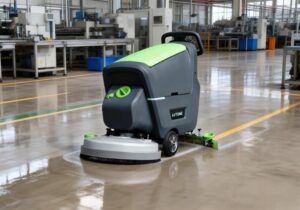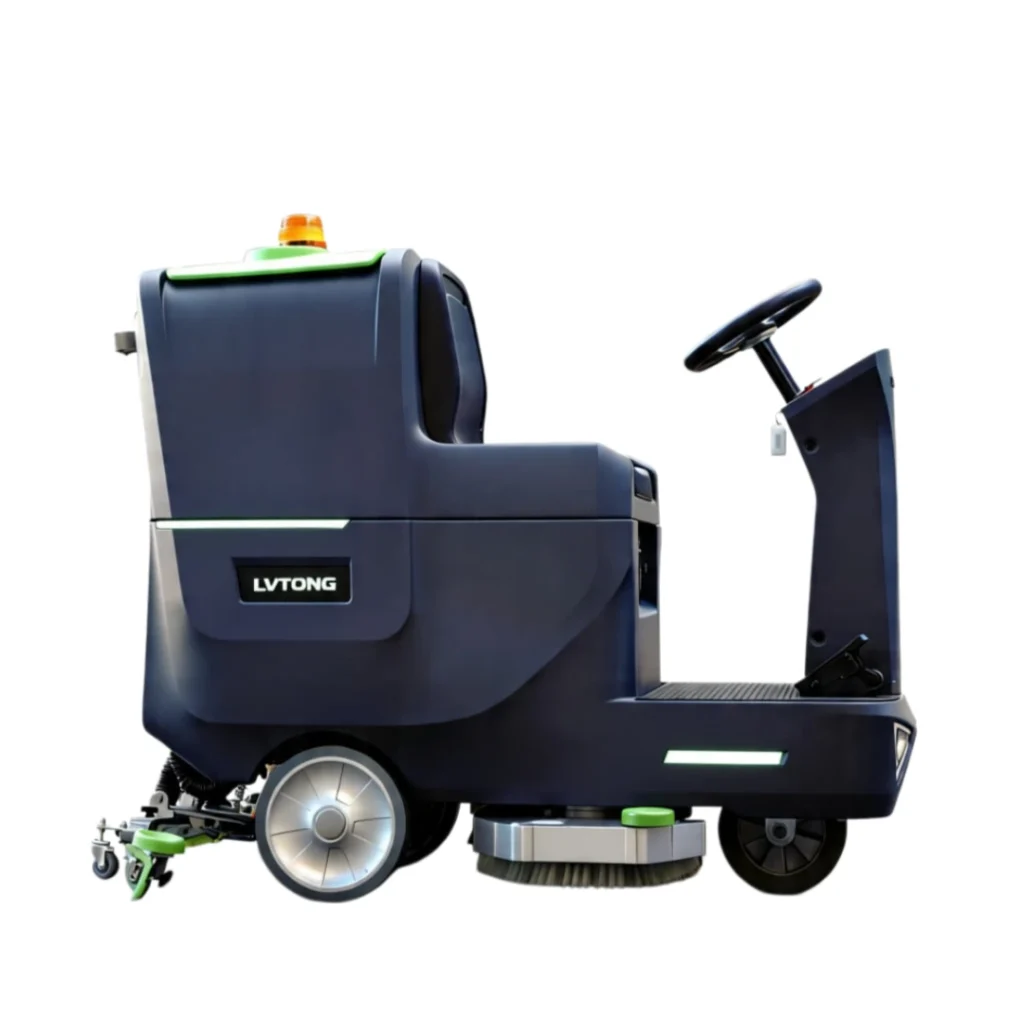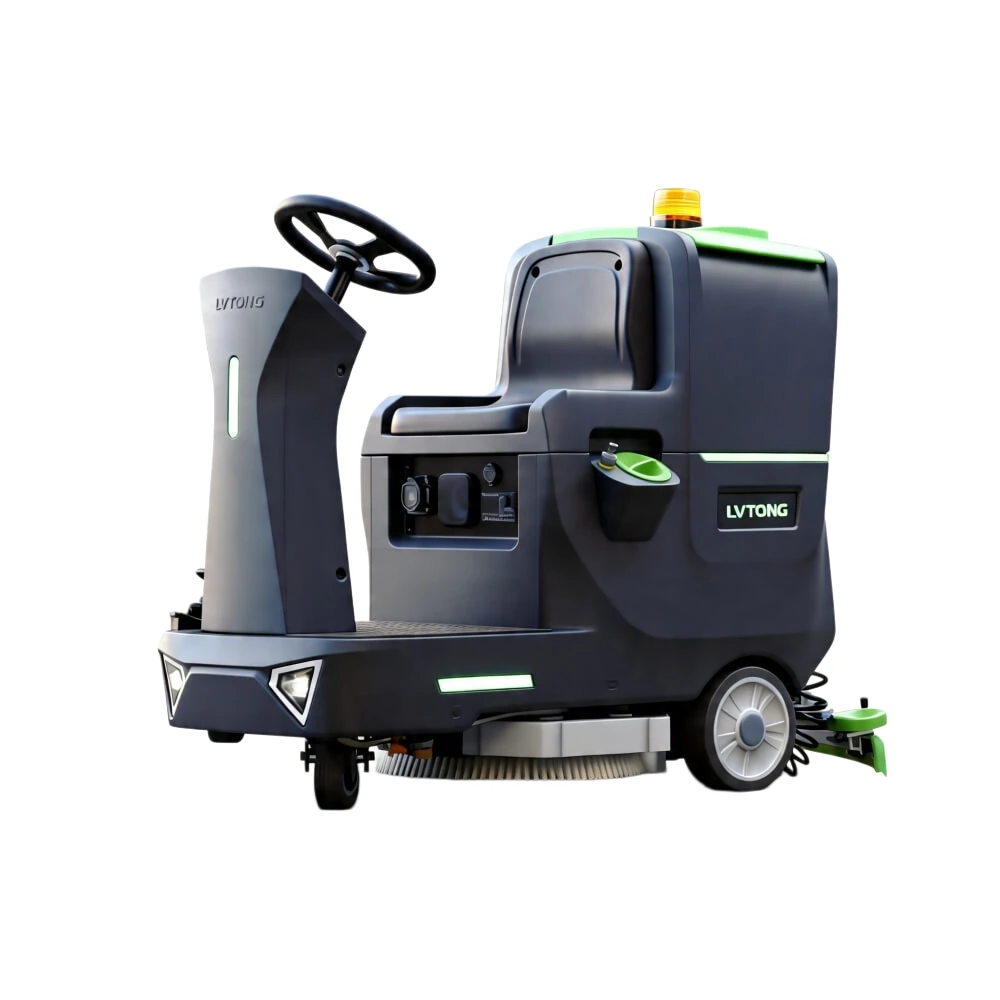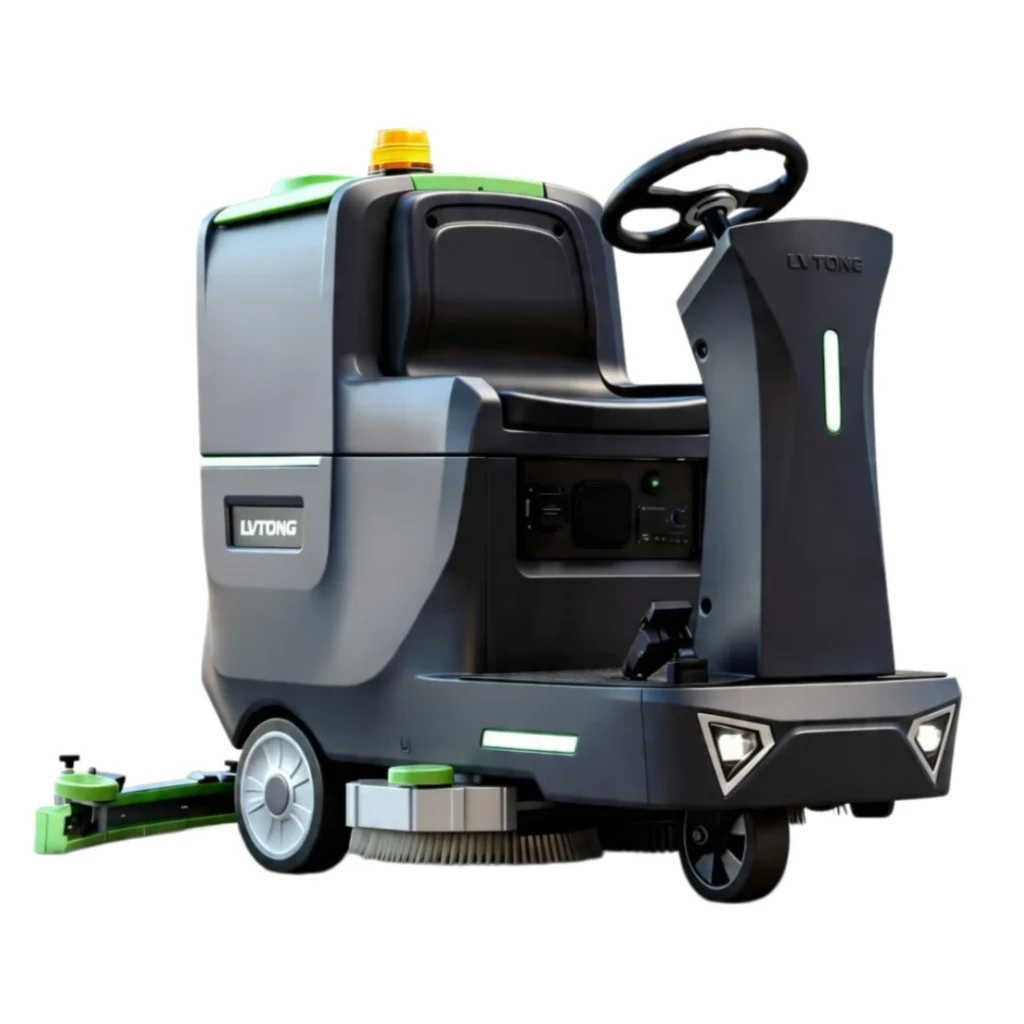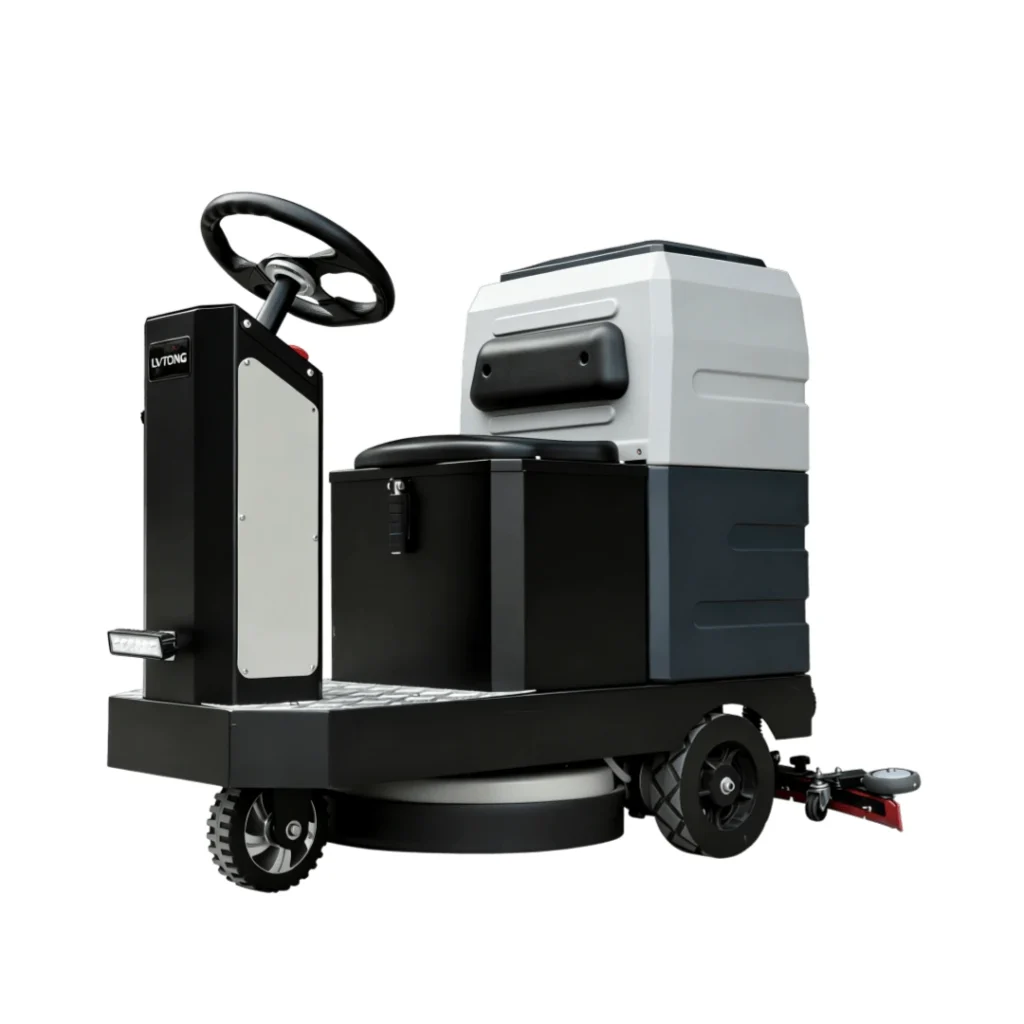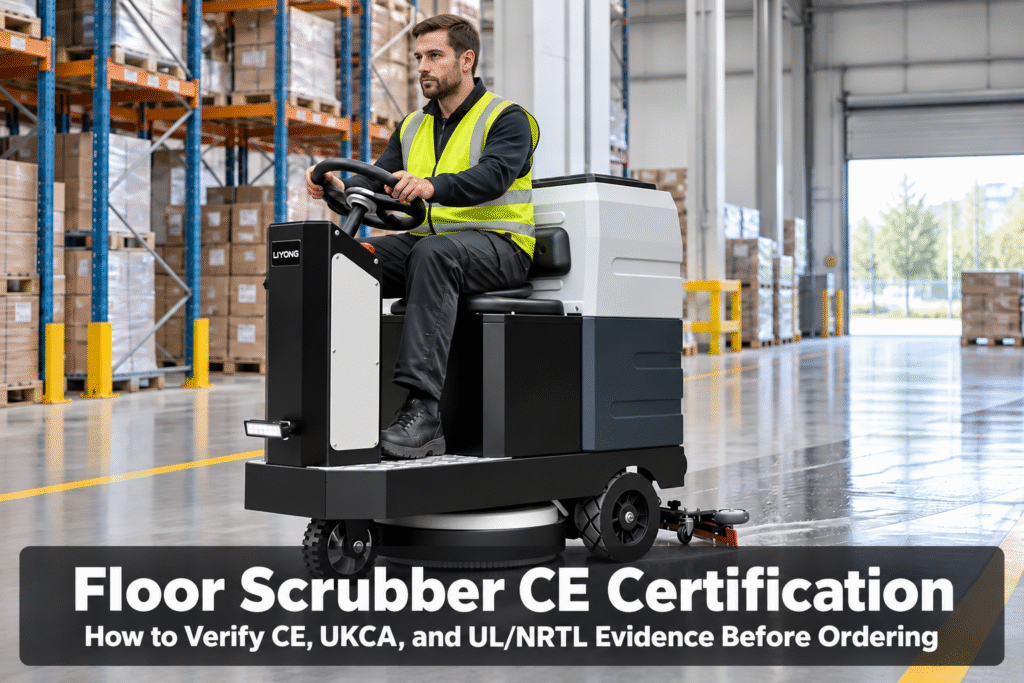

When you source a commercial floor scrubber from us, begin by confirming your destination market and project requirements. Then verify that the machine’s marking and compliance documents match the ordered configuration. Record the exact model, battery, charger, labels, and responsible legal entity; then compare the applicable CE, UKCA, or UL/NRTL route and the model-specific Declaration of Conformity or test evidence against that configuration. The order is ready only when the evidence file matches the serial-numbered machine and shipment documents. Product pages such as the V6 Ride-On Floor Scrubber page can help identify a machine and its intended application, but they do not replace a configuration-specific compliance review. A battery, charger, label, or private-label change can reopen that review.
Destination Market and Certification Route
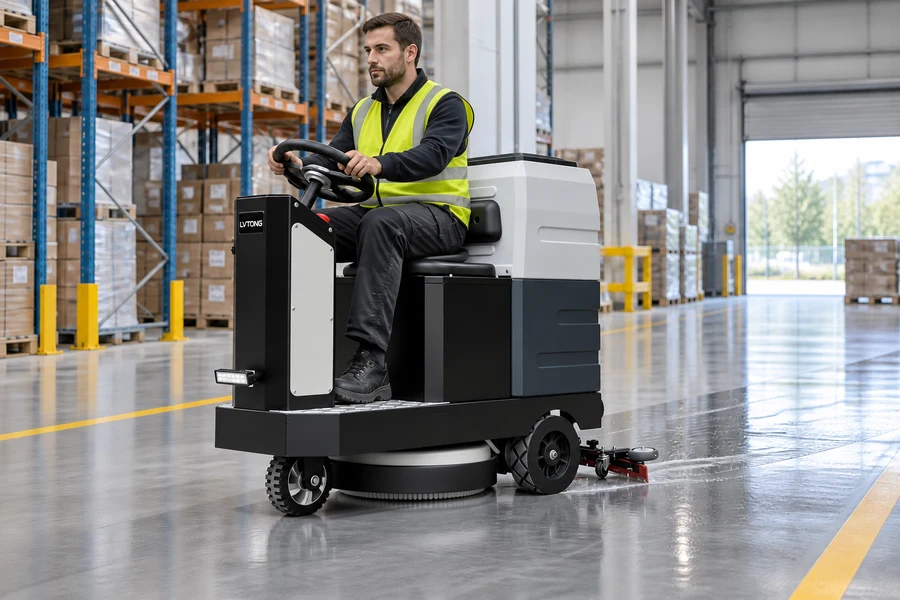
EU Orders: CE Evidence for Market Entry
For EU/European Economic Area (EEA) orders, the first question is when the machine is placed on the market. Machines placed before 20 January 2027 must comply with Machinery Directive 2006/42/EC. From that date, Machinery Regulation (EU) 2023/1230 applies mandatorily. Where applicable, a manufacturer may state conformity with the Regulation earlier. This timeline establishes the CE route. CE is a conformity marking applied after the applicable conformity assessment; it is not, by itself, a model-specific certificate.
The European Commission machinery guidance confirms the transition and frames the EU machinery route. Evidence for a specific LVTONG model still requires a separate review of the quotation and exact configuration.
For powered commercial ride-on or walk-behind machines within its scope, particularly those with a more linear cleaning motion, IEC 60335-2-72:2021 may be relevant. Check its exclusions and assess IEC 60335-2-67:2021 for commercial machines without traction drive and with a more lateral or periodic cleaning motion. Neither standard is a CE mark or model approval.
Great Britain Orders: The Applicable CE or UKCA Route
Great Britain and Northern Ireland require separate route decisions. In England, Scotland, and Wales, qualifying products may use CE or UKCA under product-specific rules in force when the product is placed on the market. Northern Ireland generally uses CE; CE plus UKNI applies when a UK-based Northern Ireland notified body performs mandatory third-party conformity assessment, and UKNI is not used alone. The GOV.UK Great Britain guidance and Northern Ireland guidance should be read separately for the order. A mark selected for Great Britain should not be copied automatically to Northern Ireland.
U.S. Commercial Orders: UL/NRTL Evidence
For U.S. commercial orders, CE does not replace a UL or other OSHA-recognized NRTL mark when the customer, project, insurer, or workplace requires one. The request needs a defined scope—complete machine, component, or a limited hazard or performance claim. UL Product iQ and OSHA’s NRTL FAQ help check the certification record and recognized laboratory scope; the ordered model and configuration still require a separate review. OSHA recognition is limited to the NRTL’s recognized product, test-standard, site, and certification scope; it is not blanket approval of every product associated with a laboratory name or logo. Where NRTL approval is required, verify the certification mark and record against the ordered model and configuration.
Customer and Project Acceptance Requirements
Project acceptance depends on the buyer, tender authority, site owner, insurer, and internal procurement team. Record who must approve the machine, which configuration-specific documents are required, and when they are due. The legal market route and model-specific evidence remain separate checks; a valid market route does not guarantee project acceptance.
Approval and acceptance scope: The tender authority, site owner, insurer, and internal procurement team may have different roles. Acceptance is complete only when the quotation names the party—or defined group—whose written approval is required. The acceptance scope may cover the complete machine or set a higher threshold for a charger, battery, component, or customer-specific certification level.
Site and configuration conditions: Power supply, operating language, labels, packaging, and other site-specific or configuration-related constraints belong beside the relevant quotation rather than in a generic product description. A site may reject an otherwise suitable machine because the charger, instructions, or label format does not fit its operating procedure.
Review timing and change control: Some projects require document review before the purchase order, shipment, delivery, or final payment. The quotation records the applicable deadline. A charger substitution, configuration revision, label change, or change in responsible legal entity can reopen acceptance. Production begins only after the approval route for such changes is settled.
Consider a hospital tender: the applicable CE route may be acceptable, yet the site could still require whole-machine UL/NRTL evidence and pre-delivery document review. Record that difference and obtain written approval from the responsible authority. Our commercial floor scrubber supplier evaluation guide can help assess supplier support.
Model-Specific Compliance Evidence
Compare each record with the exact ordered model and configuration. First identify what the record proves; then check whether its scope covers the machine being ordered. For UL/NRTL records, compare the certification reference, status, model range, standard, and scope. Use the table below to apply this two-step check.
Review item | Evidence or attributes to compare | Boundary or release rule |
|---|---|---|
Market route and marks | CE/UKCA route and applicable legislation | A mark alone is not a model-specific certificate or project approval. |
Document scope | DoC: responsible party and product; test report: test scope and sample; UL/NRTL: reference, status, standard, and scope. | A generic report, laboratory logo, or component-only record does not prove coverage of the complete machine. |
Model identity | Model number, product name, and revision | Put the order on hold when the model reference is different or generic. |
Power system | Voltage, frequency, current, and power rating | Any discrepancy requires a new evidence review. |
Battery | Chemistry, voltage, capacity, and battery pack | A different battery pack changes the evidence boundary. |
Charger | Model, input, output, and plug | A charger substitution requires re-approval. |
Machine and optional systems | Walk-behind/ride-on type, IoT, wireless, display, controller, and remote functions | Missing modules, firmware, or host-machine details create a scope gap. |
Brand and legal identity | Manufacturer, OEM brand, address, and data plate | An inconsistent identity chain requires correction before release. |
The final evidence question is whether the documents match the ordered configuration.
For example, when a V6 order uses a different battery, charger, wireless module, or private-label data plate, recheck whether the existing Declaration of Conformity, test evidence, labels, and certification scope still cover the ordered configuration. The product page can identify the base machine and intended application, but it does not prove CE, UKCA, or UL/NRTL coverage for every variant. Before shipment release, confirm that all model references and configuration details match the ordered machine. This is customer-application evidence from one site, not proof of CE, UKCA, or UL/NRTL certification and not a guaranteed result for every facility. For a new order, request a model- and configuration-specific Declaration of Conformity (DoC), test report, or certification record that identifies the ordered model and installed configuration.
Build the Compliance File Before Ordering
Build the compliance file around the records the buyer must receive, the records that may remain confidential, and the person authorized to release supporting evidence. The market route and model/configuration checks should already be settled.
Before releasing the purchase order, request the records needed to approve the ordered model and configuration:
Applicable EU or UK Declaration of Conformity naming the ordered model and any safety-relevant configuration or variant.
Test reports identifying the tested sample, model or configuration, and applicable criteria.
Approved product data, manual, safety instructions, battery, charger, label, and data-plate details.
The applicable UL/NRTL certification record, including the NRTL, reference, current status, standard, and scope, where required.
A document index showing what is supplied before release, what remains confidential, and who can release it.
Shipment-Release Evidence
A completed serial-numbered pre-shipment inspection record tied to the ordered machine, identifying the inspection date, test scope and results, acceptance decision, and disposition of any nonconformance. The later pre-shipment section defines the minimum inspection fields and release checks for this record.
Confidential Evidence and Legal Identity
A technical file may remain confidential, but any record needed by a regulator, customer, or project authority needs a named release route. The DoC identifies the responsible party, product, applicable legislation, standards, date, and signatory. The package also distinguishes records supplied before approval from those released only on request.
ISO 9001, CE/UKCA, and UL/NRTL evidence serve different purposes. ISO 9001 indicates a quality-management system; CE/UKCA concerns the applicable product-compliance route; and UL/NRTL evidence depends on the relevant product, test standard, certification scope, and site. Evidence for one model or component does not automatically extend to every model in the range. Private-label or EU-import orders also need a settled responsible legal entity before documents and labels are issued.
Lock the Requirements Into the Purchase Contract
Put the exact model, configuration, destination market, customer application, and responsible manufacturer, importer, or private-label party into the quotation or purchase order. State which evidence is due before balance payment, including the completed serial-numbered pre-shipment inspection record, and require written approval for safety-relevant changes. Changes to the battery, charger, firmware, brand, or data plate should not be treated as minor substitutions when they affect the approved evidence. Link the agreed documents and inspection records to the shipped machine’s serial number. A contract cannot create conformity, but it can make evidence, review rights, payment conditions, and remedies enforceable.
Confirm the Shipped Machine Matches the Compliance File
Before loading, use the approved file as the reference point for the serial-numbered machine, its labels, and the shipment contents. Compare the model and serial, marking and legal entity, rated power, battery and charger labels, accessories, and packaging documents. This check establishes shipment identity and completeness. Keep market-route evidence as a separate release requirement. A mismatch should stop release until corrected evidence or a written scope decision is available.
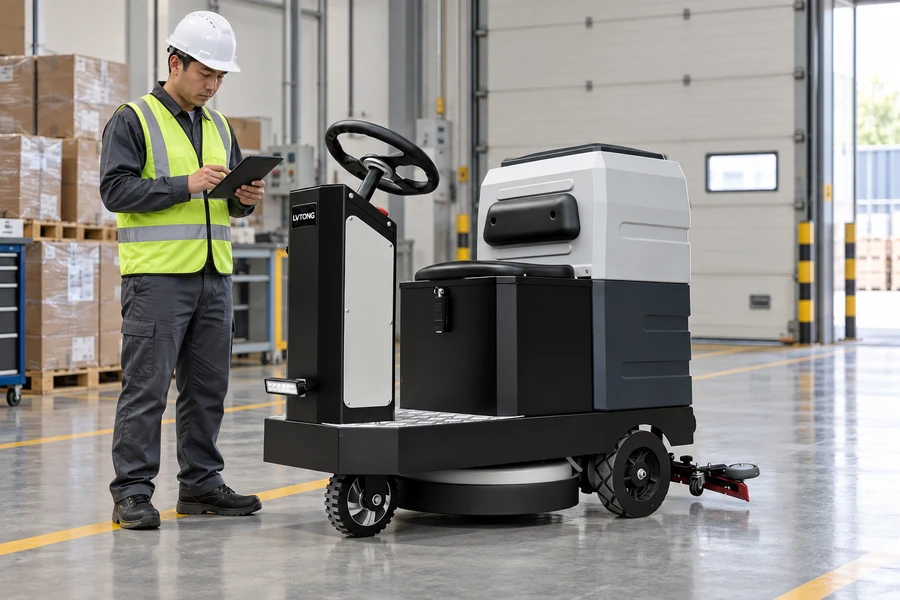
Release the Shipment Only After Pre-Shipment Checks
Factory inspection is separate from certification. A useful pre-shipment report names the model and serial, inspection date, test method and results, acceptance limit, instrument and calibration status, photos, pass/fail decision, and nonconformance disposition. Results should be tied to the serial-numbered machine, not a blank template or an unidentifiable sample. Our published floor scrubber inspection checklist shows the types of checks a report may contain; only the completed, serial-numbered report can show what was checked on the shipped machine. A report that is not tied to the shipped serial number, or that leaves a nonconformance unresolved, is not a basis for shipment release.
Red Flags That Put the Order on Hold
An isolated CE mark, a certificate image without a model reference, a UL/NRTL claim that cannot be traced to a certification record, or an unsettled responsible legal entity leaves the evidence chain incomplete. The order should remain on hold until the missing model, scope, verification reference, or legal identity is resolved.
Frequently Asked Questions
Can a Test Report Replace the Declaration of Conformity?
No. A test report records what was tested and against which criteria. A signed DoC is a separate legal statement for the identified product and applicable requirements.
Can One Compliance Package Cover Several Floor Scrubber Models?
Only when the DoC, reports, and certification scope expressly include the model family and ordered configurations. Similar appearance is not enough.
What If the Destination Market Changes or a Private Label Is Used?
A new destination reopens the route decision. A private-label sale can also change the responsible party, data plate, and document scope. Recheck the route, legal entity, and model evidence before production.
Does the Buyer Need the Complete Technical File?
Usually not every page. Agree which model-specific records will be supplied, which remain confidential, and who can release supporting evidence. The release path matters when an authority or project customer needs a record that is not part of the routine delivery package.
What documents should I request for floor scrubber CE certification?
CE is a conformity-marking route, not a standalone certificate. For a specific floor scrubber, request a model- and configuration-specific Declaration of Conformity, test evidence identifying the tested sample and criteria, and the relevant battery, charger, label, and data-plate records. Add any UL/NRTL record required by the destination market or project, and require the completed serial-numbered pre-shipment report before loading. For the general CE process, see Your Europe’s CE marking overview, but do not treat it as model approval.
Conclusion
If you need CE, UKCA, or UL/NRTL documentation for a specific market, use our contact form for a market-specific document review. Send the destination country, model, battery and charger configuration, OEM label requirements, and customer document list before ordering. This keeps the inquiry tied to the same market, model, and configuration that the review assessed.