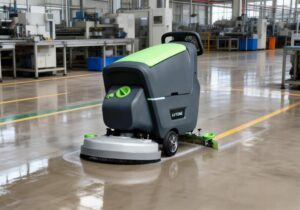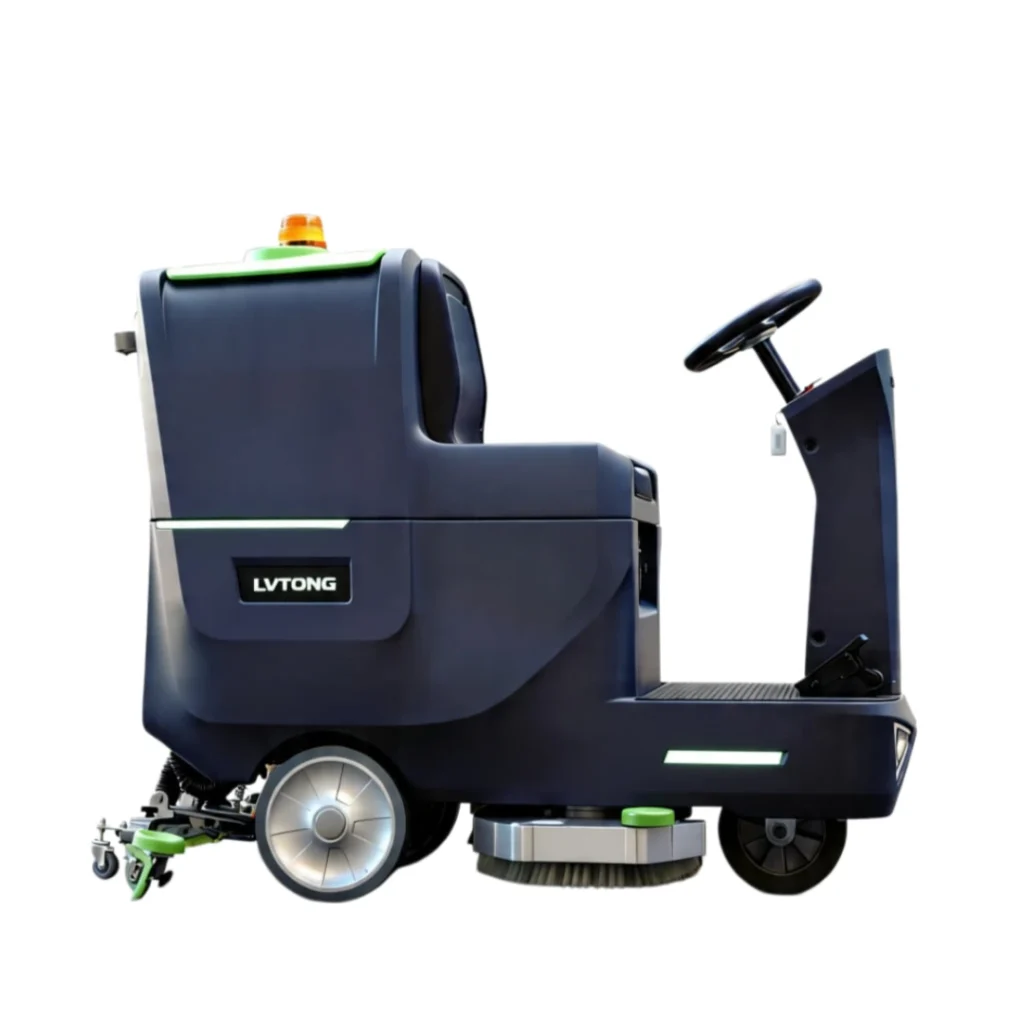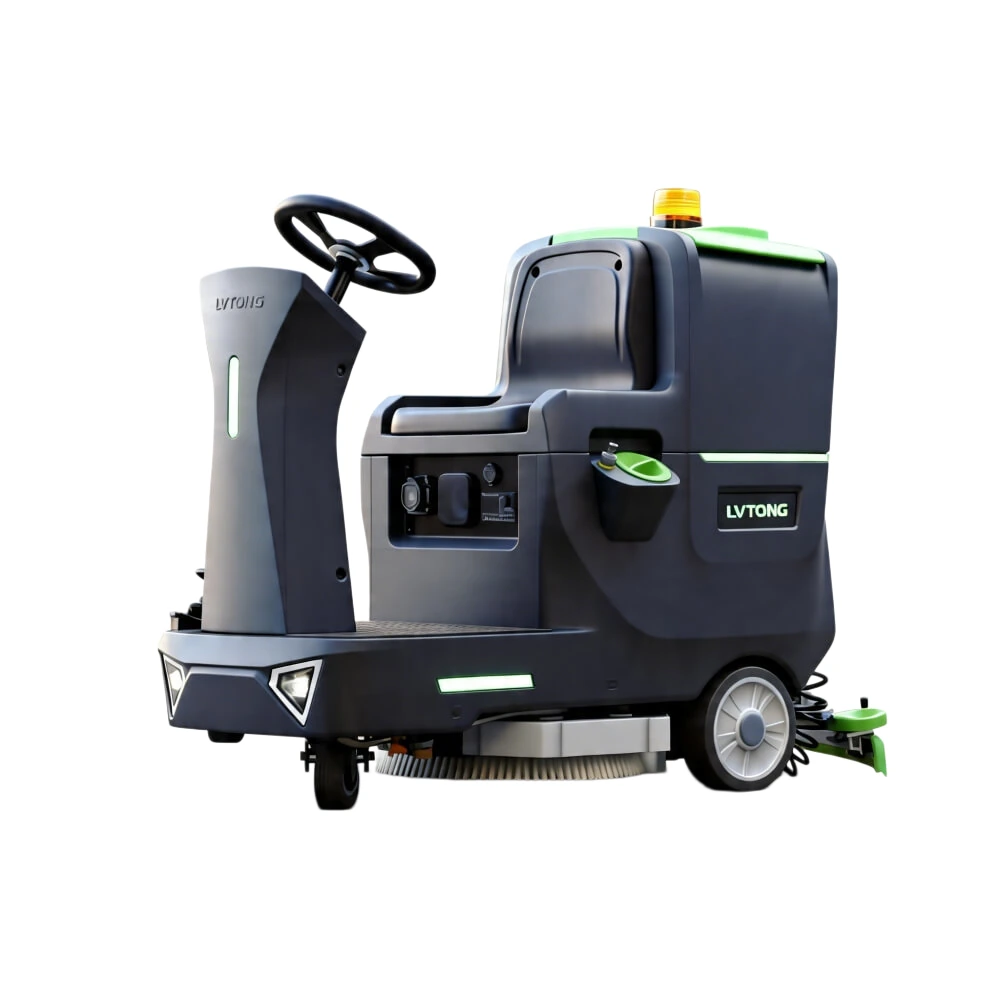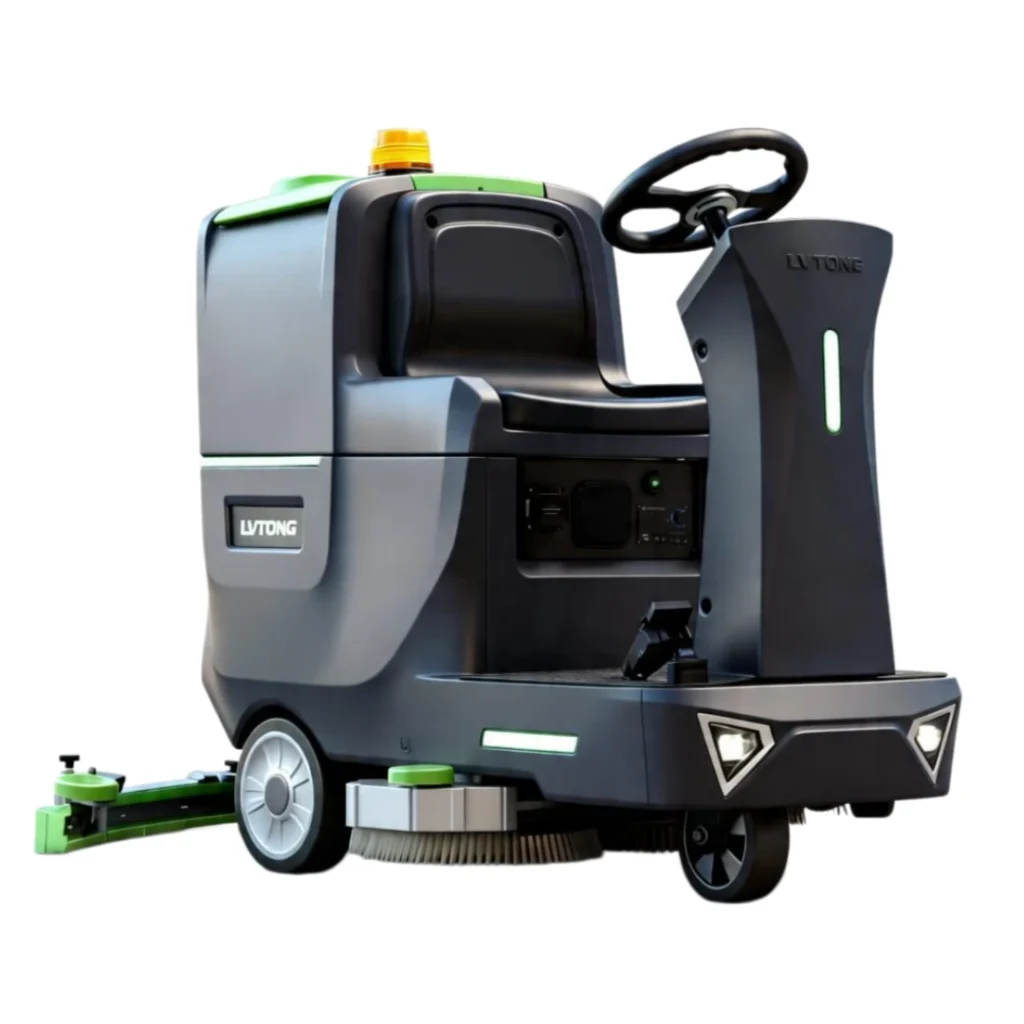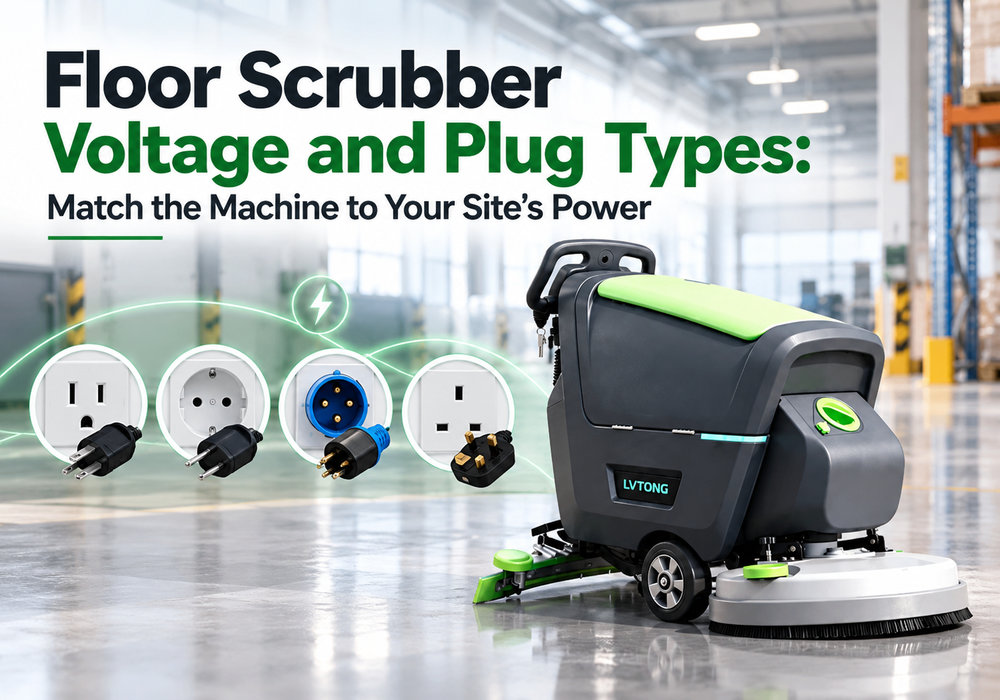


Most import surprises arrive by email, not by sea. A distributor orders a container of walk-behind scrubbers, they arrive in perfect condition, and the first customer plugs one in — nothing happens, because the charger was built for a different grid. Floor scrubber voltage, frequency and plug type are order-time specifications: handled at quotation they cost nothing, discovered at the loading dock they cost a charger swap and credibility with the end user. This guide covers the nameplate numbers, the plug families that matter, and the circuit questions behind a clean charge.
QUICK ANSWER
Floor scrubber voltage is decided at order time: the charger’s input range must match the destination grid — commonly 120V/60Hz in North America and 230V/50Hz in Europe, the UK, Australia and most of Asia — and the plug type must match the socket family used on site.
- Machines are usually sold with a charger, not with a fixed mains connection — the charger nameplate, not the machine body, holds the answer.
- Wide-range chargers (100–240V, 50/60Hz) simplify mixed-market stock; fixed-voltage chargers need one SKU per grid.
- Current draw rises as voltage falls, so a charger that runs on a 10A circuit at 230V may need a dedicated 20A circuit at 120V.
- Ask for the nameplate photo and the plug type in writing before the purchase order is confirmed.
The sections below cover grids, chargers, plugs, current draw, site conditions and a purchase-order checklist.
Why Voltage Is a Purchase Decision, Not a Shipping Detail
A floor scrubber without a matching charger is not a working machine — voltage belongs in the quotation, alongside price and lead time.
Electric motors and control electronics are built for a voltage band, and the charger for a specific mains input. Once the machine is crated, neither is easy to change: a charger swap is a new order with its own lead time, and field rewiring is a conversation no distributor wants with a customer. The mistake usually happens earlier and more quietly — two quotations compared on price and capacity, with the electrical line never written down.
Treat the electrical line as three fields filled before the order is placed: mains voltage, frequency, plug type. Everything else follows from those three, including pack sizing and charger matching, reviewed together in the battery selection dimensions guide.
The Two Big Grids: 120V/60Hz and 230V/50Hz
Two grids cover most of the world: 120V at 60Hz across North America, and 230V at 50Hz across Europe, the UK, Australia and most of Asia — with Japan and Brazil as the notable exceptions.
For a 220v floor scrubber buyer in Europe, 230V nominal at 50Hz is the design target; North American sites run 120V at 60Hz, with 208V or 240V for larger equipment. The floor scrubber 50hz 60hz question matters most for mains-driven motors and simple transformers; modern switch-mode chargers typically accept both, so the label — not the old rule of thumb — decides.
| Region | Nominal voltage | Frequency | Typical plug family |
|---|---|---|---|
| United States, Canada, Mexico | 120V (208/240V available) | 60Hz | NEMA 5-15 / 5-20 (Type A/B) |
| European Union | 230V | 50Hz | Type C / Type F (Schuko) |
| United Kingdom, Ireland | 230V | 50Hz | Type G (BS 1363, fused) |
| Australia, New Zealand | 230–240V | 50Hz | Type I (AS/NZS 3112) |
| Japan | 100V | 50Hz east / 60Hz west | Type A / Type B |
| Brazil | 127V / 220V | 60Hz | Type N |
| India, Gulf states, Southeast Asia | 220–240V | 50Hz | Type C/D/M, Type G (Gulf) |
Japan earns its own line: 100V is the lowest common mains voltage in major markets, and the country splits between 50Hz and 60Hz. A Japan specification needs a charger rated down to 100V and Type A or B sockets — a 230V unit will not be rescued by an adapter.
Charger Input Range: Fixed-Voltage vs Wide-Range
Ask one question first: is the floor scrubber charger voltage fixed to a single grid, or rated 100–240V across both? The answer decides your SKU count.
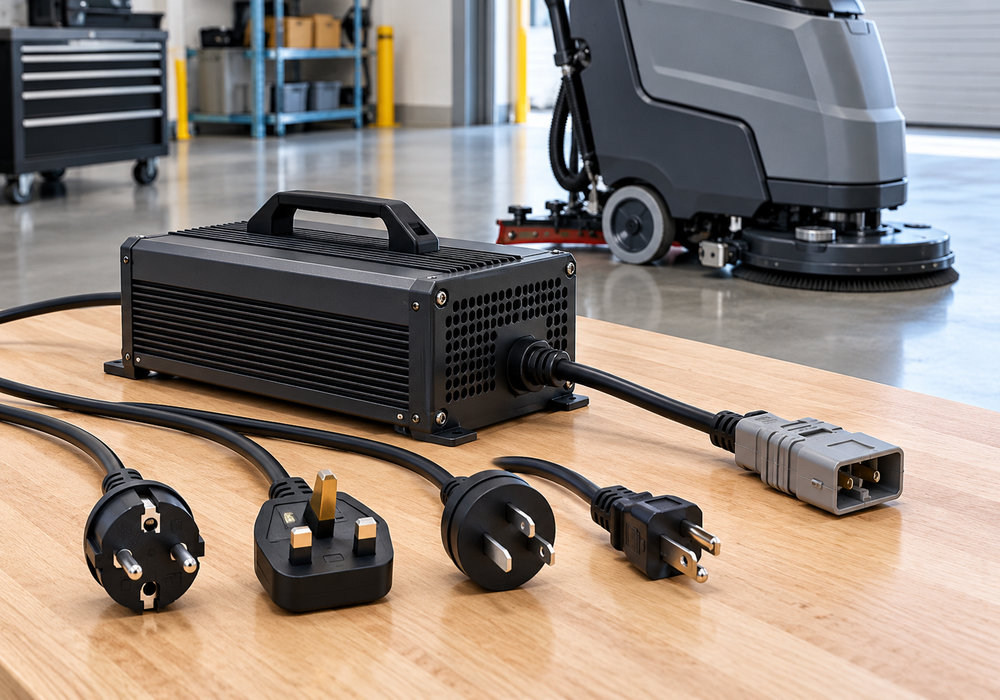
Small chargers are often wide-range: a switch-mode unit rated 100–240V, 50/60Hz needs only a plug change between markets — ideal for distributors holding stock for several countries. Larger ride-on chargers, with higher output currents and harder heat management, are more often built for one input band, with separate 120V and 230V versions. Neither approach is wrong; assuming which one you have is the trap.
Verification is a photograph: the charger nameplate showing input voltage, frequency, output voltage and current, plus the plug fitted. Check that the input range brackets your site’s voltage under load. A label reading 220–240V is not a dual-market charger; it is a European charger that will not run in Ohio.
Plug Types by Market and What to Specify
The floor scrubber plug type is the cheapest part of the order and the most common reason a new machine cannot be demonstrated on day one.
Plugs are standardized by family, not by country alone. Schuko (Type F) fits most continental sockets; the UK uses fused Type G; Australia and New Zealand use Type I; North America uses NEMA 5-15 or 5-20 by circuit rating; Japan uses Type A/B at 100V; Brazil uses Type N. Gulf markets commonly accept Type G, while India mixes C, D and M. A 220v floor scrubber arriving with a Schuko plug may work through an adapter, but adapters are a maintenance liability.
Specify three things in writing: plug type by standard name (not “European plug”), cord length, and moulded versus field-wired. For fleet orders ask for a plug mix per destination — otherwise cross-border resellers re-terminate cords in their own warehouse, which looks unprofessional to the end customer.
Single-Phase, Current Draw and Circuit Capacity
Lower voltage means higher current for the same charger output — a ride-on charger that is modest at 230V can demand a dedicated circuit at 120V.
Almost all scrubber chargers run on single-phase supply, but the current they pull depends on both output power and mains voltage. The relationship is simple:
input current (A) ≈ charger output power (W) ÷ (mains voltage (V) × efficiency)
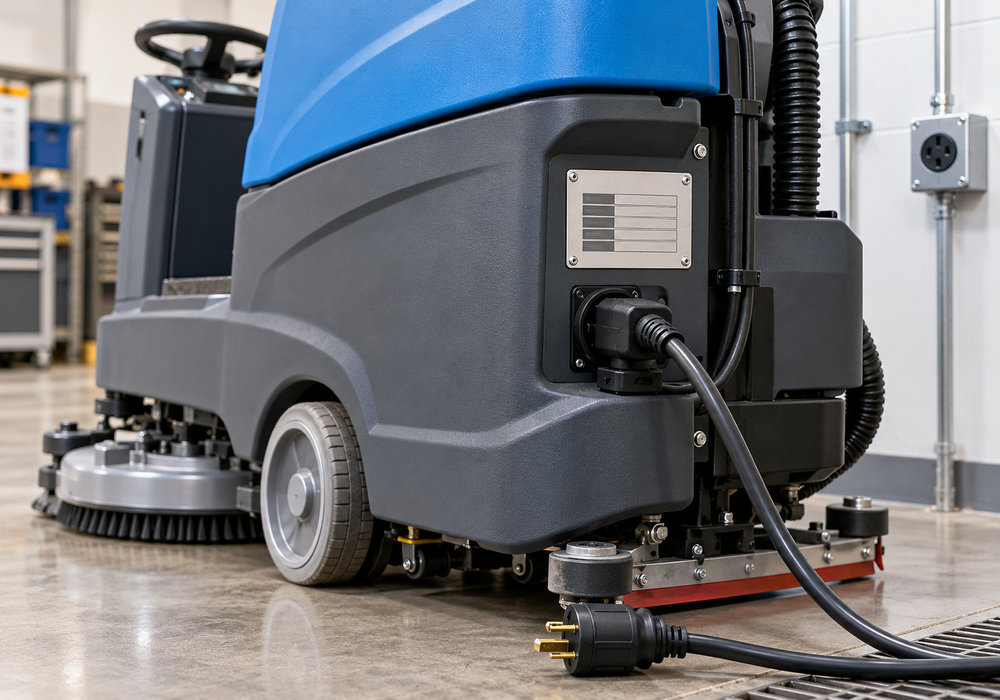
Take a 48V ride-on pack charged at 25A: output is roughly 1.5kW. At 230V and 90 percent efficiency that is about 7A — comfortable on a normal circuit. At 120V the same job pulls roughly 14A, at the practical limit of a 15A branch circuit once continuous-load derating applies. That is why the same ride-on scrubber that charges happily in Europe trips breakers in North America when it shares a circuit.
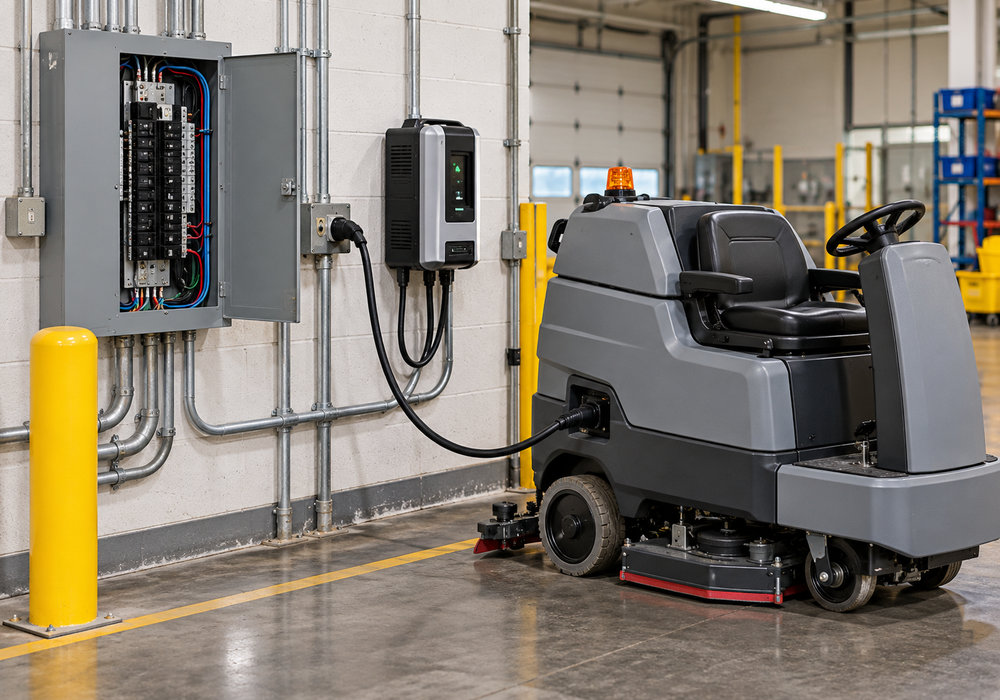
The practical answer is a commissioning check: charger input current against breaker and wiring rating, then a decision on a dedicated circuit. For multi-machine bays, add the chargers’ currents and compare with panel capacity before the electrician arrives.
Generators, Extension Cords and Voltage Drop
A generator that “runs the lights” is not automatically able to run a charger — continuous rating, waveform quality and cord length all decide the outcome.
Charging from a generator is common on construction sites. Size on continuous rating, not peak, and leave headroom above charger input power: chargers are steady loads, and a generator near its limit sags in voltage, which some chargers read as a fault and refuse to start. Poor waveform quality triggers the same refusal even when the rating looks adequate.
Extension cords introduce voltage drop, which grows with length and current; a long thin cord at 120V can push the charger outside its input window or overheat. Prefer the shortest heavier-gauge cord, keep cords off wet floors, and use residual-current protection — RCD at 230V, GFCI in North America. US workplace rules sit in eCFR 1910 Subpart S, and comparable local rules apply elsewhere; your electrician’s sign-off matters more than any guide.
Mixed-Voltage Fleets and Dealer Stock
If you resell across grids, voltage becomes a SKU dimension — decide it per destination market before you commit to container quantities.
A distributor covering both 230V and 120V markets has three options: wide-range chargers with a plug change, two fixed-voltage variants, or one grid with a charger swap for cross-border resale. The first is cleanest for stock flexibility, the second often cheaper per unit, the third a commercial call. What never works is discovering the mix after the container is on the water.
Label each carton with voltage, frequency and plug type, keep the nameplate photo on file, and brief sales so “will it work in my building” is answered from a document. Distributors setting up regional stock through the distribution program should settle this dimension in the first planning call, alongside the market’s certification path.
What to Put in the Purchase Order
Six lines in the purchase order prevent almost every electrical mismatch: voltage, frequency, plug type, charger model, cord length and circuit requirement.
Ask the supplier to confirm each line in writing with the nameplate photo attached; the table below fits in an email and costs less than one service call.
| Field | What to Write | Why It Matters |
|---|---|---|
| Mains voltage | e.g. 230V nominal, tolerance ±10% | Sets charger input requirement |
| Frequency | 50Hz or 60Hz (or dual) | Confirms charger and any mains motor compatibility |
| Plug type | Standard name, e.g. Type F, Type G, NEMA 5-15 | Decides whether the machine can be demonstrated on arrival |
| Charger model and input range | Model code + nameplate photo | Verifies what was actually built |
| Cord length | Metres, measured from charger to plug | Avoids extension cords in daily use |
| Circuit requirement | Rated input current and recommended breaker | Prevents breaker tripping at the charging bay |
For a market-specific confirmation of charger input range and plug type, send the destination country and site voltage through the contact page before the order is released.
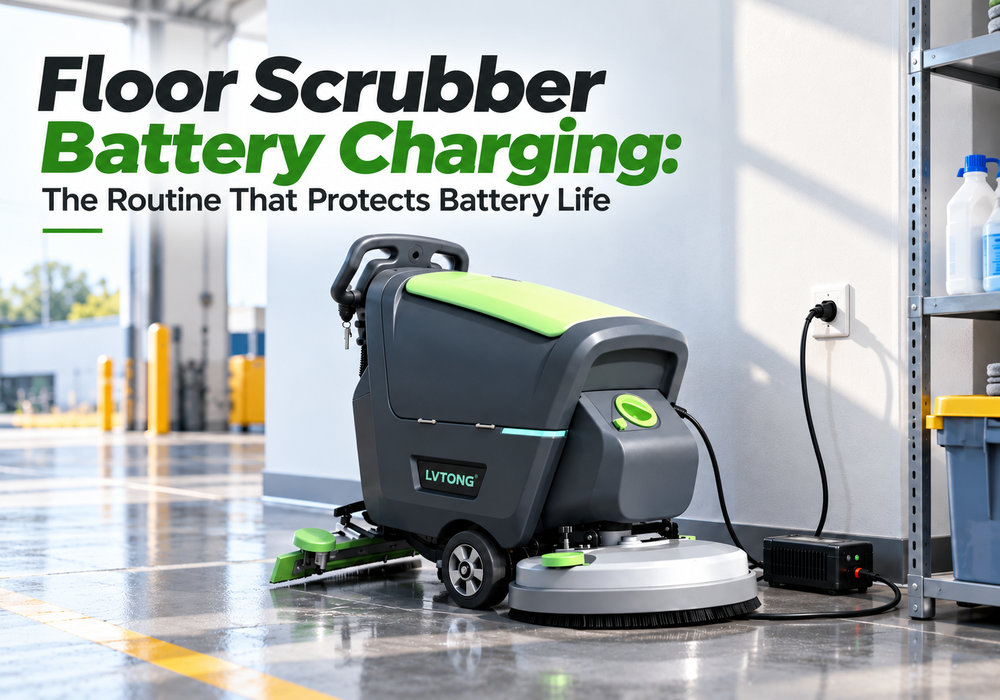
Once the machine is on site, the charging routine takes over: the daily sequence, charging bay setup and log are covered in the floor scrubber battery charging guide. Getting the interface right at order time is what lets that routine start on day one.
When Site Power, Not the Machine, Is the Problem
Four site faults explain most “the charger is broken” calls: voltage sag, a shared circuit, a tripped protective device, and an adapter that does not make solid contact.
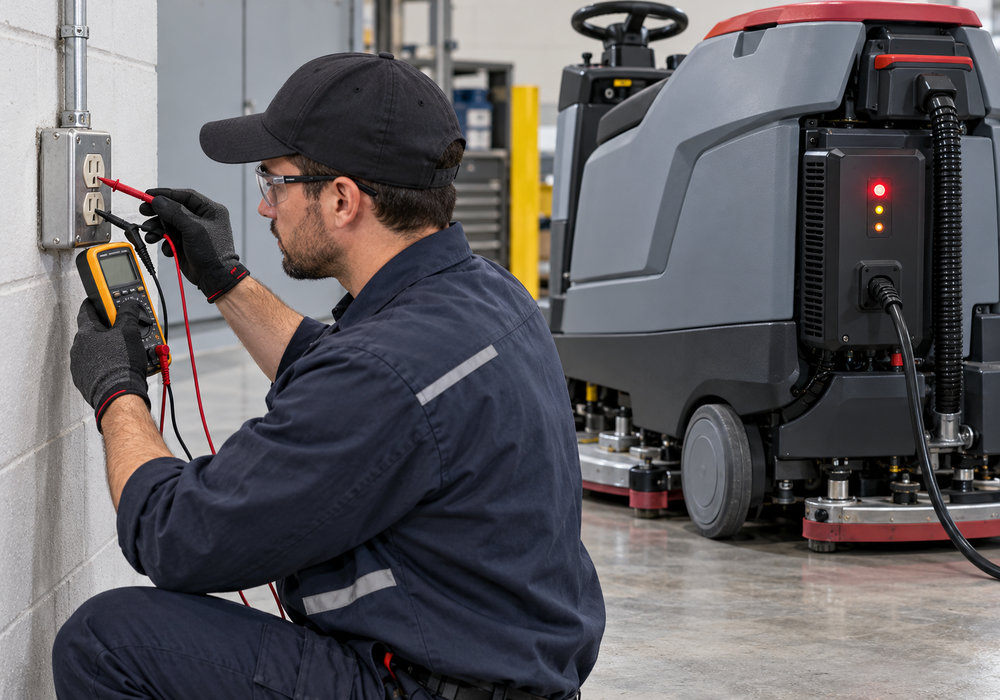
Start with the measurement. A socket reading 230V at rest and 205V under load has a supply problem, not a charger problem. Then check what shares the circuit: a kettle, a compressor and two chargers on one breaker will trip on a hot afternoon. Confirm the protective device type and condition, and inspect adapters and leads for heat marks.
If a fault code appears at the expected voltage, photograph display and nameplate together and send both before opening anything — most makers diagnose from those two images, and the warranty stays intact. Charging-bay electrical work should be signed off by a qualified electrician against local rules; UL marks, IEC 60335-2-72 for floor treatment machines and the plug configurations published by NEMA are the references buyers cite in specifications.
Floor Scrubber Voltage FAQs
Will a 110v floor scrubber work in Europe?
Not directly. European sites supply 230V at 50Hz, and a machine built for 120V needs a matching transformer or a different charger. Buying a 230V charger with the machine is almost always cheaper and safer than adding a site transformer.
Can I just change the plug to use a machine in another country?
Only if the charger is rated for that voltage and frequency. A new plug does not change what the electronics expect, and it can void the warranty and the electrical approval.
Do wide-range chargers cover every market?
Most cover 100–240V at 50/60Hz, handling Japan through Europe and North America, but the plug still changes and current still rises at low voltage. Confirm both before ordering.
How much current does a scrubber charger draw?
Roughly the charger’s output power divided by mains voltage and efficiency. A 1.5kW charge is about 7A at 230V and about 14A at 120V — the reason North American charging bays often need a dedicated circuit.