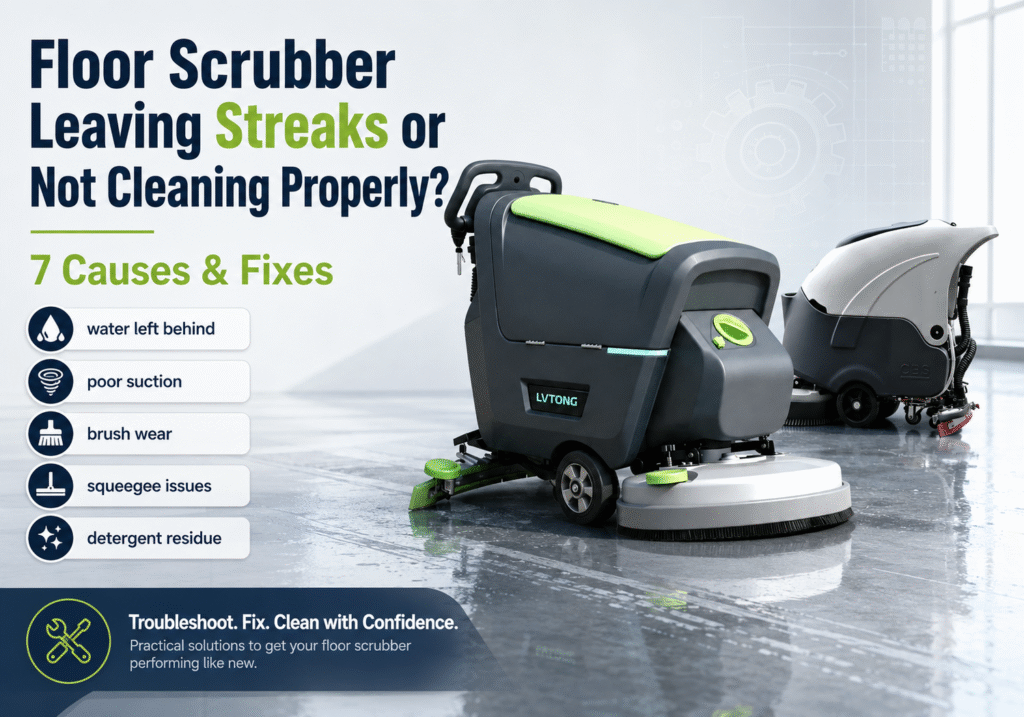
Choosing between a walk behind scrubber and a ride-on scrubber is an important decision for warehouses, factories, supermarkets, parking areas, schools, workshops, and large commercial facilities.
Both machines are designed to scrub and dry floors more efficiently than manual cleaning. They use brushes or pads, water, detergent, and a recovery system to remove dirt, grime, stains, and wastewater from the floor. However, they are not used in exactly the same way.
A walk-behind scrubber is usually better for smaller areas, narrow aisles, tight corners, and facilities with limited budgets. A ride-on scrubber is usually better for large facilities, wide open spaces, long cleaning routes, and sites that need higher cleaning productivity with less operator fatigue.
This guide compares walk-behind and ride-on scrubbers by cleaning area, aisle width, efficiency, cost, operator fatigue, floor type, and warehouse cleaning needs.
Quick Answer
A walk-behind scrubber is better for small and medium areas, narrow aisles, lower budgets, and facilities that need flexible cleaning. A ride-on scrubber is better for large facilities, wide open spaces, long cleaning routes, and users who need higher productivity with less operator fatigue.
For many facilities, the best choice depends on floor area, layout, cleaning frequency, labor cost, and how much open space needs to be cleaned every day.

What Is a Walk-Behind Scrubber?
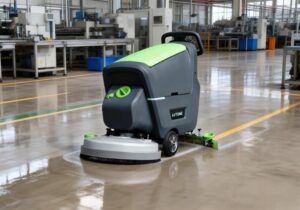
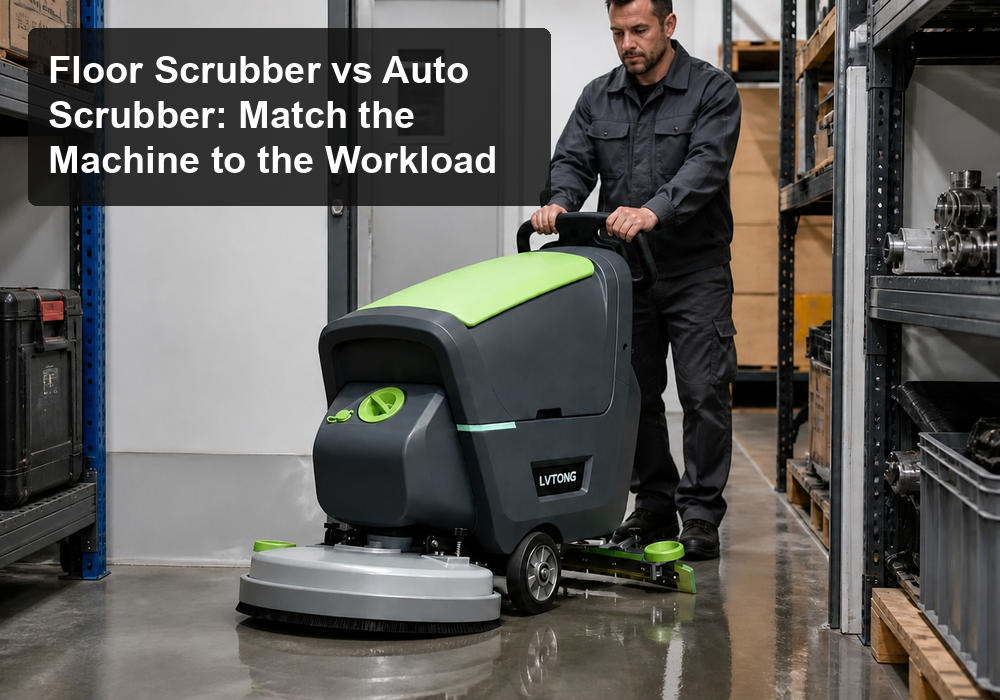
A walk-behind scrubber is a floor cleaning machine that the operator walks behind while guiding the machine across the floor. It uses a rotating brush or pad to scrub the surface, then uses a squeegee and vacuum recovery system to collect dirty water.
Walk-behind scrubbers are commonly used in:
- Small warehouses
- Workshops
- Supermarkets
- Schools
- Offices
- Narrow aisles
- Equipment rooms
- Storage areas
- Retail spaces
- Small industrial facilities
A walk-behind scrubber is compact, flexible, and easier to move through tight spaces. It is usually the better option when the cleaning area is not very large or when the facility has many corners, racks, obstacles, or narrow routes.
What Is a Ride-On Scrubber?
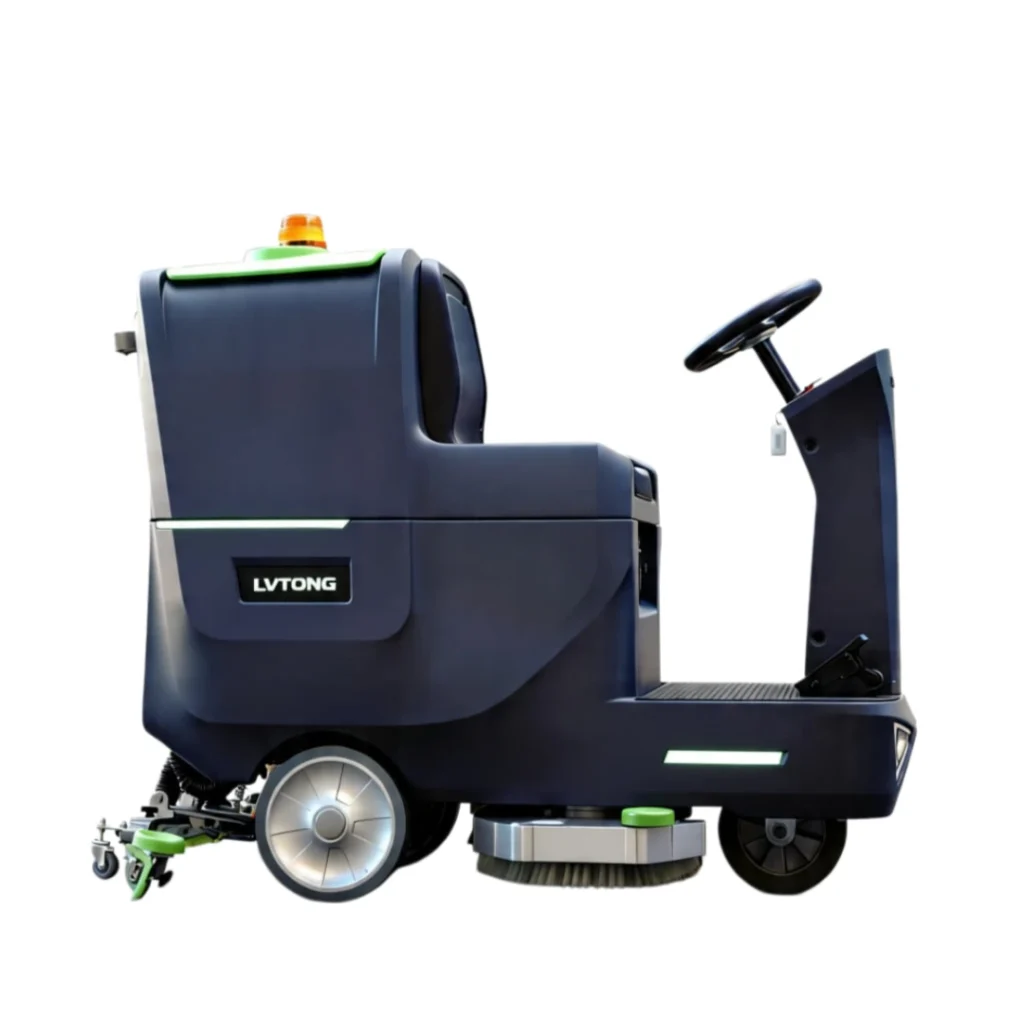
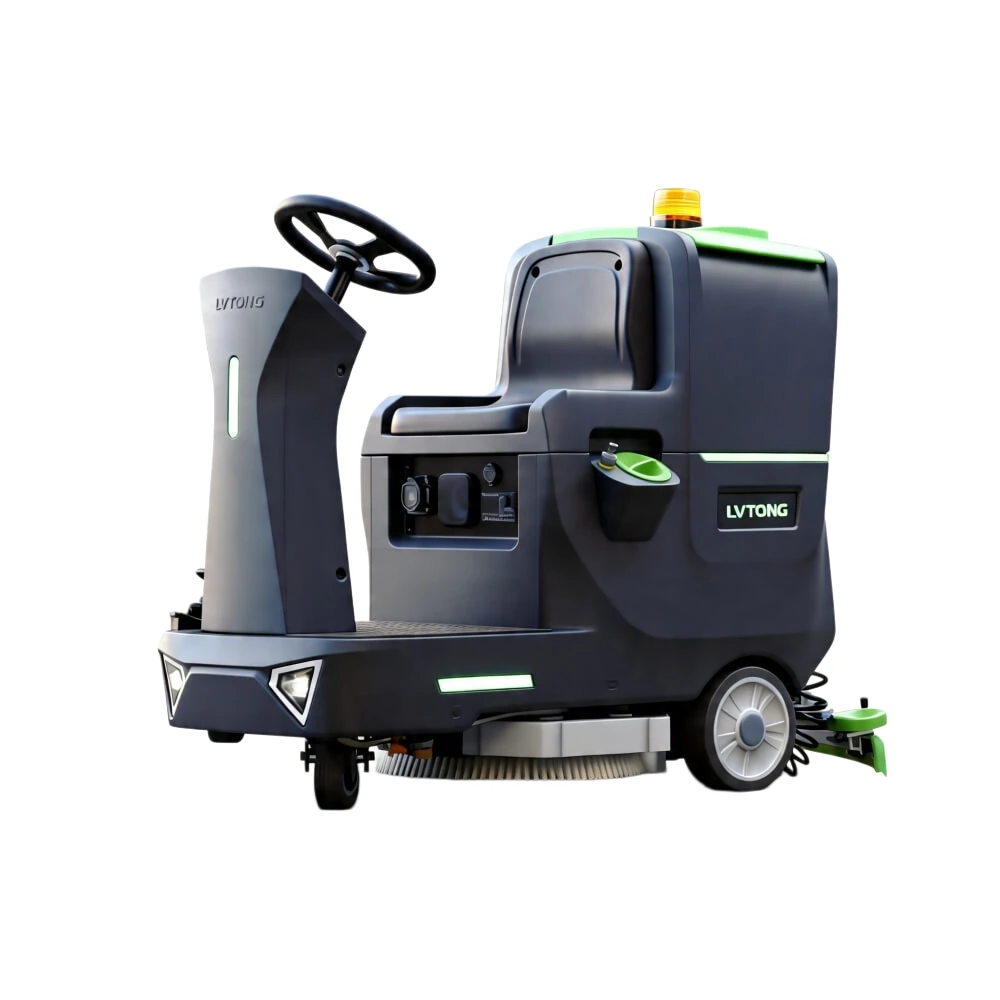
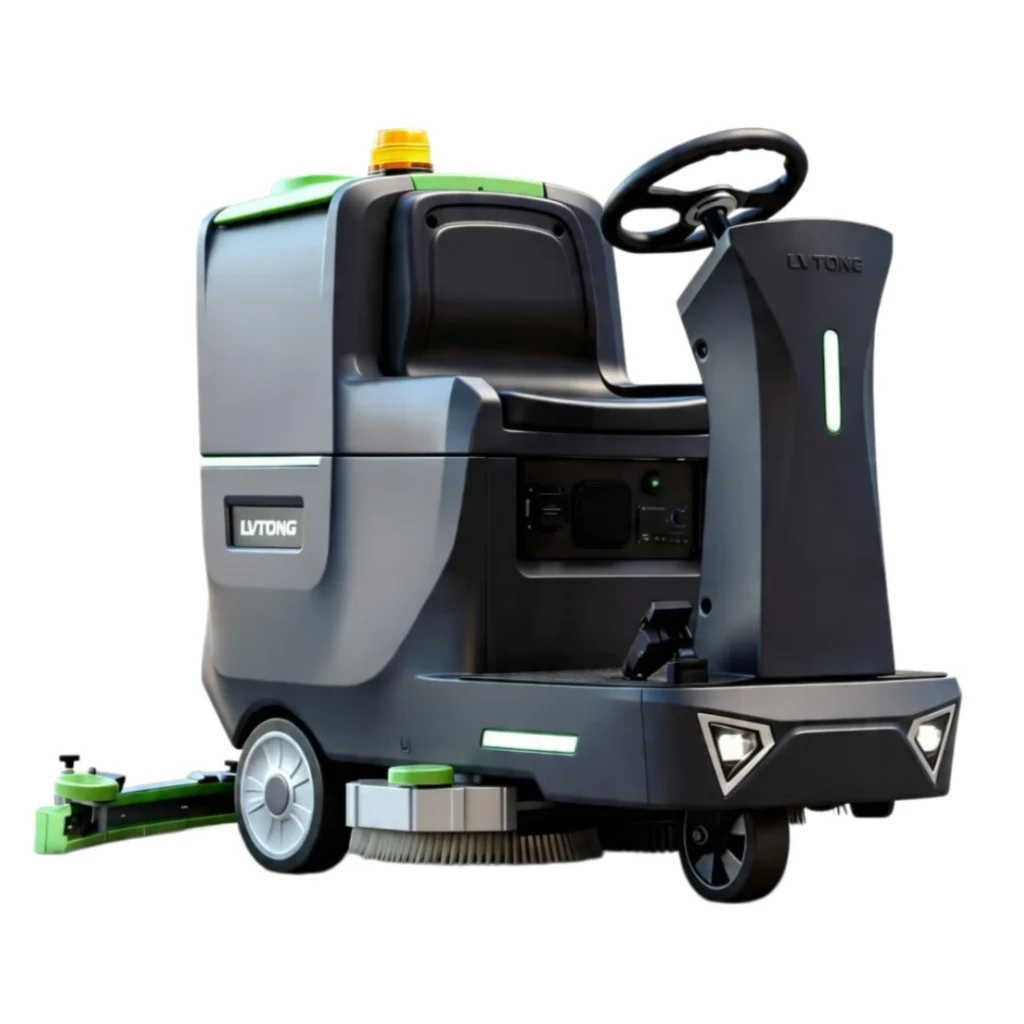
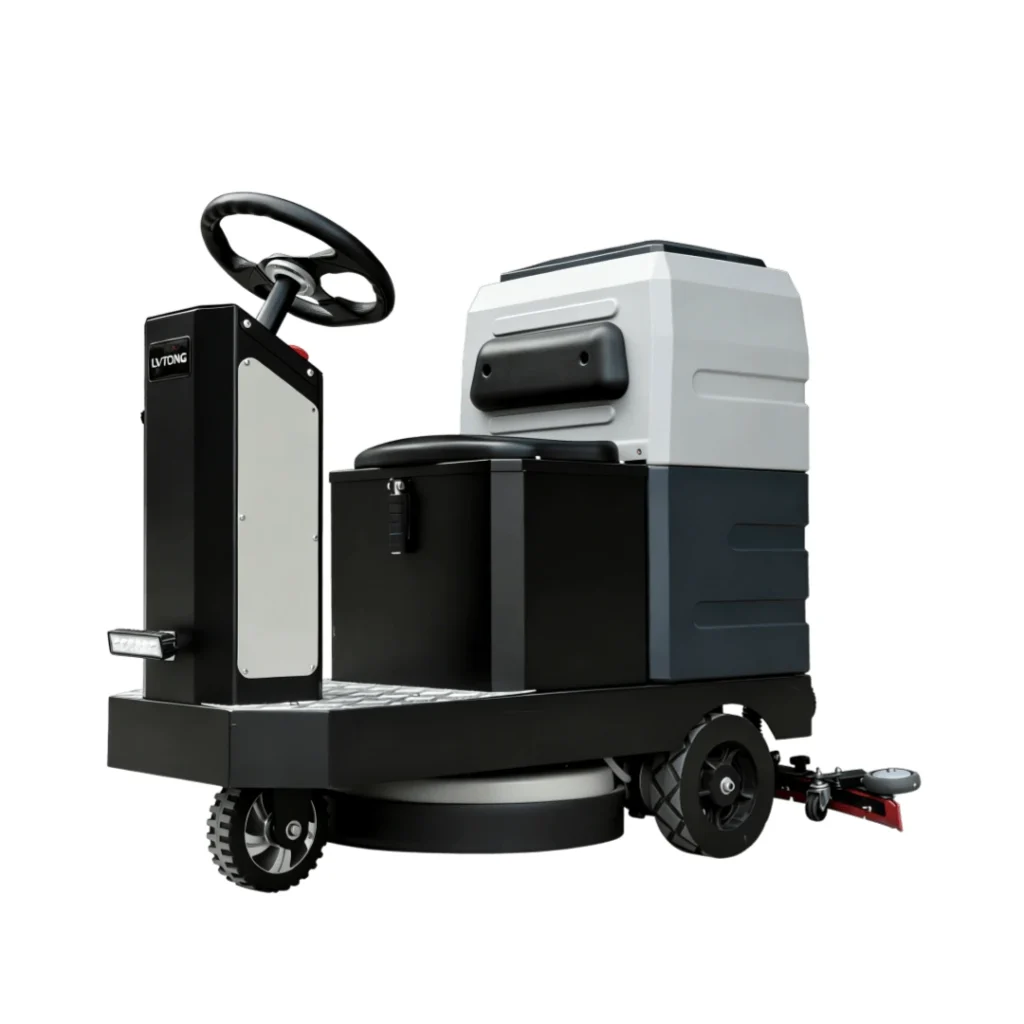
A ride-on scrubber is a floor scrubber that allows the operator to sit and drive the machine. It works in a similar way to a walk-behind scrubber, but it usually has a wider cleaning path, larger water tanks, stronger scrubbing pressure, and higher coverage per hour.
Ride-on scrubbers are commonly used in:
- Large warehouses
- Factories
- Distribution centers
- Parking areas
- Airports
- Shopping malls
- Logistics facilities
- Large supermarkets
- Industrial plants
- Public facilities
A ride-on scrubber is usually selected when the floor area is large, cleaning routes are long, and daily cleaning needs to be completed faster with less physical effort.
Walk-Behind Scrubber vs Ride-On Scrubber: Key Differences
The main difference is how the operator uses the machine. With a walk-behind scrubber, the operator walks behind the equipment. With a ride-on scrubber, the operator sits and drives.
This difference affects cleaning efficiency, labor intensity, turning radius, cleaning speed, water tank size, and total operating cost.
| Factor | Walk-Behind Scrubber | Ride-On Scrubber |
|---|---|---|
| Best for | Small and medium areas | Large facilities and open spaces |
| Operator position | Operator walks behind the machine | Operator sits and drives |
| Aisle suitability | Better for narrow aisles and tight spaces | Better for wide aisles and open routes |
| Cleaning efficiency | Lower to medium | Higher |
| Operator fatigue | Higher because the operator walks | Lower because the operator sits |
| Initial cost | Lower | Higher |
| Turning radius | Smaller | Larger |
| Training difficulty | Easier to learn | Requires safe driving training |
| Tank capacity | Smaller | Larger |
| Ideal users | Small warehouses, stores, workshops | Large warehouses, factories, parking areas |
Pros and Cons of Walk-Behind Scrubbers
Advantages of Walk-Behind Scrubbers
A walk-behind scrubber has several practical advantages for small and medium facilities.
1. Better maneuverability
Walk-behind scrubbers are easier to use in narrow aisles, small rooms, storage areas, and spaces with many obstacles. If your facility has tight corners or limited turning space, a walk-behind scrubber is often more practical.
2. Lower initial cost
Compared with ride-on scrubbers, walk-behind models usually have a lower purchase cost. This makes them suitable for smaller businesses or facilities with limited cleaning budgets.
3. Easier operation
Most operators can learn to use a walk-behind scrubber quickly. The controls are usually simple, and the machine is easier to manage in compact areas.
4. Suitable for detailed cleaning
Walk-behind scrubbers are useful for cleaning along walls, racks, doorways, equipment edges, and congested areas where larger machines may not fit.
5. Easier storage
Because walk-behind scrubbers are smaller, they require less storage space. This is useful for facilities with limited equipment storage areas.
Disadvantages of Walk-Behind Scrubbers
1. Lower productivity in large areas
A walk-behind scrubber is not the best choice for very large open floors. The operator must walk the entire route, which limits cleaning speed and daily coverage.
2. Higher operator fatigue
Because the operator walks behind the machine, fatigue can increase during long cleaning shifts. This may reduce productivity in large warehouses or factories.
3. Smaller water tanks
Walk-behind scrubbers usually have smaller solution and recovery tanks. This means more frequent refilling and wastewater emptying during long cleaning tasks.
4. Less suitable for long routes
If a facility requires long continuous cleaning routes, a ride-on scrubber is usually more efficient.
Pros and Cons of Ride-On Scrubbers
Advantages of Ride-On Scrubbers
A ride-on scrubber is designed for higher productivity in larger facilities.
1. Higher cleaning efficiency
Ride-on scrubbers usually have wider cleaning paths and larger tanks, allowing them to clean more floor area per hour. This is useful for warehouses, factories, parking areas, and distribution centers.
2. Lower operator fatigue
The operator sits while driving the machine, reducing physical effort. This is important when cleaning large areas every day.
3. Larger tank capacity
Ride-on scrubbers usually have larger clean water and recovery tanks. Larger tanks reduce downtime caused by refilling and wastewater emptying.
4. Better for wide open spaces
If your facility has large open floors, long aisles, or wide routes, a ride-on scrubber can complete the work faster than a walk-behind model.
5. Suitable for frequent daily cleaning
Facilities with high traffic, forklift movement, dust, grime, or tire marks often benefit from the higher productivity of ride-on scrubbers.
Disadvantages of Ride-On Scrubbers
1. Higher initial cost
Ride-on scrubbers usually cost more than walk-behind models. The investment may be justified for large facilities, but it may not be necessary for small areas.
2. Larger turning radius
Ride-on scrubbers need more space to turn. They may not be suitable for narrow aisles, crowded storage areas, or facilities with many obstacles.
3. More training required
Operators need basic driving and safety training before using a ride-on scrubber regularly.
4. More storage space required
Because ride-on scrubbers are larger, they require more storage and charging space.
Which Scrubber Is Better for Warehouse Cleaning?
For warehouse cleaning, the right choice depends mainly on floor area, aisle width, traffic level, and cleaning frequency.
A walk-behind scrubber is usually better for small warehouses, narrow aisles, loading corners, storage rooms, and areas with frequent obstacles. It is easier to maneuver and more suitable for detailed cleaning.
A ride-on scrubber is usually better for large warehouses, distribution centers, wide aisles, and open floors. It helps reduce operator fatigue and improves cleaning productivity when the cleaning route is long.
| Warehouse Condition | Better Choice | Reason |
|---|---|---|
| Narrow aisles | Walk-behind scrubber | Easier to maneuver |
| Small warehouse | Walk-behind scrubber | Lower cost and compact size |
| Large open floor | Ride-on scrubber | Higher productivity |
| Long cleaning routes | Ride-on scrubber | Lower operator fatigue |
| Limited budget | Walk-behind scrubber | Lower upfront cost |
| Frequent daily cleaning | Ride-on scrubber | Saves labor time |
| Mixed layout | Both types | Use ride-on for open areas and walk-behind for tight spaces |
For facilities with both large open areas and tight corners, using both types can be practical. A ride-on scrubber can handle the main floor, while a walk-behind scrubber can clean narrow aisles, edges, small rooms, and congested zones.
Choose by Cleaning Area and Aisle Width
Floor area is one of the most important factors when choosing between a walk-behind scrubber and a ride-on scrubber.
Small Areas
For small areas, a walk-behind scrubber is usually enough. It is easier to control, costs less, and can clean around furniture, racks, equipment, and narrow passages.
Typical examples include:
- Small warehouses
- Retail stores
- Workshops
- School corridors
- Small supermarkets
- Equipment rooms
Medium Areas
For medium-sized facilities, the choice depends on layout. If the floor has many aisles and obstacles, a walk-behind scrubber may still be the better choice. If the area is more open, a compact ride-on scrubber may improve efficiency.
Large Areas
For large warehouses, factories, parking areas, and distribution centers, a ride-on scrubber is usually more efficient. It can clean more floor area per hour and reduce operator fatigue during long shifts.
Narrow Aisles
Walk-behind scrubbers are better for narrow aisles because they have smaller machine dimensions and a smaller turning radius.
Wide Open Spaces
Ride-on scrubbers are better for wide open spaces because they offer higher coverage and require less physical effort from the operator.
Choose by Cleaning Efficiency
Cleaning efficiency depends on cleaning width, travel speed, tank capacity, floor condition, and how much time is lost during turning, refilling, and wastewater dumping.
Walk-behind scrubbers are efficient in compact spaces, but their productivity decreases when used in very large areas.
Ride-on scrubbers are more efficient in large open areas because they usually have:
- Wider cleaning paths
- Larger solution tanks
- Larger recovery tanks
- Higher cleaning speed
- Lower operator fatigue
- Longer continuous operation
However, the most efficient machine is not always the largest one. A large ride-on scrubber may be inefficient in a narrow or congested facility. The right scrubber should match the real floor layout.
Choose by Cost and ROI
Cost is not only the purchase price. Buyers should also consider labor time, cleaning frequency, maintenance, consumables, downtime, and machine lifespan.
Walk-Behind Scrubber Cost Advantages
A walk-behind scrubber usually has a lower upfront cost. It is a practical choice when:
- The cleaning area is small or medium
- Cleaning is not required all day
- The budget is limited
- The facility has many tight spaces
- Labor cost is not the main problem
Ride-On Scrubber Cost Advantages
A ride-on scrubber usually has a higher upfront cost, but it may reduce long-term labor cost in large facilities. It is worth considering when:
- The cleaning area is large
- Cleaning is required every day
- Labor cost is high
- Operators spend too much time walking
- Large open floors need fast cleaning
Simple ROI Logic
If a ride-on scrubber reduces cleaning time significantly every day, the labor savings may justify the higher purchase cost. If the facility is small and cleaning time is already manageable, a walk-behind scrubber may be more cost-effective.


Choose by Operator Fatigue and Safety
Operator fatigue is often underestimated when choosing cleaning equipment.
With a walk-behind scrubber, the operator walks behind the machine for the entire cleaning route. This is manageable in small areas, but it can become tiring in large facilities or long shifts.
With a ride-on scrubber, the operator sits while cleaning. This reduces physical effort and helps maintain productivity during longer cleaning tasks.
Safety also matters. Ride-on scrubbers need more driving awareness, especially around people, forklifts, racks, and corners. Walk-behind scrubbers are easier to control in congested areas, but operators still need training on turning, water recovery, squeegee use, and safe operation.
Choose by Floor Type and Dirt Level
Both walk-behind and ride-on scrubbers can clean many hard floor surfaces, including concrete, epoxy, tile, PVC, and sealed industrial floors.
The right choice depends on dirt level and cleaning frequency.
| Floor or Dirt Condition | Better Choice | Reason |
|---|---|---|
| Light daily dust | Walk-behind or ride-on scrubber | Both can handle routine cleaning |
| Narrow epoxy floor areas | Walk-behind scrubber | More controlled movement |
| Large concrete floors | Ride-on scrubber | Higher coverage |
| Heavy forklift tire marks | Ride-on scrubber | Higher productivity and stronger scrubbing options |
| Corners and equipment edges | Walk-behind scrubber | Better access |
| Parking areas | Ride-on scrubber | Better for large floor areas |
| Mixed dirt and wet residue | Depends on layout | Choose based on floor size and recovery needs |
For heavy oil, grease, or sticky residue, pre-treatment may be needed before scrubbing.
When Should You Choose a Walk-Behind Scrubber?
Choose a walk-behind scrubber if:
- The cleaning area is small or medium
- Aisles are narrow
- The layout is crowded
- The facility has many corners or obstacles
- The budget is limited
- Operators need a machine that is easy to learn
- Storage space is limited
- Detailed cleaning is more important than maximum speed
A walk-behind scrubber is often the practical choice for compact facilities and areas where maneuverability matters more than high coverage.
When Should You Choose a Ride-On Scrubber?
Choose a ride-on scrubber if:
- The cleaning area is large
- The facility has wide open floors
- Cleaning routes are long
- Cleaning is required daily or frequently
- Operator fatigue is a concern
- Labor cost is high
- Faster cleaning is required
- Larger water tanks are needed
- The facility has enough turning and storage space
A ride-on scrubber is usually the better option when productivity and labor savings are more important than the initial purchase cost.
Can One Facility Use Both Types?
Yes. Many facilities use both walk-behind and ride-on scrubbers.
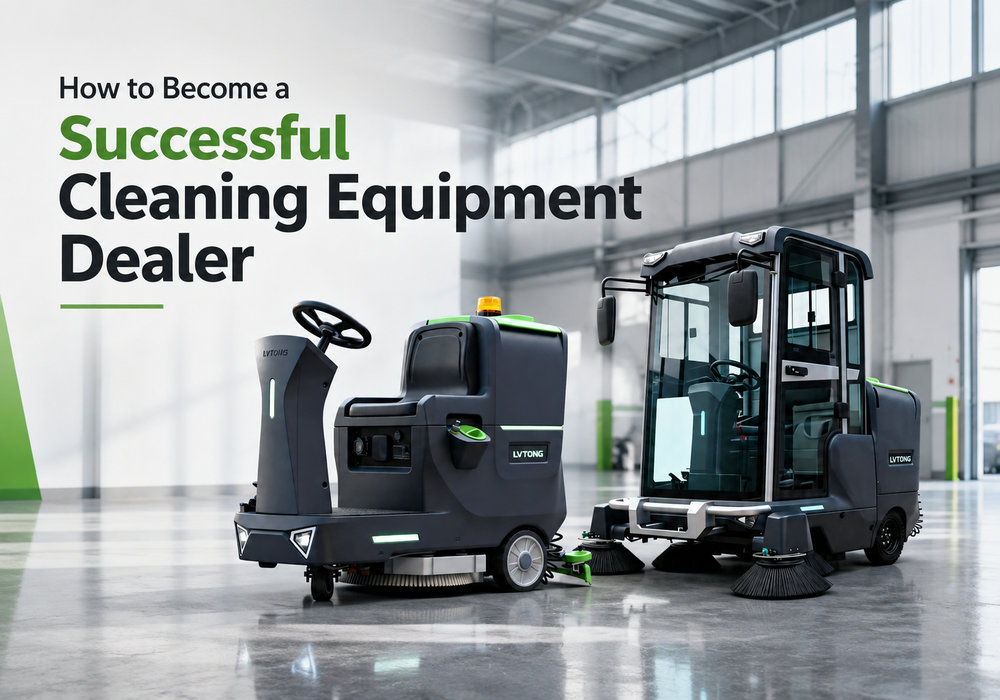
This combination works well when a facility has both large open areas and narrow or congested spaces. The ride-on scrubber can clean the main floor, while the walk-behind scrubber can clean corners, aisles, small rooms, loading areas, and areas around equipment.
This approach is common in:
- Warehouses
- Factories
- Logistics centers
- Shopping malls
- Airports
- Large supermarkets
- Parking facilities
Using both machines can improve cleaning efficiency without forcing one machine to handle every type of area.
Walk-Behind Scrubber vs Ride-On Scrubber: Final Decision Guide
| Facility Requirement | Recommended Choice |
|---|---|
| Small floor area | Walk-behind scrubber |
| Medium floor area with many obstacles | Walk-behind scrubber |
| Large open floor | Ride-on scrubber |
| Narrow aisles | Walk-behind scrubber |
| Wide aisles | Ride-on scrubber |
| Low budget | Walk-behind scrubber |
| High labor cost | Ride-on scrubber |
| Long cleaning shifts | Ride-on scrubber |
| Detailed edge cleaning | Walk-behind scrubber |
| Daily large-area cleaning | Ride-on scrubber |
| Mixed facility layout | Use both types |
The better scrubber is not always the bigger machine. The better scrubber is the one that matches your floor area, cleaning route, budget, labor conditions, and daily cleaning requirements.
FAQs
Which is better, a walk-behind scrubber or a ride-on scrubber?
A walk-behind scrubber is better for small areas, narrow aisles, and lower budgets. A ride-on scrubber is better for large facilities, wide open spaces, and long cleaning routes where higher productivity and lower operator fatigue are important.
What is the main difference between a walk-behind scrubber and a ride-on scrubber?
The main difference is how the operator uses the machine. With a walk-behind scrubber, the operator walks behind the machine. With a ride-on scrubber, the operator sits and drives. This affects productivity, operator fatigue, turning radius, and suitable cleaning area.
Is a walk-behind scrubber good for warehouse cleaning?
Yes. A walk-behind scrubber is useful for small warehouses, narrow aisles, storage rooms, loading corners, and congested spaces. For large open warehouse floors, a ride-on scrubber is usually more efficient.
When should I choose a ride-on scrubber?
Choose a ride-on scrubber when the cleaning area is large, the cleaning route is long, the floor is open, and cleaning needs to be completed quickly. Ride-on scrubbers are also useful when reducing operator fatigue is important.
Is a ride-on scrubber worth the higher cost?
A ride-on scrubber can be worth the higher upfront cost if it reduces cleaning time, labor hours, and operator fatigue in large facilities. For small spaces or occasional cleaning, a walk-behind scrubber may be more cost-effective.
Conclusion
Both walk-behind scrubbers and ride-on scrubbers are effective floor cleaning machines, but they serve different facility needs.
A walk behind scrubber is usually the better choice for small and medium areas, narrow aisles, lower budgets, and flexible cleaning routes. It is compact, easy to operate, and practical for detailed cleaning.
A ride-on scrubber is usually the better choice for large facilities, wide open spaces, long cleaning routes, and frequent daily cleaning. It improves productivity, reduces operator fatigue, and helps large sites complete floor cleaning faster.
The right decision depends on your cleaning area, aisle width, floor type, dirt level, labor cost, and cleaning schedule.
Need Help Choosing the Right Floor Scrubber?
Choosing between a walk-behind scrubber and a ride-on scrubber depends on more than machine size. You need to compare floor area, aisle width, cleaning frequency, water recovery, operator fatigue, budget, and long-term operating cost.
LVTONG provides floor scrubber solutions for warehouses, factories, supermarkets, parking areas, schools, and large commercial facilities. Contact us to compare suitable walk-behind and ride-on scrubber options for your cleaning environment.