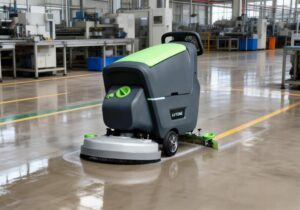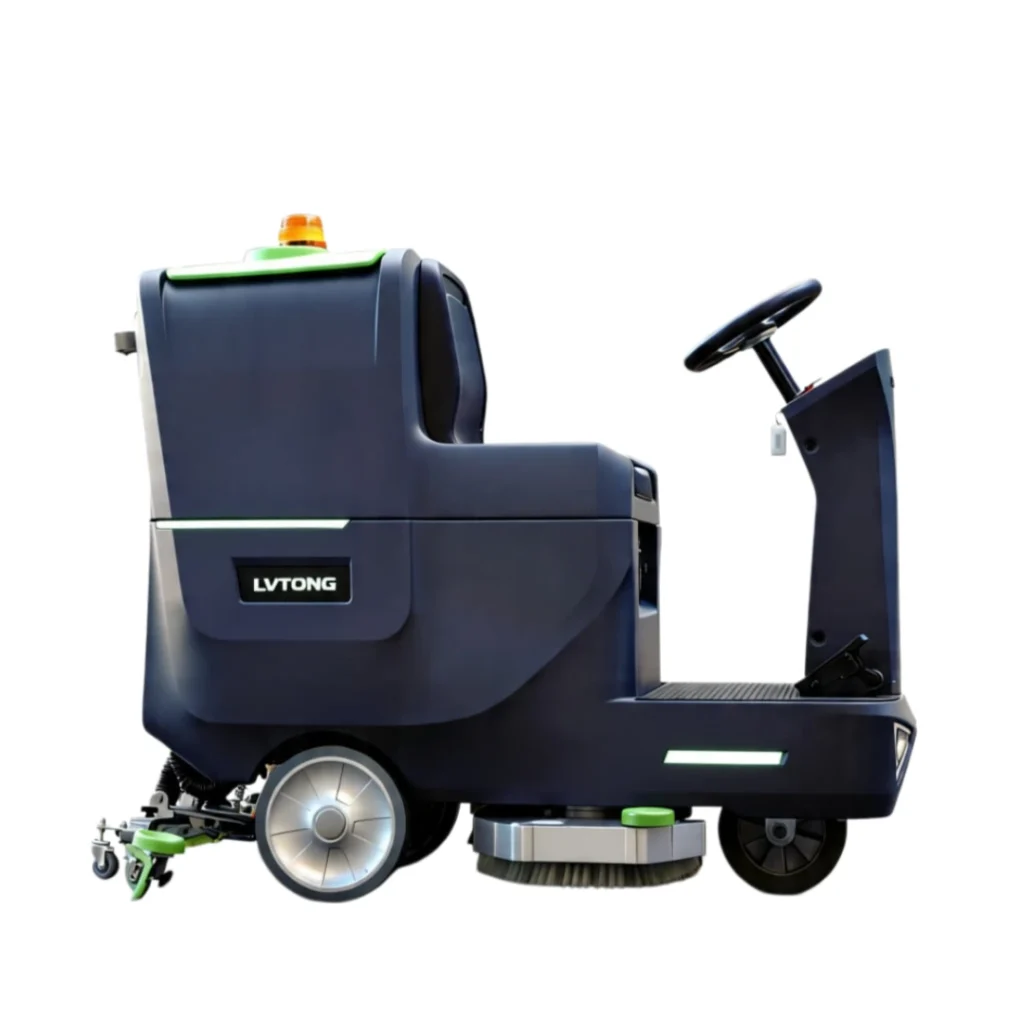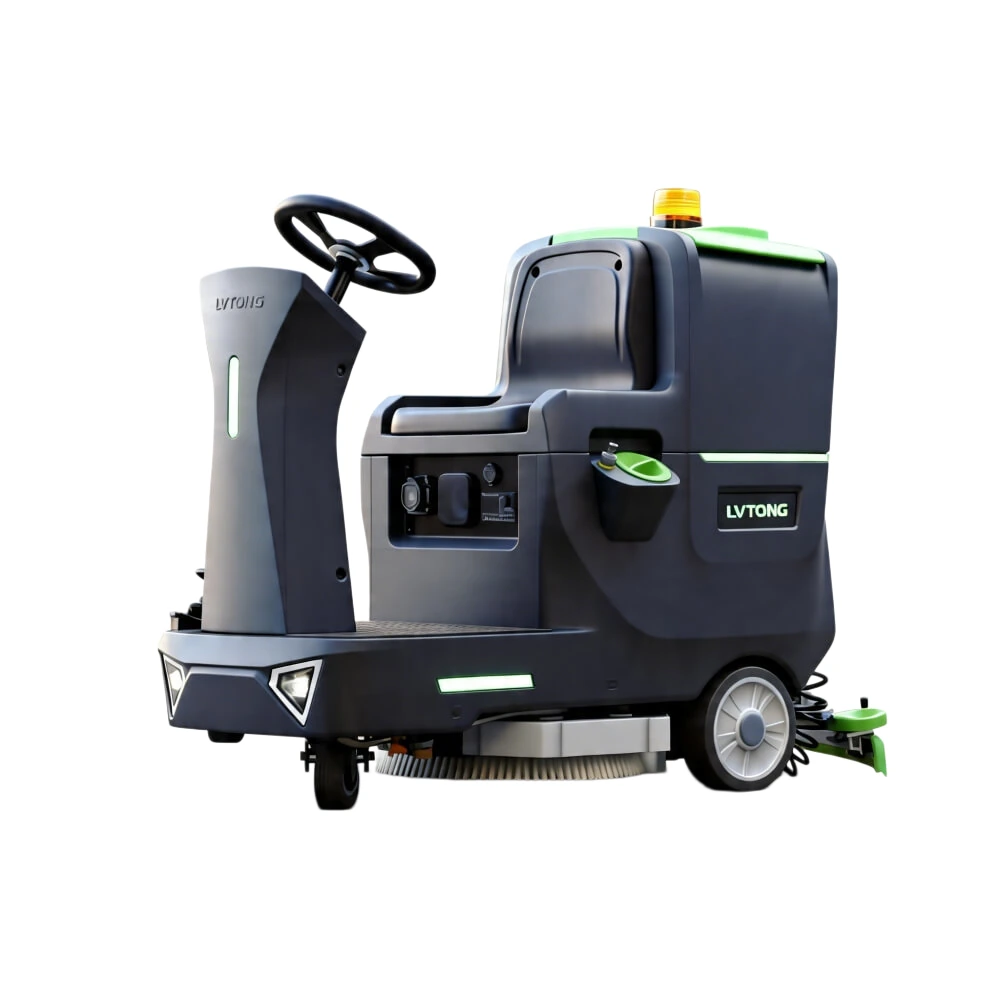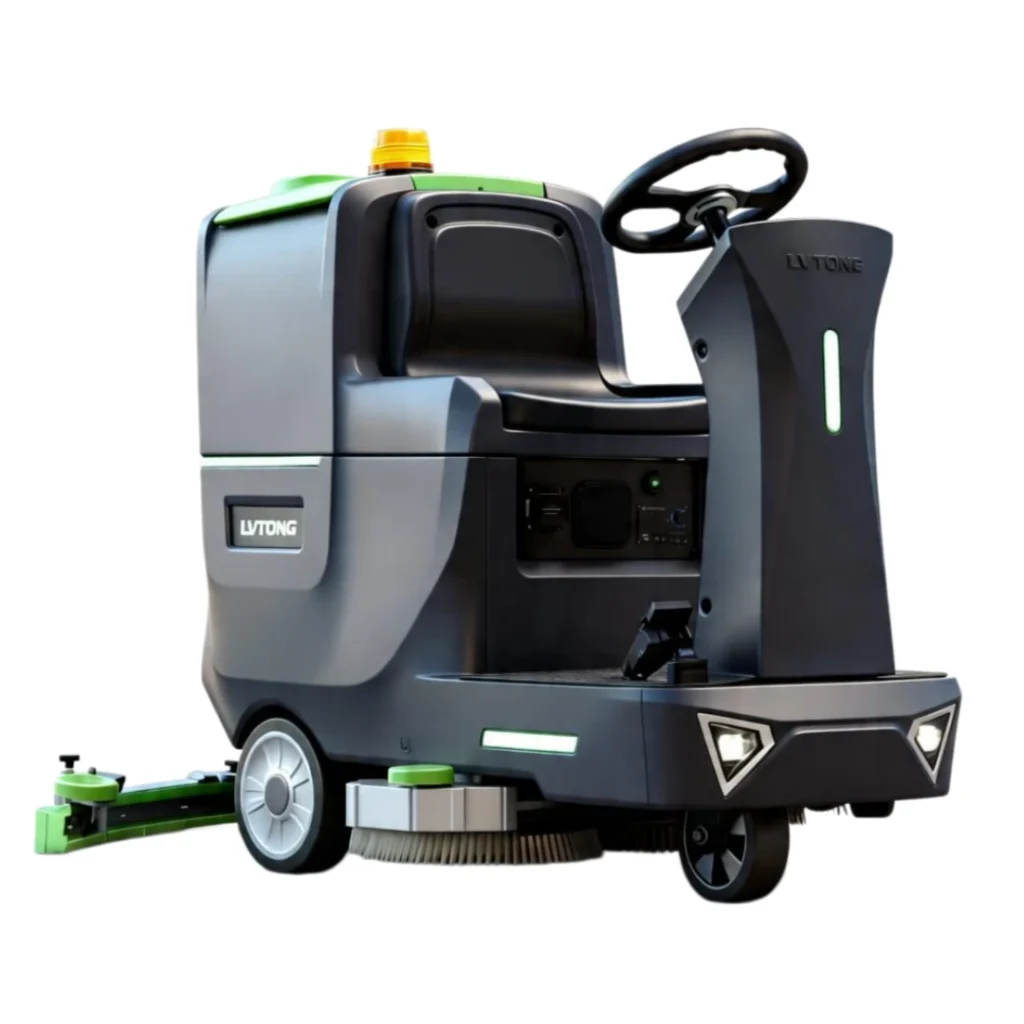
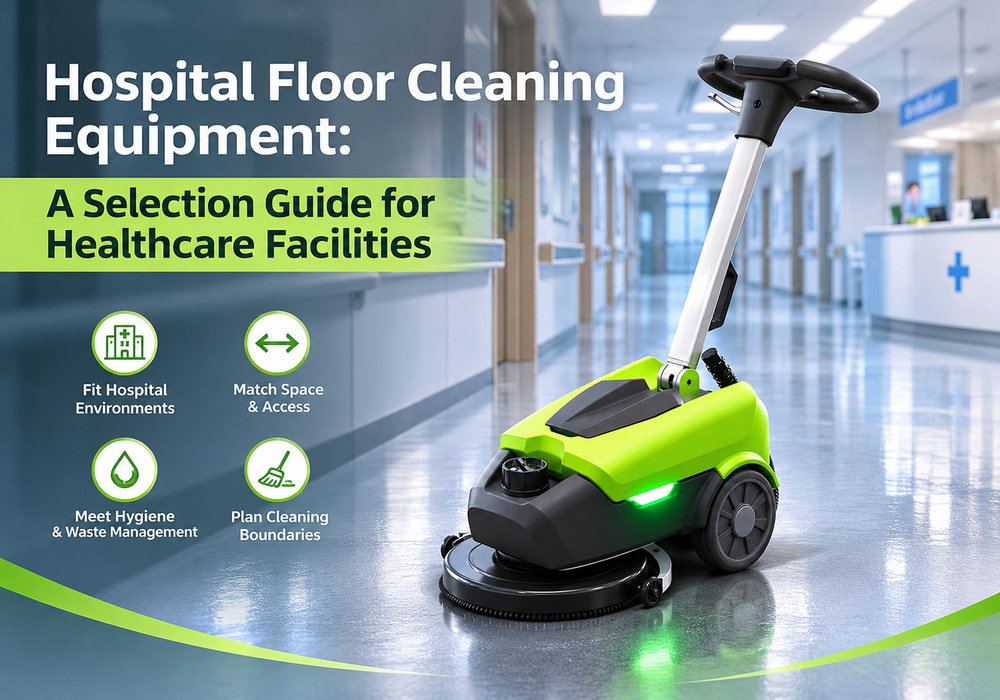
A corded floor scrubber is the simplest machine in the range: a motor fed from an outlet, a brush deck, a squeegee and a cable. No battery to charge, no runtime to plan. That simplicity is real, and it is also the whole story — the cable that removes the battery is the same cable that limits where the machine can go. This guide sets out exactly where a corded floor scrubber earns its place, where it quietly costs you more, and how to decide between mains power and a battery powered floor scrubber before you buy.
RESPOSTA RÁPIDA
A corded floor scrubber is worth buying only when the work is small, wet and close to a power point — a single storage room, a back-of-house wet area, or an entry the machine never leaves. For anything that travels through a building, the cable becomes the constraint: it caps your reach, decides where you fill and empty, and turns every pass into cable management. A cordless floor scrubber does the same cleaning with no tether and a full shift on one charge. Match the corded floor scrubber to the room, not the building.
- Corded wins on: small wet rooms, backup spill duty, lowest upfront price.
- Corded loses on: reach, water capacity, pass speed and cable safety.
- Battery wins on: any multi-room route, water volume and labour time.
- One question decides it: does the machine ever have to leave the room?
The rest of this guide walks through the trade-offs in the order they hit you on site.
What Is a Corded Floor Scrubber?
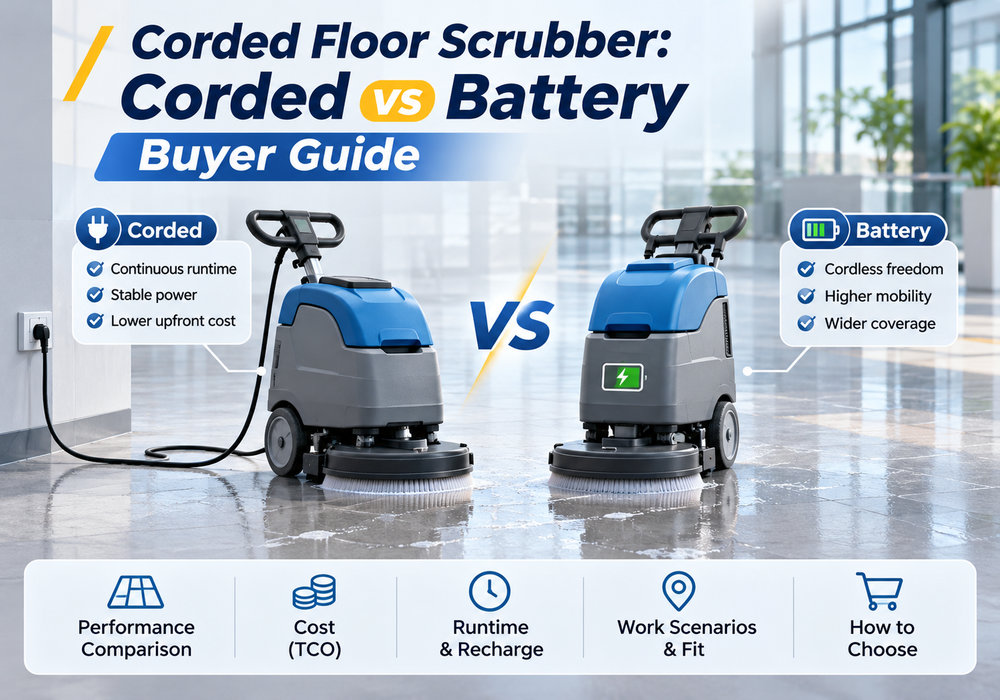
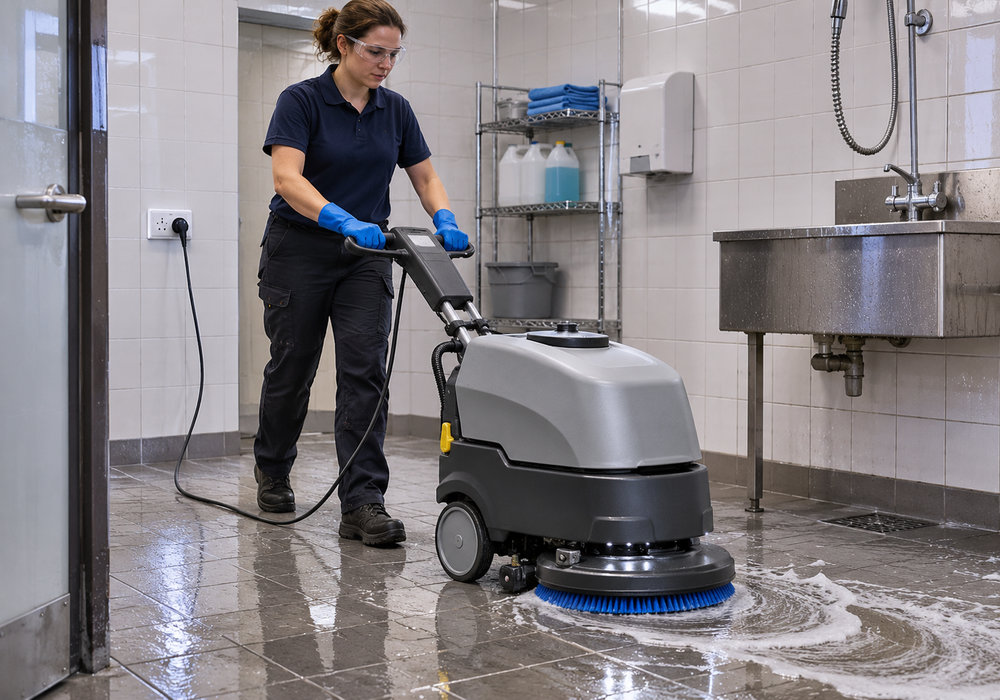
A corded floor scrubber, also sold as a corded electric floor scrubber or a mains powered floor scrubber, is an auto scrubber whose motor runs from a wall outlet through a power cable — so it carries no battery, has no runtime limit and costs less to buy.
Strip a scrubber back to its core and you have scrubbing water, a rotating brush, a vacuum-assisted squeegee and two tanks. A corded machine powers all of that from the mains. The cordless floor scrubber does the same job from an on-board battery. Both clean a floor the same way; the difference is where the electricity comes from, and that single difference drives reach, tank size, machine weight and daily routine. Corded machines are almost always the small walk-behind class, because a cable and a large tank do not travel well together.
Corded vs Battery: The Decision at a Glance
On paper a corded vs cordless floor scrubber looks like a price-and-runtime trade; in practice reach, water capacity and speed decide most commercial jobs — and those favour battery.
| Fator | Corded floor scrubber | Cordless floor scrubber |
|---|---|---|
| Power source | Mains via cable | On-board battery |
| Runtime limit | None while plugged in | One charge ≈ one shift |
| Reach | Cable length from the nearest socket | Whole building |
| Water tank size | Small (mobility limits it) | Medium to large |
| Cable handling | A management task on every pass | Nenhum |
| Safety on wet floors | Trip and electrical risk near water | No trailing lead |
| Upfront price | Mais baixo | Mais alto |
| Ideal para | One small wet room, backup duty | Any route that moves |
Where a Corded Floor Scrubber Still Wins
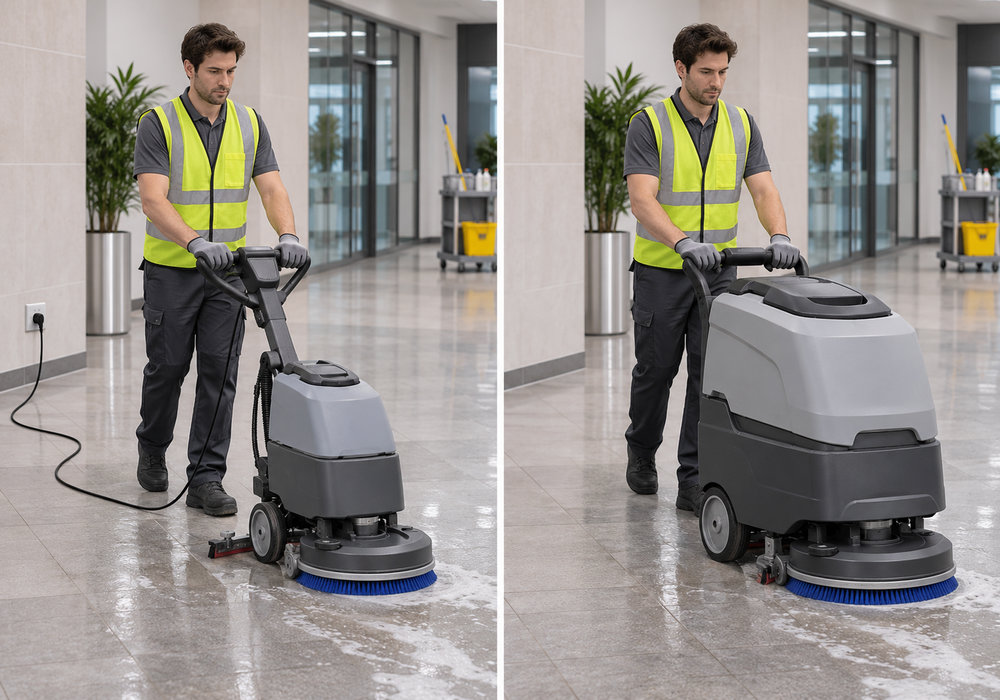
Corded makes sense in three narrow cases: a single small wet room, a backup machine kept for spill response, and the tightest budget entry point.
The first case is the wet room itself — a tiled wash-down area, a food-prep room or a small utility space where the floor is cleaned in one pass and the machine never crosses a threshold. There the cable is short, the tank demand is low and the lowest price wins. The second is backup: a spare corded machine that sits ready for a burst pipe or a one-off deep clean, where a battery that is only charged twice a year is a worse bet than a cable that always works. The third is budget: for a genuinely small footprint, a corded floor scrubber is the cheapest way into powered scrubbing, provided you accept its limits.
The Hidden Costs of a Cable in a Commercial Building
A cable is not free: it adds a hard reach limit, a trip hazard on a wet floor, a management task on every pass, and a full stop wherever there is no socket.
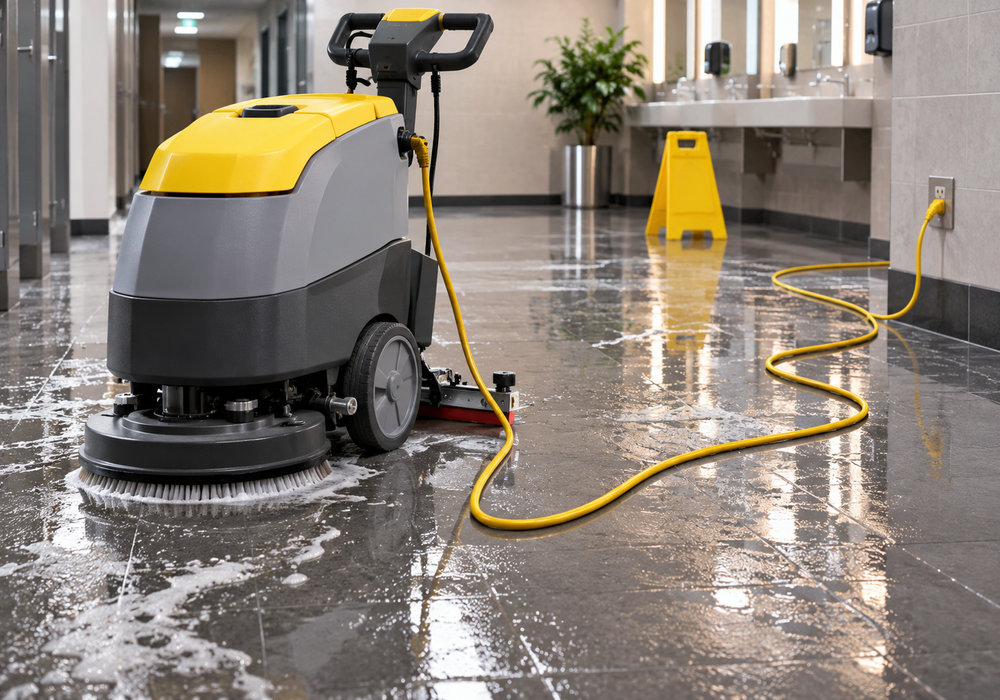
The first cost is distance. A corded electric floor scrubber can only work within reach of an outlet plus the length of its lead, so any corridor, hall or open floor without a socket is off-limits unless you add extension leads — which multiply the trip risk. The second is cable management: dragging, looping and lifting a lead over obstacles slows every pass and adds operator fatigue that a battery machine simply does not carry. The third is safety. A trailing cable across a wet floor is a recognised trip hazard: slip-and-fall safety practice treats a lead across a floor as a risk to control, while commercial cleaning machines are built to electrical-safety standards such as IEC 60335-2-72 and, in many markets, carry a listing from a body such as Soluções UL. The lead never disappears; it only means a corded machine must be used with care around water. The fourth is coverage: the moment a route leaves the reach of a socket, a corded machine stops and a battery machine carries on.
Runtime, Recharge and the Real Downtime Question
A battery machine does not need to run forever — it needs to run one shift, and modern lithium packs deliver a full shift on a single charge, so “unlimited runtime” is a corded advantage that rarely shows up in practice.
The corded sales pitch is that mains power never runs flat. True — but the operator, the clean-water tank and the recovery tank all run out first, so the extra runtime is largely theoretical. On the battery side, the question is not maximum minutes but shift coverage: our guia de bateria para lavadora de pisos covers how capacity, voltage and cycle life add up, and the walk-behind and ride-on machines in the range are specified so that a single charge covers a working shift with a charge window between shifts. Choose a battery powered floor scrubber sized to your shift, not to a headline number.
Why Mains Machines Stay Small: Water, Cable and Recovery
A corded scrubber stays small because the cable and the tank are linked — a bigger tank means a heavier machine, and a heavier machine on a lead is harder to move and to empty.
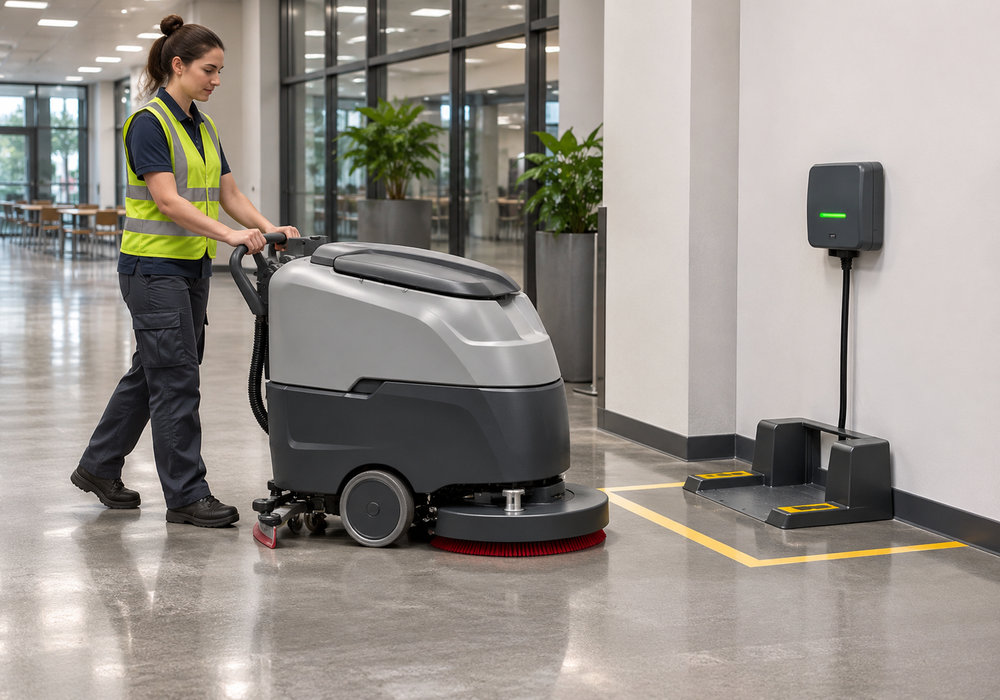
Cleaning water is heavy. A large electric floor scrubber machine carries a big solution and recovery tank, and that weight is only manageable because a battery-driven traction system moves it. On a corded machine the operator, or the machine’s small drive, has to handle that weight on a tether, so corded designs stay in the small walk-behind class with modest tanks — which in turn means more fill-and-empty stops and shorter cleaning runs. If your route needs serious water volume, that requirement alone usually pushes the decision to a battery machine.
Corded Electric Floor Scrubber: Cost and TCO Over Five Years
Corded has the lower sticker price but rarely the lower five-year cost, because labour, cable time and coverage losses are counted every working day.
| Cost line (illustrative) | Corded floor scrubber | lavadora de pisos movida a bateria |
|---|---|---|
| Preço de compra | Mais baixo | Mais alto |
| Energia | Mains, low per hour | Charge cost, low per shift |
| Substituição da bateria | Nenhum | Expected, over the cycle life |
| Labour per shift | Higher (cable handling, more stops) | Lower (one pass, fewer stops) |
| Coverage limit | Capped by cable reach | Building-wide |
| Safety exposure | Trailing lead on wet floor | Nenhum |
Read the table as a decision aid, not a quote: the numbers depend on your area, your shift and your labour rate, which is why our machine productivity baseline uses a measure-and-multiply method rather than a fixed figure. The pattern holds, though — a corded machine that slows every pass and stops at the edge of a socket carries a labour cost that the sticker price hides.
The Decision Framework: Corded or Battery?
Ask one question first — does the machine have to travel? If yes, the answer is a battery machine; if the work is one small room with a nearby socket, corded is defensible.
Work through it in order:
- Does the machine ever leave the room? If yes, stop here — choose battery.
- Is there a socket within a short lead of every area? If no, corded cannot reach it.
- How much water does the job need? Large tanks point to a battery machine.
- Is this a primary or a backup machine? Backup duty can justify corded.
- What is the true five-year cost? Price the labour, not just the machine.
If most answers sit on the battery side, a guia de seleção de lavadoras de piso will help you size the machine to the route rather than to the floor.
What LVTONG Builds — and Why
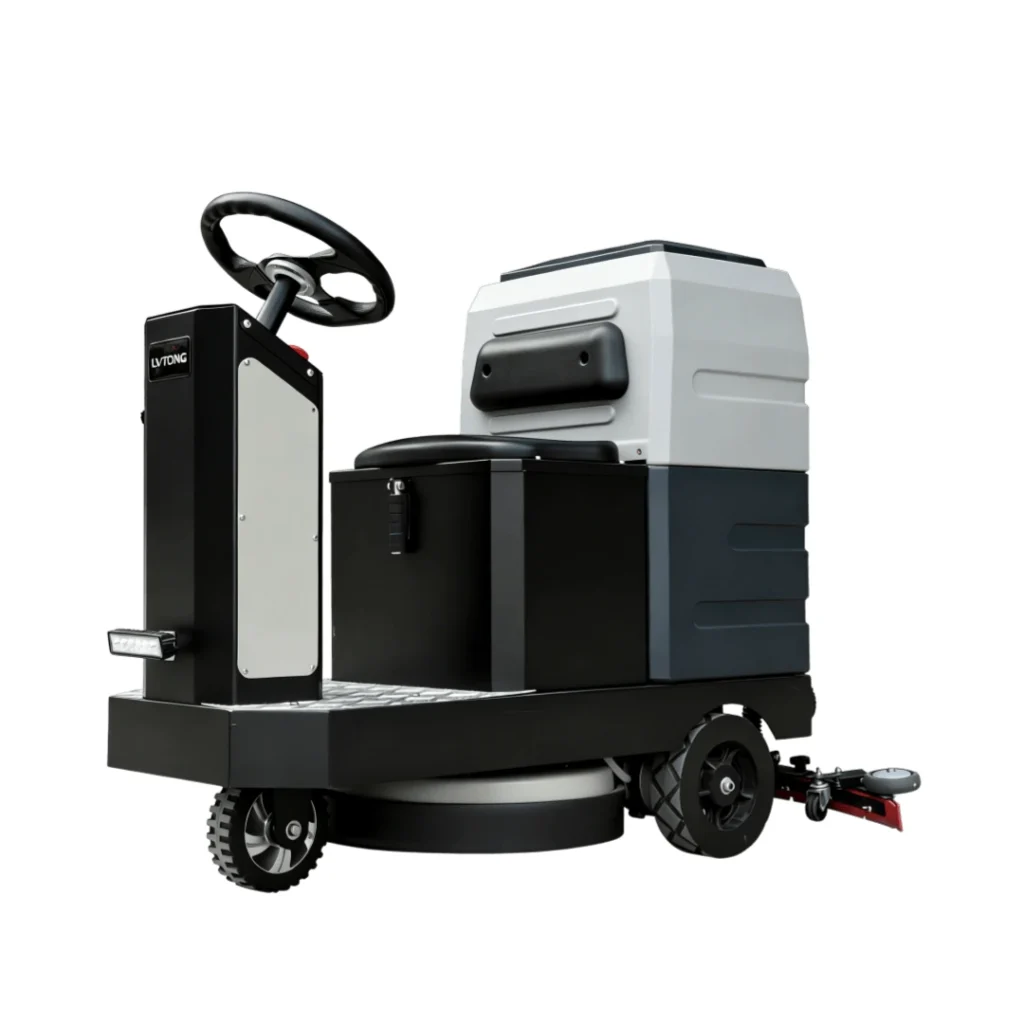
LVTONG builds lithium battery machines only — walk-behind and ride-on — because the routes our buyers clean do not stay next to a socket, and a machine that stops at the wall cannot finish the job.
We make no corded models, and that is a deliberate consequence of the jobs the machines are bought for. A walk-behind lithium scrubber handles a small facility with a lightweight body and a low-push design, and a ride-on battery scrubber covers large floors on a single charge without a tether. Both do what a corded floor scrubber cannot: keep moving, in any order, across any part of the building. If your site really is one small wet room, a corded machine may still be the pragmatic buy — but for a route that travels, the battery machine is the one that pays back. Talk to us about becoming a distributor if you supply these markets.
Perguntas frequentes
Is a corded floor scrubber better than a battery one?
Only for a small, wet room where the machine stays within reach of a socket. For any route that moves between rooms, a battery machine is faster, safer and cheaper over five years.
Can you use a corded floor scrubber in a wet room?
Yes — that is where corded works best — provided the machine and its cable are kept clear of standing water and the electrical safety of the machine suits a wet environment. Corded machines are designed for exactly this small-area duty.
How long does a battery floor scrubber run on one charge?
A well-specified lithium machine covers a full working shift on a single charge, with recharging between shifts. Size the battery to your shift length, not to a maximum-minute claim.
Are corded floor scrubbers cheaper?
The purchase price is lower, but the five-year cost is usually higher once cable handling, more fill-and-empty stops and reduced coverage are counted.