If you are researching Tennant floor scrubber price, the purchase price alone does not tell you which machine will cost less over its working life.
Tennant is a well-established global cleaning equipment brand with walk-behind, ride-on and automated floor scrubbers. However, buyers comparing equipment for factories, warehouses, logistics centers, shopping malls and other large facilities also need to consider battery configuration, cleaning productivity, tank capacity, maintenance, spare parts, local service and total cost of ownership.
LVTONG provides another option for industrial buyers who prioritize practical configurations, factory-direct sourcing and cost control.
This guide compares Tennant and LVTONG floor scrubbers from a procurement perspective, including public Tennant pricing examples, specifications, operating costs, technology, service and real-world applications.
Quick Answer: How Much Does a Tennant Floor Scrubber Cost?
There is no single Tennant floor scrubber price.
The final cost depends on the model, cleaning width, battery package, scrub head, charger, cleaning technology, accessories, dealer, country and service package.
As a current U.S. market reference, publicly listed Tennant T300 walk-behind scrubbers are available in several configurations at approximately $9,500 to $12,800. A recent public procurement price for a 24-inch Tennant T300 was also around $10,900.
Larger ride-on machines such as the Tennant T16 are generally handled through dealer quotations rather than a universal online list price.
For procurement teams, the more useful question is therefore:
What will the machine cost to buy, operate and maintain over three to five years?
That is where comparing Tennant with alternative industrial floor scrubbers becomes more useful.

Tennant Floor Scrubber Price Overview
The following table gives buyers a practical framework for understanding Tennant pricing.
| Machine | Type | Public Price Situation | Typical Buying Consideration |
|---|---|---|---|
| Tennant T300 | Walk-behind | Public U.S. listings are roughly $9,500–$12,800 depending on configuration | Cleaning head, battery, self-propelled drive, ec-H2O and accessories |
| Tennant T300e | Walk-behind | Often slightly lower than comparable T300 configurations | Simpler configuration and feature requirements |
| Tennant T16 | Ride-on | Usually request-a-quote pricing | Battery package, disk/cylindrical head, ES, ec-H2O and service package |
| LVTONG LT-S530X | Walk-behind | Factory quotation | Battery, quantity, destination and customization |
| LVTONG LT-S860X | Ride-on | Factory quotation | Battery, order quantity, shipping and configuration |
Important: These figures should not be treated as universal manufacturer MSRP. Equipment prices vary by market, configuration, dealer, freight, tax and optional equipment.
For international buyers, a proper comparison should use landed cost and total ownership cost, not just the machine price shown by a dealer.

What Changes the Tennant Floor Scrubber Price?
Two machines carrying the same model name can have substantially different final prices.
Before comparing quotations, check the following factors.
1. Cleaning Width
A larger cleaning path can increase productivity but may also increase purchase price, brush cost and battery demand.
The correct width depends on:
- aisle dimensions;
- doorway clearance;
- open floor area;
- obstacles;
- required cleaning frequency.
Buying the largest machine is not always the most economical choice.
2. Battery Configuration
Battery type has a major effect on both initial cost and long-term operating cost.
Buyers should compare:
- flooded lead-acid;
- AGM;
- lithium-ion;
- battery capacity;
- charging time;
- expected runtime;
- battery replacement cost;
- charger specification.
A cheaper machine with an inadequate battery package may create more downtime than a higher-priced configuration.
3. Scrub Head
Tennant models may be available with different cleaning systems, including disk, cylindrical or orbital configurations depending on the model.
Different scrub heads affect:
- cleaning performance;
- debris handling;
- pad and brush costs;
- maintenance;
- suitability for specific floors.
4. Cleaning Technology
Some Tennant machines can be configured with technologies such as ec-H2O NanoClean or ES Extended Scrubbing.
These features can change both the initial purchase price and operating strategy.
Facilities should evaluate whether the additional technology delivers measurable savings for their actual cleaning conditions.
5. Service and Warranty
The lowest equipment quotation is not necessarily the lowest-cost purchase.
Ask whether the quote includes:
- commissioning;
- operator training;
- warranty;
- preventive maintenance;
- service visits;
- replacement parts;
- technical support;
- delivery.
These costs matter particularly for machines expected to operate every day.

Tennant vs LVTONG: Brand Positioning
Tennant and LVTONG target overlapping but not identical buyer priorities.
| Comparison Area | Tennant | LVTONG |
|---|---|---|
| Brand Positioning | Established international cleaning equipment brand | China-based industrial cleaning equipment manufacturer |
| Product Focus | Commercial, industrial and automated cleaning equipment | Industrial and commercial scrubbers and sweepers |
| Purchasing Model | Dealer / regional sales network | Factory-direct and distributor channels |
| Technology | Proprietary technologies and multiple scrub-head configurations | Practical industrial configurations, intelligent controls and modular options |
| Customization | Depends on model and regional offering | OEM, ODM and configuration customization available |
| Service | Established service infrastructure in many markets | Factory technical support, parts supply and distributor support |
| Best Fit | Buyers prioritizing established brand ecosystem and local service availability | Buyers prioritizing procurement cost, configuration flexibility and factory-direct sourcing |
Neither brand should be selected only because of its name.
A better decision is based on facility size, required productivity, local support, equipment utilization and total cost of ownership.
Tennant T300 Price and Specifications vs LVTONG LT-S530X
For buyers evaluating a walk-behind scrubber, the Tennant T300 and LVTONG LT-S530X represent two different purchasing approaches.
The T300 is an established commercial walk-behind platform with multiple scrub-head configurations. The LT-S530X focuses on industrial simplicity, relatively large tank capacity and practical operation.
Tennant T300 Key Specifications
Tennant publishes the following specifications for the T300:
| Specification | Tennant T300 |
|---|---|
| Machine Type | Walk-behind |
| Cleaning Path | 430 / 500 / 600 mm |
| Solution Tank | 42 L |
| Recovery Tank | 53 L |
| Estimated Productivity | Up to 2,230 m²/h |
| Estimated Runtime | Up to 3.8 hours |
| Main Down Pressure | Up to 49 kg |
| Sound Level | As low as 66.4 dBA |
| Quiet Mode | As low as 57.6 dBA |
| Head Options | Disk / Orbital |
| Power | Battery |
One advantage of the T300 is configuration flexibility.
Facilities can select different cleaning widths and technology options according to the floor environment.
LVTONG LT-S530X Key Specifications
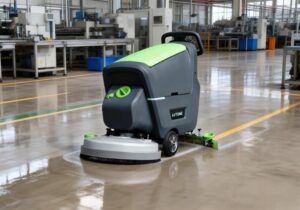
The LT-S530X industrial walk-behind floor scrubber is designed for industrial workshops, narrow aisles and commercial facilities where operators need a compact walk-behind machine.
Published LVTONG product information includes:
| Specification | LVTONG LT-S530X |
|---|---|
| Machine Type | Walk-behind |
| Cleaning Width | Approx. 530 mm class |
| Solution Tank | 62 L |
| Recovery Tank | 65 L |
| Published Cleaning Efficiency | Up to 2,100 m²/h |
| Noise | ≤70 dB |
| Battery Options | Lead-acid / lithium depending on configuration |
| Typical Floor Types | Epoxy, ceramic tile, marble, cement and other hard floors |
The larger 62 L / 65 L tank combination can be useful where operators want to reduce refill and wastewater-disposal interruptions.
The LT-S530X also incorporates features such as an LCD interface, one-button operation and intelligent control functions depending on configuration.
Tennant T300 vs LT-S530X: Which One Makes More Sense?
The answer depends on procurement priorities.
Consider Tennant T300 if:
- an established Tennant dealer is already supporting your facility;
- standardized Tennant equipment is required;
- quiet-mode operation is especially important;
- you want access to Tennant-specific cleaning technologies;
- your organization already maintains a Tennant fleet.
Consider LT-S530X if:
- acquisition cost is an important factor;
- larger solution and recovery tanks are useful;
- factory-direct sourcing is preferred;
- customized battery or equipment configurations are required;
- you are a distributor or fleet buyer comparing alternative suppliers.
This is why comparing Tennant floor scrubber price without comparing configuration can be misleading.
A $10,000 machine and an $8,000 machine are not truly comparable unless they include equivalent batteries, chargers, cleaning heads, warranties and delivery terms.

Tennant T16 Price and Specifications vs LVTONG LT-S860X
For large industrial sites, buyers often move from walk-behind equipment to ride-on scrubbers.
The Tennant T16 is a substantially larger platform than the LT-S860X, so these machines should not be treated as exact one-to-one substitutes.
However, they are useful to compare because both may appear on a buyer’s shortlist for medium-to-large industrial cleaning projects.
Tennant T16 Key Specifications
Tennant publishes the following T16 specifications:
| Specification | Tennant T16 |
|---|---|
| Machine Type | Ride-on |
| Standard Cleaning Path | 910 mm |
| Cleaning Path with Options | Up to 1,170 mm |
| Solution Tank | 190 L standard |
| Solution Capacity with ES | 280 L |
| Recovery Tank | 225 L |
| Estimated Productivity | Up to 8,230 m²/h |
| Estimated Runtime | Up to 4 hours |
| Main Down Pressure | Up to 114 kg |
| Empty Machine Weight | Approx. 500 kg |
| Sound Level | Approx. 68–71 dBA |
| Head Options | Disk / Cylindrical |
| Power | Battery |
The T16 is designed for high-productivity cleaning and offers Tennant technologies including ec-H2O and ES configurations.
Its larger tank capacity is particularly useful in large facilities where reducing refill stops is important.
LVTONG LT-S860X Key Specifications
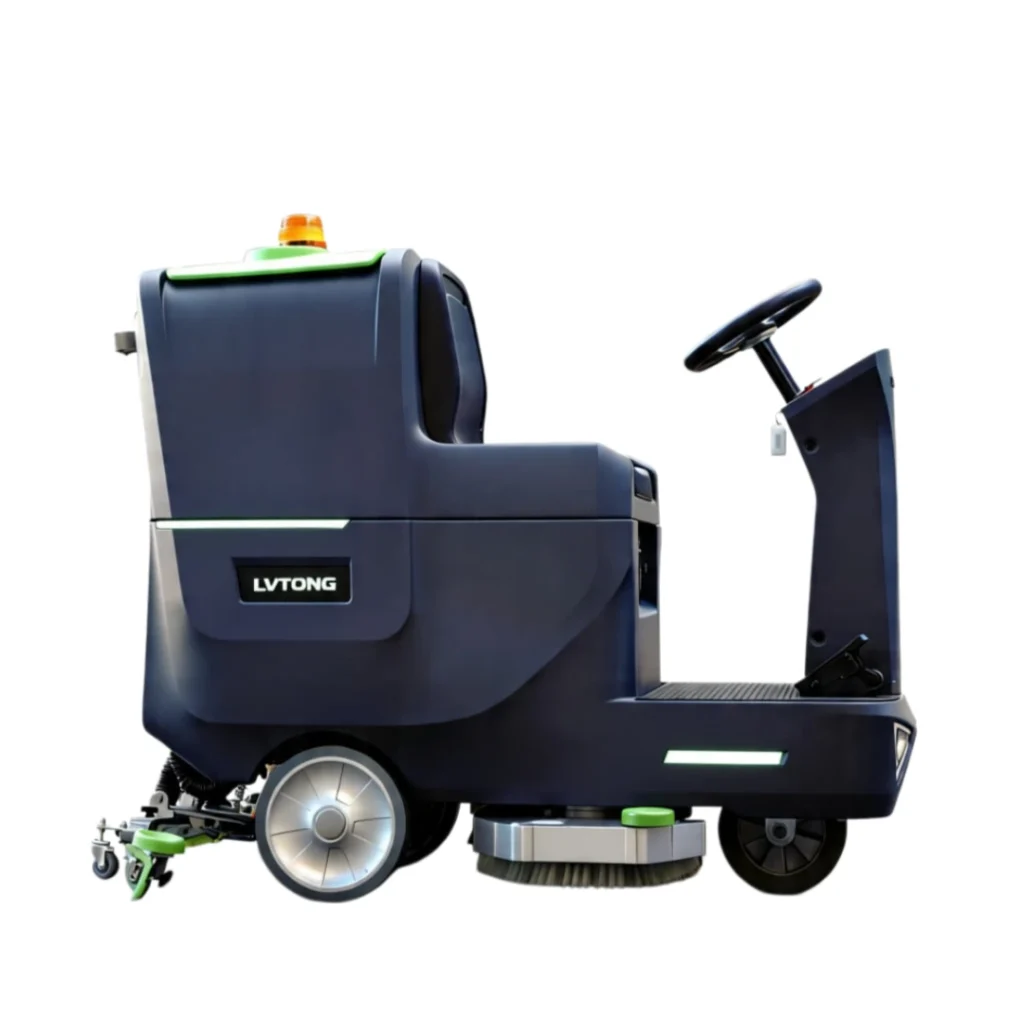
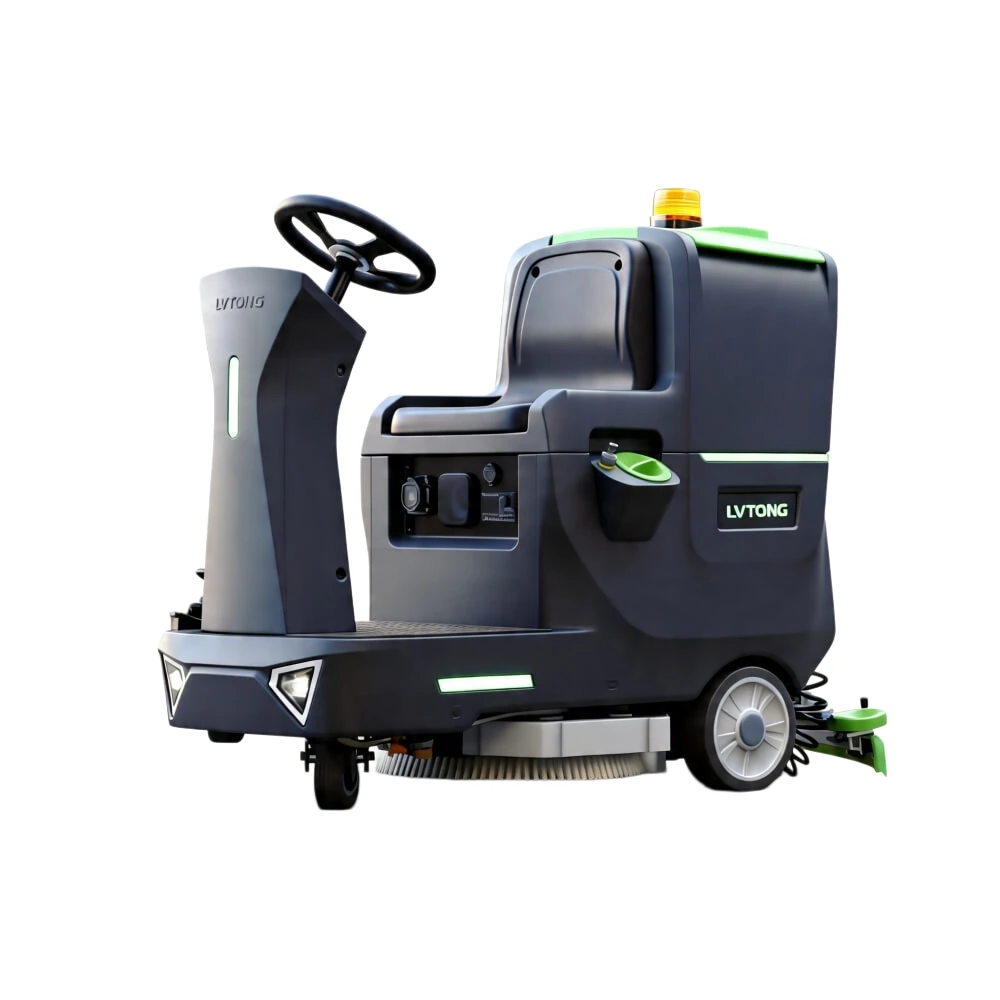
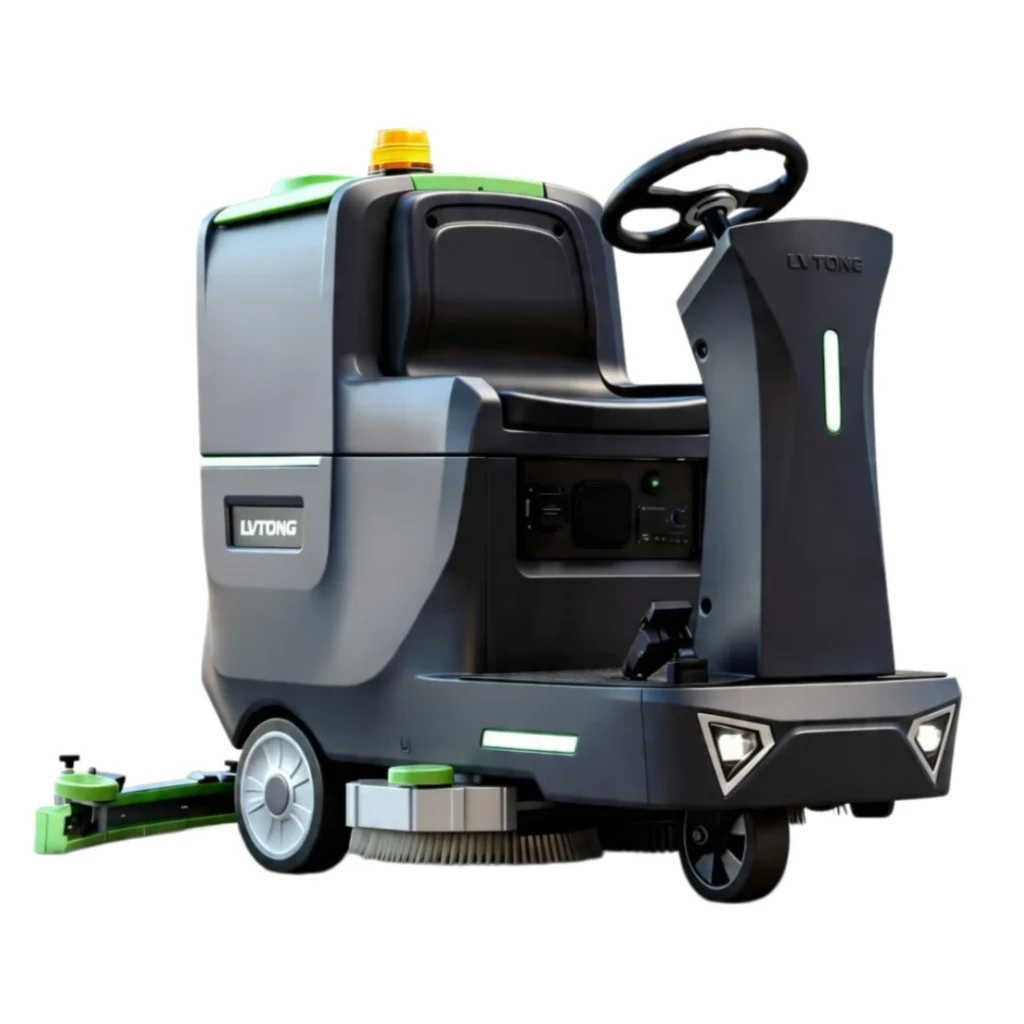
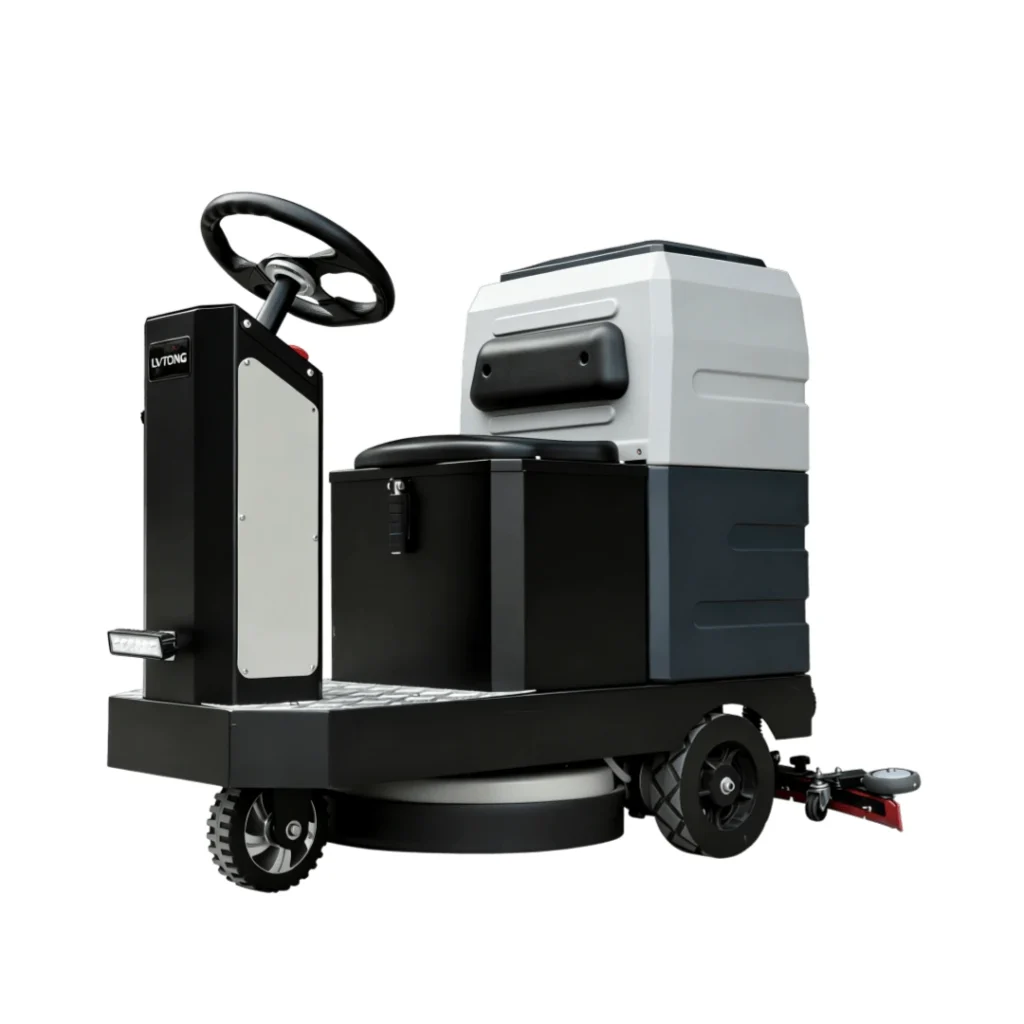
The LT-S860X ride-on scrubber is a more compact machine intended for factories, warehouses, logistics centers, shopping malls, airports and other large hard-floor environments.
Published product information includes:
| Specification | LVTONG LT-S860X |
|---|---|
| Machine Type | Ride-on |
| Scrubbing Width | 860 mm |
| Squeegee Width | 1,140 mm |
| Solution Tank | 130 L |
| Recovery Tank | 135 L |
| Battery | 24V / 100Ah configuration available |
| Working Time | Approximately 4–6 hours depending on configuration and conditions |
| Maximum Speed | Approx. 7 km/h |
| Published Theoretical Productivity | Up to approximately 6,800 m²/h |
| Noise | Approx. 65–70 dB |
| Net Weight | Approx. 235 kg |
The LT-S860X uses dual brushes and incorporates intelligent monitoring, fault alerts and configurable operating functions.
Its smaller overall platform may be attractive where buyers want ride-on productivity without moving to a significantly larger industrial machine.
Tennant T16 vs LT-S860X: Important Procurement Difference
This comparison illustrates an important rule:
Do not compare industrial floor scrubbers only by purchase price. Compare machine class and required output first.
The T16 has:
- larger tanks;
- a wider standard cleaning platform;
- higher published theoretical productivity;
- multiple scrub-head options;
- a heavier industrial chassis.
The LT-S860X is:
- lighter;
- more compact;
- factory-direct;
- designed around an 860 mm cleaning platform;
- configurable for industrial and commercial applications.
Therefore, the correct purchasing decision depends on how much machine your facility actually needs.
Buying excess capacity increases capital cost.
Buying insufficient capacity increases labor cost.
Performance and Technology Comparison
Cleaning Productivity
Productivity figures should be treated as theoretical maximums rather than guaranteed real-world results.
Actual productivity changes with:
- turning;
- filling and emptying;
- obstacle density;
- floor condition;
- operator experience;
- brush selection;
- battery state;
- cleaning speed.
For procurement decisions, calculate required productivity from your actual facility.
For example:
Required productivity = Cleanable floor area ÷ Available cleaning time
A warehouse with 12,000 m² of floor but only 8,000 m² of actual cleanable area may not require the same machine as an unobstructed 12,000 m² production floor.
Tennant Cleaning Technology
Tennant differentiates many machines through proprietary cleaning technologies.
Depending on model and configuration, these may include:
- ec-H2O NanoClean;
- ES Extended Scrubbing;
- configurable cleaning zones;
- onboard diagnostics;
- intelligent fleet management functions.
These technologies can provide operational advantages, but buyers should evaluate their value against the actual application.
A technology that produces measurable savings in a high-utilization facility may be worth the additional investment.
The same feature may provide little financial return on a machine used only a few hours per week.
LVTONG Technology
LVTONG focuses on industrial usability and configurable electronic controls.
Depending on the model, features may include:
- LCD control displays;
- fault self-diagnosis;
- water-level monitoring;
- low-battery protection;
- automatic brush functions;
- multiple cleaning modes;
- lithium battery configurations;
- IoT or intelligent management functions.
For international distributors and project buyers, configuration flexibility can also be important when equipment must meet different operating or market requirements.
Tennant Floor Scrubber Price vs Total Cost of Ownership
The initial invoice is only one part of the real cost.
For a professional buyer, a more useful calculation is:
5-Year TCO = Purchase Price + Battery Cost + Consumables + Maintenance + Parts + Labor + Downtime + Financing + Logistics − Residual Value
This is especially important for facilities operating multiple machines.
1. Purchase Price
Compare equivalent configurations.
Ask whether each quote includes:
- batteries;
- charger;
- brushes;
- pad drivers;
- squeegee blades;
- accessories;
- freight;
- commissioning;
- training.
A quote that appears cheaper can become more expensive once missing items are added.
2. Battery Cost
Battery replacement can become one of the largest lifecycle expenses.
Ask suppliers:
- battery chemistry;
- battery capacity;
- expected service life;
- replacement price;
- charging requirements;
- warranty period;
- local availability.
For multi-shift operations, battery strategy may be more important than a small difference in machine purchase price.
3. Consumables
Recurring consumables include:
- brushes;
- pads;
- squeegee blades;
- filters;
- hoses;
- detergents;
- wear components.
Facility managers should estimate annual consumption rather than evaluating only the initial equipment package.
4. Maintenance and Spare Parts
Downtime has a cost. Buyers should therefore evaluate cleaning equipment maintenance and service together with spare-parts availability before comparing the long-term ownership cost of different floor scrubbers.
Before purchasing, ask:
- Which parts are stocked locally?
- Which parts must be imported?
- What is the typical parts lead time?
- Can your own technicians perform common repairs?
- Are service manuals available?
- Is remote troubleshooting available?
- Is on-site service available in your country?
Tennant has an established service and dealer network in many markets.
LVTONG provides factory technical support, spare-parts supply and distributor support, but local service availability should be confirmed for the buyer’s country.
This is a more useful comparison than simply claiming that one brand always has lower maintenance cost.

How to Compare Tennant and LVTONG Quotes Fairly
Use the same quotation requirements for both suppliers.
A professional RFQ should include:
| Procurement Item | Information to Request |
|---|---|
| Machine | Exact model and configuration |
| Cleaning Width | mm / inches |
| Productivity | Theoretical and recommended practical output |
| Battery | Type, voltage, Ah |
| Runtime | Expected under normal operation |
| Charger | Included / optional |
| Solution Tank | Liters |
| Recovery Tank | Liters |
| Brushes | Type and quantity |
| Squeegee | Width and replacement cost |
| Warranty | Machine, battery and major components |
| Spare Parts | Availability and lead time |
| Training | Included or additional |
| Delivery | Incoterm and destination cost |
| Service | Local / remote / distributor |
| Lead Time | Production and delivery |
| Total Price | Complete delivered configuration |
This approach prevents misleading price comparisons.
Which Brand Is Better for Your Facility?
There is no universal winner.
The right decision changes with operating conditions.
Tennant May Be the Better Fit When:
- your company already owns Tennant machines;
- your procurement policy prioritizes an established international brand;
- strong local dealer coverage is available;
- standardized fleet management is important;
- Tennant-specific technologies are required;
- acquisition price is less important than maintaining a standardized equipment ecosystem.
LVTONG May Be Worth Considering When:
- purchase cost is a major procurement factor;
- you want factory-direct sourcing;
- you require customized machine configurations;
- you operate factories, warehouses or logistics facilities;
- you are purchasing multiple machines;
- you are a distributor or equipment importer;
- you want to diversify your supplier base;
- OEM or private-label options are required.
The key is not simply choosing the cheaper machine.
The objective is choosing the machine that gives your operation the lowest cost per cleaned square meter while maintaining acceptable reliability and support.
Tennant Floor Scrubber Price for Factories and Warehouses: What Matters Most?
Industrial buyers often focus on equipment price first, but labor usually has a much larger impact on long-term cleaning cost.
Suppose two machines differ by several thousand dollars in purchase price.
If one machine allows an operator to finish the same cleaning area significantly faster every day, the labor savings over several years can exceed the original equipment price difference.
When comparing machines for factories or warehouses, prioritize:
- actual cleanable floor area;
- available cleaning hours;
- aisle width;
- floor contamination;
- required brush pressure;
- battery runtime;
- tank capacity;
- refill locations;
- operator skill;
- expected annual operating hours.
A machine should be selected around the cleaning process—not around a specification sheet alone.
Walk-Behind or Ride-On: Which Offers Better Value?
For smaller and more congested facilities, walk-behind floor scrubber machines may provide a lower overall cost because they are easier to maneuver through narrow aisles, equipment areas and confined spaces.
For larger open floors, ride-on floor scrubber machines can reduce operator walking and increase cleaning productivity, making them more suitable for warehouses, factories and other large facilities.
Walk-behind scrubbers are generally better suited to:
- narrow aisles;
- smaller factories;
- schools;
- clinics;
- supermarkets;
- medium commercial areas.
Ride-on scrubbers are generally better suited to:
- warehouses;
- logistics centers;
- manufacturing plants;
- airports;
- large shopping centers;
- parking facilities;
- large distribution centers.
Do not select a ride-on machine only because it appears more productive.
Turning space, doorway width and obstacle density can significantly reduce real-world productivity.

Questions to Ask Before Buying a Tennant or LVTONG Floor Scrubber
Before approving any quotation, ask the supplier these questions:
- What machine size is recommended for my actual cleanable floor area?
- What is the practical cleaning productivity, not just theoretical productivity?
- Which battery configuration is included?
- What runtime should I expect under my cleaning conditions?
- Is the charger included?
- Which brush or pad is recommended for my floor?
- What is included in the quoted price?
- What consumables should I budget for annually?
- What is the battery replacement cost?
- What is the warranty period?
- Where are spare parts shipped from?
- What is the typical spare-parts lead time?
- Is local service available?
- Can remote technical support be provided?
- What is the expected delivery time?
- Can the machine be customized?
- Is operator training included?
- What is the estimated three- or five-year ownership cost?
A supplier that can answer these questions clearly gives procurement teams much better information than a simple equipment price.
Frequently Asked Questions
How much does a Tennant floor scrubber cost?
The Tennant floor scrubber price varies substantially by model and configuration. Current public U.S. listings for the Tennant T300 show examples from roughly $9,500 to $12,800 depending on cleaning width, drive system and configuration. Larger ride-on machines are commonly quotation-based.
Always confirm current regional pricing with an authorized supplier.
Why are Tennant floor scrubber prices different between sellers?
Differences may come from:
- battery configuration;
- cleaning head;
- machine width;
- charger;
- ec-H2O technology;
- accessories;
- warranty;
- freight;
- dealer margin;
- service package.
Two quotations for the same model name may therefore represent different equipment packages.
How much does a Tennant T300 floor scrubber cost?
Public U.S. listings currently place several new Tennant T300 configurations at approximately $9,500–$12,800.
The final price depends on configuration and region, so this should be treated as a market reference rather than a universal Tennant list price.
How much does a Tennant T16 floor scrubber cost?
Tennant generally directs T16 buyers to request pricing rather than publishing one universal online price.
Because the T16 can be configured with different batteries, scrub systems and cleaning technologies, buyers should request a complete equipment quotation instead of relying on an isolated historical price.
Is LVTONG cheaper than Tennant?
LVTONG is positioned as a factory-direct industrial cleaning equipment supplier and may provide a lower acquisition-cost option in many projects.
However, exact savings cannot be determined without comparing equivalent machine specifications, shipping, battery configuration, warranty, parts and local service.
The correct comparison is delivered total cost and lifecycle cost, not factory price alone.
What is comparable to the Tennant T300?
For buyers looking at an industrial walk-behind configuration, the LVTONG LT-S530X can be evaluated alongside the Tennant T300.
They are not identical machines, so buyers should compare cleaning width, tanks, battery configuration, runtime, noise, service and delivered cost.
What is an alternative to the Tennant T16?
The correct alternative depends on required productivity.
The LVTONG LT-S860X can be considered by buyers who need a more compact ride-on scrubber, while the Tennant T16 belongs to a larger machine class with greater tank capacity and higher published productivity.
For this reason, facility requirements should be calculated before comparing price.
Which is better for warehouse cleaning: Tennant or LVTONG?
Both brands offer equipment suitable for industrial cleaning.
Tennant may suit organizations that prioritize its established product and service ecosystem.
LVTONG may be attractive to buyers prioritizing factory-direct purchasing, configurable machines and procurement cost.
The best choice depends on facility size, operating hours, local support and total cost of ownership.
What should I compare besides floor scrubber price?
For professional procurement, compare:
- productivity;
- battery runtime;
- cleaning width;
- tank capacity;
- consumables;
- battery replacement cost;
- maintenance;
- spare parts;
- warranty;
- local support;
- downtime;
- resale value.
These factors can have a greater financial impact than the initial purchase price.
Final Verdict: Tennant or LVTONG?
The right industrial floor scrubber should not be selected on brand or purchase price alone.
Tennant offers an established cleaning equipment ecosystem, multiple machine configurations and proprietary cleaning technologies. It can be a strong choice for organizations that value brand standardization and established service coverage.
LVTONG takes a different approach, focusing on industrial applications, factory-direct supply, configurable equipment and competitive procurement cost.
For buyers researching Tennant floor scrubber price, the most useful comparison is therefore:
Purchase price + productivity + battery + maintenance + parts + downtime + service + expected machine life.
If your facility already uses Tennant equipment and has reliable local support, staying within the Tennant ecosystem may simplify fleet management.
If you are comparing suppliers, purchasing multiple machines, seeking OEM/ODM options or trying to reduce capital expenditure, LVTONG is worth including in your RFQ process.
Get a Floor Scrubber Recommendation and Quote
Not sure which machine size is suitable for your facility?
Send LVTONG the following information:
- country;
- cleaning area in m² or ft²;
- floor material;
- floor condition;
- aisle or doorway width;
- cleaning hours per day;
- preferred walk-behind or ride-on machine;
- battery requirements;
- required quantity.
Our team can recommend a suitable configuration and provide a quotation for comparison with your existing Tennant floor scrubber budget.
Ready to compare your current Tennant budget with a LVTONG solution? Request a floor scrubber quote and send us your cleaning area, floor type, operating hours, required quantity and destination country. Our team can recommend a suitable machine configuration for your facility.
Data Note
Tennant specifications in this comparison are based on published Tennant product information for the T300 and T16. LVTONG specifications are based on published LT-S530X and LT-S860X product information. Public price examples are market references rather than manufacturer MSRP and may change by country, configuration, dealer and date.