Introduction
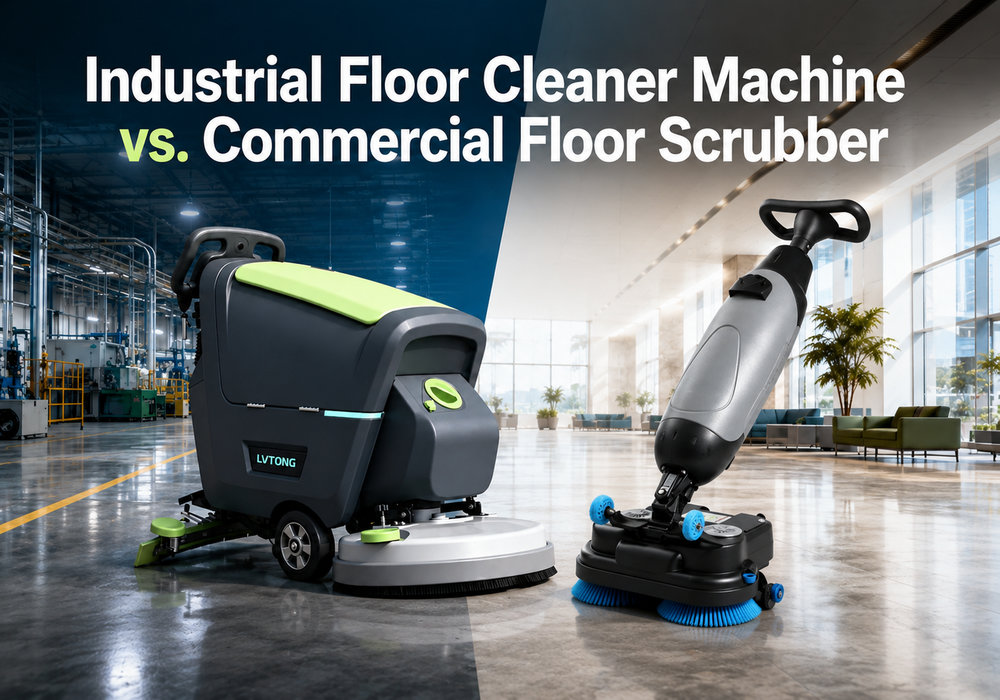
Choosing between an industrial floor cleaner machine and a commercial floor scrubber depends less on the label on the machine and more on the actual cleaning workload.
Industrial floor scrubbers are generally better suited to larger facilities, heavier contamination, longer cleaning routes, and demanding operating conditions. Commercial floor scrubbers are typically better for routine floor maintenance in offices, retail spaces, hotels, healthcare facilities, and other environments where maneuverability, noise control, and ease of operation are important.
However, “industrial” and “commercial” are not universal technical classifications. Two machines may look similar but have very different cleaning widths, tank capacities, brush pressure, battery systems, durability, and recommended duty cycles.
For this reason, the best way to choose a machine is to compare the actual operating requirements of your facility.
Note: In this guide, the term industrial floor cleaner machine refers primarily to automatic floor scrubbers or scrubber dryers used to wash and recover water from hard floors. Industrial sweepers, vacuums, burnishers, and other floor cleaning machines are separate equipment categories.
Quick Answer: Industrial or Commercial Floor Scrubber?
Choose an industrial floor cleaner machine when you need to clean large areas, operate for longer periods, handle heavier soil, or maintain floors in demanding environments such as manufacturing and logistics facilities.
Choose a commercial floor scrubber when the main requirement is routine cleaning of relatively smooth floors in occupied commercial spaces where compact size, maneuverability, low noise, and simple operation are more important.
The decision should normally be based on:
- Total cleaning area
- Floor type
- Type and amount of contamination
- Cleaning frequency
- Available cleaning time
- Aisle width and obstacles
- Required productivity
- Tank capacity
- Battery runtime and charging access
- Maintenance and service requirements
Industrial Floor Cleaner Machine vs. Commercial Floor Scrubber: Quick Comparison
| Factor | Industrial Floor Cleaner Machine | Commercial Floor Scrubber |
|---|---|---|
| Typical use | Heavy-duty or extended cleaning | Routine daily floor cleaning |
| Common environments | Factories, production facilities, logistics sites, large industrial buildings | Offices, malls, hotels, retail facilities, healthcare and public buildings |
| Contamination | Oil, tire marks, dust, debris and heavier industrial soil | Dust, footprints, light spills and general daily dirt |
| Cleaning routes | Larger or longer | Small to medium |
| Machine configuration | Often larger walk-behind or ride-on units | Often compact walk-behind or compact ride-on units |
| Cleaning width | Usually wider | Usually narrower |
| Tank capacity | Usually larger | Usually smaller |
| Duty cycle | Designed for longer or repeated cleaning periods | Generally intended for scheduled daily maintenance |
| Durability priority | High | Moderate to high depending on model |
| Maneuverability | Important, but often secondary to productivity | Usually a major design priority |
| Noise | Depends on industrial environment | Often important in occupied spaces |
| Initial investment | Usually higher | Usually lower |
| Maintenance requirements | Can be more service-intensive | Usually simpler |
| Main selection priority | Productivity, durability and workload | Accessibility, convenience and daily maintenance |
These differences are general guidelines rather than fixed industry standards. Actual performance depends on the design and configuration of each machine.

What Is an Industrial Floor Cleaner Machine?
An industrial floor cleaner machine is designed for demanding hard-floor cleaning tasks where productivity, durability, operating time, and cleaning performance are important.
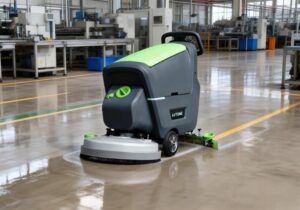
These machines are commonly used in environments such as manufacturing plants, distribution facilities, workshops, large storage areas, and other sites with extensive hard flooring.
Industrial environments may expose cleaning equipment to:
Dust and fine particles, oil or grease, tire marks, production residue, frequent vehicle traffic, large cleaning areas, longer operating hours, and uneven cleaning schedules.
As a result, an industrial floor cleaning machine may use a larger cleaning deck, higher-capacity solution and recovery tanks, more robust components, stronger drive systems, and configurations designed for longer cleaning routes.
Not every industrial facility requires the largest machine available. A compact industrial walk-behind scrubber may still be the correct choice if the site contains narrow production aisles or many obstacles.
The application should determine the machine.
What Is a Commercial Floor Scrubber?
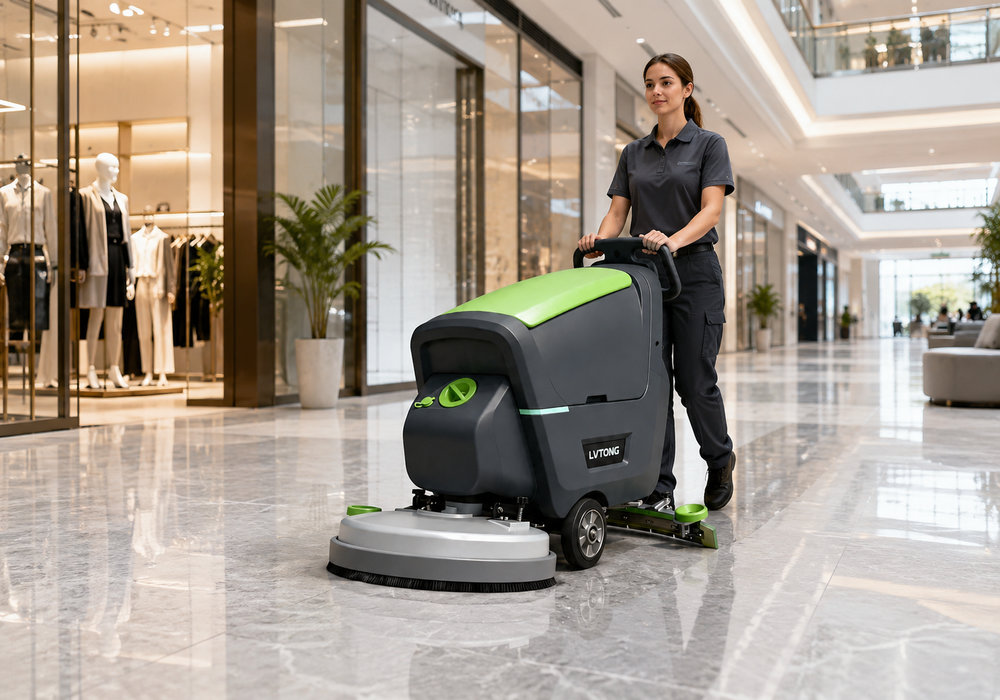
A commercial floor scrubber is primarily designed for regular floor maintenance in commercial and public environments.
Typical applications include:
Shopping centers, office buildings, hotels, healthcare facilities, retail stores, schools, restaurants, and other occupied buildings.
In these environments, the cleaning challenge is often different from heavy industry.
Operators may need to clean around people, furniture, displays, doors, elevators, shelves, and narrow passages. Noise may also be important if cleaning takes place during business hours.
For this reason, commercial machines often place greater emphasis on compact dimensions, maneuverability, operator convenience, noise control, and compatibility with finished floor surfaces.
This does not mean commercial machines are weak. A well-selected commercial scrubber can deliver excellent productivity when its design matches the cleaning area and contamination level.
Are “Industrial” and “Commercial” Floor Scrubbers Really Different Categories?
This is an important distinction for buyers.
The terms industrial floor scrubber and commercial floor scrubber are widely used in the cleaning equipment market, but they are not always based on a universal technical standard.
Manufacturers may classify similar-sized machines differently.
If you are still comparing machine formats and cleaning technologies, our guide to the types of floor scrubbers explains how walk-behind, ride-on, robotic, disc, cylindrical, and orbital scrubbers differ.
Instead of relying only on the category name, compare the specifications and operating conditions that determine actual performance.
The most important factors include duty cycle, cleaning width, tank capacity, brush system, brush pressure, water recovery, battery configuration, drive system, turning radius, machine dimensions, serviceability, and recommended cleaning area.
A machine should be selected according to what it needs to do—not simply according to whether the product brochure calls it “industrial” or “commercial.”
1. Facility Size and Daily Duty Cycle
One of the clearest differences is the expected workload.
An industrial floor cleaner machine may need to clean a large facility every day, complete several cleaning routes, or operate for extended periods.
In these situations, productivity becomes critical.
A machine that is perfectly suitable for a small commercial building may require too many tank refills, battery charging interruptions, or operator hours when used in a much larger industrial environment.
Commercial facilities often operate differently.
A hotel lobby, retail store, office corridor, or healthcare area may be cleaned in specific time windows. The machine may operate for shorter periods and cover multiple smaller areas instead of one continuous large floor.
Ask This Before Choosing
Instead of asking only:
How large is the building?
Ask:
How many square meters must actually be cleaned, and how much time is available to complete the work?
Those two figures provide a much better basis for comparing machines.
For warehouse-specific sizing, aisle-width, floor-type, and productivity considerations, see our warehouse floor scrubber guide before selecting a machine.
2. Floor Conditions and Contamination
The type of dirt on the floor can be just as important as the size of the facility.
Industrial facilities may need to remove:
Oil, grease, tire marks, fine dust, mud, metal particles, production residue, and other difficult contamination.
Commercial facilities more commonly deal with:
Dust, footprints, beverage spills, food residue, tracked-in dirt, and normal pedestrian traffic.
This difference affects the required brush or pad, brush pressure, cleaning chemical, water flow, and number of cleaning passes.
A heavy-duty floor cleaning machine may offer better results in challenging environments, but the machine alone does not determine cleaning performance.
The correct brush or pad and cleaning process must also match the floor material.

3. Floor Material
Industrial and commercial machines can both clean many hard-floor surfaces, but the cleaning configuration should be selected carefully.
Common industrial floors include:
Concrete, epoxy flooring, industrial hardened floors, coated production floors, and other durable surfaces.
Commercial floors may include:
Ceramic tile, terrazzo, marble, vinyl, finished floors, and other decorative surfaces.
A more aggressive brush is not always better.
For sensitive floors, excessive abrasion or unsuitable pads can damage the surface. For heavily contaminated concrete, a cleaning system that is too gentle may require repeated passes and increase labor time.
The correct floor cleaner should balance cleaning performance with floor protection.
4. Cleaning Width and Productivity
Industrial applications usually place greater emphasis on productivity.
A wider cleaning path can reduce the number of passes required to clean a large open floor. This can be valuable in production plants, large storage areas, and other sites with long cleaning routes.
However, wider is not automatically better.
A machine that performs efficiently in an open industrial hall may struggle in a facility with narrow aisles, racks, machines, pillars, or frequent turns.
Commercial environments often benefit from smaller machines because they need to clean around furniture, retail displays, doors, elevators, and pedestrian areas.
When comparing machines, consider both:
Rated productivity and real-world productivity.
Manufacturer-rated cleaning capacity can help compare models, but actual productivity is affected by turning, water filling, recovery tank emptying, obstacles, operator experience, cleaning speed, and the number of required passes.
5. Tank Capacity and Water Management
Tank capacity has a direct impact on cleaning workflow.
A larger solution tank can allow an industrial floor cleaner machine to clean for longer before returning to a filling point.
A larger recovery tank can also reduce interruptions for wastewater disposal.
This matters in large facilities where the distance between the cleaning area, water supply, and drainage point may be significant.
Commercial machines may use smaller tanks because compact size and maneuverability are more important.
For a small facility, a very large tank can add unnecessary machine size and weight.
Therefore, tank capacity should be evaluated together with cleaning area and water access.
6. Battery Runtime and Charging
Battery runtime is frequently used to compare floor scrubbers, but the advertised number should not be viewed in isolation.
Actual operating time can change according to:
Battery type and capacity, brush motors, vacuum system, drive motor, machine speed, floor conditions, brush pressure, battery age, and operator settings.
For a more detailed comparison of battery types, runtime, charging requirements, cycle life, and replacement considerations, read our guide to floor scrubber battery life.
Industrial machines often use battery configurations intended to support longer cleaning routes.
Commercial machines may use smaller battery systems because they typically complete shorter cleaning cycles.
The important question is:
Can the machine complete the required cleaning route within your available cleaning window without creating unnecessary charging interruptions?
Also consider the charging environment.
Facilities should confirm charger compatibility, available electrical supply, charging time, charging location, ventilation requirements where applicable, and whether additional battery capacity is necessary.
7. Construction and Durability
Industrial cleaning equipment frequently operates in more demanding environments.
The machine may work close to forklifts, production equipment, loading areas, dust, debris, and high-traffic routes.
For this reason, industrial equipment is often designed with durability, component protection, chassis strength, and service access in mind.
Commercial machines generally place more emphasis on compact dimensions and easy handling, although professional commercial equipment can still be very durable.
When evaluating construction, look beyond the external cover.
Consider:
Chassis design, wheel quality, squeegee protection, brush deck design, hose routing, electrical protection, bumper placement, component accessibility, and availability of wear parts.
These details often affect long-term ownership more than appearance.
8. Maneuverability, Noise and Operator Comfort
Commercial environments frequently operate while customers, employees, patients, guests, or students are present.
Therefore, machine size and noise can strongly influence equipment selection.
A compact commercial floor scrubber may be easier to operate in:
Narrow corridors, elevators, retail aisles, reception areas, dining spaces, and rooms containing furniture.
Industrial sites may have larger open areas, but maneuverability still matters around production lines, warehouse racks, equipment, columns, and loading zones.
Operator comfort is also important.
For longer cleaning shifts, evaluate steering effort, visibility, seat position for ride-on machines, control layout, vibration, mounting and dismounting, and access to daily maintenance points.
A productive machine should not create unnecessary operator fatigue.
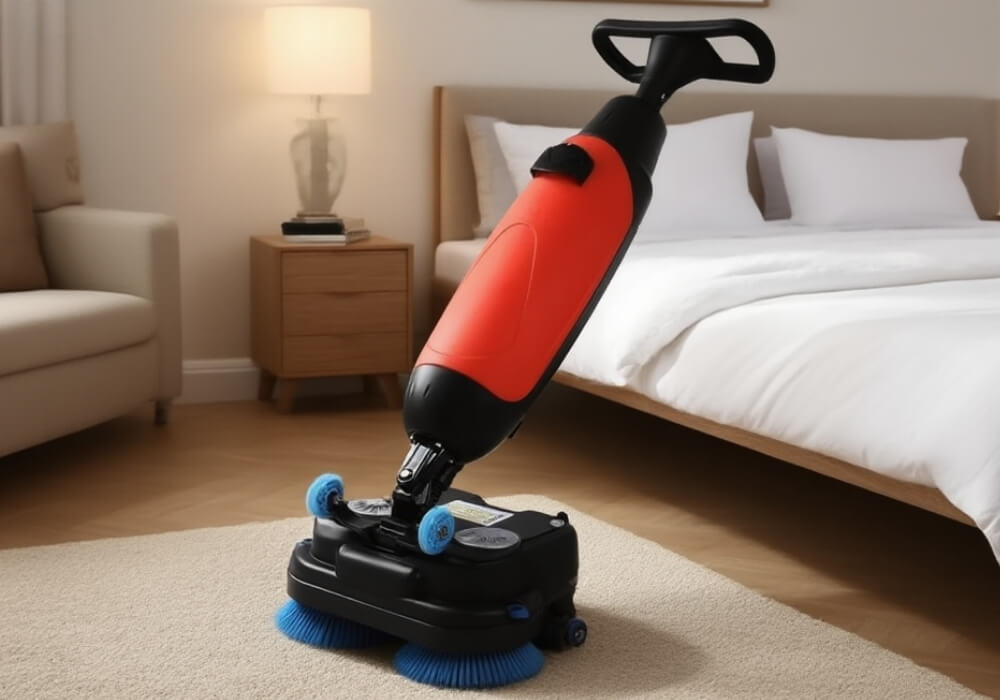
Industrial vs. Commercial Cleaning Systems
Both industrial and commercial floor scrubbers use a scrubbing system to loosen soil and a vacuum recovery system to collect dirty water.
The difference is usually found in how the system is configured for the application.
Industrial machines may prioritize higher productivity, more demanding cleaning conditions, and longer duty cycles.
Commercial machines may prioritize smooth operation, floor protection, maneuverability, and quieter cleaning.
Brush or pad selection remains critical in both environments.
Depending on the machine and application, buyers should evaluate:
Disc or other supported scrubbing systems, brush material, pad type, brush pressure, squeegee design, vacuum performance, chemical compatibility, and water flow control.
Do not choose a floor scrubber based only on motor power.
Cleaning performance is the result of the complete cleaning system.
Industrial vs. Commercial Power Systems
Battery-powered floor scrubbers are widely used because they allow cordless operation and help reduce restrictions caused by power cables.
However, battery capacity should be matched to the workload.
An industrial floor cleaner machine used for extended routes may require more available battery energy than a compact scrubber performing short scheduled cleaning tasks.
Commercial equipment may prioritize compact batteries, simplified charging, and lower machine weight.
When comparing battery systems, consider:
Battery chemistry, rated capacity, expected runtime, charging time, charger requirements, battery replacement cost, and local parts availability.
A longer advertised runtime is only useful if the machine can also be serviced and charged efficiently.
Cleaning Results: Heavy Soil vs. Daily Maintenance
Industrial cleaning often focuses on removing difficult contamination while maintaining large operational areas.
This may include repeated cleaning of tire marks, oily residue, dust, tracked-in dirt, and production-related contamination.
Commercial cleaning often focuses on maintaining appearance and hygiene throughout the day.
The main challenge may be frequent but lighter contamination.
This distinction affects machine selection.
A commercial machine may work perfectly well inside an industrial building if the floor remains relatively clean and the area is small.
Likewise, a larger commercial facility may require a high-productivity ride-on machine even though the site is not classified as industrial.
The actual cleaning problem is more important than the facility label.
Recommended Applications
| Facility Condition | Recommended Starting Point |
|---|---|
| Large open industrial floor | Industrial floor cleaner machine |
| Heavy dirt or frequent contamination | Industrial configuration |
| Long daily cleaning route | Industrial configuration |
| Production area with demanding operating conditions | Industrial configuration |
| Small office or retail area | Commercial floor scrubber |
| Narrow aisles or many obstacles | Compact commercial or compact industrial machine |
| Noise-sensitive occupied environment | Commercial-oriented machine |
| Light daily floor maintenance | Commercial floor scrubber |
| Mixed industrial and public areas | Evaluate each cleaning zone separately |
This table should be treated as a starting point.
The final choice still depends on floor type, cleaning width, contamination, available time, operator requirements, and facility layout.

Can a Commercial Floor Scrubber Clean a Factory Floor?
Yes, in some situations.
The word “factory” does not automatically mean that an industrial machine is required.
A commercial floor scrubber may be suitable when:
The cleaning area is relatively small, contamination is light, the floor is smooth, cleaning routes are short, and the machine is not required to operate continuously.
However, a more industrial configuration is usually preferable when the facility has heavy contamination, long cleaning routes, demanding working conditions, or high daily utilization.
Instead of choosing equipment according to the building name, evaluate the workload.
Can an Industrial Floor Cleaner Machine Be Used in Commercial Facilities?
Yes.
An industrial floor cleaner machine can be used in some large commercial facilities, particularly when productivity is more important than compact size.
For example, a large exhibition hall, transportation facility, or extensive commercial complex may have cleaning requirements similar to an industrial site.
However, a machine that is too large can create problems with elevators, doors, narrow passages, storage, turning radius, and daytime cleaning.
The machine must still fit the building.
Walk-Behind or Ride-On: Which Configuration Is Better?
Industrial and commercial floor scrubbers are available in different machine formats.
The correct format depends mainly on floor area and layout.
Walk-behind machines are generally useful where maneuverability is important or cleaning routes are relatively short.
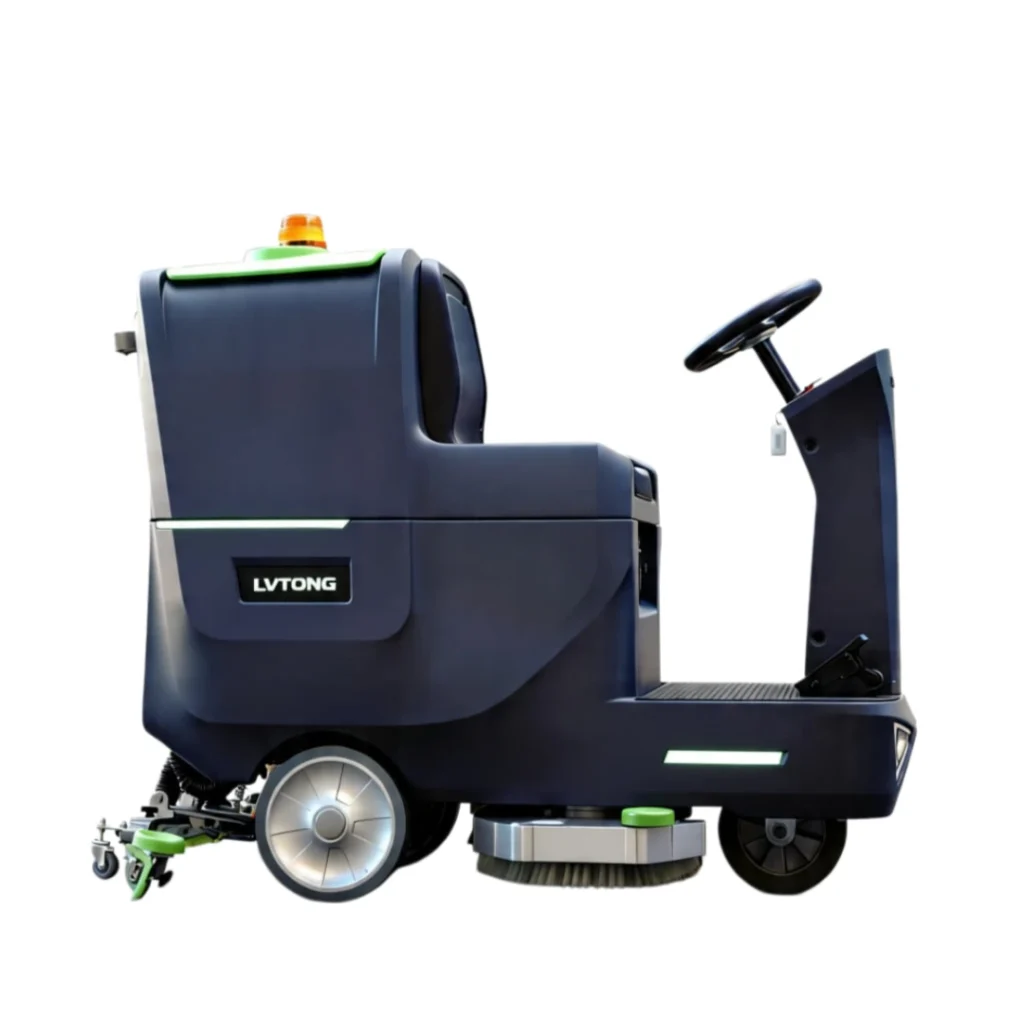
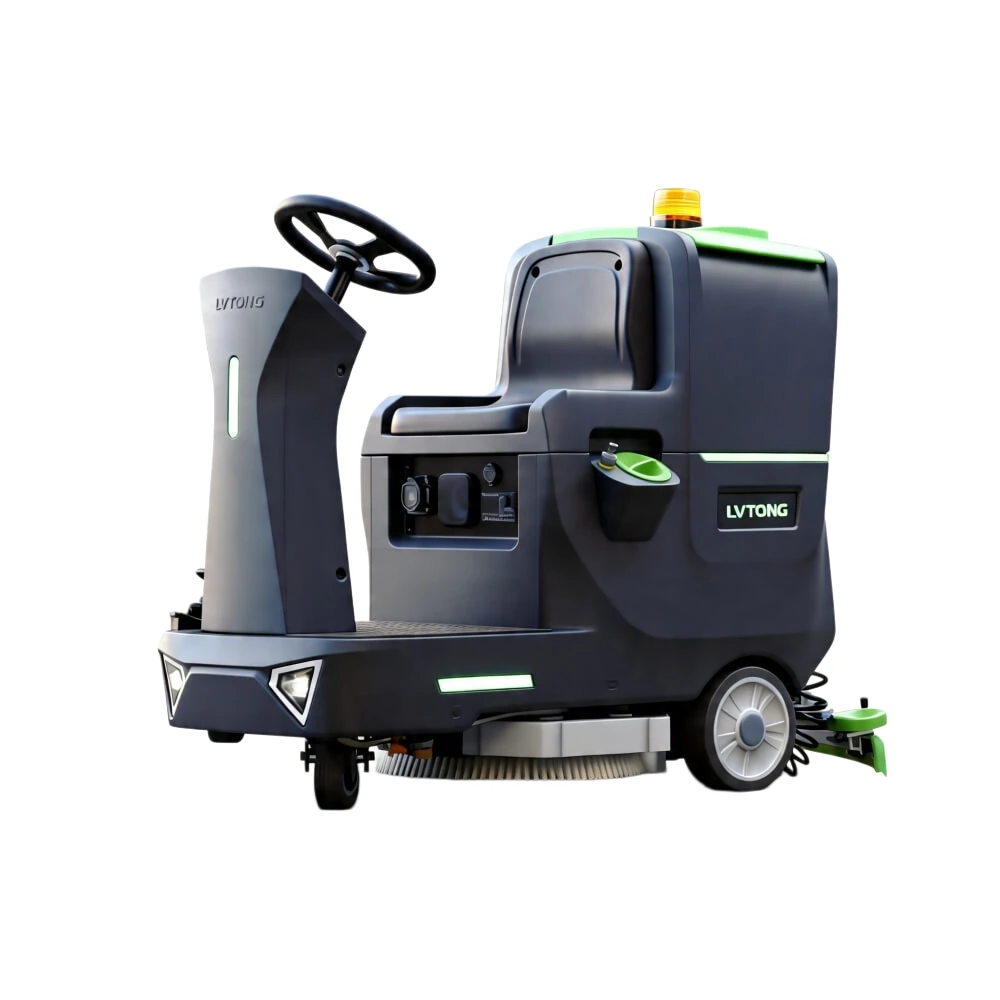
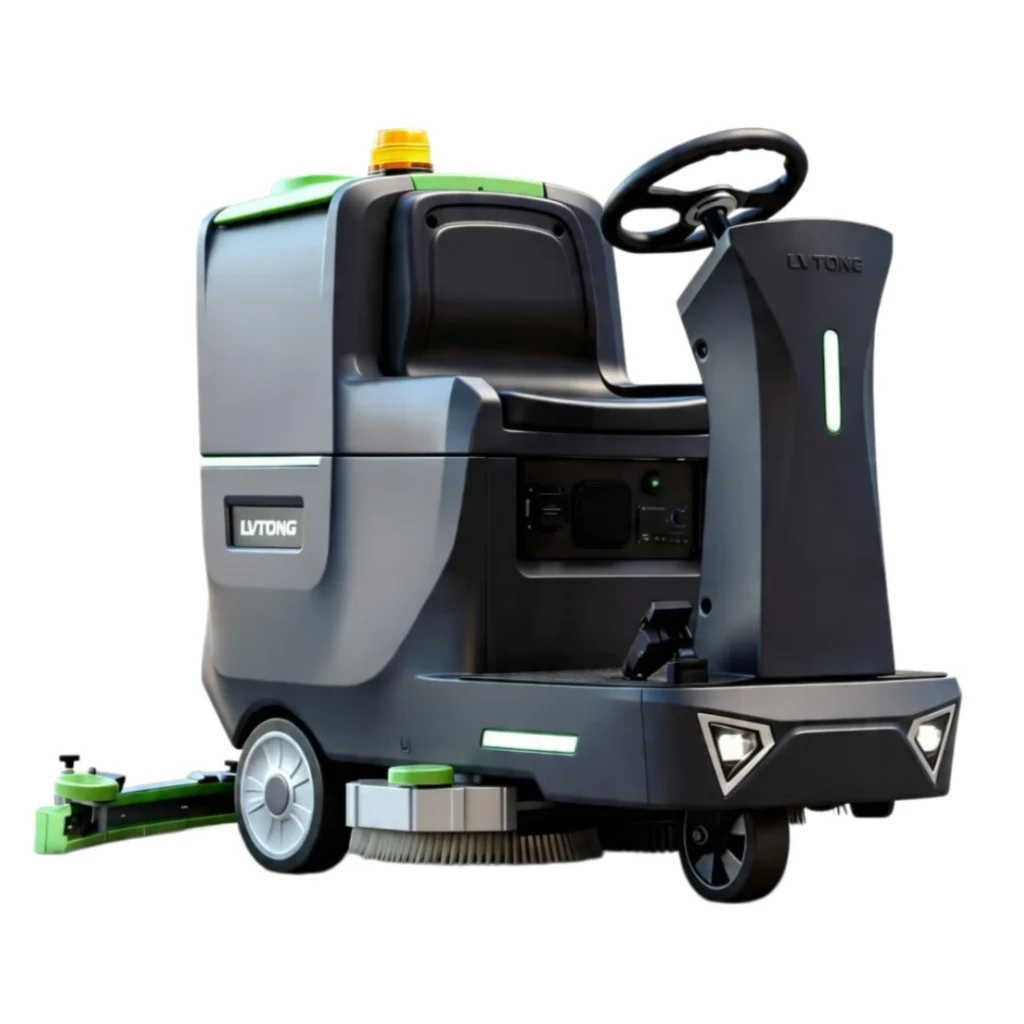
Ride-on machines become more attractive as cleaning areas and travel distances increase because they can reduce operator walking and improve productivity.
However, machine format should not be confused with industrial or commercial classification.
A walk-behind machine can be industrial, and a ride-on machine can be used in commercial applications.
Choose according to workload rather than appearance.
Operation and Maintenance
Ease of Operation
Both industrial and commercial floor scrubbers should be easy enough for trained operators to use consistently.
A clear control layout helps reduce training time and operating mistakes.
Commercial cleaning teams may place additional emphasis on quick operator changes and straightforward controls because several employees may use the same machine.
Industrial operations may place more emphasis on durability, operating status, diagnostics, and control over cleaning settings.
Before purchasing, a practical machine demonstration can help determine whether operators can use the equipment comfortably.
Daily Maintenance
Routine maintenance has a major impact on cleaning performance and machine life.
Typical tasks include checking and cleaning:
Brushes or pads, squeegee blades, recovery tank, solution tank, filters, hoses, wheels, battery connections, and charging equipment.
For a complete daily, weekly, monthly, and annual service routine, use our floor scrubber maintenance checklist to help reduce avoidable downtime.
Machines working in dusty or heavily contaminated industrial environments may require more frequent inspection.
More important than assuming that industrial equipment is always more expensive to maintain is understanding the specific model.
Before purchasing, ask the supplier:
Which wear parts are replaced most often?
How much do they cost?
Which parts should be stocked locally?
How quickly can technical support be provided?
How easy is it to access motors, batteries, brushes, hoses, and squeegee assemblies?
Serviceability can significantly influence total cost of ownership.
Industrial vs. Commercial Floor Scrubber Cost
Industrial floor cleaner machines are often more expensive because larger or higher-duty models may use larger batteries, tanks, cleaning decks, drive systems, and structural components.
Commercial machines are often less expensive, especially compact walk-behind models.
However, purchase price alone does not determine whether a machine is cost-effective.
If you are comparing upfront investment with long-term operating value, our industrial floor scrubber price guide explains why industrial models cost more and when the higher investment can make financial sense.
A less expensive machine may become costly if it requires substantially more labor to clean the same area.
A larger machine may also be a poor investment if it cannot move efficiently through the facility.
The correct comparison is total cost of ownership.
Consider:
Purchase Price + Labor + Energy + Cleaning Consumables + Wear Parts + Maintenance + Downtime
Then compare that cost with the amount of floor the machine must clean over its expected working life.
How to Compare Total Cost of Ownership
For large facilities, labor is often one of the most important variables.
If a more productive machine reduces the number of operating hours required to complete a cleaning route, the higher initial equipment cost may be justified.
For smaller facilities, the opposite may be true.
A large industrial machine may offer excellent rated productivity but provide little financial benefit if it spends most of its time maneuvering through narrow areas.
This is why machine selection should begin with the facility rather than with a product catalog.
Which Floor Scrubber Is Better for Your Facility?
An industrial floor cleaner machine is generally the better starting point if your facility has:
Large cleaning areas, heavy contamination, long cleaning routes, high equipment utilization, difficult floor conditions, or limited time to complete cleaning.
A commercial floor scrubber is usually a better starting point if your priorities are:
Compact size, maneuverability, low noise, routine maintenance cleaning, simple operation, and access to narrow spaces.
For mixed-use facilities, you may not need to make one choice for the entire building.
Some sites use a larger machine for open areas and a smaller scrubber for narrow or occupied zones.
What Specifications Should You Compare Before Buying?
Do not compare two floor scrubbers only by price.
A professional comparison should include:
| Specification | Why It Matters |
|---|---|
| Cleaning width | Determines how much floor is covered per pass |
| Squeegee width | Affects water recovery coverage |
| Solution tank capacity | Influences refill frequency |
| Recovery tank capacity | Influences wastewater disposal frequency |
| Rated productivity | Helps estimate cleaning time |
| Battery configuration | Influences runtime and charging |
| Brush type | Must match floor and contamination |
| Brush pressure | Influences scrubbing performance |
| Turning radius | Important in narrow facilities |
| Machine dimensions | Determines access through aisles, doors and elevators |
| Gradeability | Relevant where ramps or slopes are present |
| Noise level | Important in occupied spaces |
| Service access | Affects maintenance time |
| Spare parts availability | Influences downtime |
| Operator ergonomics | Affects productivity during longer shifts |
Comparing these specifications provides a more reliable decision than simply comparing whether two machines are labeled “industrial” or “commercial.”
A Simple Floor Scrubber Selection Example
Consider two facilities.
Facility A has a large open production floor, long cleaning routes, frequent tire marks, and only a limited cleaning window between shifts.
Productivity, tank capacity, durability, and cleaning performance are likely to be the main priorities. An industrial floor cleaner machine would normally be the better starting point.
Facility B has several smaller public areas, narrow corridors, elevators, light daily dirt, and cleaning takes place while the building remains occupied.
Maneuverability, compact size, noise, and operator convenience are more important. A commercial floor scrubber is likely to be more suitable.
This illustrates why there is no single “best” category for every site.
Frequently Asked Questions
What is the difference between an industrial floor cleaner machine and a commercial floor scrubber?
An industrial floor cleaner machine is generally designed for heavier workloads, larger areas, longer cleaning routes, and more demanding operating conditions. A commercial floor scrubber usually prioritizes maneuverability, lower noise, compact dimensions, and routine daily floor maintenance.
The exact difference depends on the machine specifications rather than the category name alone.
Is an industrial floor scrubber always larger than a commercial floor scrubber?
No.
Industrial machines are often larger, but machine size is not the only difference.
Compact industrial scrubbers are available for demanding cleaning in smaller spaces, while large commercial facilities may use ride-on machines.
Duty cycle, construction, tank capacity, cleaning system, and application are more useful selection factors.
When should I choose an industrial floor cleaner machine?
Choose an industrial floor cleaner machine when your operation involves large cleaning areas, heavier dirt, longer operating periods, demanding floor conditions, or high daily utilization.
It is particularly important to evaluate required productivity and how much time is available to complete each cleaning cycle.
Can a commercial floor scrubber clean factory floors?
Yes, if the cleaning area and contamination level are relatively light.
A commercial machine may be suitable for offices, inspection areas, corridors, or lightly contaminated sections inside a factory.
Heavy production areas with oil, debris, long routes, or frequent cleaning normally require a more industrial configuration.
Which is more important: cleaning width or tank capacity?
Both affect productivity.
A wider cleaning deck reduces the number of passes required, while larger tanks reduce interruptions for filling and emptying.
The best combination depends on facility size, aisle width, water access, and the required cleaning time.
Do industrial floor scrubbers have longer battery life?
They are often configured for longer operating requirements, but battery runtime varies significantly by model.
Battery capacity, brush and vacuum motors, drive system, floor condition, operating speed, battery age, and cleaning settings all affect actual runtime.
Always compare the battery system with your required cleaning route instead of relying only on a general runtime claim.
Is an industrial floor cleaner machine more expensive to maintain?
Not necessarily.
Larger and more complex machines may have higher parts and service costs, but maintenance expenses depend heavily on machine design, operating environment, maintenance practices, parts availability, and local technical support.
Compare expected wear parts and service requirements before purchasing.
Which floor scrubber is more cost-effective?
The most cost-effective machine is the one that completes the required cleaning work with the lowest practical total cost.
For a large facility, a higher-productivity industrial machine may reduce labor cost.
For a smaller facility, a compact commercial machine may deliver a better return because it costs less and is easier to maneuver.
Conclusion
The difference between an industrial floor cleaner machine and a commercial floor scrubber is not simply machine size.
Industrial equipment generally places greater emphasis on productivity, durability, heavy-duty cleaning, larger cleaning areas, and longer operating cycles.
Commercial equipment generally places greater emphasis on maneuverability, quieter operation, compact dimensions, and routine daily maintenance.
Before choosing a machine, evaluate:
cleaning area, floor type, contamination, available cleaning time, aisle width, tank capacity, battery requirements, maintenance, and local service support.
These factors provide a much more reliable basis for equipment selection than the words “industrial” or “commercial” alone.
Need Help Choosing the Right Floor Cleaning Machine?
If you are comparing machines for a factory, commercial building, distribution facility, or other large hard-floor environment, LVTONG can help evaluate the application before you select a configuration.
For a more accurate recommendation, send us:
Cleaning area + floor type + main contamination + narrowest aisle width + daily cleaning hours + country or market
Our team can use this information to help you identify a more suitable machine type, cleaning width, battery configuration, and operating setup.