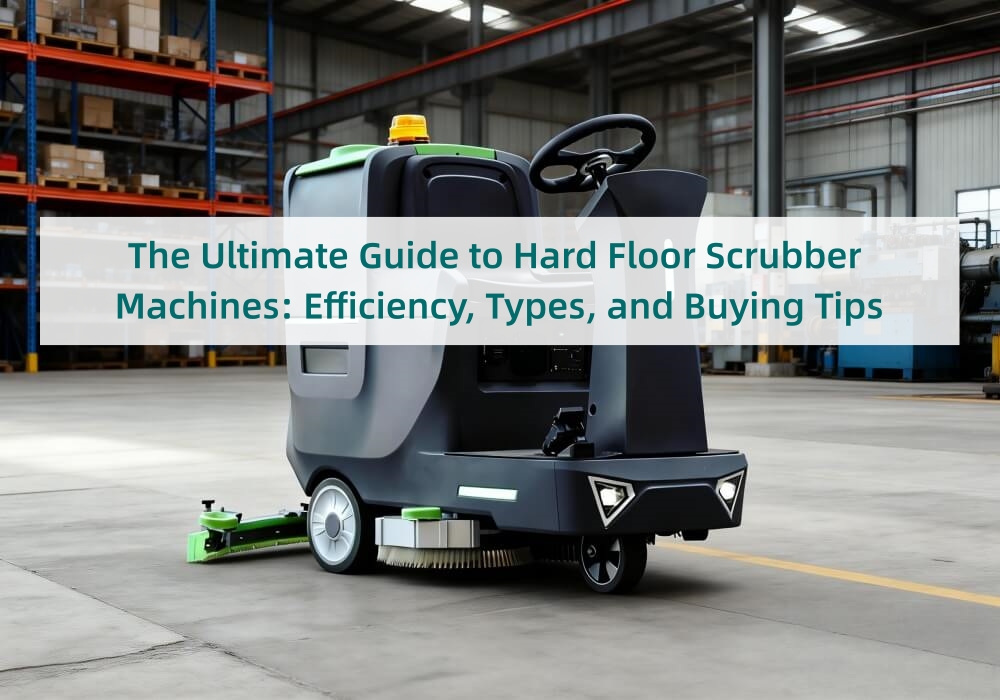
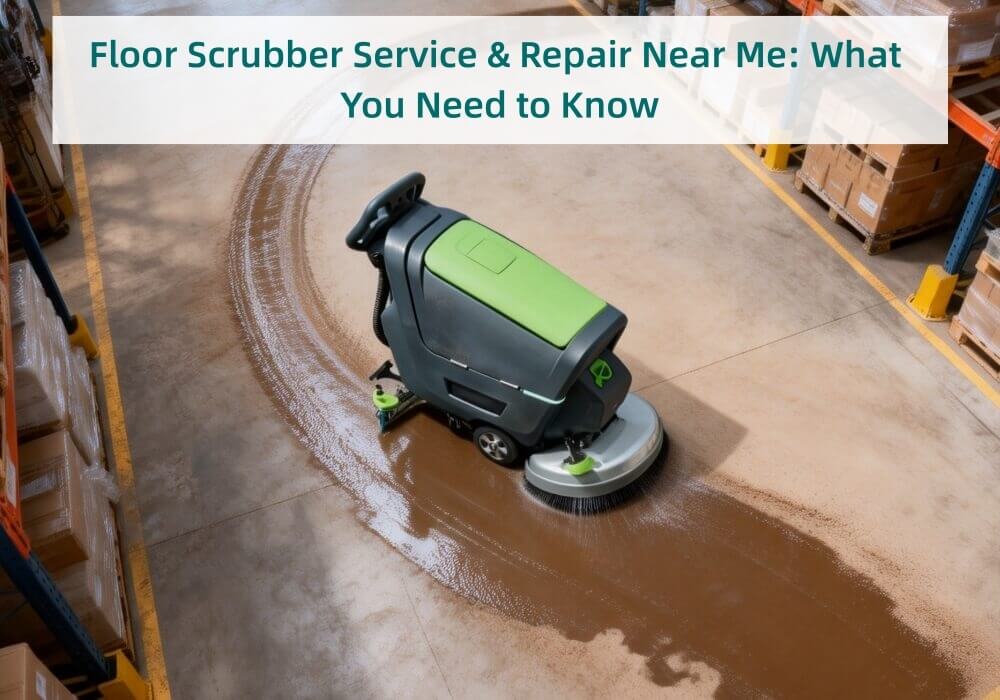
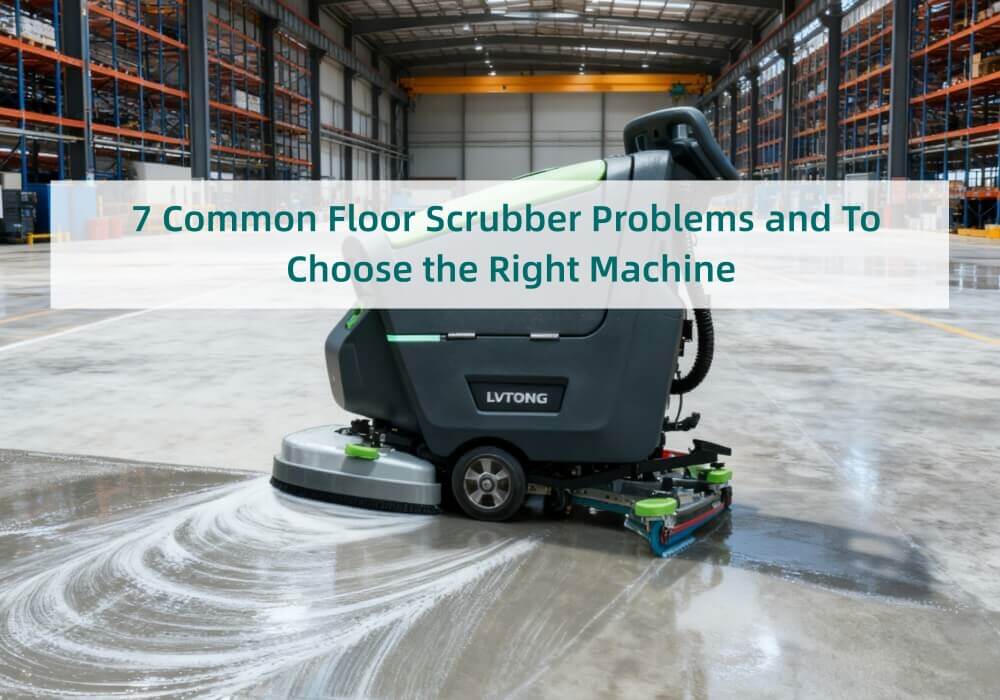
Selecting the right warehouse floor scrubber means looking closely at how big your space is, how much dirt builds up, and what the floors are like - this helps things run smoothly while spending less on cleanups. If your building covers many square feet, getting tough industrial machines might cut worker expenses by a solid percentage, sometimes freeing up thousands each week.
We’ll break down exactly what matters when picking a heavy-duty floor scrubber for warehouses, checking differences between walk-behind floor scrubbers and ride-on floor scrubbers. You could be running a compact storage site or handling operations at a huge freight terminal - either way, knowing these points leads to smarter gear choices.
Choosing the Right Industrial Floor Scrubber for Your Warehouse Environment
The choice starts with how big the space is - that’s what matters most. Places ranging from 500 to 5,000 square feet usually work better with walk-behind machines or small ride-ons, whereas bigger sites over 5,000 square feet need a larger ride-on floor cleaning machine to clean quickly. Picking the right one ties back to what we cover in our basic guide about choosing a floor scrubber for factories.
Floor surface composition plays an equally crucial role, influencing both cleaning efficacy and machine longevity:
- Smooth Concrete & Epoxy Floors: Best suited for disk scrubbers. Their design concentrates the motor's weight directly over the brush, creating higher down pressure (measured in PSI) for deep cleaning of flat surfaces.
- High-Debris Environments (e.g., wood shops, metal fabrication): Benefit from cylindrical scrubbers. These scrubbers operate at higher RPMs (approx. 600-900 RPM) and function with a sweep-and-scrub mechanism, tossing small debris into a hopper before the scrubbing action. This prevents squeegee clogs and improves water recovery.
- Rough or Uneven Surfaces (e.g., old concrete, grouted tile): May require specialized grit brushes on a disk platform with a flexible pad driver to follow floor contours.
Our proprietary Cleaning Efficiency Framework balances three key variables:
- Practical Coverage Rate (sq ft/hr): Not just the theoretical maximum, but the real-world output after accounting for turns, overlaps, and tank refills.
- Maneuverability & Access: Measured by turning radius and machine dimensions, ensuring access to narrow aisles and perimeter areas.
- Total Cost of Ownership (TCO): A comprehensive calculation including acquisition, labor, consumables, and maintenance over the asset's lifecycle. We will explore this with a formula later in the guide.
Walk-Behind vs. Ride-On Warehouse Scrubbers: A Direct Comparison
| Feature | Walk-Behind Models | Ride-On Models |
|---|---|---|
| Cleaning Width | 17 - 32 inches (43-81 cm) | 28 - 48 inches (71-122 cm) |
| Theoretical Coverage Rate | 18,000 - 35,000 sq ft/hr | 30,000 - 96,800 sq ft/hr |
| Practical Coverage Rate (ISSA Est.) | Approx. 10,000 - 20,000 sq ft/hr | Approx. 22,000 - 65,000 sq ft/hr |
| Solution/Recovery Tank Capacity | 10 - 25 gallons | 30 - 70+ gallons |
| Down Pressure Range | 50 -150 lbs (manual or actuator) | 150 - 400+ lbs (machine weight) |
| Ideal Facility Size | 5,000 - 20,000 sq ft | 20,000 - 200,000+ sq ft |
| Acquisition Cost (Est.) | 8,000 - 15,000 | 20,000 - 50,000+ |
| Operator Fatigue | Moderate to High | Low |
| Maneuverability | Excellent in tight, congested areas | Superior in open spaces, limited in narrow aisles (< 6 ft) |
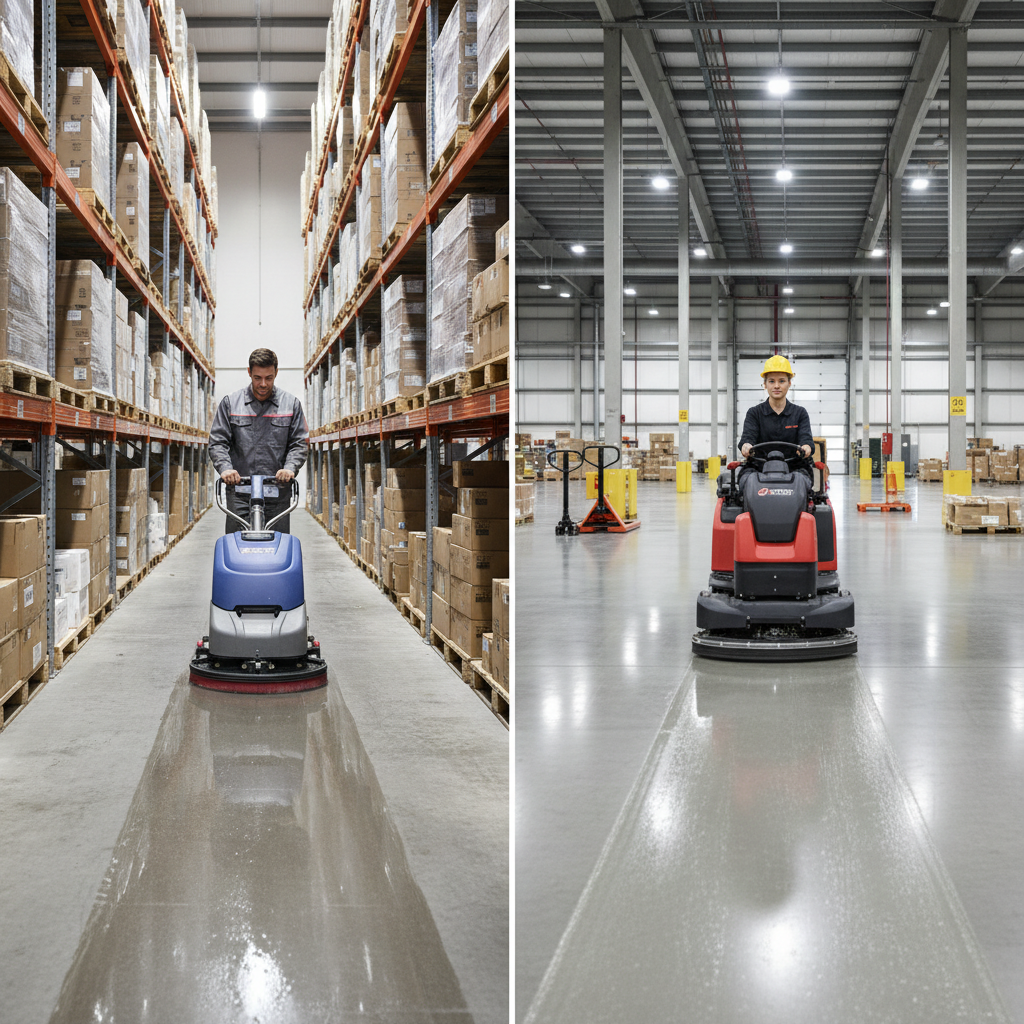
To see these specifications in action, you can explore LVTONG's range of walk-behind scrubbers, which are designed for agility in confined spaces. For larger facilities, understanding the productivity gains offered by our industrial ride-on scrubbers provides a clearer path to optimizing your cleaning operations.
How hard should I press the brush when cleaning a warehouse floor?
In warehouses, walk-behind scrubbers rely on how much weight presses down through the brushes to clean well. Because ride-on units use their own mass across a broader base, they push harder on the floor - so they handle grime-heavy spots better. That’s why busy sections with tough stains often need these larger machines instead.
Key Performance Metrics: Evaluating Scrubber Efficiency
Evaluating a scrubber's efficiency doesn't have to be complicated. Here are two simple, vital calculations you can use to compare floor scrubbers and forecast your labor costs accurately.
1. Coverage Rate and Productivity
First, let's figure out the maximum area a machine can clean. This is called the theoretical coverage rate. While manufacturers often advertise this number, it's not what you'll get in the real world. Still, it's a useful starting point.
The Simplified Formula:
- Theoretical Coverage (sq ft/hr) = Cleaning Width (in) × Operating Speed (mph) × 440
This formula combines all the necessary conversions into one easy-to-use number: 440.
From Theory to Reality:
No one cleans in a straight line forever. The International Sanitary Supply Association (ISSA) acknowledges that turns, overlaps, and refilling tanks reduce the theoretical rate. A realistic number, the Practical Coverage Rate, is often only 50-60% of the theoretical maximum.
- Why this adjustment? Our internal testing, conducted across various client facilities, confirms that practical cleaning time is consumed by non-productive activities such as turning at the end of aisles, navigating around temporary obstacles, and operator overlaps. A factor of 0.55 is a reliable estimate for moderately-racked warehouses with standard 10-12 ft aisles. For open-plan facilities, this factor may increase to 0.65, while highly congested environments might see it drop to 0.45.
Example:
Let's take a 36-inch ride-on scrubber that operates at 3.5 mph.
- Theoretical Rate: 36 in×3.5 mph×440=55,440 sq ft/hr
- Practical Rate: 55,440×0.55=30,492 sq ft/hr
This practical rate is the number you should use to calculate how long a job will actually take.
2. Tank Capacity and Uptime
A bigger tank means less time wasted driving to a drain and faucet. This continuous cleaning time is a critical performance indicator (KPI).
- Compact Walk-Behinds: 10-15 gallons
- Large Walk-Behinds: 20-30 gallons
- Industrial Ride-Ons: 40-70+ gallons
You can calculate this with a simple formula:
- Time Between Refills (in minutes) = Solution Tank Capacity (gallons) ÷ Solution Flow Rate (gallons per minute)
Example:
- A scrubber with a 40-gallon tank using 0.75 gallons per minute (gpm) can run for over 53 minutes (40÷0.75=53.3).
- A smaller 10-gallon unit using 0.5 gpm needs a refill every 20 minutes (10÷0.5=20).
That extra 30 minutes of continuous work per cycle is where large ride-on scrubbers generate massive labor savings.
For commercial appliances, adherence to electrical safety standards, often governed by bodies such as UL (Underwriters Laboratories), is crucial for battery and charging system reliability.
Essential Features for High-Traffic Warehouse Cleaning
Brush Systems
- Disk scrubbers: 200-240 RPM for maximum pressure
- Cylindrical units: 630 RPM with debris capture
- Synthetic brushes for chemical resistance
Water Recovery
Industrial models feature powerful vacuum systems that minimize slip hazards and reduce drying time to 15-30 minutes, allowing for a rapid return to operations.
Brushes and Squeegees
Brush and squeegee replacement typically follows this schedule:
- High-traffic areas: Monthly evaluation
- Standard use: Quarterly replacement
- Light duty: Semi-annual inspection
Recommendations by Facility Size
Small Warehouses (5,000-20,000 sq ft)
Small walk-behind scrubbers with a narrow cleaning path handle cluttered spaces well while still covering enough ground each day. Take the Q5 Industrial Walk Behind Floor Scrubber as an example- it works reliably even in cramped hallways, showing how practical this type can be.
Mid-Size Facilities (20,000-50,000 sq ft)
Think big walk-behind models or compact ride-on machines with 28 to 36-inch cleaning decks. They get way more done than tiny ones, yet still turn easily in tight aisles. If your space is on the larger side, go for a small ride-on floor scrubber, like the LVTONG V6 ride-on floor scrubber, which handles floors faster without losing agility.
Large Operations (50,000+ sq ft)
For such jobs, heavy-duty ride-on scrubbers make a big difference. Pick ones with broad cleaning widths plus roomy water tanks to cut down on refills and save time. If your site runs on EPA Safer Choice-approved cleaners, double-check that the machine’s seals, gaskets, and tubing resist chemical wear - this keeps parts from failing early. Take the LVTONG LT-S860X Ride On Scrubber - it’s built for places like yours, offering wide coverage along with high tank capacity so you stay productive longer.
Case Study: How a Distribution Center Cut Cleaning Costs
A large 3PL warehouse space sees constant forklift movement - leaving behind ongoing tire scuffing across floors.
The problem? They were stuck with two-inch walk-behind scrubbers from a different company - those needed way too much time every day, but still gave spotty clean-ups. Water wasn't being sucked up well, so puddles often stayed behind, which meant slippery floors or delays in work.
Solution: Once we checked the location, experts suggested swapping out both units for one LT-S710X Ride-On Floor Scrubber.. Because it cleans with two brushes at once, applies strong downward force - plus offers multiple settings - the crew saw it’d handle tough spots better. With a scrubbing path of mm wide, this model fit just right.
The Results:
- Drastic Labor Reduction: Cleaning time was reduced from 16 labor hours to just 5.5 hours for one operator, a 65% reduction.
- Measurable Efficiency Gains: The LT-S710X demonstrated a cleaning efficiency over 12 times that of manual methods, allowing staff to be reallocated to other value-added tasks.
- Safety Improvement: The accident rate associated with slip-and-falls was reduced by over 90% due to the machine's excellent water recovery, leaving floors immediately dry.
Total Cost of Ownership Considerations
A strategic acquisition focuses on the Total Cost of Ownership (TCO), not the purchase price. At LVTONG, we encourage clients to use this formula to compare machines objectively:
TCO=Acquisition Cost((Annual Labor Cost+Annual Maintenance Cost+Annual Consumables Cost)×Asset Lifespan)
- Annual Labor Cost is the biggest factor. A more productive machine offers exponential savings.
For example, cleaning a 100,000 sq ft area daily at a $20/hr labor rate:
- A standard walk-behind (practical rate: 15,000 sq ft/hr) costs $34,667 annually in labor.
- An efficient ride-on like the LVTONG LT-S710X (practical rate: ~30,000 sq ft/hr) costs just $17,333 annually in labor.
That's over $17,000 in savings each year from a single machine upgrade. This is why TCO, not purchase price, should guide your decision.
Conclusion: Making Data-Driven Scrubber Selection Decisions
Picking the right floor scrubber for your warehouse means looking at several things carefully - this helps you clean better while getting more value from what you spend. Instead of guessing, think through each detail so it works well every time
- Look past just total space - check how much actually needs cleaning, what the floors are made of, plus dirt types tied to your work.
- Look at real-world coverage numbers instead of ideal lab results - work out downtime based on how much the tank holds and how often it needs refilling.
- Look at the full price by checking upfront costs, plus staff time, repairs, and supplies for how long the machine should last.
- Think about how the gear fits into your current routines, what your team can handle, also space limits at your place.
Using these proven guidelines, warehouses usually get better cleaning results while cutting long-term expenses, instead of just looking at upfront cost or size when choosing equipment.
To get help picking the right scrubber for your needs, talk to LVTONG’s cleaning experts - they offer free on-site checks along with thorough cost breakdowns.