Introduction
Commercial and industrial floor cleaning is changing rapidly.
For factories, warehouses, logistics centers, shopping facilities, transportation hubs, and other large sites, cleaning equipment is no longer evaluated only by brush width or theoretical productivity. Facility managers are increasingly considering automation, data connectivity, water and chemical consumption, battery utilization, maintenance requirements, operator safety, and total operating efficiency.
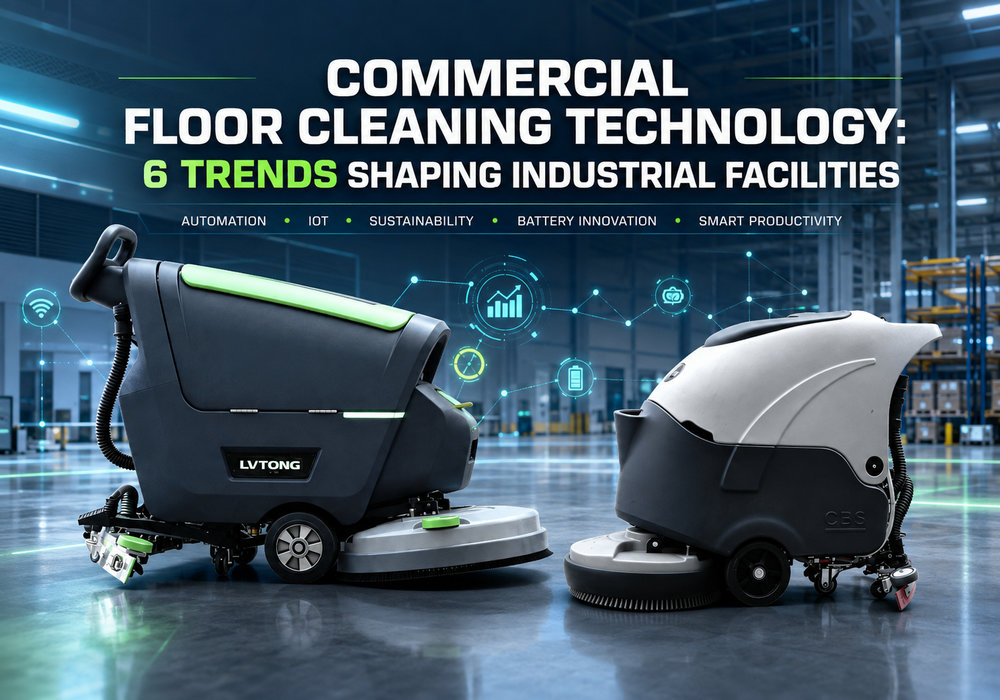
Modern commercial floor cleaning technology is moving in six clear directions: automation, connected equipment, smarter water and chemical control, improved battery systems, higher practical productivity, and data-driven maintenance.
The key question for professional buyers is no longer simply whether cleaning technology is becoming smarter.
It is:
Which technologies are mature enough to solve a real operational problem in my facility?
This guide explains the major floor cleaning technology trends, how they affect daily operations, and what facility managers should evaluate before investing.
Quick Answer: What Is Changing Commercial Floor Cleaning Technology?
The biggest changes in commercial floor cleaning technology are automation, AI-assisted navigation, IoT fleet monitoring, smarter solution control, improved battery management, higher cleaning productivity, and predictive maintenance.
For professional facilities, these technologies can help reduce repetitive operator tasks, improve equipment utilization, control water and chemical use, provide better visibility into cleaning operations, and reduce unexpected downtime.
However, not every new technology is equally useful in every facility.
The right investment depends on floor layout, traffic, cleaning frequency, labor availability, shift structure, maintenance capabilities, and the operational problem the technology is expected to solve.
Global Industrial Cleaning Equipment Market Trends
The industrial cleaning equipment market is being influenced by several long-term changes, including rising labor costs, stricter hygiene requirements, factory automation, sustainability goals and the need for more predictable cleaning operations.
For factories, warehouses and commercial facilities, cleaning equipment is increasingly evaluated as part of overall operational efficiency rather than a standalone machine purchase.
The future market direction is moving from traditional cleaning equipment toward integrated solutions combining mechanical cleaning performance, automation, connectivity, energy efficiency and data management.
Commercial Floor Cleaning Technology Trends at a Glance
| Technology | What It Changes | Main Operational Benefit | General Maturity |
|---|---|---|---|
| Automation | Route execution and repetitive cleaning | Reduces repetitive operator work | Commercially deployed |
| AI-assisted navigation | Obstacle detection and route decisions | Improves adaptability | Rapidly evolving |
| IoT connectivity | Equipment and fleet visibility | Improves utilization and management | Established |
| Smart solution control | Water and detergent delivery | Reduces unnecessary resource use | Established |
| Battery technology | Runtime and charging flexibility | Improves equipment availability | Established |
| Predictive maintenance | Maintenance planning | Helps reduce unexpected downtime | Growing |
| Cleaning-performance data | Reporting and verification | Improves accountability | Growing |
The most valuable technology is not necessarily the newest one. It is the technology that improves a measurable part of the cleaning operation.
1. Automation and AI-Assisted Floor Cleaning
Automation is one of the most visible developments in professional floor cleaning.
Traditional floor scrubbers depend on an operator for steering, route planning, speed control, obstacle avoidance, and cleaning decisions.
Newer systems can automate some of these tasks.
Depending on the machine and application, automated cleaning functions may include:
- Predefined cleaning routes
- Mapping of cleaning areas
- Obstacle detection
- Route adjustment
- Automatic speed management
- Cleaning-zone configuration
- Remote monitoring
- Return-to-start or task-completion functions
These capabilities can be particularly useful in large and relatively repeatable environments such as warehouses, logistics centers, manufacturing facilities, shopping centers, and transportation facilities.
Where Autonomous Cleaning Technology Creates the Most Value
Autonomous cleaning technology creates the highest value in facilities with repeatable routes, large open areas, predictable schedules and frequent cleaning requirements.
However, automation should always be evaluated based on actual facility conditions.
Forklift traffic, temporary obstacles, narrow production areas, changing layouts and complex operating environments may reduce the efficiency of autonomous systems.
The future of industrial cleaning is therefore not replacing every operator with automation, but combining automation with the right application environment.
Where automation creates value
Automation is most useful when the facility has:
- Repetitive cleaning routes
- Large open floor areas
- Predictable operating periods
- High daily cleaning frequency
- Limited cleaning labor
- Clear separation between cleaning and heavy traffic
- A need for more consistent route execution
The operational benefit is not simply that a machine can move without continuous steering.
The greater value is the ability to assign repetitive cleaning work to equipment while employees focus on detailed cleaning, inspections, spill response, or other tasks requiring human judgment.
Automation still has limitations
Autonomous or AI-assisted floor cleaning is not equally suitable for every facility.
Performance can be affected by:
- Dense pedestrian traffic
- Constantly changing obstacles
- Narrow or irregular layouts
- Temporary storage
- Forklift activity
- Construction zones
- Poor connectivity
- Complex ramps or transitions
For this reason, professional buyers should evaluate automation based on the actual cleaning route rather than assuming that a more autonomous machine is automatically more efficient.
For a deeper look at SLAM navigation, obstacle detection, route planning, autonomous charging, and suitable application environments, see our guide to autonomous floor scrubber technology.
From Cleaning Machines to Smart Cleaning Systems
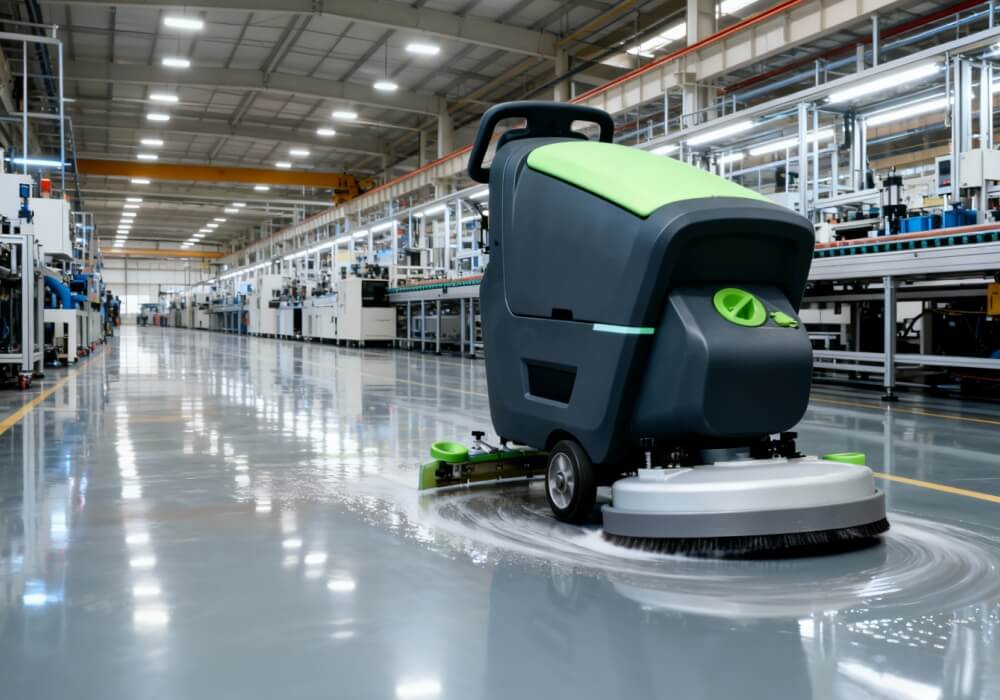
Future industrial cleaning equipment will not only focus on cleaning performance but also on operational visibility.
Modern facilities are moving from individual machines toward connected cleaning systems that combine equipment, sensors, software platforms, battery management and maintenance information.
This change allows facility managers to evaluate not only how powerful a machine is, but also how efficiently it is used, how often it requires service and whether cleaning tasks are completed as planned.
2. IoT and Connected Floor Cleaning Equipment
Another major trend is the transformation of floor cleaning equipment from isolated machines into connected assets.
IoT-enabled cleaning equipment can collect and transmit operational information to a fleet or management platform.
Depending on the system, managers may be able to monitor information such as:
- Machine operating hours
- Equipment utilization
- Cleaning activity
- Battery status
- Charging behavior
- Maintenance status
- Fault notifications
- Machine location
- Operator activity
- Service history
This changes how large fleets are managed.
From machine ownership to fleet visibility
Without connected data, a facility may know how many cleaning machines it owns but have limited information about how effectively those machines are being used.
For example, a site may have several scrubbers but still experience cleaning delays because:
- One machine is heavily overused
- Another machine is rarely used
- Charging is poorly scheduled
- Maintenance is performed too late
- Operators are not following the planned routes
- Equipment faults are not reported quickly
Connected commercial floor cleaning technology can make these problems easier to identify.
Why IoT matters to facility managers
The main value of IoT is not collecting more data.
It is turning operational information into decisions.
For example:
Is the fleet large enough?
Which machine has the highest utilization?
Is downtime increasing?
Are batteries being charged correctly?
Which machine is approaching scheduled service?
Are cleaning operations being completed when planned?
For multi-site companies, logistics networks, cleaning contractors, and large industrial facilities, this visibility can make equipment management more systematic.
3. Smarter Water and Chemical Management
Sustainability is increasingly connected with operating efficiency.
Traditional cleaning methods can waste water or cleaning chemicals when the operator uses a fixed solution flow regardless of machine speed, soil level, or floor condition.
Modern commercial floor cleaning systems increasingly use more controlled solution delivery.
Depending on machine design, this may include:
- Adjustable water flow
- Speed-related solution control
- Precise detergent dosing
- ECO cleaning modes
- Improved solution distribution
- Better dirty-water recovery
- More efficient brush and pad systems
The goal is not simply to use less water.
The goal is to use the appropriate amount of water and cleaning solution to achieve the required result.
ustainability and Resource Efficiency in Industrial Cleaning
Sustainability in industrial cleaning is becoming more measurable.
Professional buyers are increasingly evaluating cleaning equipment based on water consumption, chemical usage, energy efficiency, battery lifecycle, maintenance requirements and total operating cost.
The future of cleaning technology is not only about automation, but also about achieving reliable cleaning results with fewer resources.
For factories, warehouses and commercial facilities, resource efficiency should be evaluated together with cleaning performance, productivity and long-term operating costs.
Why smarter solution control matters
Too little solution can reduce cleaning performance.
Too much solution can:
- Waste water
- Increase detergent consumption
- Increase recovery requirements
- Leave more moisture on the floor
- Increase refill frequency
- Increase operating costs
This is why water, chemical dosing, brush performance, and recovery efficiency should be evaluated as one cleaning system.
Sustainability should be measurable
Professional buyers should be cautious with broad claims such as:
“eco-friendly”
or:
“green cleaning.”
Instead, ask suppliers for measurable information where available, such as:
- Solution-tank capacity
- Adjustable water-flow settings
- Detergent dosing capability
- Energy-management modes
- Battery information
- Noise data
- Consumable requirements
- Component replacement frequency
Sustainable floor cleaning is more useful when it can be connected to measurable water, chemical, energy, labor, or consumable reductions.
For a broader view of energy use, emissions, battery power, and resource efficiency, read our guide to electric floor scrubber sustainability.
Battery Technology Evolution
Battery technology is becoming a key factor in professional cleaning equipment because machine availability directly affects cleaning schedules, labor planning and operational efficiency.
Future battery development will focus not only on longer runtime, but also charging flexibility, energy management, lifecycle cost and integration with intelligent equipment systems.
4. Battery Technology Is Increasing Equipment Utilization
Battery development is also changing how commercial floor cleaning equipment is used.
In the past, battery selection was often treated mainly as an equipment specification.
Today, it increasingly affects the entire cleaning schedule.
Important considerations include:
- Runtime
- Charging time
- Charging opportunities
- Shift structure
- Battery maintenance
- Energy management
- Equipment utilization
- Replacement planning
Why battery flexibility matters
Consider a facility that cleans only once each night.
It may have a long charging window before the next cleaning period.
A distribution center operating across multiple shifts has a different problem.
The cleaning machine may need to be available repeatedly throughout the day, leaving much less time for charging.
Therefore, the best battery configuration depends on the duty cycle.
Lithium-ion and other battery developments
Lithium-ion battery systems are increasingly used in professional cleaning equipment because certain configurations can provide advantages such as:
- Reduced routine battery maintenance
- Flexible charging options
- High usable energy density
- More consistent power delivery
However, battery technology should not be selected based on one universal rule.
Professional buyers should compare:
- Manufacturer-rated runtime
- Charging requirements
- Allowed charging method
- Battery-management system
- Replacement cost
- Expected duty cycle
- Local technical support
Battery technology is most valuable when it improves machine availability within the facility’s actual cleaning schedule.
For a detailed comparison of battery type, runtime, charging behavior, cycle life, and replacement considerations, see our floor scrubber battery life guide.
5. Smarter Cleaning Systems Improve Practical Productivity
Cleaning productivity is becoming more sophisticated than simply increasing brush width or machine speed.
Traditional specifications often emphasize theoretical productivity.
But a facility does not operate under ideal test conditions.
Actual cleaning routes involve:
- Turns
- Obstacles
- Pedestrian traffic
- Forklifts
- Tank refilling
- Wastewater disposal
- Charging
- Brush changes
- Operator stops
- Repeated cleaning passes
For this reason, commercial floor cleaning technology is increasingly focused on practical productivity.
Brush and pad performance
Effective cleaning begins at the floor.
Machine performance can be influenced by:
- Brush type
- Pad selection
- Brush pressure
- Cleaning width
- Soil conditions
- Floor material
More pressure or a wider cleaning deck is not automatically better.
The system should remove the target contamination efficiently without creating unnecessary wear or requiring repeated cleaning passes.
Solution delivery
Consistent solution distribution helps maintain predictable cleaning results across the cleaning width.
Intelligent or adjustable solution control can also reduce unnecessary water consumption when conditions do not require maximum flow.
Water recovery
Cleaning productivity is not complete when the brush passes over the floor.
The dirty water must also be recovered.
Effective squeegee and vacuum performance can help:
- Reduce water left behind
- Shorten floor drying time
- Reduce repeat passes
- Improve safety
- Return the area to traffic more quickly
In high-traffic commercial and industrial facilities, this can be just as important as scrubbing performance.
Maneuverability also affects productivity
A very large machine may perform well in an open warehouse but become inefficient in:
- Narrow aisles
- Elevator areas
- Tight turns
- Congested factories
- Loading zones
- Areas with fixed equipment
The most productive machine is therefore not always the machine with the highest theoretical square-meter-per-hour specification.
To understand how cleaning width, brush power, suction, battery capacity, and working efficiency should be interpreted together, review our floor scrubber performance specifications guide.
It is the machine that completes the actual cleaning route with the least unnecessary downtime.
6. Predictive Maintenance and Data-Driven Fleet Management
Maintenance is also becoming more data-driven.
Traditional maintenance often follows one of two approaches:
Reactive maintenance:
Repair the machine after something fails.
Fixed-interval maintenance:
Inspect or replace components according to a predetermined schedule.
Connected equipment creates another possibility:
Condition- and usage-informed maintenance.
Depending on the equipment, managers may be able to use:
- Operating hours
- Fault history
- Battery information
- Service records
- Utilization data
- Error alerts
- Component inspection data
to plan maintenance more effectively.
Why predictive maintenance matters
Unexpected floor scrubber downtime can disrupt:
- Production schedules
- Warehouse operations
- Customer-facing cleaning
- Contractor service commitments
- Night cleaning programs
If maintenance teams receive better information before a failure becomes critical, service can sometimes be planned for a less disruptive period.
This does not mean every future floor scrubber will automatically predict every failure.
Predictive maintenance should be viewed as an evolving combination of:
machine data + maintenance history + alerts + technician judgment
rather than a replacement for professional inspection.
For the routine tasks that still need to support any connected or predictive system, follow our commercial floor scrubber maintenance checklist.
Which Floor Cleaning Technologies Are Mature and Which Are Still Emerging?
One of the biggest mistakes in technology purchasing is treating every new feature as equally mature.
A better approach is to separate commercially established technologies from rapidly evolving ones.
| Technology | Current Position |
|---|---|
| Battery-powered commercial scrubbers | Mature |
| Adjustable solution flow | Mature |
| Low-noise / ECO operating modes | Mature |
| Connected fleet monitoring | Established |
| Basic autonomous navigation | Commercially deployed |
| Obstacle detection | Commercially deployed |
| AI-assisted route optimization | Rapidly evolving |
| Remote fleet analytics | Established / growing |
| Predictive maintenance | Growing |
| Automated cleaning verification | Growing |
| Completely human-free cleaning in every environment | Not universal |
This distinction is important because professional cleaning facilities do not need technology for its own sake.
They need technology that is reliable enough to solve an operational problem.
he Role of Sweepers and Scrubbers in Future Industrial Cleaning
Future industrial cleaning systems will continue to include different equipment categories.
Industrial sweepers are mainly designed for collecting dry debris, dust and loose particles, while floor scrubbers focus on removing stains, oil, residue and performing wet cleaning with water recovery.
In many industrial environments, the most effective cleaning workflow may combine sweeping, scrubbing and intelligent maintenance cleaning depending on contamination type and facility requirements.
What Should Facility Managers Evaluate Before Investing?
Before adopting a new commercial floor cleaning system, ask six questions.
1. What operational problem are we solving?
Examples might include:
- Cleaning labor shortages
- Too much downtime
- Excessive water use
- Inconsistent route execution
- Poor fleet utilization
- Short battery runtime
- Difficult maintenance planning
If there is no clearly defined problem, it will be difficult to measure whether the technology created value.
2. Does the technology match the facility?
Evaluate:
- Floor area
- Floor type
- Aisle width
- Pedestrian traffic
- Vehicle traffic
- Obstacles
- Cleaning frequency
- Shift pattern
- Connectivity
- Charging infrastructure
A technology that performs well in a large open warehouse may not deliver the same value in a dense production workshop.
3. Can operators and maintenance teams use it?
Technology should simplify operations rather than create unnecessary complexity.
Ask about:
- Operator interface
- Training
- Daily inspection
- Troubleshooting
- Software use
- Service procedures
4. What happens when the system fails?
Smart equipment still needs:
- Parts
- Service
- Technical support
- Diagnostic capability
- Replacement consumables
Evaluate support availability before the machine becomes critical to daily operations.
5. Can the system be updated or expanded?
For connected or software-supported equipment, ask:
- Can firmware or software be updated?
- Can new machines be added to the platform?
- Who owns the data?
- Can reports be exported?
- Are subscriptions required?
- What happens if connectivity is unavailable?
These questions become more important as cleaning equipment becomes increasingly digital.
6. Can the expected ROI be measured?
Do not rely on one universal payback period.
The economics of advanced cleaning equipment depend on factors such as:
- Labor cost
- Cleaning hours
- Equipment price
- Maintenance
- Software costs
- Training
- Consumables
- Water and chemical use
- Machine utilization
- Operator intervention
- Financing
- Downtime
A realistic ROI assessment should compare the facility’s current cleaning process with the proposed new operating model.
If you are moving from technology research to actual machine selection, use our floor scrubber buying guide to compare facility size, machine type, brush system, battery runtime, tank capacity, total cost, and after-sales support.
How Will Commercial Floor Cleaning Change Over the Next Few Years?
The future of floor cleaning is likely to involve increasing integration rather than one single breakthrough technology.
Cleaning equipment will increasingly combine:
- Mechanical cleaning performance
- Battery management
- Automation
- Sensors
- Connectivity
- Fleet software
- Resource control
- Maintenance data
The result will be a gradual transition from standalone cleaning machines toward managed cleaning systems.
For facility managers, this means equipment selection will increasingly involve more than mechanical specifications.
Future procurement decisions may need to compare:
cleaning performance + machine utilization + data + service + energy + water + software + operator requirements
Professional buyers should therefore focus on technologies that provide measurable operational value rather than simply selecting the machine with the largest number of digital features.
Frequently Asked Questions
What are the biggest trends in commercial floor cleaning technology?
Major trends include automation, AI-assisted navigation, IoT fleet monitoring, smart water and detergent control, improved battery management, data-driven maintenance, and more measurable cleaning performance.
The importance of each technology depends on the size, layout, traffic, cleaning frequency, and operational requirements of the facility.
How is AI being used in commercial floor cleaning?
AI-assisted systems can support functions such as obstacle recognition, route adjustment, navigation decisions, and cleaning-task optimization.
The level of AI capability varies significantly between machines, so buyers should evaluate actual operating functions rather than relying only on the term “AI.”
How does IoT improve floor cleaning management?
IoT connectivity can give facility managers better visibility into machine utilization, operating hours, battery status, faults, maintenance needs, and other fleet information.
This data can support cleaning scheduling, equipment allocation, and maintenance decisions.
Can smart floor cleaning systems reduce water and chemical use?
They can help.
Adjustable solution flow, controlled chemical dosing, efficient brush systems, and effective water recovery can reduce unnecessary resource use.
Actual savings depend on machine design, settings, floor conditions, soil level, and operator practices.
Are autonomous floor scrubbers mature enough for industrial facilities?
Autonomous cleaning equipment is commercially deployed in many structured environments.
However, suitability depends on route complexity, obstacle density, pedestrian and forklift traffic, floor conditions, connectivity, and the level of human intervention required.
Facilities should evaluate autonomous equipment through actual site conditions rather than assuming it is suitable everywhere.
How does battery technology affect commercial floor cleaning?
Battery technology affects runtime, charging flexibility, machine availability, maintenance requirements, and multi-shift operation.
The best battery configuration depends on how many hours the machine operates and how much charging time is available between cleaning periods.
What should facility managers evaluate before investing in new cleaning technology?
Evaluate the operational problem being solved, facility layout, cleaning workload, operator requirements, technology maturity, service availability, parts support, connectivity, maintenance needs, and measurable financial benefits.
Technology should support the cleaning operation rather than add unnecessary complexity.
How should ROI for advanced floor cleaning equipment be calculated?
Compare the current cleaning process with the proposed system.
Include labor, equipment cost, maintenance, training, consumables, water, chemicals, software, financing, downtime, machine utilization, and any additional operator intervention.
There is no universal ROI payback period that applies to every facility.
Conclusion
Commercial floor cleaning technology is moving toward smarter, more connected, resource-efficient, and data-driven cleaning operations.
Automation can reduce repetitive operator tasks. IoT can provide greater fleet visibility. Smart solution systems can improve water and chemical control. Battery technology can increase equipment availability. Better cleaning systems can improve practical productivity, while connected data can support more proactive maintenance.
However, technology should not be adopted simply because it is new.
The most valuable floor cleaning technology is the technology that solves a measurable operational problem.
Before investing, facility managers should evaluate:
- Cleaning workload
- Facility layout
- Labor requirements
- Machine utilization
- Battery and charging needs
- Water and chemical consumption
- Maintenance capability
- Technology maturity
- Service and parts availability
- Expected operational return
For large factories, warehouses, logistics centers, commercial facilities, and other professional environments, the future of floor cleaning will increasingly depend on combining reliable cleaning performance with intelligent management.
Planning Your Next Floor Cleaning Technology Upgrade?
If you are evaluating new cleaning technology for a factory, warehouse, logistics center, commercial facility, or other large site, prepare information about your cleaning area, floor type, daily cleaning hours, traffic conditions, labor requirements, charging schedule, current cleaning equipment, and major operational challenges.
LVTONG can use these operating conditions to help evaluate which floor cleaning functions and equipment configurations are relevant to your application—without adding technology that your facility does not actually need.