Introduction
An electric floor scrubber is a professional floor-cleaning machine powered by electricity, most commonly through a rechargeable battery system.
For warehouses, factories, supermarkets, hospitals and other commercial or industrial facilities, electric scrubbers can provide an alternative to engine-powered cleaning equipment while supporting quieter indoor operation, lower direct exhaust emissions and simpler powertrain maintenance.
However, “electric” does not automatically mean “zero carbon” or “lowest cost.”
The actual environmental and financial benefit depends on factors such as:
- Electricity source;
- Battery technology;
- Machine efficiency;
- Daily operating hours;
- Facility size;
- Cleaning frequency;
- Water and chemical consumption;
- Maintenance requirements;
- Machine lifespan;
- The equipment being replaced.
This guide explains how electric floor scrubbers affect emissions, energy use and operating costs, how lithium-ion and lead-acid batteries differ, and what B2B buyers should evaluate before switching to electric cleaning equipment.

An electric floor scrubber can help reduce the environmental impact of floor cleaning by eliminating direct combustion exhaust emissions during operation.
Compared with diesel- or propane-powered cleaning equipment, electric machines can also offer:
- Lower operating noise;
- No engine exhaust inside the facility;
- Fewer engine-related maintenance requirements;
- Battery-powered indoor operation;
- Flexible charging options;
- Potentially lower energy costs;
- Easier integration with renewable electricity;
- Reduced dependence on fossil fuels.
However, the total carbon footprint still depends on electricity generation, battery manufacturing, machine utilization, service life and maintenance.
For B2B buyers, the best decision should therefore consider both:
environmental impact + total cost of ownership.
What Is an Electric Floor Scrubber?
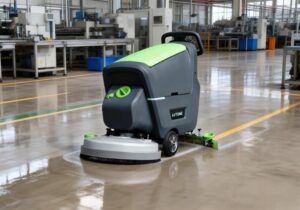
An electric floor scrubber is a machine that uses electric power to drive the cleaning system, vacuum recovery system and, where applicable, traction motors.
Most professional models use rechargeable batteries.
During cleaning, the machine typically:
- Applies cleaning solution to the floor;
- Uses rotating brushes or pads to loosen soil;
- Collects dirty solution with a squeegee;
- Transfers recovered wastewater into a recovery tank.
Electric floor scrubbers are available in:
- Walk-behind configurations;
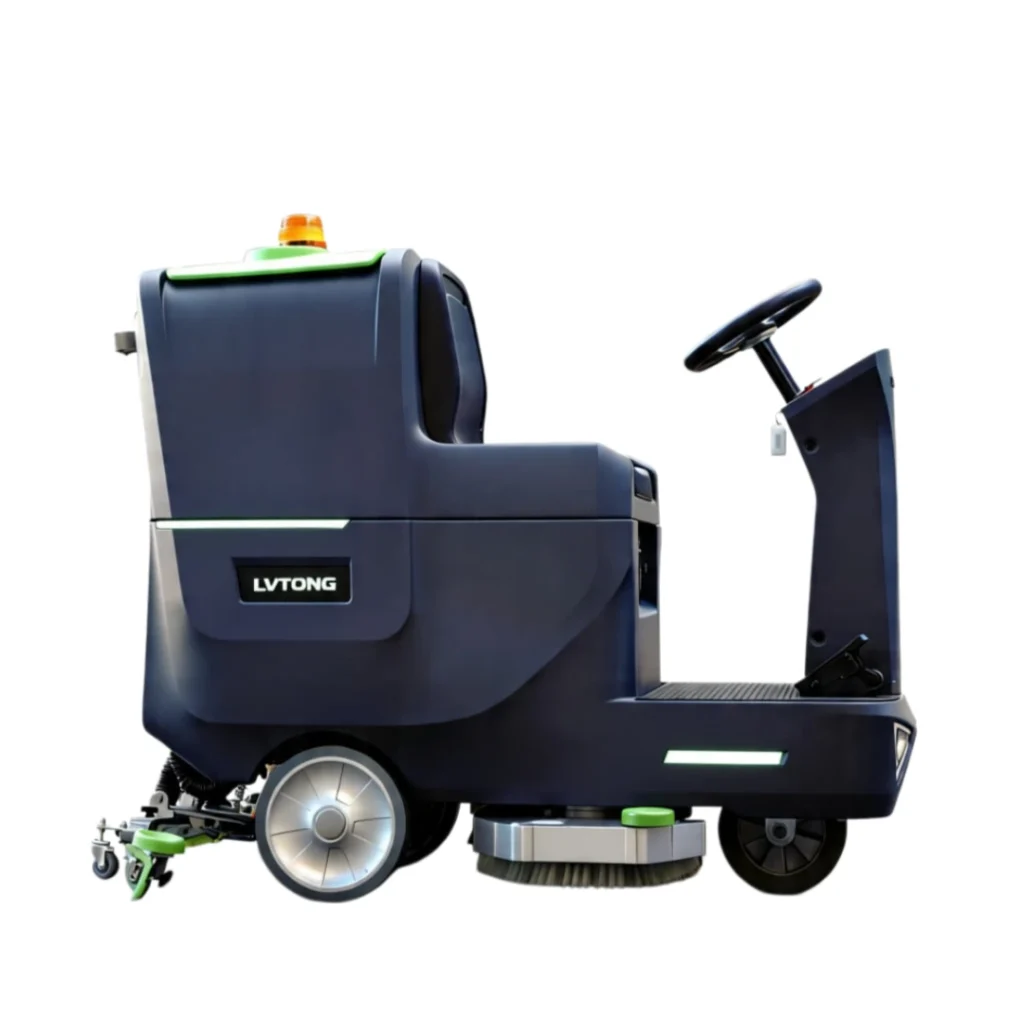
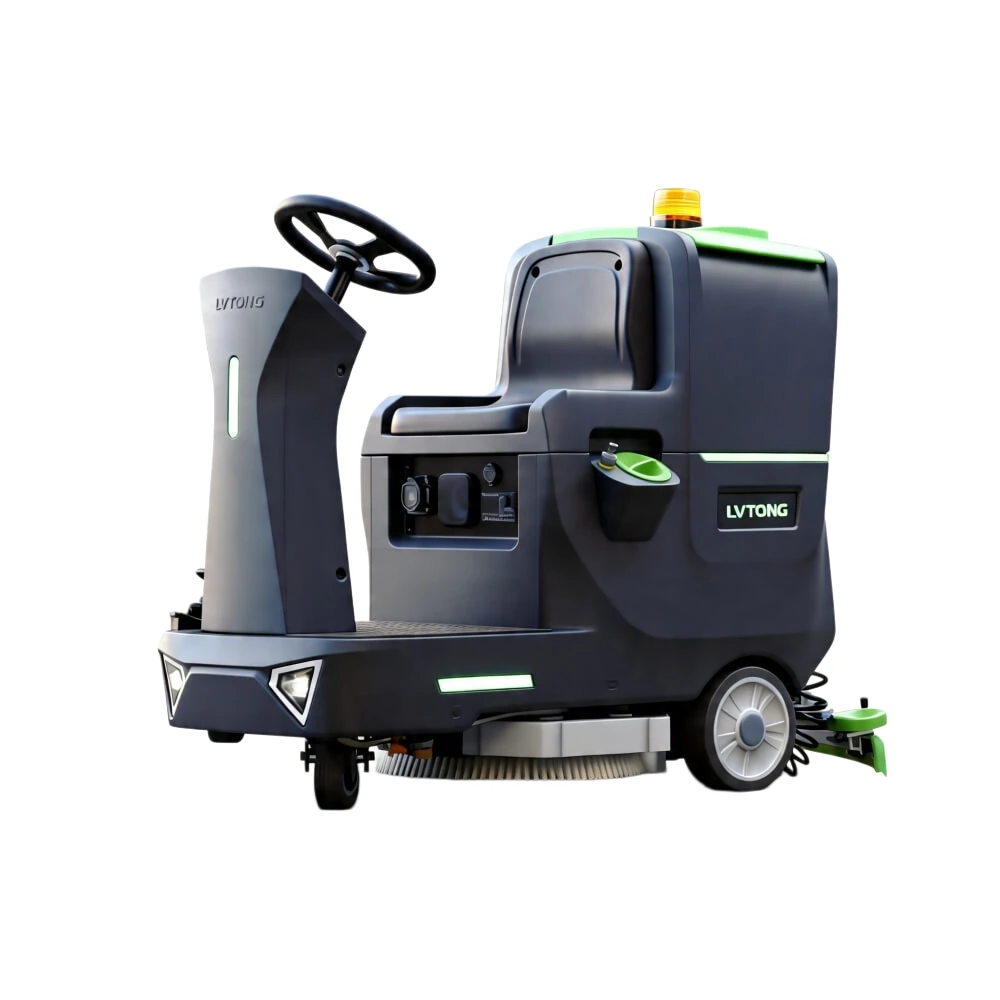
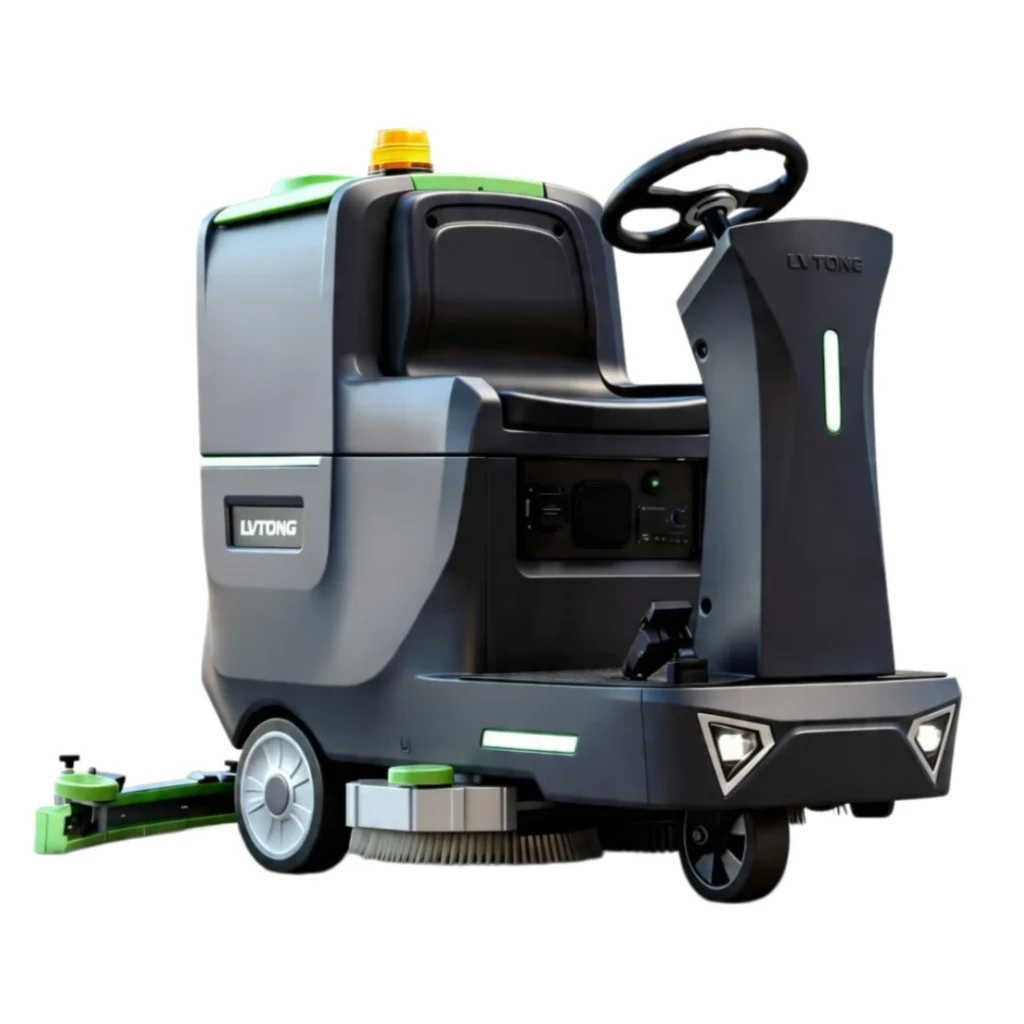
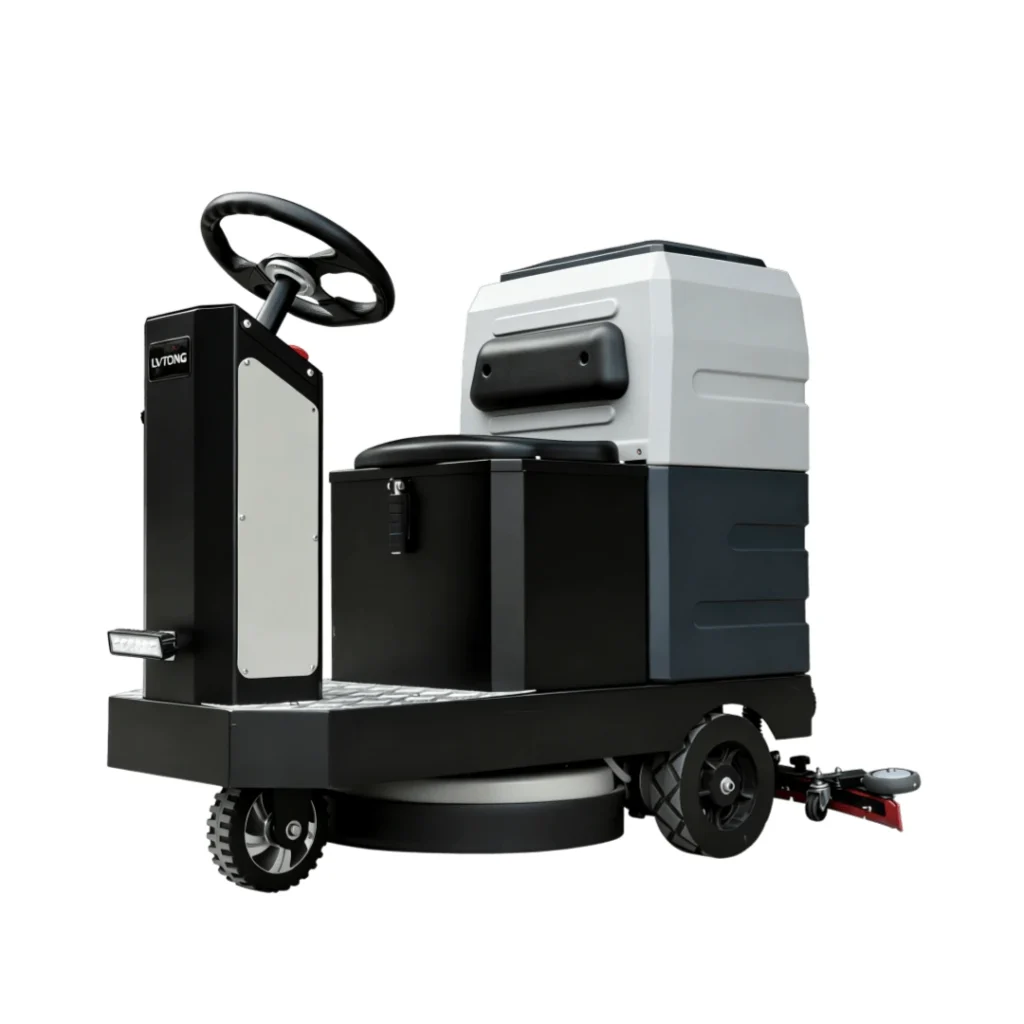
- Ride-on configurations;
- Compact commercial models;
- Larger industrial models;
- Selected autonomous configurations.
The correct type depends more on the facility than on the power source alone.
Buyers who want to compare available machine configurations can explore LVTONG’s commercial floor scrubber dryers, including walk-behind and ride-on models for different facility sizes and operating requirements.

How Does an Electric Floor Scrubber Reduce Carbon Emissions?
The biggest carbon-related advantage is the elimination of fuel combustion at the point of use.
Zero Direct Exhaust Emissions During Operation
Electric floor scrubbers do not burn diesel, gasoline or propane during normal electric operation.
As a result, they do not produce direct combustion exhaust from the machine while cleaning.
This can be particularly useful in indoor environments such as:
- Warehouses;
- Factories;
- Supermarkets;
- Hospitals;
- Logistics centers;
- Commercial buildings.
This does not mean the machine is completely carbon-free.
Its lifecycle footprint can still include emissions from:
- Electricity generation;
- Battery production;
- Equipment manufacturing;
- Transportation;
- Replacement parts;
- End-of-life processing.
The more accurate statement is therefore:
An electric floor scrubber eliminates direct exhaust emissions during operation, while its total lifecycle carbon footprint depends on how the electricity, battery and equipment are produced and used.
Reduced Dependence on Fossil Fuels
Fuel-powered machines depend directly on gasoline, diesel or propane.
Electric equipment shifts the energy source to electricity.
This allows a facility to benefit when its electricity supply becomes less carbon-intensive or when the business uses renewable electricity.
For companies with wider decarbonization programs, electrifying cleaning equipment can therefore become one part of a broader operational strategy.
Indoor Air Quality Considerations
Engine-powered equipment can produce combustion-related pollutants during operation.
Electric machines remove the exhaust source from the cleaning process itself.
This is one reason battery-powered cleaning equipment is widely suited to enclosed commercial and industrial facilities.
However, electric equipment should still be operated according to applicable workplace, battery and charging safety requirements.

Electric Floor Scrubber vs. Fuel-Powered Floor Scrubber
A useful comparison should go beyond emissions.
| Factor | Electric Floor Scrubber | Fuel-Powered Floor Scrubber |
|---|---|---|
| Direct exhaust during operation | None from electric motor | Produced through combustion |
| Energy source | Electricity / battery | Diesel, gasoline or propane |
| Indoor suitability | Generally strong | Depends on exhaust and ventilation conditions |
| Operating noise | Generally lower | Engine can increase noise |
| Engine oil changes | Not required for electric motor | May be required |
| Battery maintenance | Depends on battery type | Usually not the primary power system |
| Refueling / charging | Requires charging strategy | Requires fuel supply |
| Maintenance | Fewer combustion-engine components | Engine and fuel-system maintenance |
| Carbon impact | Depends partly on electricity source | Includes direct fuel combustion |
| Best fit | Indoor commercial/industrial cleaning | Selected heavy-duty or specialized applications |
Neither power system should be evaluated in isolation.
The correct decision depends on:
facility + workload + energy cost + maintenance + charging infrastructure + machine availability.
Benefits of Electric Floor Scrubbers
1. Lower Operating Noise
Electric motors generally operate with less engine noise than internal-combustion systems.
That can be useful in facilities that clean:
- During operating hours;
- Around employees;
- Around customers;
- During multiple shifts;
- In noise-sensitive environments.
Actual machine noise still varies by model, vacuum system, brush configuration and operating mode, so buyers should compare manufacturer specifications where noise is a major requirement.
2. Reduced Engine-Related Maintenance
An electric powertrain does not require the same combustion-related components as a diesel or propane engine.
Depending on machine design, this can eliminate maintenance associated with items such as:
- Engine oil;
- Fuel filters;
- Spark ignition components;
- Exhaust-related systems.
However, an electric scrubber still requires regular maintenance.
Typical items may include:
- Brushes;
- Pads;
- Squeegee blades;
- Vacuum system;
- Tanks;
- Filters;
- Hoses;
- Wheels;
- Battery;
- Charger.
“Electric” means a different maintenance profile—not a maintenance-free machine.
3. Flexible Indoor Operation
Battery-powered machines do not require a trailing power cable during normal operation.
This helps operators work across:
- Warehouses;
- Production areas;
- Retail floors;
- Parking facilities;
- Large corridors.
Machine dimensions, turning space and battery runtime still need to match the actual cleaning route.
4. Potential Energy-Cost Savings
Electricity can be less expensive than liquid or gaseous fuel on an equivalent operating basis in some markets.
But this should not be assumed universally.
Energy cost depends on:
- Local electricity tariff;
- Fuel price;
- Machine efficiency;
- Charging efficiency;
- Daily runtime;
- Cleaning productivity.
For procurement, the correct comparison is:
Cost per completed cleaning task, not simply cost per kWh or cost per liter of fuel.
5. Potential Water and Chemical Efficiency
Modern scrubbers may use controlled solution-flow systems, optimized brush systems or adjustable cleaning modes to reduce unnecessary water and detergent use.
However, savings vary by:
- Machine model;
- Soil level;
- Operator settings;
- Cleaning chemistry;
- Floor type;
- Required cleaning standard.
Buyers should request model-specific consumption data rather than assuming one universal percentage reduction.
Chemical consumption also depends on detergent type, soil conditions and dilution control. Our floor scrubber cleaning solution guide explains how to select low-foam cleaners, degreasers and suitable dilution ratios for automatic scrubbers.

Does an Electric Floor Scrubber Automatically Have a Lower Carbon Footprint?
Not always.
The answer depends on how the comparison is made.
An electric machine usually eliminates direct exhaust at the point of use, but lifecycle emissions can still come from:
- Electricity generation;
- Battery manufacturing;
- Machine manufacturing;
- Transportation;
- Maintenance;
- Replacement components.
A carbon comparison should therefore ask:
What Machine Is Being Replaced?
Replacing a diesel-powered machine creates a different comparison from replacing an older battery-powered scrubber.
What Electricity Is Used?
Electricity generated with a lower-carbon mix can reduce operating emissions more than electricity generated primarily from high-carbon sources.
How Many Hours Is the Machine Used?
High-utilization equipment may create a larger opportunity for energy and maintenance savings.
How Long Does the Machine Last?
Longer useful life can affect lifecycle impact because manufacturing emissions are spread over more operating hours.
How Efficient Is the Cleaning Process?
A theoretically efficient machine can still perform poorly if:
- It is too large for the layout;
- It requires frequent refilling;
- It needs repeated cleaning passes;
- Battery runtime is inadequate.
Lithium-Ion vs. Lead-Acid Batteries for Electric Floor Scrubbers
Battery technology is one of the most important considerations when selecting an electric floor scrubber.
The battery affects:
- Runtime;
- Charging;
- Maintenance;
- Shift availability;
- Replacement planning;
- Total ownership cost.
| Factor | Lead-Acid Battery | Lithium-Ion Battery |
|---|---|---|
| Initial cost | Generally lower | Generally higher |
| Charging speed | Usually slower | Usually faster |
| Opportunity charging | More limited | Better suited |
| Routine battery maintenance | Higher for flooded types | Generally lower |
| Energy density | Lower | Higher |
| Cycle life | Generally shorter | Generally longer |
| Multi-shift operation | Can require more planning | Often more flexible |
| Best fit | Budget-sensitive or lower-utilization operations | Higher-utilization and flexible charging applications |
When Lead-Acid May Still Make Sense
Lead-acid can remain practical where:
- Initial budget is a major priority;
- The machine operates only a limited number of hours;
- Overnight charging is available;
- Battery maintenance procedures are established.
It should not automatically be treated as obsolete.
When Lithium-Ion May Be More Suitable
Lithium-ion may be worth evaluating where:
- Cleaning happens across multiple shifts;
- Faster charging is important;
- Opportunity charging is useful;
- Reduced routine battery maintenance is valued;
- Higher equipment availability matters.
The final decision should be based on the specific battery pack, charger, machine and operating schedule.
For a deeper evaluation of runtime, charging speed, cycle life, safety and replacement planning, see our floor scrubber battery life guide.
How to Calculate Electric Floor Scrubber Operating Cost
A sustainability claim is more useful when combined with an operating-cost model.
Instead of asking:
Is electric cheaper?
Calculate:
Annual Operating Cost = Energy + Labor + Consumables + Maintenance + Battery Cost + Downtime Cost
1. Energy Cost
Estimate:
- Electricity consumed per charge;
- Charges per day;
- Cleaning days per year;
- Electricity tariff.
2. Labor Cost
Estimate:
- Operator hours per cleaning cycle;
- Cleaning frequency;
- Hourly labor rate.
A machine that cleans the facility faster may reduce labor even if its purchase price is higher.
3. Consumables
Include:
- Brushes;
- Pads;
- Squeegee blades;
- Cleaning detergent;
- Filters.
4. Maintenance
Include scheduled maintenance and expected replacement components.
5. Battery Cost
Battery replacement should be considered over the expected ownership period rather than ignored at the time of purchase.
6. Downtime Cost
Downtime may result in:
- Manual cleaning;
- Rental equipment;
- Reduced cleaning frequency;
- Operational disruption.
For professional buyers, the lowest purchase price does not necessarily mean the lowest cost per cleaned square meter.
Electric vs. Fuel-Powered Floor Scrubber: Total Cost of Ownership
Use a comparison framework such as:
| Cost Category | Electric | Fuel-Powered |
|---|---|---|
| Machine purchase | Model dependent | Model dependent |
| Electricity / fuel | Electricity | Fuel |
| Battery replacement | Applicable | Usually not traction-battery based |
| Engine oil/service | Not applicable to electric motor | Applicable |
| Brushes/pads/squeegees | Applicable | Applicable |
| Operator labor | Depends on productivity | Depends on productivity |
| Charging/refueling | Charging infrastructure | Fuel storage/supply |
| Downtime | Depends on service support | Depends on service support |
| Parts | Machine dependent | Machine dependent |
The most useful result is:
Total cost per year
or
Total cost per 1,000 m² cleaned
rather than simply comparing purchase prices.

How to Choose the Right Electric Floor Scrubber
1. Cleaning Area
Start with the actual cleanable floor area rather than total building size.
Large open facilities usually require greater practical productivity than small, obstacle-heavy areas.
2. Facility Layout
Measure:
- Narrowest aisle;
- Door width;
- Turning space;
- Ramps;
- Columns;
- Shelving;
- Machinery.
A smaller machine can sometimes outperform a larger model in a complex layout.
3. Available Cleaning Time
Ask:
How many hours do we actually have to complete cleaning?
The same 10,000 m² facility can require completely different machines if one operator has two hours instead of six.
4. Floor Conditions
Evaluate:
- Floor material;
- Surface texture;
- Main contamination;
- Oil or grease;
- Tire marks;
- Dust;
- Chemical residue.
These conditions affect brush selection, brush pressure and cleaning chemistry.
These conditions affect brush selection, brush pressure and cleaning chemistry. For a deeper explanation of how brush and pad selection changes by floor material and soil level, see our guide to floor scrubber brush types.
5. Battery Runtime
The battery should support the planned cleaning route with suitable reserve.
Consider:
- Daily operating hours;
- Number of shifts;
- Charging time;
- Charging location;
- Replacement planning.
6. Charging Infrastructure
Plan a suitable charging area before the machine arrives.
Consider:
- Electrical supply;
- Charger requirements;
- Ventilation where applicable;
- Dry location;
- Distance from operating area;
- Site battery-safety procedures.
7. Water Recovery
An electric floor scrubber does more than scrub.
The squeegee and vacuum system must also recover dirty solution effectively.
Poor water recovery can cause:
- Streaking;
- Residual water;
- Repeat cleaning;
- Longer reopening time.
8. Service and Spare Parts
Before ordering, ask:
- Which consumables should be stocked?
- What is the expected parts lead time?
- Is remote technical support available?
- What warranty applies?
- Are service documents available?
Environmental performance has little value if a machine spends excessive time out of service. Buyers evaluating long-term uptime can also review LVTONG’s cleaning equipment maintenance and service support for maintenance guidance, troubleshooting and after-sales assistance.
Which Facilities Benefit Most From Electric Floor Scrubbers?
Warehouses and Logistics Centers
Electric scrubbers can be well suited to warehouses where buyers value:
- Indoor operation;
- Long cleaning routes;
- Reduced exhaust;
- Battery-powered mobility;
- Lower operating noise.
Large open facilities may benefit from ride-on configurations.
Manufacturing Facilities
Factories may prioritize:
- Heavy-duty cleaning;
- Oil or production residue removal;
- Battery runtime;
- Rugged construction;
- Dirty-water recovery.
The machine should be selected according to actual process contamination.
Supermarkets and Retail Facilities
Retail users may prioritize:
- Low noise;
- Maneuverability;
- Effective water recovery;
- Compact dimensions;
- Cleaning during operating hours.
Hospitals and Healthcare Facilities
Electric scrubbers can support routine hard-floor cleaning where exhaust-free point-of-use operation, maneuverability and water recovery are important.
Machine cleaning procedures should still follow the facility’s hygiene requirements.
Food and Commercial Facilities
Food-related areas may require additional attention to:
- Machine cleanability;
- Chemical compatibility;
- Floor texture;
- Grease;
- Dirty-water recovery.
The scrubber supports cleaning but does not by itself guarantee sanitation compliance.

How Can a Business Estimate Carbon Savings From an Electric Floor Scrubber?
Do not use a universal “carbon saving percentage.”
Instead, compare the specific machines.
Collect:
Existing Machine
- Fuel type;
- Fuel consumption;
- Annual operating hours.
Electric Replacement
- Electricity consumption;
- Charging efficiency;
- Annual operating hours.
Electricity Emission Factor
Use an appropriate electricity-generation emission factor for the operating region.
Fuel Emission Factor
Use an appropriate fuel combustion factor for the existing equipment.
Then compare annual operational emissions.
For a full lifecycle assessment, additional factors such as battery manufacturing, machine manufacturing and end-of-life treatment would also need to be considered.
This approach produces a more credible sustainability estimate than claiming every electric scrubber reduces emissions by the same percentage.
Common Mistakes When Switching to Electric Floor Scrubbers
Choosing Only for Sustainability
The machine must still meet productivity and cleaning requirements.
Ignoring Charging Time
A machine with inadequate charging availability can create operational downtime.
Buying the Largest Battery Available
Larger is not automatically better.
Battery size should match the actual shift.
Ignoring Facility Layout
Cleaning width and machine dimensions must fit aisles, doors and turning areas.
Assuming Lithium Is Always Required
Lithium can offer advantages, but lead-acid may remain practical for some low-utilization operations.
Comparing Purchase Price Only
The better comparison is total cost of ownership.
Calling Electric Equipment “Zero Carbon”
Electric equipment eliminates direct combustion exhaust during operation, but lifecycle emissions still exist.
Frequently Asked Questions
What is an electric floor scrubber?
An electric floor scrubber is a powered floor-cleaning machine that uses electricity, usually from rechargeable batteries, to operate its brushes, vacuum recovery system and traction functions.
It scrubs hard floors and recovers dirty cleaning solution into a separate recovery tank.
How does an electric floor scrubber reduce carbon footprint?
It eliminates direct fuel-combustion exhaust emissions during electric operation and reduces dependence on diesel, gasoline or propane.
Actual lifecycle carbon savings depend on the electricity source, battery production, machine efficiency, utilization and the equipment being replaced.
Do electric floor scrubbers produce emissions?
They produce no direct combustion exhaust during normal electric operation.
However, electricity generation, battery production, equipment manufacturing and transportation can still create indirect lifecycle emissions.
Are electric floor scrubbers more energy efficient?
They can be more energy-efficient than comparable combustion-powered equipment because electric motors avoid many combustion-related energy losses.
Actual energy efficiency still depends on machine design, cleaning productivity, charging efficiency and operating conditions.
Electric floor scrubber vs. propane floor scrubber: which is better?
Electric machines are often better suited to indoor facilities that value lower direct exhaust emissions, lower operating noise and battery operation.
Propane equipment may remain relevant in specific applications where charging infrastructure or operating requirements favor fuel-powered equipment.
The correct decision depends on the facility.
What battery is best for an electric floor scrubber?
There is no universal best battery.
Lead-acid may suit lower-budget, lower-utilization operations with sufficient charging time.
Lithium-ion may be more suitable for high-utilization environments that value faster charging, opportunity charging and lower routine battery maintenance.
How much electricity does an electric floor scrubber use?
Electricity use varies by machine model, battery capacity, cleaning mode, floor condition and operating time.
Use the machine’s battery capacity and charger specifications to estimate energy consumption for the actual cleaning schedule.
How do I choose an electric floor scrubber?
Evaluate:
- Cleaning area;
- Facility layout;
- Cleaning window;
- Floor condition;
- Machine size;
- Battery runtime;
- Charging infrastructure;
- Brush system;
- Water recovery;
- Spare parts;
- Technical support;
- Total cost of ownership.
Key Takeaways
When evaluating an electric floor scrubber:
- Electric machines eliminate direct exhaust emissions during operation.
- They are not completely carbon-free over their lifecycle.
- Electricity source affects carbon performance.
- Electric motors can reduce combustion-engine maintenance requirements.
- Operating noise is generally lower than engine-powered alternatives.
- Lead-acid and lithium-ion batteries serve different operating needs.
- Battery runtime should match the real cleaning schedule.
- Total cost of ownership matters more than purchase price alone.
- Water, chemical and energy savings should be evaluated using model-specific data.
- Charging infrastructure should be planned before deployment.
- Carbon savings should be calculated using real operating data rather than universal percentages.
- Spare-parts and service support remain important to long-term sustainability.
Conclusion: Is an Electric Floor Scrubber Worth It?
For many commercial and industrial facilities, an electric floor scrubber can provide a practical combination of professional cleaning performance, lower direct exhaust emissions, quieter operation and a simpler powertrain.
But electrification should not be treated as an environmental label alone.
The strongest business case comes when the machine also improves:
- Cleaning productivity;
- Energy management;
- Battery utilization;
- Maintenance planning;
- Operator working conditions;
- Total cost of ownership.
The right electric floor scrubber should therefore be selected according to the actual facility, cleaning workload, floor condition, operating schedule and charging infrastructure.
For businesses moving toward lower-carbon operations, electrifying floor-cleaning equipment can be one practical step—but the best result comes from choosing the right machine and measuring performance over its full working life.
Request an Electric Floor Scrubber Recommendation
Planning to replace fuel-powered cleaning equipment or evaluate an electric floor scrubber for your facility?
Send LVTONG:
- Facility type;
- Cleaning area;
- Floor material;
- Main contamination;
- Available cleaning time;
- Daily operating hours;
- Aisle or doorway width;
- Current machine or cleaning method;
- Battery preference;
- Charging conditions;
- Destination country;
- Expected quantity.
LVTONG can review your facility type, cleaning area, floor conditions, operating hours, battery requirements and charging conditions to recommend a suitable configuration. Request an electric floor scrubber recommendation for your project.