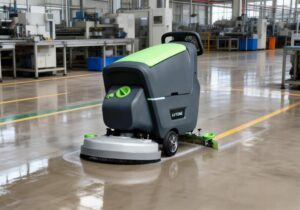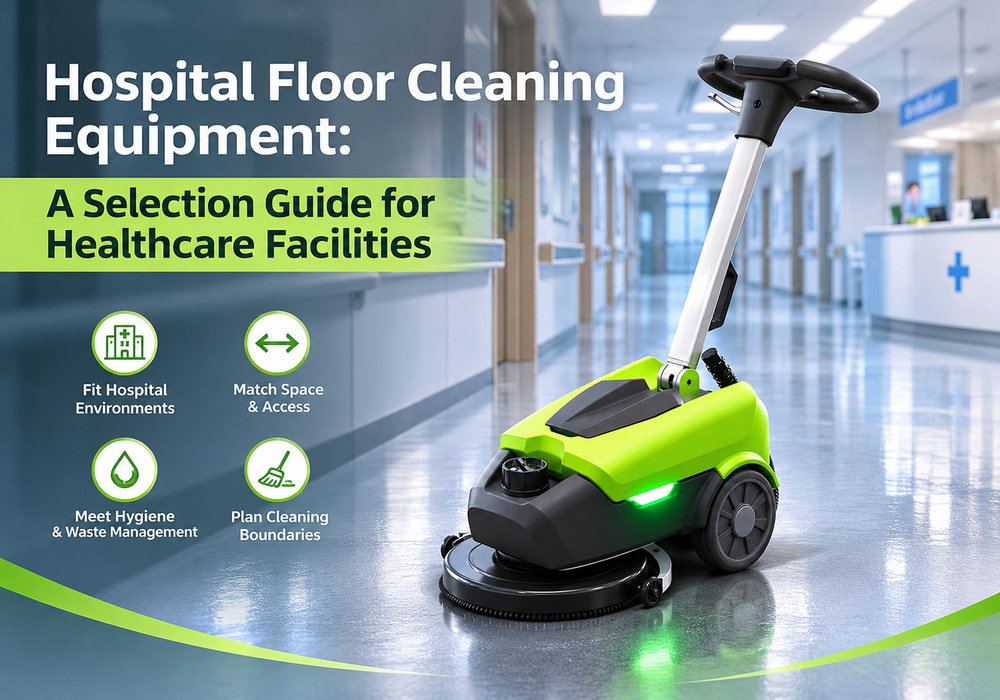
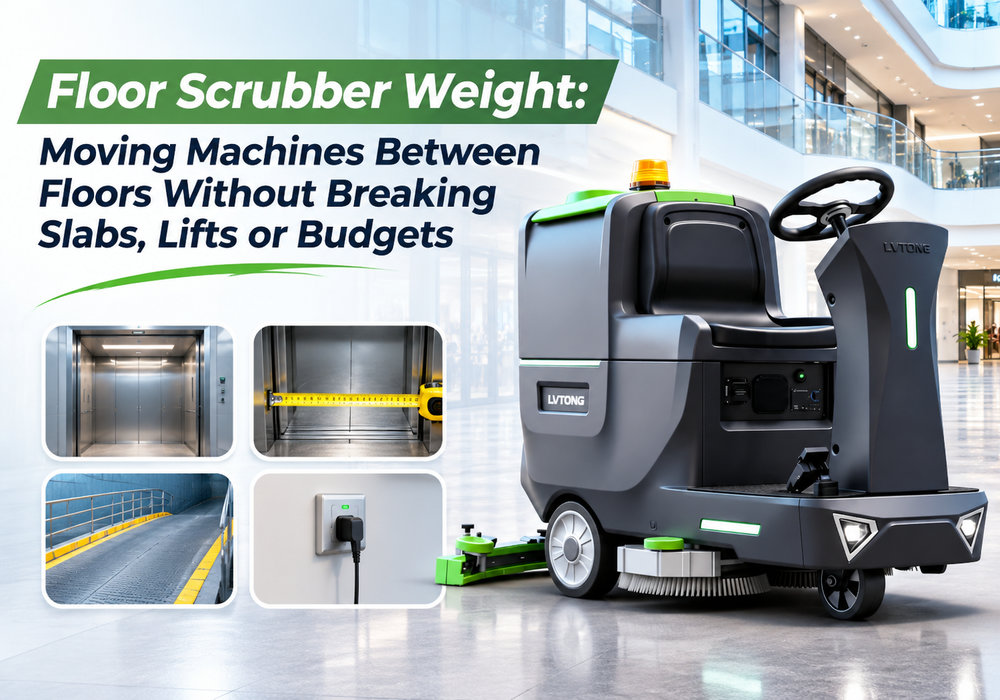
Hospital floors look like any other hard floor. The building around them does not. A hospital runs twenty-four hours a day, is zoned by clinical risk, is cleaned with disinfectants that attack ordinary finishes and equipment, and is audited on how dirty water leaves the room. That is why how to clean hospital floors cannot be answered by copying a warehouse routine. This guide covers what hospital floor cleaning equipment actually has to do: which zones a machine may serve, which format fits hospital corridors, how chemistry, noise and water containment change the specification, and where machines must stop.
RÉPONSE RAPIDE
Hospital floor cleaning equipment works when it is chosen for zones, not for square footage.
- Zones decide access. Entrances, lobbies and corridors absorb machines; patient rooms and treatment areas mostly stay with compact tools and hand methods; restricted clinical zones follow the facility’s infection-control protocol, not the equipment catalogue.
- Walk-behind dominates. Hospital corridors are long and narrow, elevators are shared with beds, and a compact lithium walk-behind covers a corridor network faster than a mop crew without a ride-on’s footprint.
- Chemistry is the hidden variable. Quaternary ammonium and chlorine-based disinfectants demand sealed surfaces, compatible pads and clean rinse water — otherwise the machine spreads residue instead of removing soil.
- Wet-floor time is the safety metric. A machine is only suitable if its recovery system hands back a walkable floor within minutes of the pass.
The sections below cover zoning, machine formats, chemistry, water containment, safety limits and a six-line specification checklist.
Why Hospitals Are a Different Cleaning Environment
Hospitals are not harder because the soil is heavier — they are harder because every cleaning decision touches patient safety, and the building never closes.
Measured in grams of soil, most hospital floors carry less dirt than a retail entrance: dust, street grit tracked in at lobbies, trolley marks, and occasional biological spills that are handled under the facility’s own protocol. The difficulty sits elsewhere. The World Health Organization’s infection prevention and control guidance treats environmental cleaning as part of patient safety, which means every pass must be consistent, documented and repeatable. Hospital floor cleaning equipment is therefore judged on containment and reliability — how well it lifts soil into a sealed recovery tank — rather than on raw brushing power. A machine that cleans aggressively but leaves dirty water on the surface has failed the hospital’s real test.
Zone by Zone: What Equipment Each Area Can Accept
Zone first, buy second: the hospital floor plan decides which machine formats are useful long before any brand comparison.
| Zone | sol typique | Equipment format | Practical note |
|---|---|---|---|
| Entrance & lobby | Street grit, rain, dust | Walk-behind, daily | Highest soil load; daytime visibility argues for low-noise passes |
| Corridors & nurse stations | Dust, trolley marks | Compact walk-behind, night shift | Long runs reward wide-but-narrow machines; watch bed traffic |
| Patient rooms & bathrooms | Light soil, tight geometry | Hand methods, microfiber | Furniture and occupied beds leave no room to maneuver |
| Treatment & imaging areas | Moderate soil | Compact walk-behind, per protocol | Access controlled by clinical staff |
| OR & sterile vicinity | Restricted | Facility protocol | Machines rarely deployed; clinical ownership |
| Basement parking & loading dock | Tire marks, dust | Ride-on acceptable | Physically separated from clinical areas |
This is an operating map, not a rulebook. Every facility’s infection-control policy overrides it, and access to any zone should be confirmed with the department that owns the space before a route is scheduled.
Walk-Behind vs Ride-On in Hospital Corridors
In a hospital the walk-behind is the default; a ride-on earns its place only where large, separated hard floors such as basement parking exist.
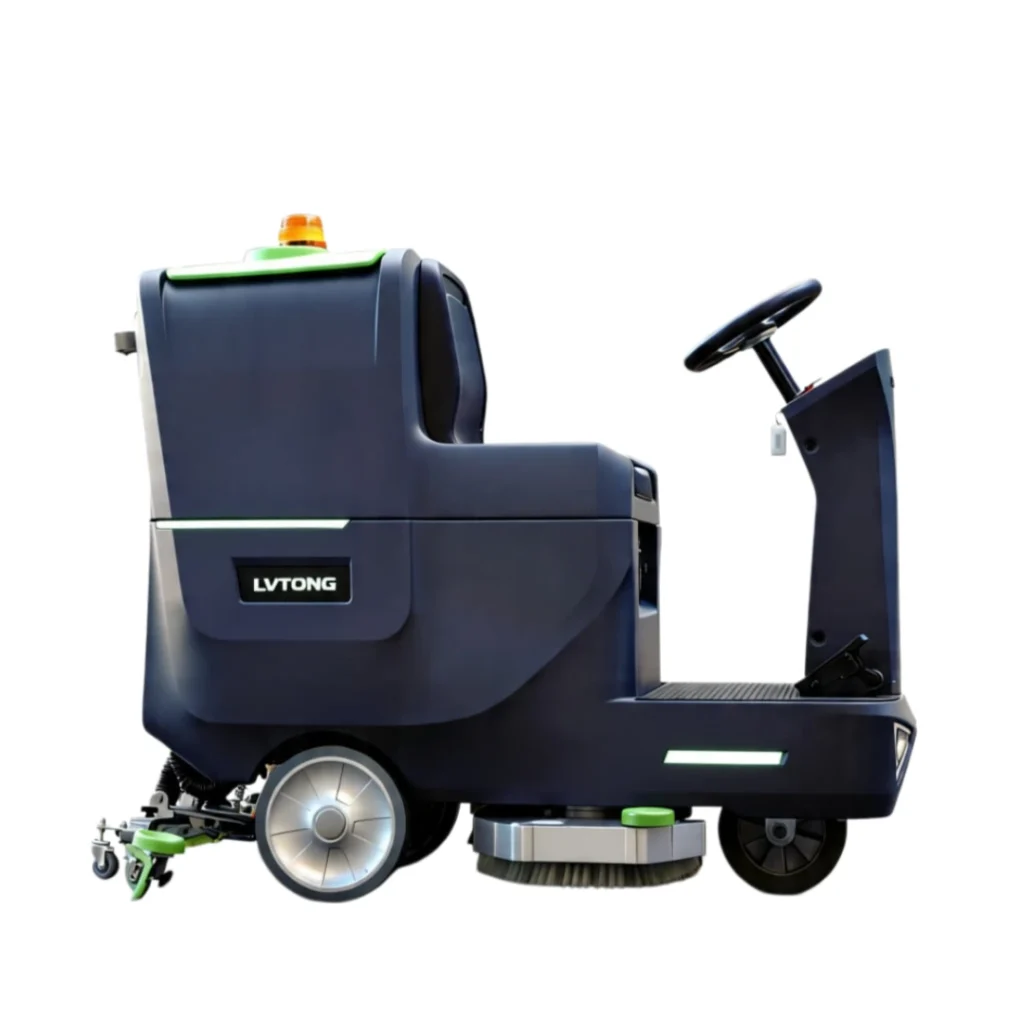
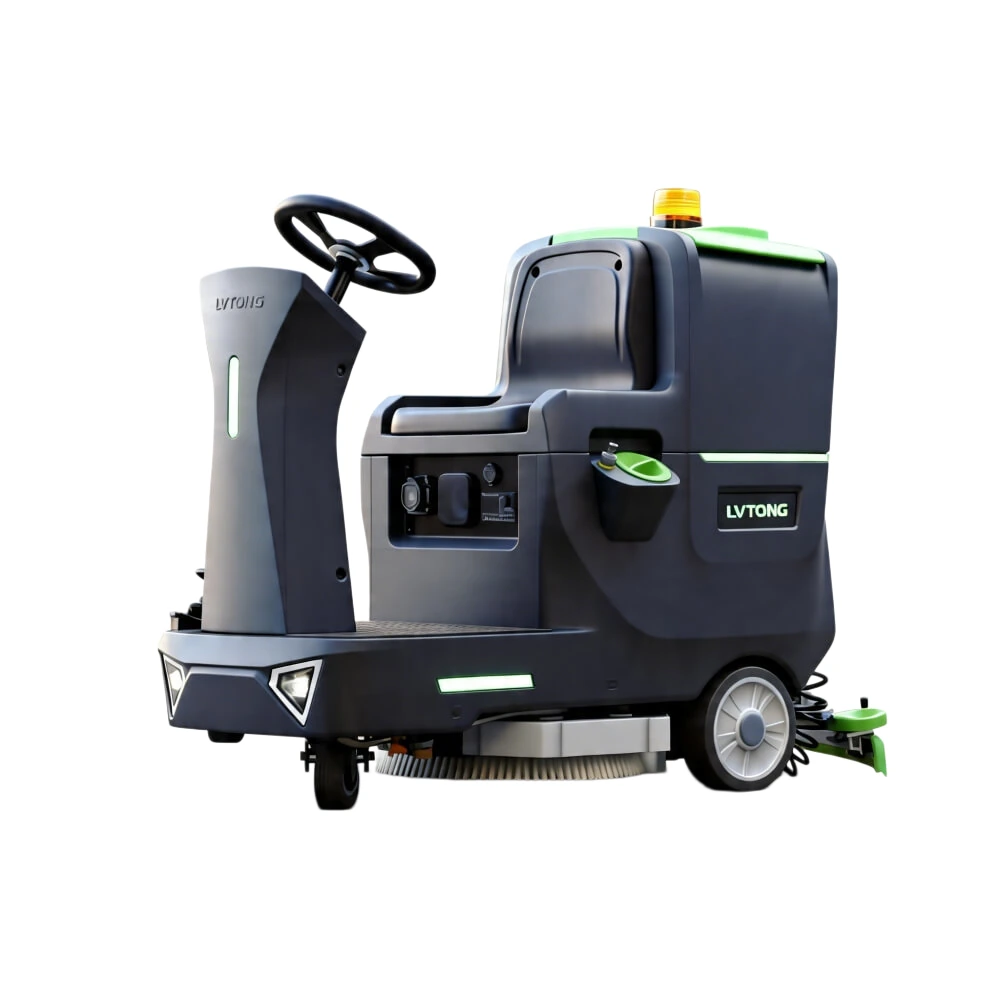
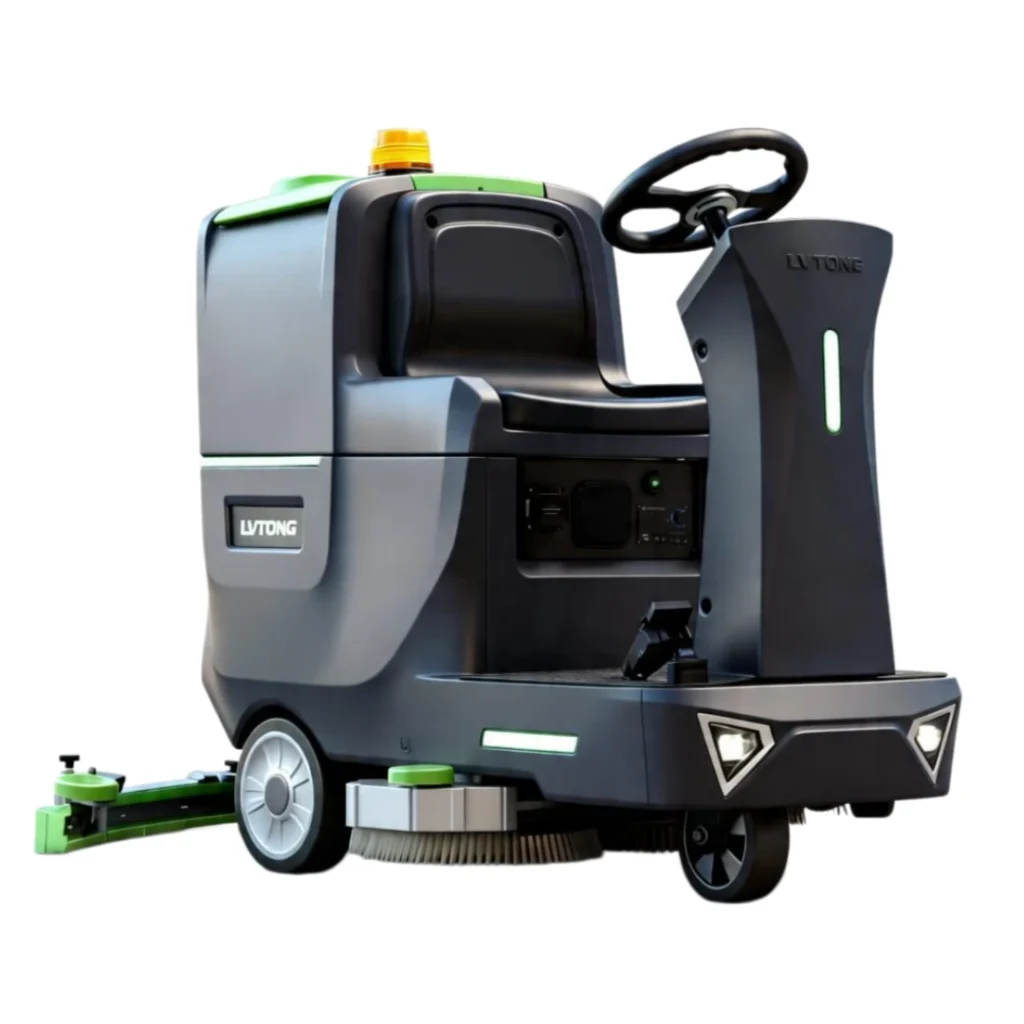
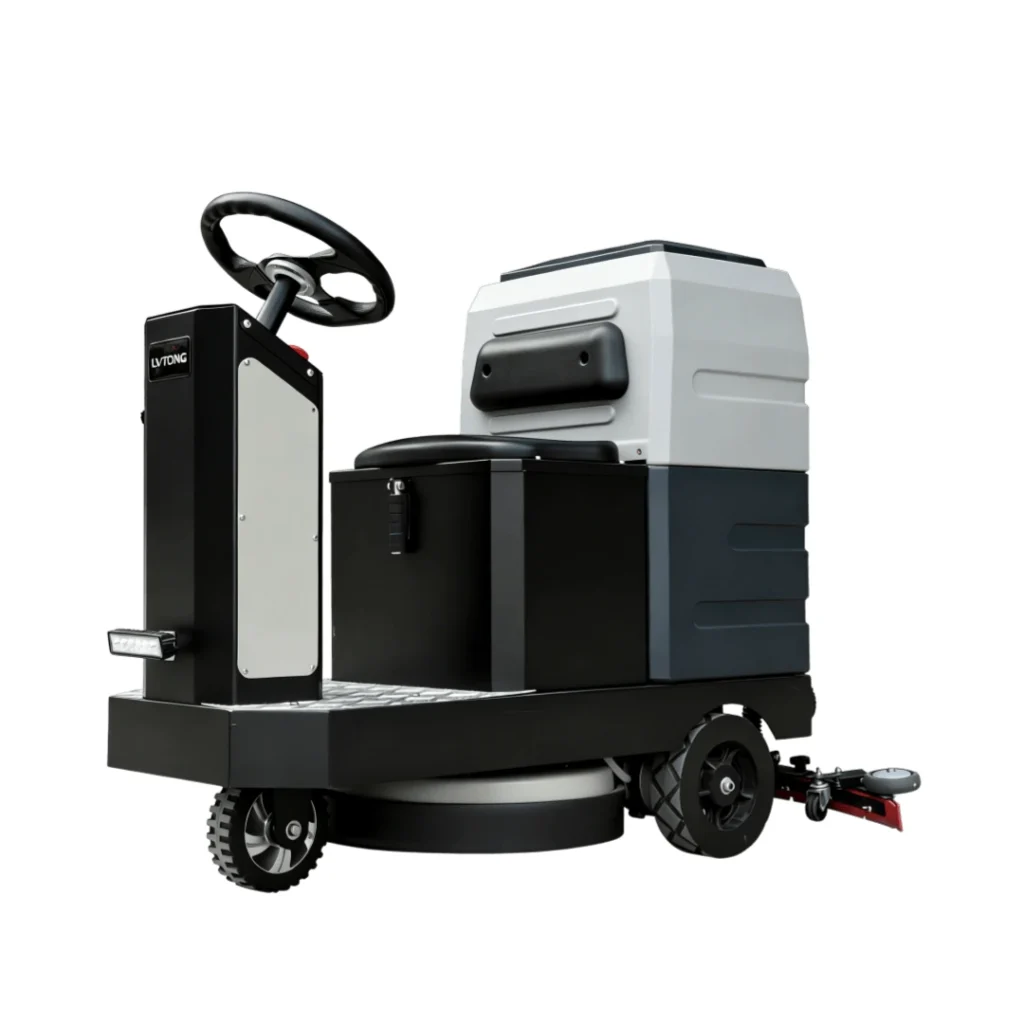
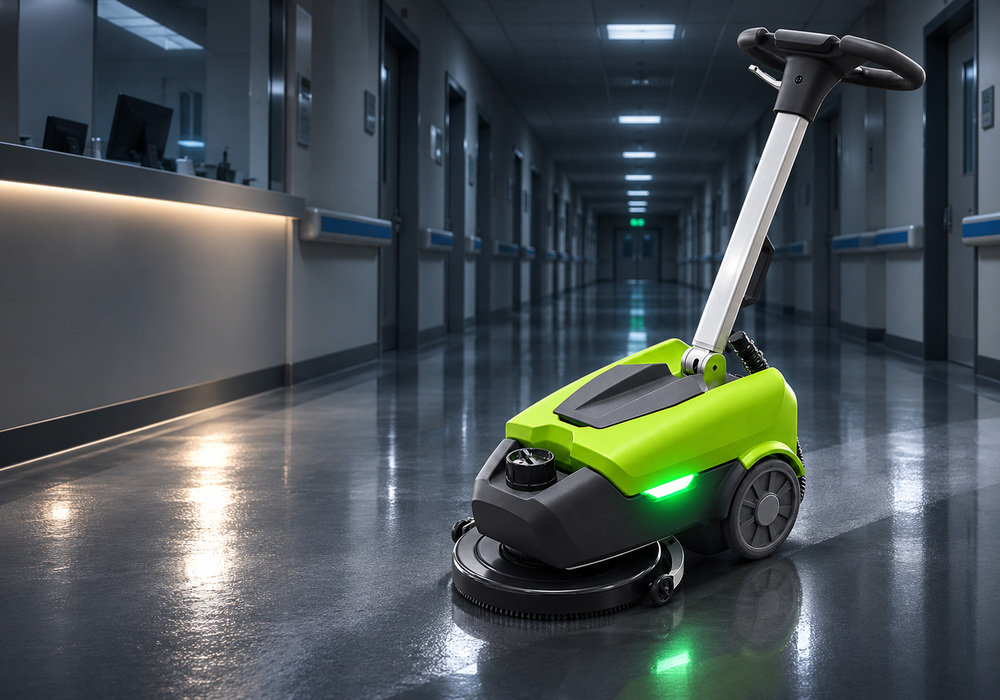
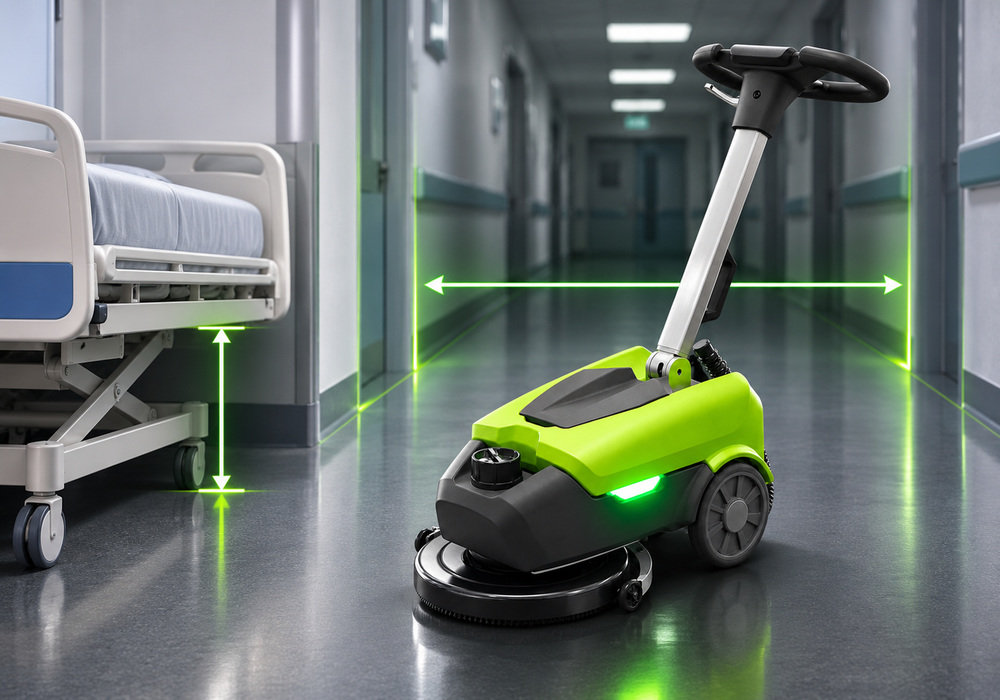
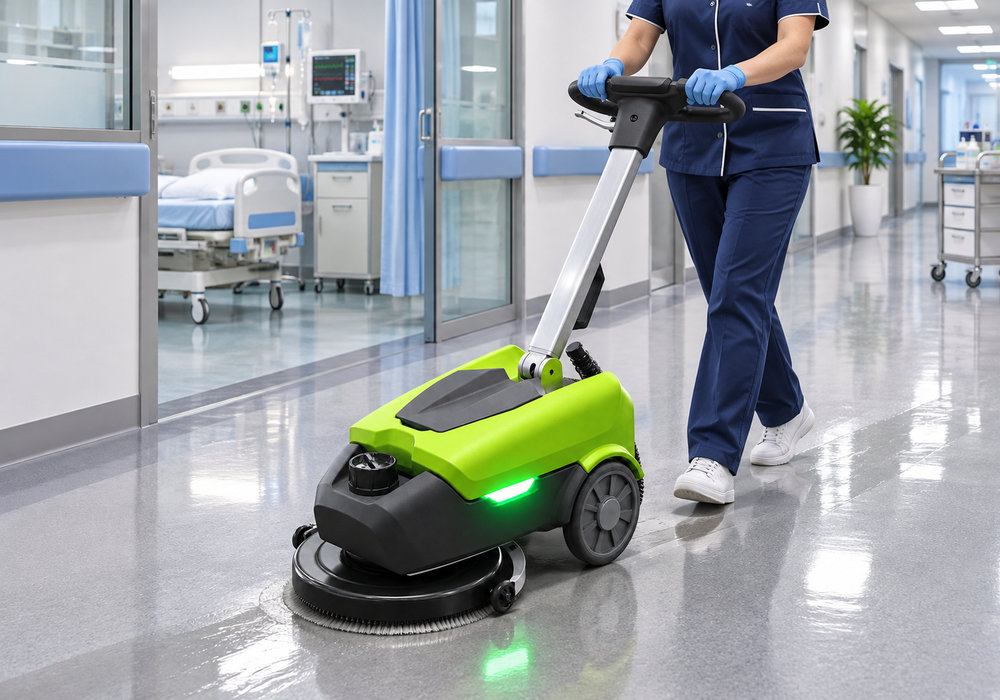
Corridors favor a walk behind floor scrubber for hospitals: runs are long enough to reward a machine, but doorways, bed lifts and shared elevators punish anything wide or heavy. A compact hospital floor scrubber — for example a lithium walk-behind with a 50 cm body width and a stated 2,100 m²/h working rate, such as the compact walk-behind floor scrubber machine — threads a corridor network that a ride-on cannot enter, and its squeegee width should still fit the narrowest door opening on the route. Ride-on formats stay outside: basement parking decks and loading docks carry the tire marks and dust volumes that justify them, and those areas never share air or traffic with wards. Confirm elevator dimensions and ramp grades for any multi-level route before ordering.
Noise Limits and the Cleaning Window
A hospital machine must fit a sound budget, not just a floor plan: the real question is which hours it may run, and at what volume.
With patients resting around the clock, the cleaning window splits: corridors and lobbies get machine passes on the night shift, while daytime work shrinks to spot cleaning between rounds. That makes sound output a purchasing criterion, not an afterthought — ask each supplier for a measured dB(A) value at one meter, and compare it against the hours the route must run. Battery-electric machines also avoid combustion exhaust indoors. The full method for building a decibel budget and choosing a low-noise floor scrubber is covered in the dedicated acoustics guide; hospitals sit at the most sensitive end of that scale.
Disinfectant Chemistry and Machine Compatibility
The machine does not disinfect — the chemistry and the protocol do. The machine’s job is to apply, agitate and remove, without degrading the floor or itself.
Disinfectant choice belongs to the facility’s infection-control policy; no equipment brochure changes it. What the equipment decision controls is compatibility. Quaternary ammonium and chlorine-based products interact differently with floor finishes, seals and machine components, and a pad or brush that is too aggressive strips the very finish the disinfectant regime assumes. Tanks and lines also need rinsing when the product changes, or yesterday’s chemistry contaminates today’s solution. Machine-side chemical selection — pH windows, brush and pad matching, tank hygiene — is treated fully in the Guide des solutions de nettoyage pour autolaveuses; for hospitals, add one rule: the product list and the machine list must be signed off together.
Dirty Water: Containment, Cross-Contamination and Disposal
In a hospital, dirty water is regulated waste: the recovery system, not the brush, is where hygiene performance is won or lost.
Traditional mopping moves soil from the floor into a bucket and back onto the floor with every dip; extraction lifts it into a sealed recovery tank instead. That difference is the core argument for hospital floor cleaning machine requirements. It only holds if the wet side is managed: rinse the recovery tank after each shift, watch for biofilm odor, and empty into utility sinks or designated drains — wash-water discharge is regulated, and the Programme NPDES de l'EPA frames how such water is controlled in the United States. Tank sizing, refill-and-dump cycles and winter handling are covered in the Guide du réservoir d'eau de l'autolaveuse; the hospital-specific point is simpler — no recovery tank, no deal.
Wet Floors, Slip Resistance and Patient Safety
A machine is suitable for a hospital only if it hands back a walkable floor in minutes — residual moisture is a fall risk, not a cosmetic issue.
Patients, visitors and staff with mobility aids cross hospital floors on wet-floor signage’s promise that the surface is genuinely dry. Machine quality decides whether that promise holds: a worn squeegee leaves a film, a flooded pass leaves a sheet, and both convert a cleaning shift into a fall incident. Slip-resistance guidance from the Institut national de sécurité des sols gives facilities a reference for what “walkable” means on sealed vinyl and terrazzo. Schedule passes ahead of shift changes rather than during them, inspect squeegee blades as a daily habit, and treat a slow-drying machine as a defect to be fixed, not a delay to be absorbed.
What Machines Do Not Replace in a Hospital
Machines serve corridors and open zones; the last meters of hospital cleaning stay manual, and that boundary is a design decision, not a failure.
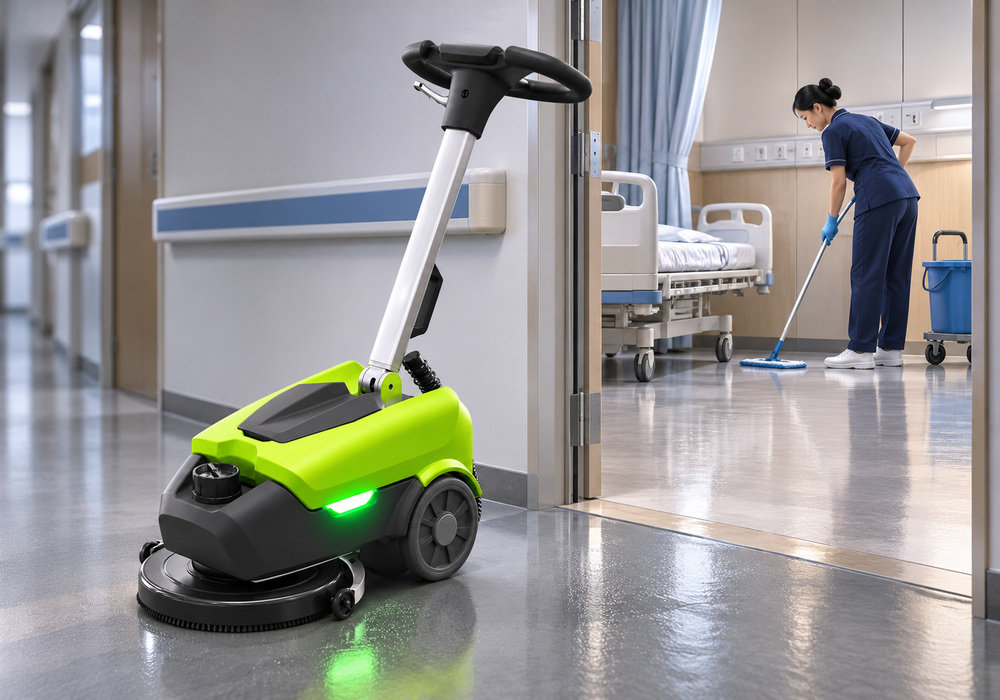
Patient rooms, bathrooms, stairwells and terminal cleaning after patient turnover are geometry-and-protocol problems, not power problems: occupied beds, tight furniture and clinical sequences leave no room for a deck. Budget the machine for the zones it can genuinely serve and staff the rest with hand methods, and the electrical safety of any wet-area machine should conform to the applicable standard for floor treatment appliances, CEI 60335-2-72, which buyers should verify in the documentation supplied with the machine. Where hand mopping remains, its method still matters — the zone-based mopping routine described for office buildings transfers directly to hospital back-of-house areas.
A Specification Checklist for Hospital Floor Equipment
Specify hospital floor cleaning machine requirements in six lines — width, sound, tanks, battery, brush, recovery — and ask every supplier to answer with numbers.
| Doubler | Que faut-il préciser ? | Why it matters here |
|---|---|---|
| Working & body width | Cleaning path plus physical width, against the narrowest door and lift | A corridor machine that cannot pass a bed lift is dead stock |
| Sound level | Measured dB(A) at 1 m, and permissible run hours | Occupied 24/7 building; the window is as scarce as the floor |
| Paire de réservoirs | Solution and recovery capacity, refill and dump points | Refill trips multiply in long corridor networks |
| Battery & runtime | Shift coverage per charge; no trailing cord | Cords are a trip hazard and a wet-area liability |
| Brush / pad type | Compatibility with sealed VCT, sheet vinyl, terrazzo | Finish damage defeats the disinfectant regime |
| Récupération de l'eau | Squeegee condition and drying performance | Wet-floor minutes are the patient-safety metric |
Numbers marked here are operational, not certified values; take them from supplier datasheets and the facility’s own floor-care policy. The general selection method behind this checklist — matching machine classes to a facility’s geometry and shifts — is set out in the guide de sélection des autolaveuses.
Conclusion
Floor cleaning equipment for hospitals is chosen the way the building is run: by zone, by hour and by protocol. A compact battery-powered hospital floor scrubber covers the corridor network, quiet operation and clean water recovery keep the building safe while it works, and the machine stops where clinical space begins. Send your corridor dimensions, floor types and shift windows, and request a hospital-spec quotation — we will price the specification that fits.
Frequently Asked Questions About Hospital Floor Cleaning Equipment
What is the best hospital floor cleaning equipment for corridors?
A compact battery-powered walk-behind: working width sized to the narrowest door on the route, low measured sound output, sealed recovery tank and lithium runtime covering the shift. Corridors reward machines; patient rooms rarely do.
Can a floor scrubber be used inside patient rooms?
Rarely. Occupied beds, furniture and clinical sequences leave no maneuvering room, and most facilities assign these areas to hand methods under their own protocol. Machines serve lobbies, corridors and other open hard-floor zones.
Which machine can run during the day in occupied areas?
Low-noise battery-electric models, scheduled between rounds for lobbies and entrances. Compare measured dB(A) at one meter across candidates, and treat quiet operation as a purchasing criterion rather than a marketing claim.
How often should hospital floors be machine-scrubbed?
Typically daily on traffic zones such as entrances and corridors, with frequency set by the facility’s infection-control policy rather than by the equipment supplier. Watch drying performance each cycle: a floor that stays wet too long is being scrubbed too fast for the machine’s recovery system.