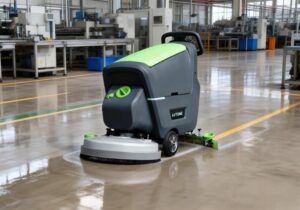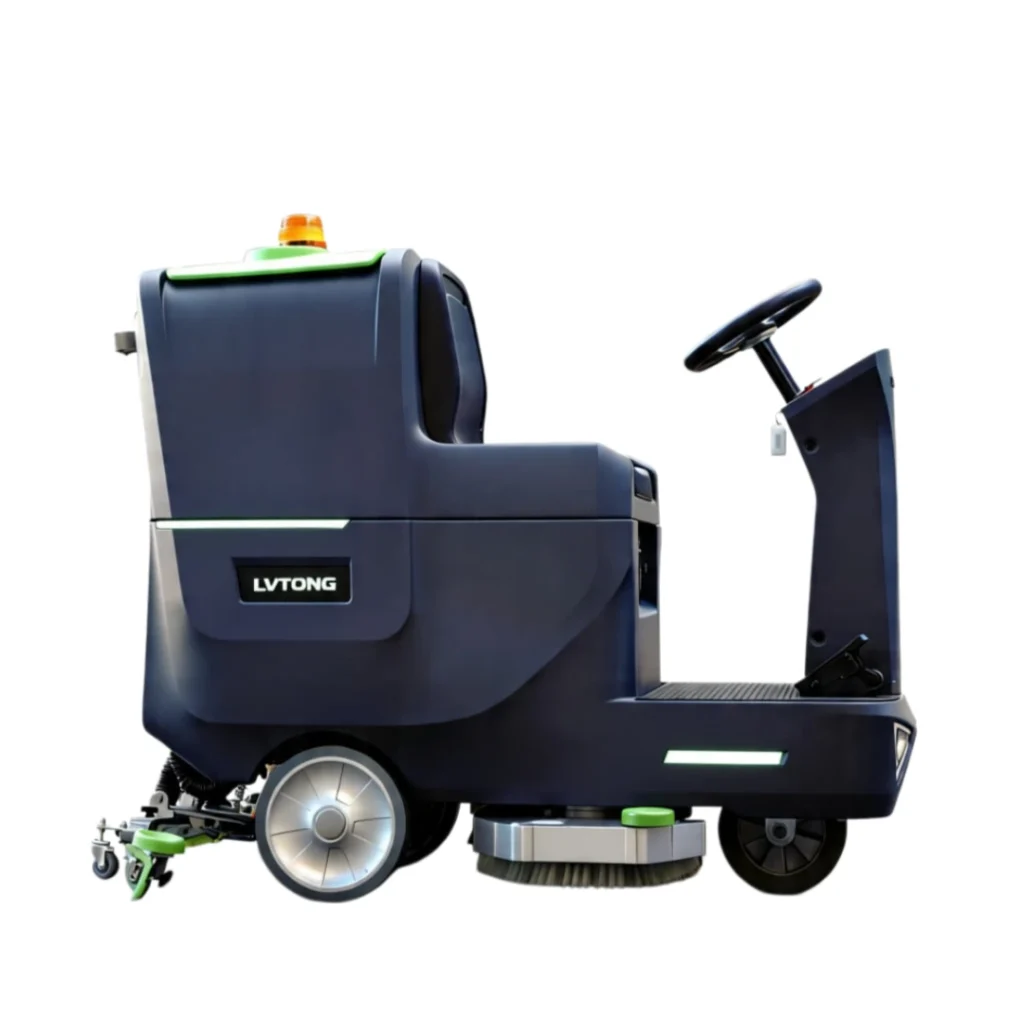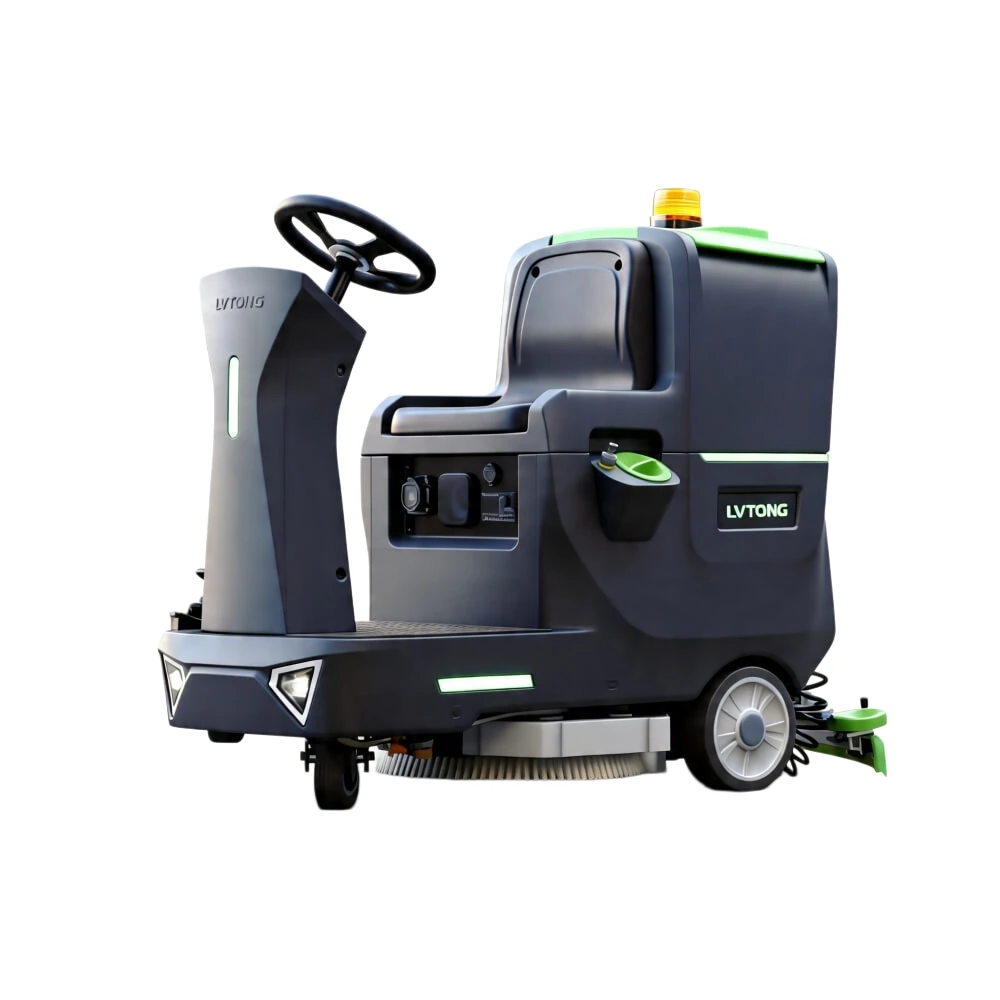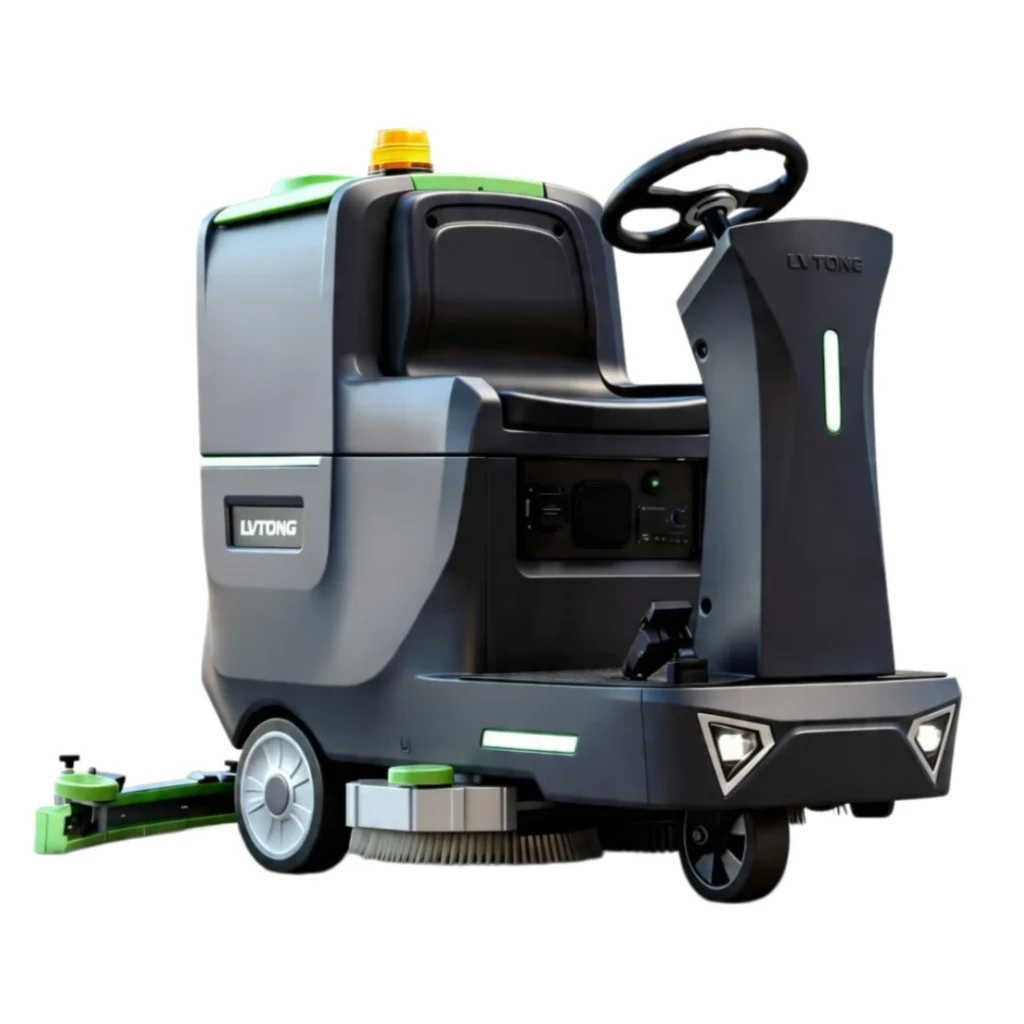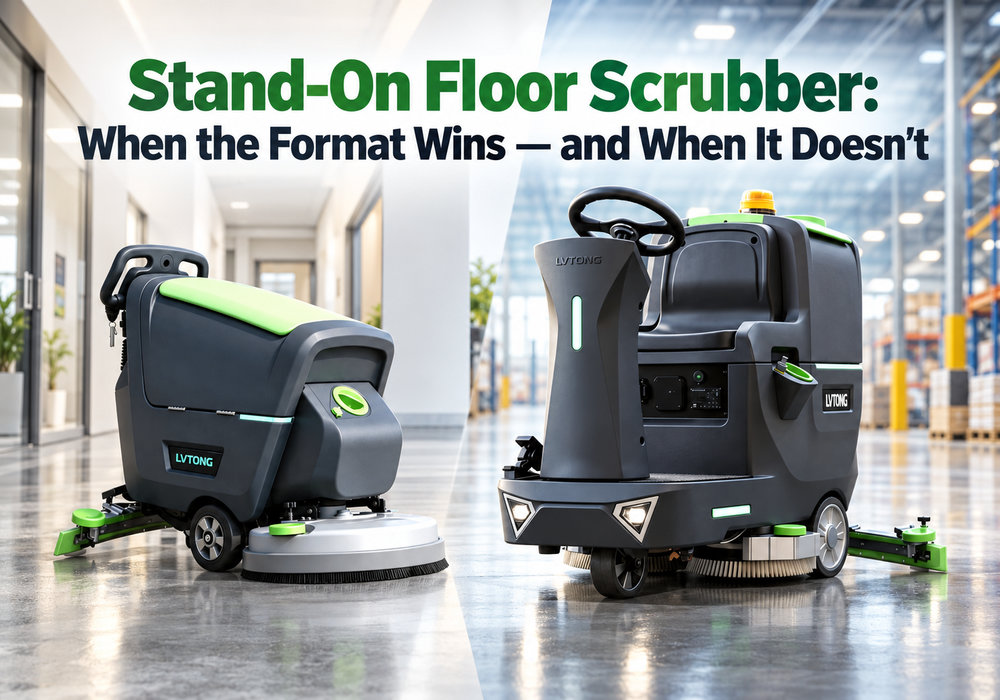
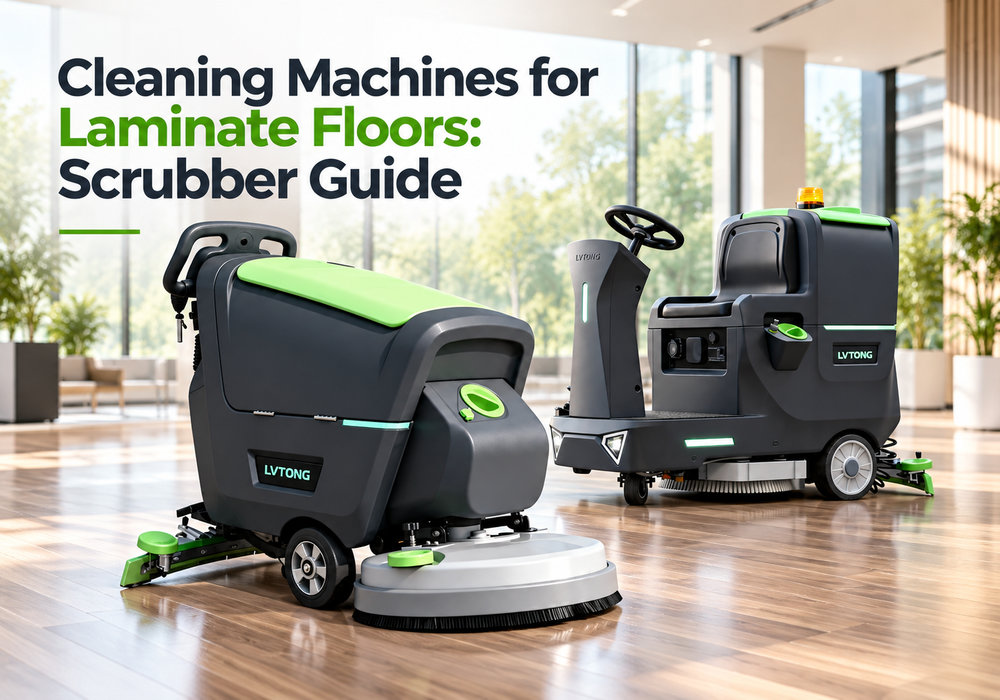
A stand on floor scrubber puts the operator on a standing platform between a walk-behind and a sit-down ride-on — smaller than most seated machines, faster than walking, and built for one specific job: routes that keep stopping. Buying one for the wrong route profile is an expensive way to learn that format, not tank size, decides productivity.
QUICK ANSWER
A stand-on floor scrubber wins when a shift is made of many short cleaning zones separated by doors, lifts and corridor changes — every dismount a walk-behind operator makes is time the standing operator never spends. It loses on long open runs, where a seated ride-on holds comfort and runtime, and in aisles tighter than its platform, where a compact walk-behind is the only machine that fits.
- Count dismounts, not square metres. Dismount count × dismount time is the hidden variable that separates formats.
- Three-way decision: walk-behind for tight geometry, stand-on for fragmented routes, sit-down ride-on for long open runs.
- Check point load and sightlines — standing platforms change both, and both change where the machine can safely work.
- No stand-on model in your shortlist? A compact walk-behind plus a ride-on pairing covers most of what a stand-on would.
Below: what the format actually is, the dismount economics that decide it, a three-way comparison, and how to map the decision onto walk-behind and ride-on machines.
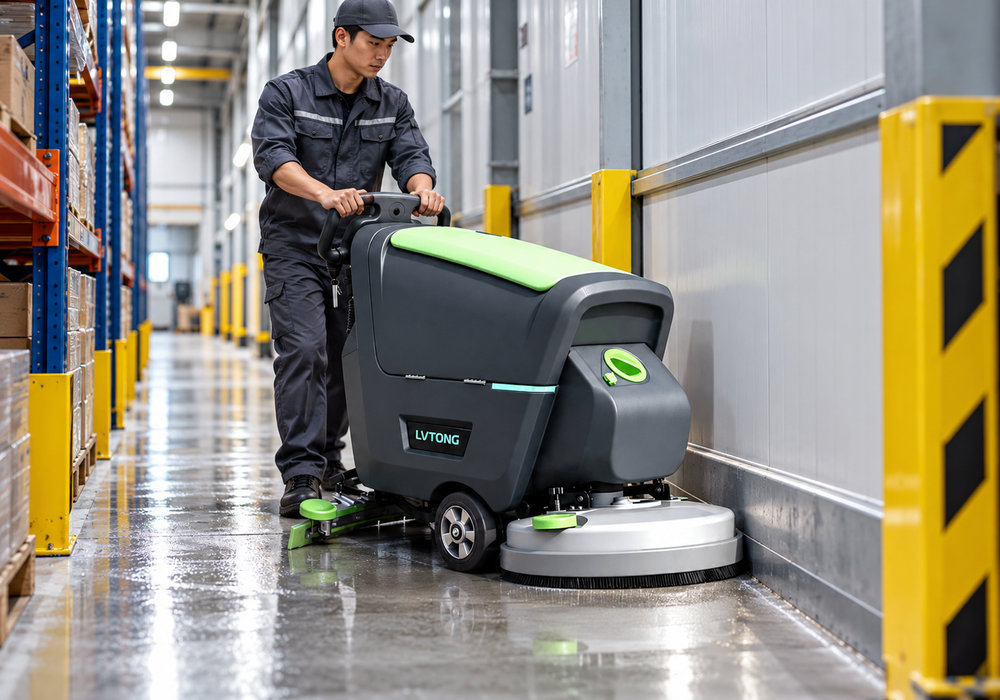
What Is a Stand-On Floor Scrubber?
A stand-on floor scrubber is a mid-size machine the operator rides standing up — physically between a walk-behind and a sit-down ride-on, trading tank size and seat comfort for agility and fast mounting.
The format sits in the middle of the range. It is wider and faster than a walk-behind, with the operator on board rather than pushing, but narrower and more nimble than most seated ride-ons, with no seat, no door frame and a much shorter machine length. Mounting and dismounting take seconds — step on, step off — which is exactly where its economics come from.
Because the operator stands, the machines carry mid-size tanks and mid-size battery systems: more water and runtime than a compact walk-behind, less than a full-size seated ride-on. The platform position also gives the operator a forward sightline over both brush and route, useful in congested areas where pedestrians and pallet traffic appear without warning.
Why Dismount Time Decides Format Economics
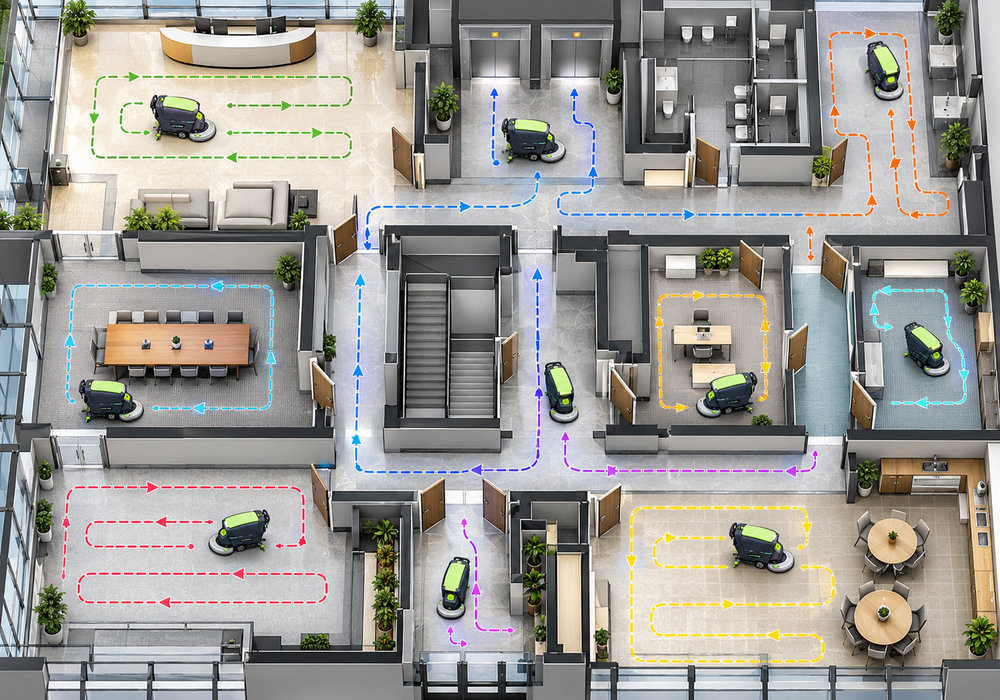
Every time a walk-behind operator stops to open a door, call a lift or move an obstacle, the machine earns nothing — a stand-on operator rolls most of those transitions instead of walking them.
The productivity figures quoted on specification sheets assume continuous running. Real routes rarely allow it. A route that covers six zones on two floors might involve a dozen doors, two lift calls, and several bollard or pallet moves. A walk-behind operator walks the machine through each of those transitions; a seated operator dismounts, moves the machine or waits, and remounts; a standing operator steps off and on, or rolls through without dismounting at all.
Effective coverage = nominal coverage × route time ÷ (route time + dismounts × dismount time)
Run the arithmetic once and the format question changes. Twenty-four dismounts at ninety seconds each is thirty-six minutes of a shift — more than the entire daily runtime of some small machines. This is the same coverage-adjustment logic we apply in our note on cleaning times and machine productivity: nominal figures are a starting point, and the route profile decides the real number.
Stand-On vs Walk-Behind vs Ride-On: The Three-Way Decision
A stand on floor scrubber vs ride on comparison usually settles on route shape: fragmented routes favour stand-on, long open runs favour seated ride-ons, and tight geometry leaves only walk-behinds.
| Parameter | Walk-behind | Stand-on | Sit-down ride-on |
|---|---|---|---|
| Best route shape | Tight, obstacle-dense, sub-0.9 m aisles | Fragmented: many small zones, doors, lifts | Long open runs, wide aisles, large open floors |
| Transitions | Operator walks each one | Step on / step off in seconds | Dismount and remount, slowest per stop |
| Tanks and runtime | Small–mid | Mid | Largest |
| Operator fatigue | Highest — walking all shift | Standing, moderate | Lowest — seated |
| Footprint and agility | Smallest | Short but wider than walk-behind | Longest, widest turning |
| Typical cost class | Lowest | Mid | Highest |
Buyers searching a stand on floor scrubber vs ride on comparison are usually really asking one question: how open is my floor? The more continuous the running, the more a seated machine’s tanks and comfort pay off; the more the route chops the shift into pieces, the more the standing format’s mounting speed is worth.
When Does a Stand-On Floor Scrubber Actually Win?
The format wins where the route fragments: multi-zone floors, door sequences, lift lobbies, back-of-house corridors — anywhere a walk-behind operator would dismount or walk slowly anyway.
Four route profiles suit it, and each answers the stand-on scrubber vs ride-on question the same way — by transition density. Multi-zone retail and mixed-use buildings, where cleaning moves between entrance, food court, back corridors and service areas. Transportation hubs, where zones sit across concourses connected by gates and lifts. Large single-storey facilities with a mix of open floor and racked aisles, where the standing machine handles the transitions between the two. And contract cleaning, where crews face a different building every night and need one machine that tolerates varied geometry.
The common thread is transition density, not floor area. A 4,000 m² building with fifteen doors can favour a stand-on machine over a 4,000 m² open hall that suits a seated ride-on — the areas are identical and the formats should not be.
Where the Stand-On Format Loses
A stand-on floor scrubber vs walk behind comparison flips in aisles: below roughly the machine’s own width plus margin, the walk-behind is the only option; on long runs, seated comfort and tank size win.
Three conditions push work back to the other formats. Aisles and doorways narrower than the platform accepts — a standing machine that cannot enter the racks is an expensive walk-behind that arrives by truck. Long continuous runs — after two hours standing, operators slow down, and a seated ride-on with larger tanks avoids the fill and dump stops a mid-tank stand-on must make. And floor conditions: heavily sloped ramps or surfaces where water control is critical favour the slower, more deliberate walk-behind format.
Fatigue deserves honest treatment. Standing platforms are easier than walking but harder than sitting; on shifts beyond roughly four hours, or where the operator also handles waste and restocking, seated formats hold an endurance advantage that shows up in the last hour of the shift.
No Stand-On Model? Matching the Decision to Walk-Behind and Ride-On
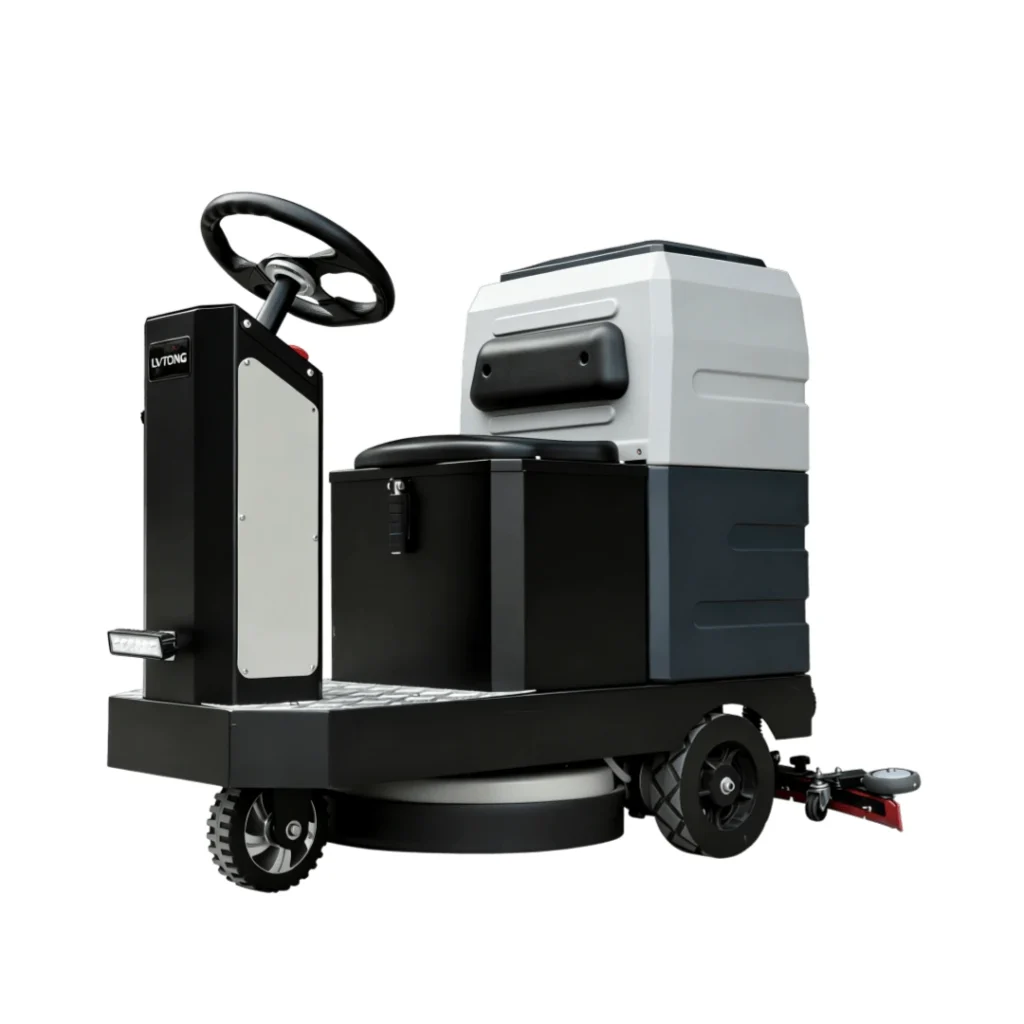
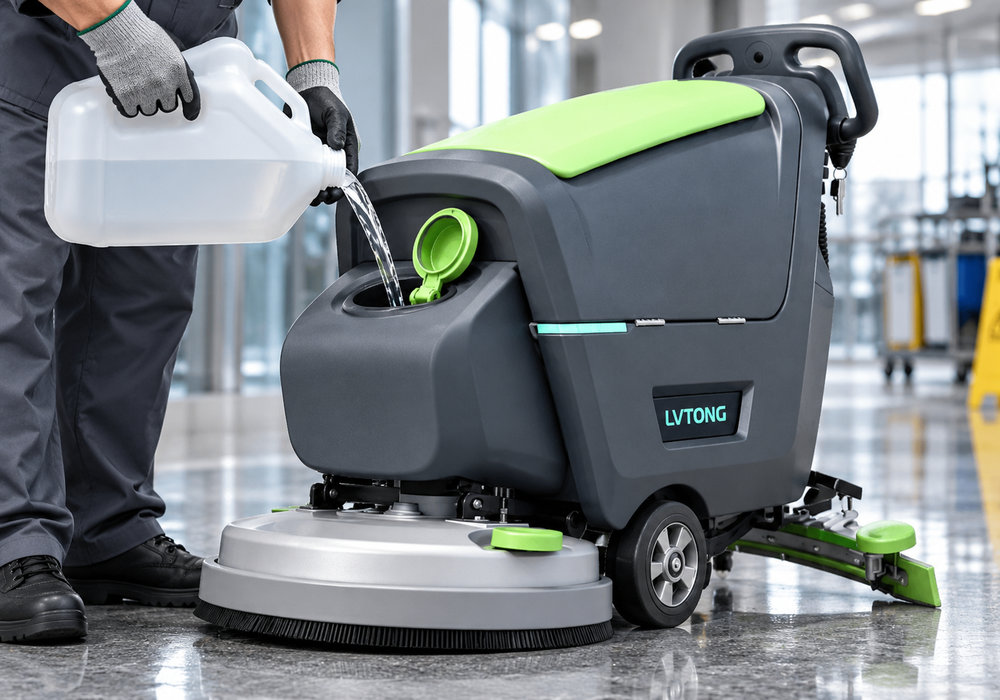
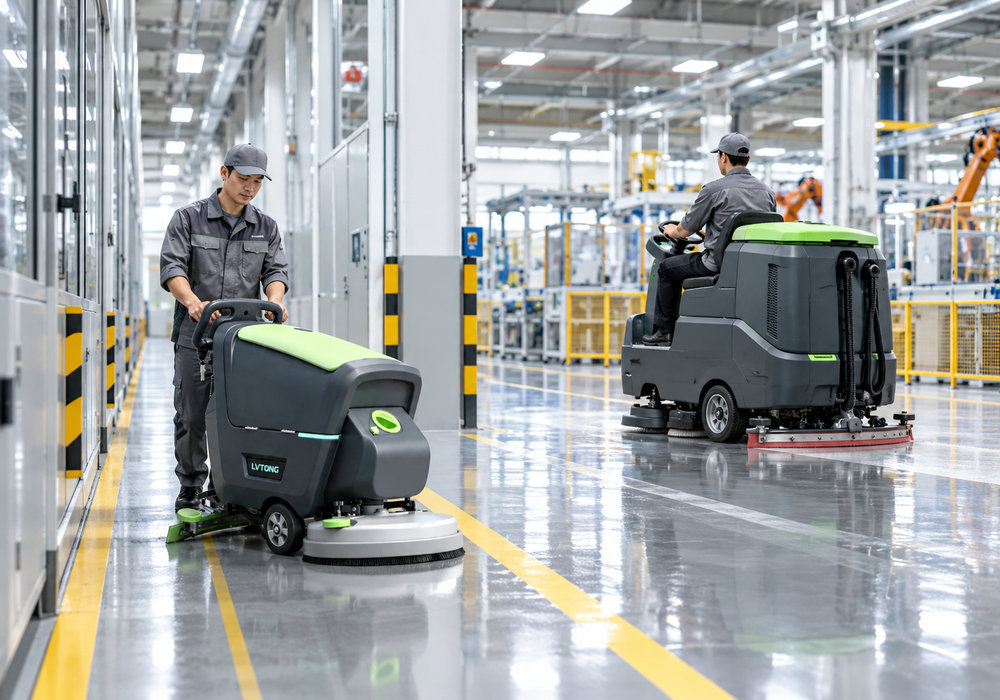
LVTONG builds walk-behind and sit-down ride-on machines, not stand-ons — and for most route profiles the stand-on decision collapses onto one of those two formats anyway.
That is a deliberate statement of where our engineering sits, and it matters for how you use this guide. If your routes are fragmented and your aisles are wide enough for a platform, a stand-on machine from any competent supplier will serve; the honest comparison points are dismount handling, tank class and after-sales reach, not brand slogans. If the decision lands on the two formats we build, the mapping is direct.
For the walk-behind side of the decision, a compact machine such as the LT-S530X walk-behind floor scrubber — a 50 cm body width for 0.8 m aisles, with 62 L clean and 65 L recovery tanks — covers the tight-geometry case where no standing platform fits. For the seated side, the V6 ride-on floor scrubber covers long runs, where its four-hour battery and larger tanks remove the fill and dump stops that interrupt a mid-size machine. Our complete guide to ride-on floor scrubbers details that format’s spec framework.
Fleet Mix: One Stand-On or a Second Machine?
If a facility mixes tight aisles with long runs, two dedicated machines usually beat one compromise machine — and the maths rarely favours the middle format.
Facilities rarely contain a single route shape. The practical comparison is therefore not always stand-on versus one other machine, but stand-on versus a two-machine pairing: a compact walk-behind for the racked and narrow zones, a ride-on for the open floor. The pairing costs more in capital but assigns each machine to the geometry it handles best, removes the compromise from both zones, and gives the operator a better machine for each part of the shift.
The pairing argument strengthens when the zones differ in more than width — different soil loads, different floor types, or different shift windows. Our facility-level floor scrubber selection guide walks through matching machines to zones in that situation.
Trial Before You Buy: Four Metrics That Settle the Format
One supervised trial night settles the format question — measure dismounts, effective coverage, wet-pass quality and transition handling, not just area covered.
Run the candidate machine on the real route, not a demo floor, and record four numbers. Dismount and transition count per shift, so the duty-factor arithmetic uses your site’s figures. Effective covered area per shift, measured against the route plan rather than the specification sheet. Wet-pass quality at the transitions — the places where operators rush are where slip risks and streaking appear, so check the surfaces around doors and lifts against the slip-resistance expectations your safety programme uses (NFSI publishes widely used guidance on walkway slip resistance). And machine handling through the narrowest point on the route, with a loaded machine, not an empty one.
On any format, the machine should be built and protected to the electrical and mechanical safety conventions for floor treatment machines (IEC 60335-2-72), and buyers comparing suppliers can use third-party listing programmes such as UL Solutions as one signal of how a manufacturer’s safety testing is organised.
Frequently Asked Questions
What is the difference between a stand-on and a ride-on floor scrubber?
A stand-on machine carries the operator standing on a platform — shorter, more agile, mid-size tanks. A sit-down ride-on carries the operator seated, with larger tanks and runtime for long open runs. The difference that matters is route shape: fragmented routes favour stand-on, continuous runs favour seated.
Are stand-on floor scrubbers worth the money?
When the route fragments — many zones, doors and lifts per shift — the dismount time they save can exceed what a larger machine gains in tank size. On open floors they are usually the wrong tool; a seated ride-on delivers more coverage per hour at lower operator fatigue.
Can a walk-behind replace a stand-on floor scrubber?
Partly. A compact walk-behind matches the agility and beats it in aisles, but the operator walks all shift and carries smaller tanks. Where transitions dominate, the standing format’s step-on, step-off advantage is real and hard to replicate with a walked machine.
What should I check before choosing the format?
Count the dismounts and door transitions on one real shift, measure the narrowest aisle, and estimate the continuous run length between stops. Those three numbers plus a supervised trial night answer the format question more reliably than any specification table.
Format decisions reward counting what actually happens on the floor — steps, stops and transitions — over comparing specification sheets. If your routes land on the walk-behind or seated ride-on side of the decision, or you want a distributor or OEM discussion around those formats, talk to our team.