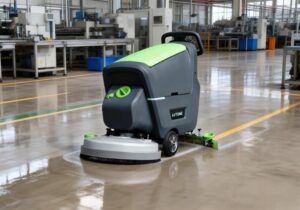
Floor scrubbers wash hard floors and recover dirty water in a single cleaning process. However, different machine configurations are designed for different floor areas, layouts, surface conditions, and productivity requirements.
Choosing the right machine requires evaluating the cleanable area, aisle width, floor material, debris level, cleaning frequency, battery runtime, and labor cost.
Quick Answer:
The main types of floor scrubbers include compact, walk-behind, stand-on, ride-on, and robotic floor scrubbers. They can also be classified by cleaning technology, including disc, cylindrical, and orbital scrubbers.
The best floor scrubber type depends on the facility size, floor layout, surface condition, cleaning frequency, and productivity requirements. Walk-behind floor scrubbers are usually suitable for narrow or obstacle-filled areas, while ride-on floor scrubbers are preferred for large open facilities that require higher cleaning efficiency.
LVTONG is an industrial floor cleaning equipment manufacturer specializing in commercial and industrial floor scrubbers. The product range includes walk-behind floor scrubbers, ride-on floor scrubbers, and floor scrubber dryers designed for factories, warehouses, logistics centers, shopping centers, and commercial facilities.
What Are the Main Types of Floor Scrubbers?
The main types of commercial floor scrubbers are:
- Compact or micro floor scrubbers
- Walk-behind floor scrubbers
- Stand-on floor scrubbers
- Ride-on floor scrubbers
- Robotic or autonomous floor scrubbers
Floor scrubbers can also be classified by scrub deck:
- Disc floor scrubbers
- Cylindrical floor scrubbers
- Orbital floor scrubbers
These different types of floor scrubbers are designed for different cleaning environments. Compact machines prioritize maneuverability, walk-behind models balance flexibility and productivity, ride-on machines maximize cleaning efficiency, and robotic floor scrubbers focus on automated repetitive cleaning routes.
The operating format primarily affects productivity, maneuverability, operator workload, and storage requirements. The scrub deck primarily affects how the machine handles soil, loose debris, grout lines, textured surfaces, and floor finishes.
Floor Scrubber Types at a Glance
| Floor Scrubber Type | Operator Position | Suitable Applications | Main Advantage | Main Limitation |
|---|---|---|---|---|
| Compact or micro | Walks behind or beside the machine | Restrooms, small stores, kitchens and confined spaces | Excellent maneuverability | Small tanks and narrow cleaning path |
| Walk-behind | Walks behind the machine | Schools, retail stores, clinics, workshops and narrow aisles | Precise control around obstacles | More operator walking during long shifts |
| Stand-on | Stands on an integrated platform | Medium-sized facilities and mixed layouts | Compact footprint with higher productivity | Smaller product range than other formats |
| Ride-on | Sits and drives the machine | Warehouses, factories, airports and large public facilities | Wider coverage and lower operator fatigue | Requires more turning and storage space |
| Robotic | Supervises autonomous operation | Predictable and repeatable cleaning routes | Reduces repetitive manual driving | Requires route suitability and human oversight |
Floor Scrubber vs Floor Sweeper: What Is the Difference?
A floor scrubber applies cleaning solution, agitates the floor with a brush or pad, and recovers the dirty solution with a vacuum and squeegee system.
A floor sweeper primarily collects dry dust, sand, packaging material and other loose debris. It does not normally wash the floor in the same way as a scrubber.
Some industrial machines combine sweeping and scrubbing functions. However, a standard floor scrubber should not be expected to collect large quantities of loose debris. Facilities with substantial dust, wood chips, metal fragments or packaging waste may need to sweep before scrubbing or select a cylindrical or combination machine designed for limited debris collection.
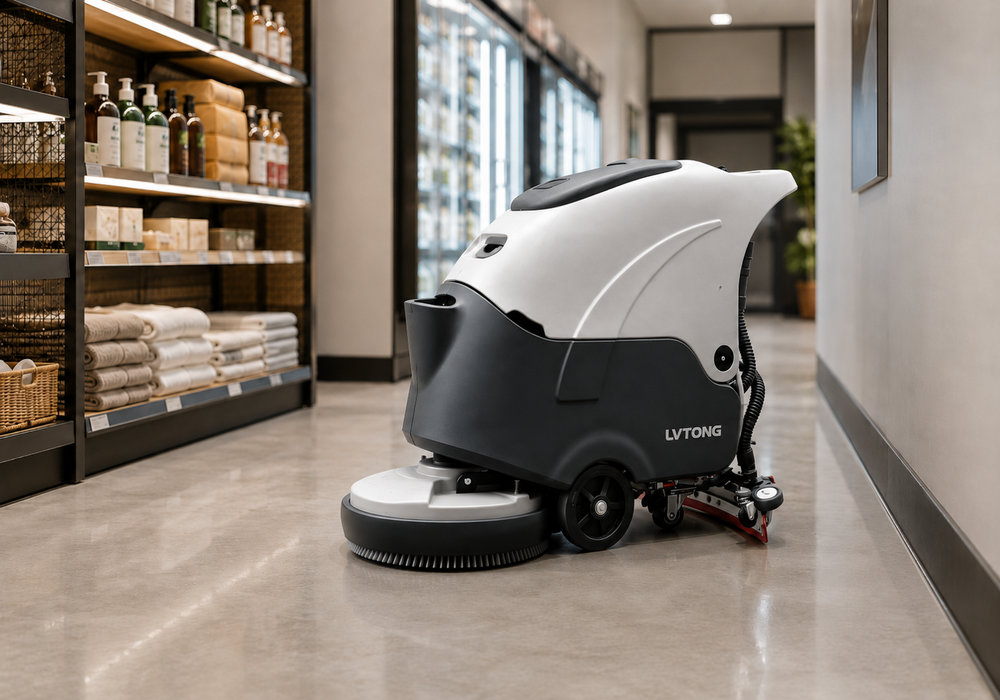
Types of Floor Scrubbers by Operator Configuration
1. Compact and Micro Floor Scrubbers
Compact floor scrubbers are designed for small or highly congested areas where a conventional commercial machine may be difficult to operate.
They are commonly used in:
- Restrooms
- Small retail stores
- Commercial kitchens
- Cafés and restaurants
- Clinic rooms
- Entrances
- Elevators
- Areas around furniture or fixed equipment
Their main advantage is maneuverability. A compact machine can enter tight spaces, turn in a small radius and occupy less storage space.
The trade-off is capacity. Smaller solution and recovery tanks require more frequent filling and draining. A narrow cleaning path also means that covering a large open floor takes longer than it would with a larger walk-behind or ride-on machine.
Compact equipment is therefore most effective when the cleaning route is small, divided or difficult to access—not simply when the total building is small.
2. Walk-Behind Floor Scrubbers
A walk-behind floor scrubber is controlled by an operator walking behind the machine. Some units are brush-assisted, while larger models may include powered traction to reduce the effort required to move the machine.
Walk-behind scrubbers are commonly used in:
- Supermarkets and retail stores
- Schools and educational facilities
- Hospitals and clinics
- Small and medium-sized factories
- Workshops
- Food-processing areas
- Warehouses with narrow aisles
- Facilities with many columns, racks or fixed obstacles
The main advantage of a walk-behind machine is control. The operator remains close to the scrub deck and can respond quickly to corners, equipment, shelving and changing floor conditions.
Walk-behind equipment also generally requires less turning and storage space than a ride-on model. It may therefore remain the better option in a relatively large facility if the cleaning route is heavily divided or contains many obstacles.
Its main limitation is operator workload. During long shifts, the employee must walk the complete cleaning route. Tank capacity and cleaning width are also usually lower than those of larger ride-on machines. Facilities that prioritize maneuverability, close operator control, and access to narrow routes can compare LVTONG’s walk-behind floor scrubber range.
LVTONG walk-behind options include the Q5 and LT-S530X. The Q5 is a compact disc-brush model for commercial and light industrial routes, while the LT-S530X is designed for applications requiring greater capacity while retaining walk-behind maneuverability.
3. Stand-On Floor Scrubbers
A stand-on floor scrubber uses a small integrated platform instead of a conventional seat. The operator stands on the machine and can step on or off quickly.
This format occupies a middle position between walk-behind and ride-on equipment.
Stand-on scrubbers may be suitable for:
- Medium-sized facilities
- Mixed open and congested layouts
- Routes requiring frequent entry and exit
- Narrower areas where a full-size ride-on machine is impractical
- Operations that need more productivity than a conventional walk-behind unit
The main advantage is the combination of a relatively compact footprint and reduced operator walking.
However, stand-on machines are less common than walk-behind and ride-on models. Product availability, local service support and operator preference should therefore be considered before selection.
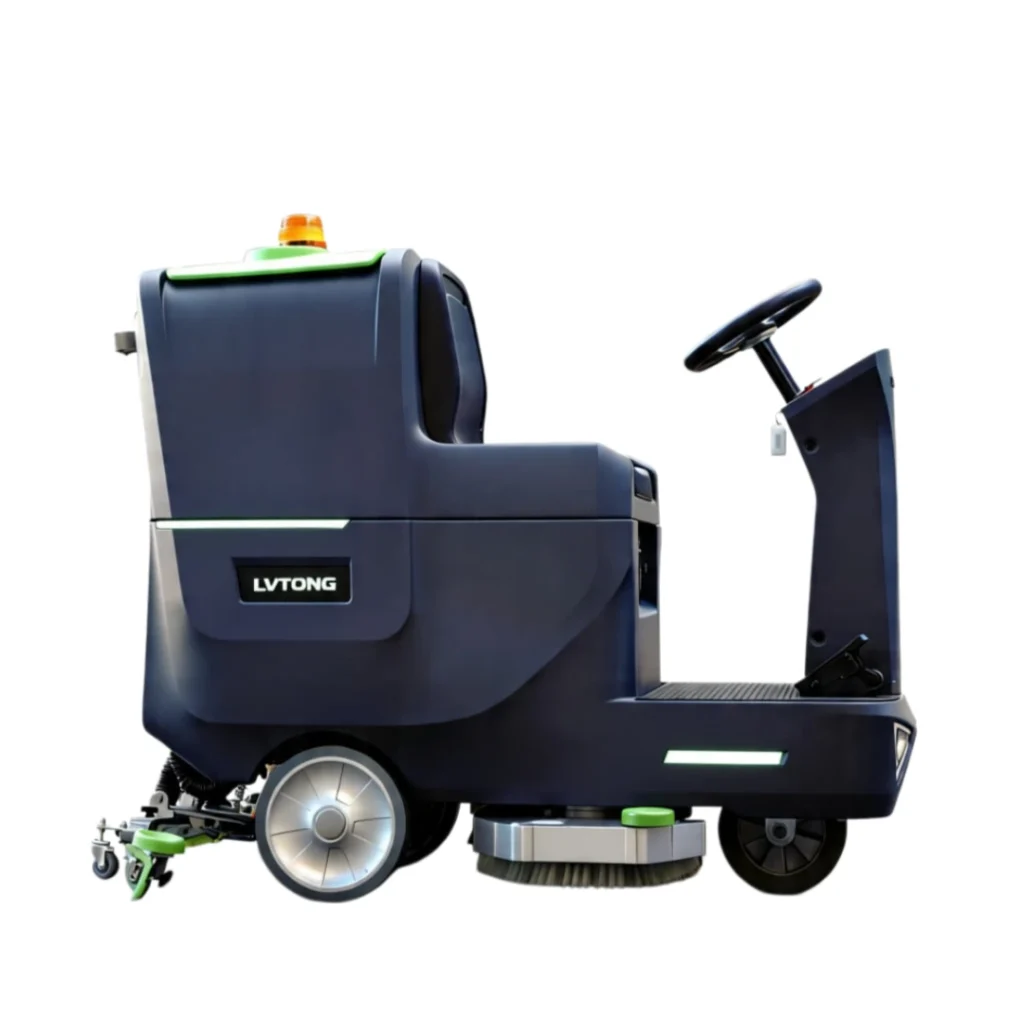
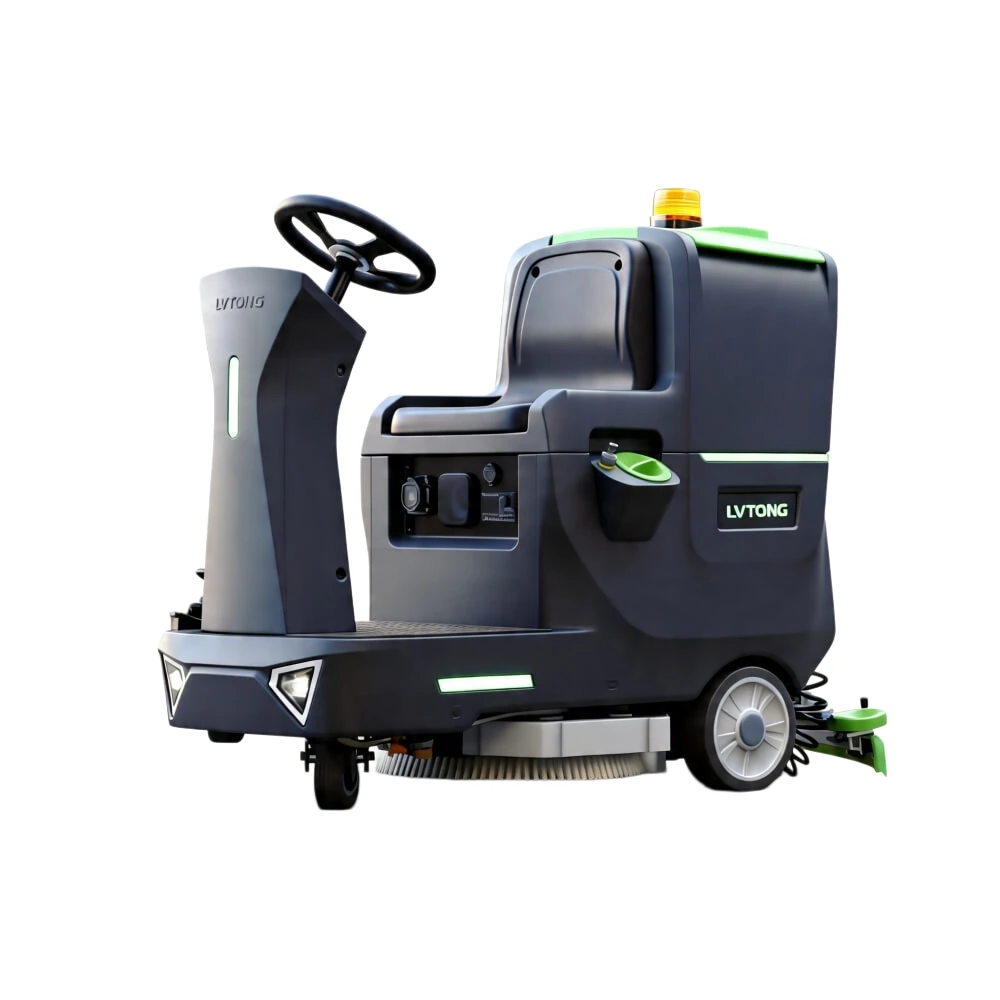
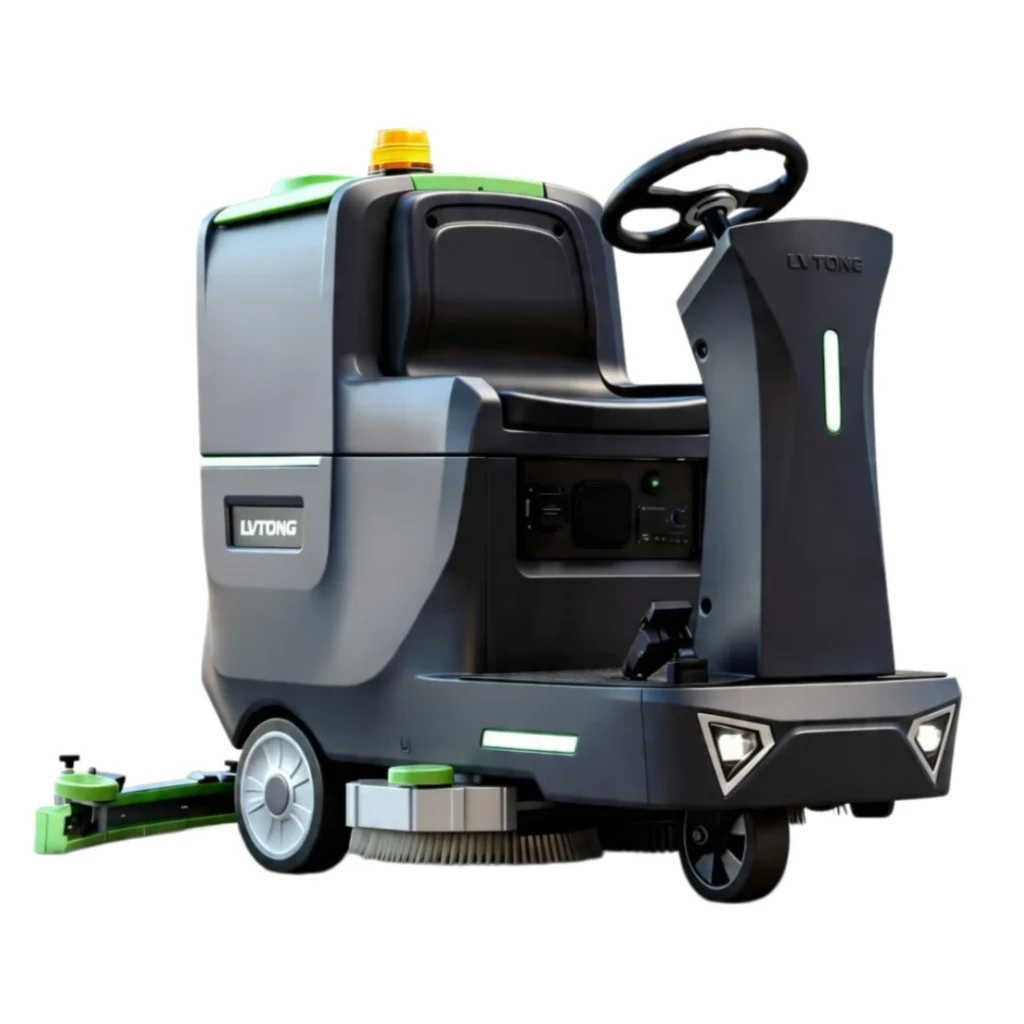
4. Ride-On Floor Scrubbers
A ride-on floor scrubber allows the operator to sit and drive the machine. These units generally provide wider cleaning paths, larger tanks and greater onboard battery capacity than walk-behind equipment.
Ride-on scrubbers are commonly used in:
- Warehouses
- Logistics and distribution centers
- Manufacturing plants
- Airports
- Shopping centers
- Parking facilities
- Exhibition halls
- Large schools and public buildings
Their main advantage is productivity over long, continuous routes. Larger tanks can reduce refill and draining interruptions, while the seated operating position reduces the amount of walking required during extended cleaning shifts.
However, a ride-on machine is not automatically the correct choice for every large building. The machine must fit through doors, turn within aisles, navigate around equipment and reach the required storage and charging area.
A compact ride-on model may work effectively in a medium-sized facility with open routes, while a large building with narrow, obstructed aisles may still require walk-behind equipment.
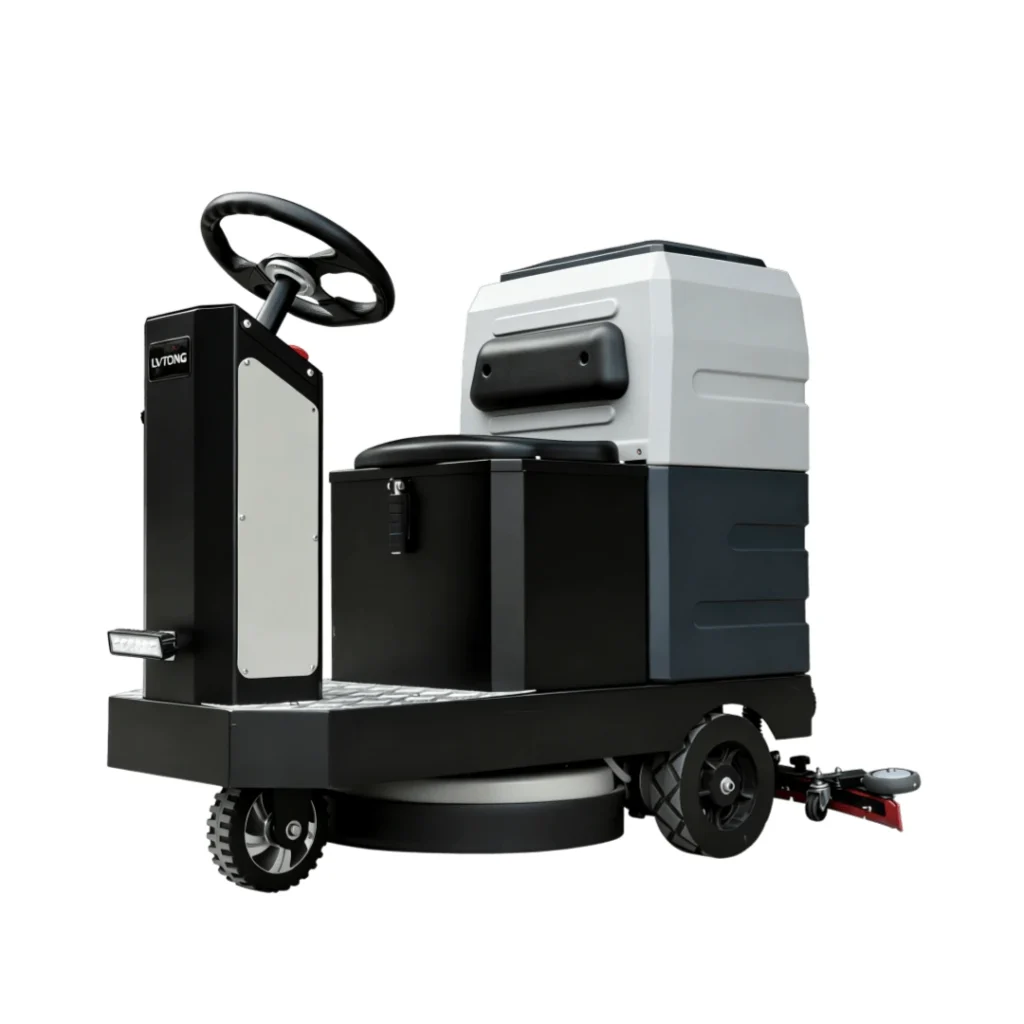
LVTONG ride-on options include the LT-S560X, LT-S710X, V6 and LT-S860X. These models address different cleaning widths, tank capacities and operating environments, so selection should be based on the actual route rather than the total building area alone.
For large or continuous cleaning routes, compare LVTONG’s ride-on floor scrubber models by cleaning width, tank capacity, runtime, and turning requirements.
5. Robotic and Autonomous Floor Scrubbers
Robotic floor scrubbers use sensors, mapping systems and navigation software to clean defined routes with limited direct driving by an operator.
They are most suitable for:
- Large, predictable floor layouts
- Repetitive cleaning routes
- Facilities with consistent daily schedules
- Areas where labor can be reassigned to detailed cleaning
- Operations able to supervise autonomous equipment
A robotic scrubber does not eliminate all manual cleaning. Employees are still needed to prepare the route, respond to exceptions, maintain the machine, refill or drain tanks and clean areas the robot cannot reach.
Robotic equipment is therefore best considered as one part of a cleaning fleet. A facility may use an autonomous machine for open routes and retain compact or walk-behind equipment for corners, rooms and congested areas.
For a closer look at navigation, mapping, obstacle avoidance, and route planning, read our guide to autonomous floor scrubber technology.
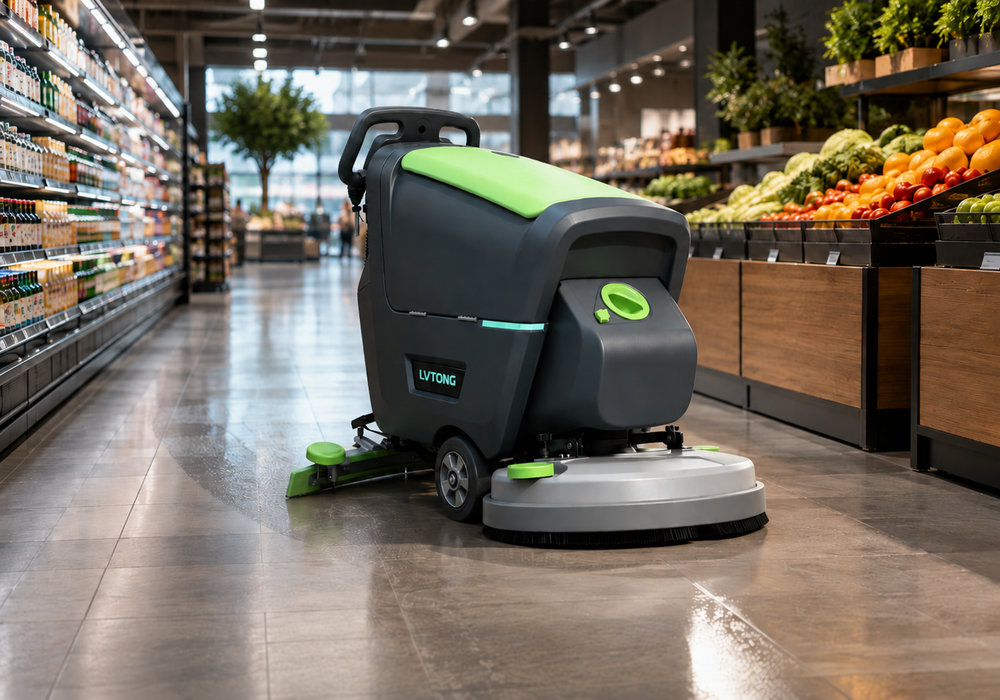
Types of Floor Scrubbers by Scrub Deck
The operator configuration and scrub deck are separate decisions.
A walk-behind, stand-on, ride-on or robotic machine may use different brush technologies. Selecting the operating format without evaluating the scrub deck can result in poor performance on the actual floor surface.
The three common scrub deck types are disc, cylindrical and orbital.
Disc Floor Scrubbers
Disc scrubbers use one or more horizontal rotating brushes or pads. They are widely used for routine cleaning on smooth hard floors.
Common applications include:
- Smooth concrete
- Polished concrete
- Epoxy floors
- Vinyl composition tile
- Ceramic tile
- Marble and other sealed hard surfaces
Disc systems provide broad pad and brush compatibility. Operators can select softer materials for routine maintenance or more aggressive options for heavier soil, subject to the flooring manufacturer’s requirements.
Disc scrubbers work particularly well on floors that have already been swept. They are less suitable for collecting significant amounts of loose debris because the rotating head may push larger material away instead of recovering it.
Choose a disc scrubber when:
- The floor is relatively smooth
- Loose debris is limited
- General-purpose cleaning is required
- Brush or pad flexibility is important
- Higher contact pressure is needed for adhered soil
Cylindrical Floor Scrubbers
Cylindrical scrubbers use horizontal roller brushes that rotate across the floor. The brush action can reach into surface texture, shallow grooves and grout lines more effectively than some flat disc systems.
They are often considered for:
- Textured concrete
- Safety flooring
- Tile and grout
- Industrial floors with surface irregularities
- Areas containing limited quantities of small loose debris
Some cylindrical scrubbers include a debris tray that can collect light material while the floor is being scrubbed. This may reduce the need for a separate pre-sweeping pass under suitable conditions.
However, a cylindrical scrubber is not a replacement for an industrial sweeper when the floor contains substantial packaging waste, metal fragments or heavy debris.
Choose a cylindrical scrubber when:
- The floor has texture, joints or shallow grooves
- Limited small debris must be collected
- Grout-line agitation is important
- The cleaning route combines washing and light debris pickup
Orbital Floor Scrubbers
Orbital scrubbers use a pad that moves in a rapid, small orbital pattern. Instead of relying only on circular rotation, the pad produces consistent mechanical agitation across the contact area.
Orbital systems may be useful for:
- Smooth hard floors
- Edge-focused cleaning
- Deep scrubbing with application-specific pads
- Surface preparation
- Selected floor-finish removal procedures
- Applications requiring controlled pad contact
Performance depends heavily on the selected pad, floor finish, chemical process and machine design. Claims about chemical-free stripping or major water savings should therefore be evaluated for the exact machine and application rather than applied to all orbital scrubbers.
Choose an orbital scrubber when:
- Edge access is a priority
- A specific pad-based process is required
- Consistent agitation across the pad is important
- The flooring and finish manufacturer approves the process
Disc vs Cylindrical vs Orbital Floor Scrubbers
| Scrub Deck | Most Suitable Surface | Loose Debris Handling | Textured Floors and Grout | Main Strength | Main Limitation |
|---|---|---|---|---|---|
| Disc | Smooth hard floors | Low | Moderate | Versatile brush and pad options | Usually requires effective pre-sweeping |
| Cylindrical | Textured or uneven floors | Moderate | High | Reaches grooves and may collect light debris | More brush components to inspect and maintain |
| Orbital | Smooth floors and pad-specific processes | Low | Moderate | Consistent agitation and improved edge access | Results depend strongly on pad and process selection |
Walk-Behind vs Ride-On Floor Scrubbers
A walk-behind scrubber is generally more suitable for tight, divided or obstacle-heavy spaces. A ride-on scrubber is generally more suitable for long, open cleaning routes where wider coverage and lower operator walking requirements justify the larger machine.
There is no universal floor-area threshold at which every facility should switch from walk-behind to ride-on equipment.
The correct choice depends on the actual cleanable area per shift, layout, cleaning frequency, labor cost, doorway width, turning space, tank capacity, runtime and storage conditions.
| Selection Factor | Walk-Behind Scrubber | Ride-On Scrubber |
|---|---|---|
| Preferred layout | Tight, divided or obstacle-heavy | Large, open and continuous |
| Maneuverability | High | Moderate |
| Operator walking | Required | Minimal |
| Cleaning path | Usually narrower | Usually wider |
| Tank capacity | Usually smaller | Usually larger |
| Refill frequency | Usually higher | Usually lower |
| Initial investment | Generally lower | Generally higher |
| Long-shift comfort | Moderate | Higher |
| Storage requirement | Lower | Higher |
| Primary selection benefit | Control and flexibility | Productivity and labor-hour reduction |
Floor Scrubber Selection Decision Table
| Facility Situation | Recommended Floor Scrubber Type | Reason |
|---|---|---|
| Small rooms, restrooms, and narrow areas | Compact or walk-behind floor scrubber | Better maneuverability and easier access |
| Medium-sized factories and workshops | Walk-behind or compact ride-on scrubber | Balanced flexibility and productivity |
| Large warehouses and manufacturing facilities | Ride-on floor scrubber | Higher cleaning efficiency and reduced operator fatigue |
| Repetitive cleaning routes | Robotic floor scrubber | Reduces repetitive manual operation |
| Textured floors and grout lines | Cylindrical floor scrubber | Better cleaning performance on uneven surfaces |
| Smooth epoxy or polished floors | Disc floor scrubber | Flexible brush and pad selection |
Machine format is only one part of the purchasing decision. For a complete evaluation of machine size, brush system, tank capacity, battery runtime, total cost, and service support, review our commercial floor scrubber buying guide.
How to Choose Between Different Types of Floor Scrubbers
Floor Scrubber Selection Framework
Choosing the right commercial floor scrubber can be simplified into six steps:
- Measure the actual cleanable floor area instead of only the total building size.
- Check aisle width, doorway clearance, turning space, and storage conditions.
- Identify the floor material and the type of contamination.
- Determine required cleaning productivity and daily operating hours.
- Compare battery runtime, charging requirements, and maintenance needs.
- Evaluate total cost of ownership, including labor, consumables, repairs, and downtime.
Following this framework helps businesses select a floor scrubber that matches their actual working environment instead of choosing a machine based only on size or purchase price.
1. Calculate the Actual Cleanable Area
Do not select a machine using total building area alone.
A 10,000 m² building may include offices, storage racks, equipment, carpets and inaccessible zones. The actual hard-floor area requiring daily scrubbing may be substantially smaller.
Record:
- Total hard-floor area
- Area cleaned during each shift
- Cleaning frequency
- Available cleaning time
- Areas requiring repeated passes
- Areas requiring a different machine
This produces a more useful requirement than total facility size.
2. Measure Aisles, Doors and Turning Space
Measure the narrowest points along the complete cleaning route, including:
- Doorways
- Warehouse aisles
- Elevators
- Ramps
- Spaces between machinery
- Storage entrances
- Battery-charging areas
- Drainage and refill locations
Compare these measurements with the machine’s total width, squeegee width, length and turning radius—not only its nominal cleaning width.
A machine that can clean the main floor but cannot enter a storage room, pass through a door or turn at the end of an aisle will create operational problems.
3. Identify Soil and Debris
The floor condition affects both machine type and brush selection.
Common contaminants include:
- Fine dust
- Sand and grit
- Food particles
- Packaging fragments
- Grease and oil
- Forklift tire marks
- Metal dust
- Chemical residue
- General tracked-in soil
Disc systems are normally effective for adhered soil on relatively smooth, pre-swept floors. Cylindrical systems may provide an advantage on textured surfaces or routes containing limited light debris.
Heavy loose debris should normally be removed with a sweeper or a separate pre-sweeping process.
4. Match the Machine to the Floor Surface
Inspect the floor material and condition before selecting a brush or pad.
Important surfaces include:
- Smooth concrete
- Polished concrete
- Epoxy
- Ceramic tile
- Tile and grout
- Vinyl composition tile
- Marble
- Textured safety flooring
- Sealed industrial flooring
The brush material, pad aggressiveness, down pressure, detergent and water flow must be compatible with the surface.
Testing the proposed configuration in a representative area is preferable to relying only on general recommendations.
5. Compare Actual Productivity, Not Only Rated Productivity
Manufacturers commonly publish theoretical productivity based on cleaning width and travel speed. Actual productivity is lower because real cleaning includes:
- Turning
- Avoiding obstacles
- Refilling the solution tank
- Emptying the recovery tank
- Repeating heavily soiled sections
- Moving between cleaning zones
- Changing brushes or pads
- Battery charging or replacement
- Operator checks
A practical evaluation should compare how much floor the machine can clean during a normal shift under real facility conditions.
A wider machine may not produce better results if it loses substantial time turning in narrow aisles. Conversely, a compact ride-on machine may reduce cleaning time significantly on a continuous open route.
6. Evaluate Battery Runtime and Infrastructure
For battery-powered machines, consider:
- Required operating hours per shift
- Battery type
- Charging time
- Charging location
- Electrical supply
- Battery maintenance requirements
- Opportunity charging
- Replacement cost
- Availability of spare batteries
The required runtime should include a reasonable operating margin. A machine that only meets the route duration under ideal conditions may not complete the shift when brush pressure, slope, battery age or repeated cleaning increases energy consumption.
Battery chemistry, charging habits, discharge depth, temperature, and maintenance can all affect usable runtime and replacement intervals. See our floor scrubber battery life guide for a detailed lithium-versus-lead-acid comparison.
7. Compare Total Cost of Ownership
The lowest purchase price does not always produce the lowest operating cost.
A total-cost comparison should include:
- Initial equipment price
- Operator labor
- Battery replacement
- Brushes and pads
- Squeegee blades
- Detergent and water
- Preventive maintenance
- Repairs
- Downtime
- Training
- Expected service life
- Resale or residual value
Before Purchasing a Floor Scrubber, Prepare These Information
Before selecting a commercial floor scrubber, buyers should prepare the following information:
- Total floor area
- Actual cleanable floor area
- Floor material
- Main contaminants such as dust, oil, grease, or debris
- Narrowest aisle width and doorway size
- Required cleaning hours per day
- Battery charging conditions
- Maintenance expectations
- Available cleaning budget
Providing these details allows manufacturers to recommend the correct floor scrubber type, cleaning width, battery configuration, and machine capacity.
A ride-on machine may cost more initially but reduce labor hours on a large open route. A walk-behind model may remain more economical in a congested area where a ride-on machine cannot use its wider cleaning path effectively.
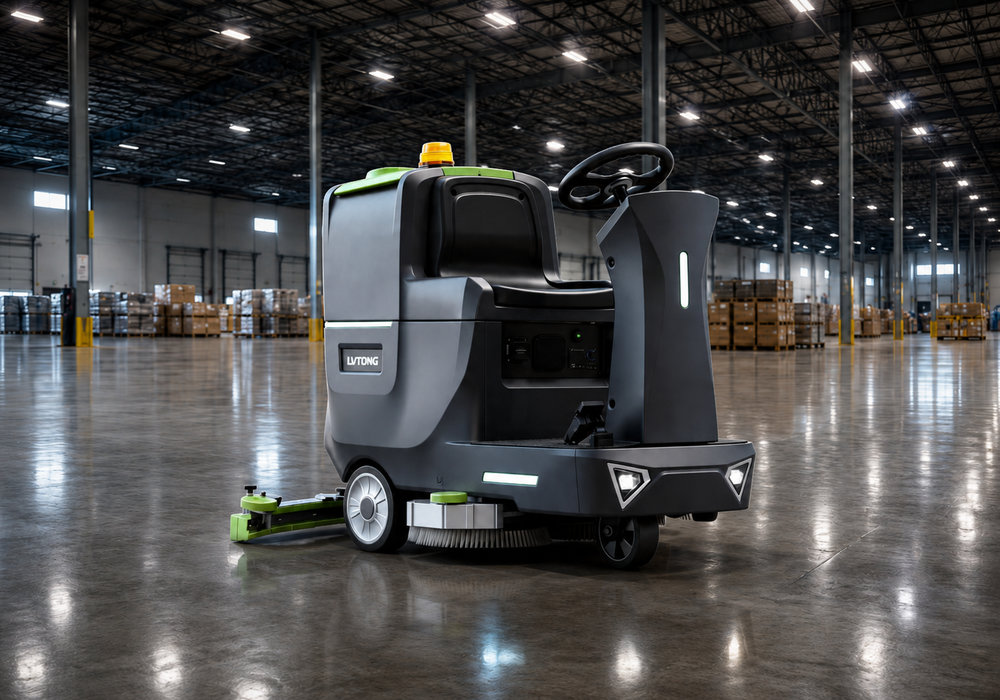
Floor Scrubber Selection by Facility Type
| Facility or Layout | Recommended Starting Point | Important Conditions |
|---|---|---|
| Restrooms and very small areas | Compact or micro scrubber | Storage, edge access and tank size |
| Retail stores | Compact or walk-behind | Customer traffic, noise and obstacles |
| Schools and clinics | Walk-behind or compact ride-on | Maneuverability, noise and drying performance |
| Narrow warehouse aisles | Walk-behind or compact ride-on | Total machine width and turning radius |
| Large open warehouse | Ride-on or robotic | Debris level, route continuity and runtime |
| Manufacturing plant | Walk-behind or ride-on | Soil type, floor condition and equipment layout |
| Airport or exhibition hall | Ride-on or robotic | Long routes, public traffic and operating schedule |
| Mixed-layout facility | Combination fleet | Separate open routes from confined zones |
| Tile and grout areas | Cylindrical or suitable disc system | Grout depth, brush type and surface condition |
| Smooth epoxy or polished concrete | Disc or orbital system | Soil type, pad selection and finish requirements |
Can One Facility Need More Than One Floor Scrubber Type?
Yes. Many facilities obtain better results from a mixed fleet rather than forcing one machine to clean every area.
For example:
- A ride-on scrubber can clean the main warehouse floor.
- A walk-behind machine can clean narrow aisles and production areas.
- A compact scrubber can clean restrooms and small rooms.
- A robotic scrubber can handle a predictable open route.
- A sweeper can remove substantial dry debris before scrubbing.
A mixed fleet can improve route coverage and reduce the compromises created by using a machine that is too large for confined areas or too small for continuous open floors.
Examples of LVTONG Floor Scrubber Types
LVTONG supplies walk-behind and ride-on floor scrubbers for commercial and industrial applications.
Q5 Walk-Behind Floor Scrubber
The Q5 walk-behind floor scrubber is a compact walk-behind disc scrubber designed for routes requiring maneuverability, controlled water application and one-pass water recovery.
It may be considered for retail stores, workshops, food-processing areas and other facilities with moderate cleaning routes and limited space.
LT-S530X Walk-Behind Floor Scrubber
The LT-S530X industrial walk-behind floor scrubber provides a larger walk-behind format for industrial and commercial environments.
It is intended for users who require more capacity than a compact machine while retaining close operator control in aisles, workshops and obstacle-rich areas.
LT-S560X Ride-On Floor Scrubber
The LT-S560X 560mm ride-on floor scrubber is a compact ride-on model for facilities that need seated operation but cannot accommodate the largest industrial riders.
It may be evaluated for shopping centers, workshops and medium or large hard-floor routes where turning space remains an important constraint.
LT-S710X Ride-On Floor Scrubber
The LT-S710X ride-on floor scrubber is intended for larger, more continuous cleaning applications.
Its ride-on configuration and larger tank system make it suitable for users comparing equipment for warehouses, manufacturing plants, logistics facilities and other high-coverage routes.
Machine selection should be confirmed using actual floor measurements, aisle dimensions, surface conditions, soil type, cleaning schedule and required operating time.
Frequently Asked Questions
Conclusion
Floor scrubbers should first be classified by operator configuration and then by scrub deck.
Compact, walk-behind, stand-on, ride-on and robotic machines address different layout, productivity and labor requirements. Disc, cylindrical and orbital decks address different floor surfaces, soil conditions and cleaning processes.
For tight or divided areas, begin by evaluating a compact or walk-behind scrubber. For long, open routes and extended shifts, compare ride-on equipment. For stable, repetitive routes, robotic equipment may become part of the cleaning fleet.
The final decision should be based on the actual cleanable area, aisle width, turning space, floor surface, debris, tank capacity, battery runtime and total operating cost.
To receive a suitable machine recommendation, provide LVTONG with your floor area, narrowest aisle width, floor material, main contaminants, required cleaning frequency and available operating time.