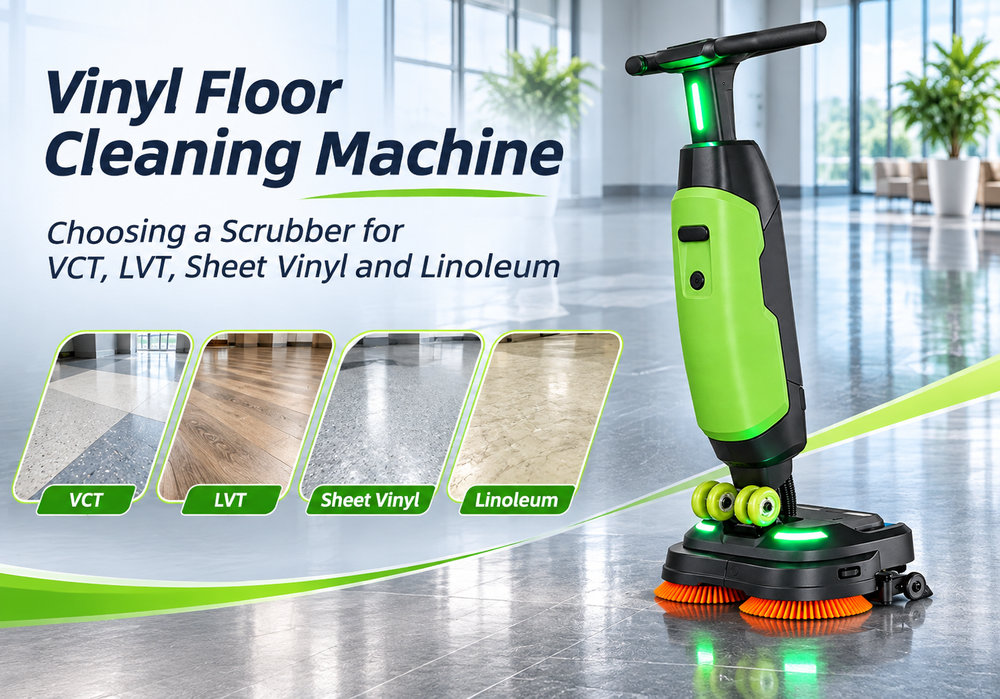
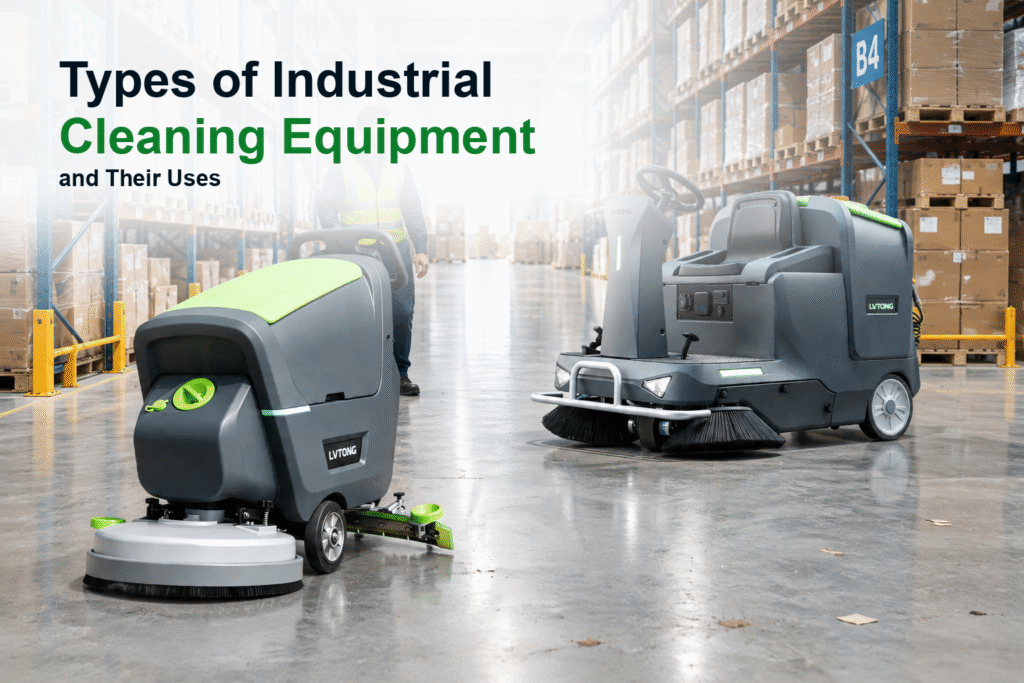
A vinyl floor cleaning machine is an auto scrubber-dryer that lays down solution, agitates with a soft brush or pad, and recovers the water in one pass — the tile class, configured differently. The distinction matters: resilient flooring is the most common commercial floor in hospitals, schools, supermarkets and offices — and the easiest to damage with a scrubber left on default settings. Water sitting along a seam softens adhesive; an abrasive brush dulls a wear layer that cannot be polished back. This guide covers how the four resilient materials differ, which specifications protect them, and how to size a machine for the floor you actually have.
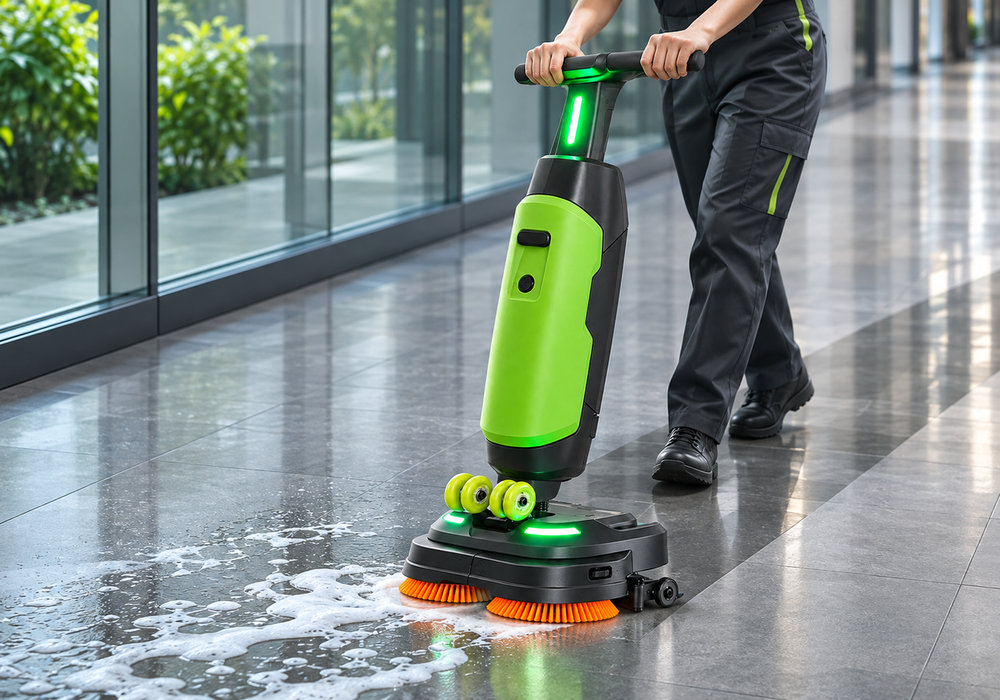
QUICK ANSWER
The right vinyl floor cleaning machine is a scrubber-dryer with soft agitation, a low adjustable solution flow, and recovery strong enough to leave the floor walk-dry in one pass — sized to your longest continuous vinyl run, not to total facility area.
- Water is the failure mode, not dirt. Vinyl fails at seams, edges and transitions where solution sits, so recovery matters more than width.
- Brush and pad follow the material. Finish-coated VCT takes a red pad; LVT and sheet vinyl take a soft brush under light pressure; linoleum dislikes alkaline chemistry.
- Coverage follows continuity. Rooms and aisles take a compact walk-behind; corridors and open retail floors take a ride-on with a wide squeegee.
- Slip resistance is a cleaning outcome. Stripping finish or leaving residue changes wet vinyl behaviour underfoot.
The sections below cover the four materials, the water budget, brush settings, sizing and an RFQ checklist.
What Counts as a Vinyl Floor Cleaning Machine
A vinyl floor cleaning machine is a scrubber-dryer set up for resilient flooring: soft agitation, controlled solution flow, and recovery that takes the water off the floor before it reaches the seams.
The hardware of a vinyl floor cleaner machine is the familiar class sold for tile and concrete — pad deck, solution tank, squeegee, recovery tank. What changes is the configuration: agitation material, down-pressure, solution volume and pass speed. A machine tuned for sealed concrete will wet and abrade vinyl beyond what the material tolerates.
Vinyl is a search term, not one material; the four resilient types below do not share a cleaning specification.
Why Machine Cleaning Damages Vinyl Floors
Vinyl fails in three ways under a scrubber: water reaching adhesive through seams, abrasion of a finish or wear layer that cannot be restored, and a change in slip resistance as the surface film changes.
- Seam and adhesive failure. VCT and LVT are modular; sheet vinyl is seamed or heat-welded. Solution pooling along a seam softens adhesive and lifts edges, most often where pickup never reaches.
- Wear-layer and finish damage. Stiff brushes, high down-pressure and fast passes cut gloss off coated VCT and dull printed LVT patterns that cannot be polished back.
- Slip-resistance shift. Stripping textured VCT or leaving detergent residue can each make wet vinyl more slippery than it was.
VCT vs LVT vs Sheet Vinyl vs Linoleum
All four take the same machine class, but brush, pressure, chemistry and water tolerance change by material — linoleum is the least forgiving of alkaline products.
| Material | Construction | Dominant cleaning risk | Agitation | Solution note |
|---|---|---|---|---|
| VCT | Modular tile, usually finish-coated | Finish wear; over-stripping | Soft brush or red pad daily; stripping pads only when stripping | Neutral cleaner; the finish programme sets the routine |
| LVT / LVP | Modular plank or tile with printed wear layer | Scuffing, dulling, edge lift | Soft brush or white/red pad at light pressure | Neutral, low-residue |
| Sheet vinyl | Rolled goods, seamed or heat-welded | Water at seams; hygiene in clinical areas | Soft brush or pad, reduced flow | Neutral, per maintenance guidance |
| Linoleum | Linseed-oil based, not PVC | Alkaline attack; excess water | A linoleum floor scrubber runs a soft brush at low flow | Neutral pH; no high-alkaline products |
Product guidance overrides generic rules: manufacturers of modular tile, plank and sheet goods each publish their own maintenance sheets, and their finish, seam and chemistry rules take precedence over any generic routine in this guide.
How Much Water Is Your Machine Leaving Behind?
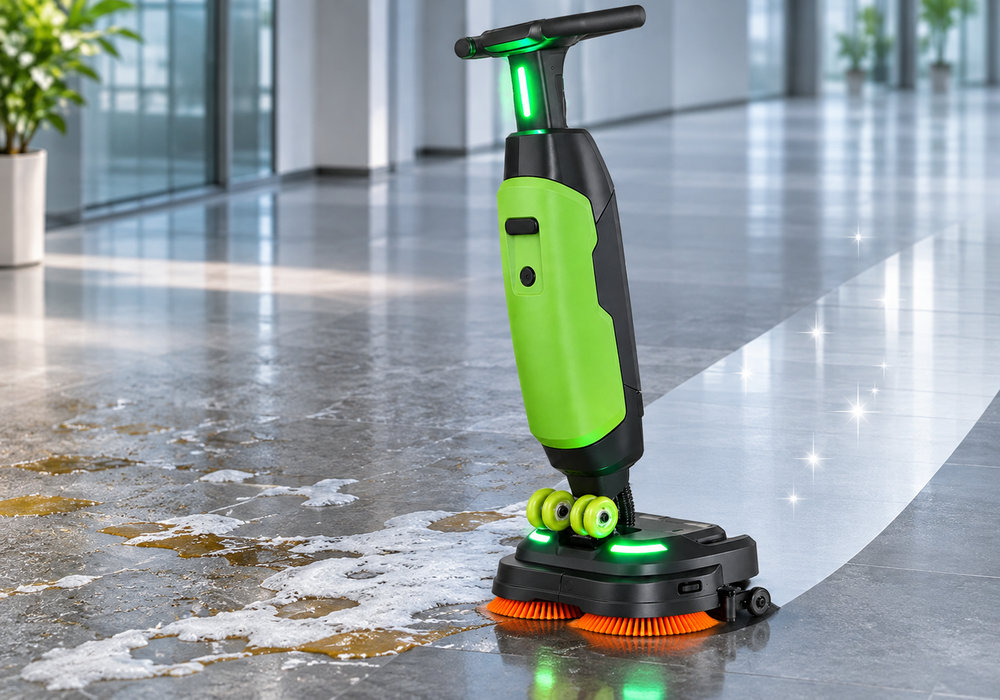
On vinyl the deciding specification is not brush width. It is how much solution goes down, and how completely the machine brings it back up.
- Solution flow rate. Litres per minute against scrub path width. Vinyl needs a lower setting than sealed concrete; ask for the adjustable range, not just the max.
- Squeegee contact. A worn, glazed or high-set blade leaves a film the vacuum cannot chase. Inspect weekly.
- Recovery vacuum and tank volume. The vacuum decides pickup speed; the tank decides when pickup stops. A tank that fills mid-corridor turns the rest of the pass into a wet spread.
- Pass speed and overlap. Slower overlapping passes remove more water per square metre. On vinyl, a fast pass is a wet pass.
After one pass the floor should be walk-dry within minutes, and a paper towel pressed on a seam should come away damp at most.
Brush, Pad and Pressure Settings for Vinyl
Daily cleaning on vinyl calls for a soft brush, or a pad driver with a red or white pad — never a stiff brush or a stripping pad as the routine.
Soft brush or pad driver
On finish-coated VCT, a pad driver with a red pad cleans without cutting the finish. LVT and sheet vinyl do best with a soft brush or white pad under light pressure. Bristle material matters more than deck shape.
Down-pressure and pass speed
Use the lightest pressure that lifts the soil. On modular vinyl, extra pressure drives water toward the seams and accelerates edge lift. If soil is not coming up, the answer is dwell time, not weight.
Chemistry and residue
Neutral, low-residue cleaner at label dilution is the default across all four materials. A linoleum floor cleaner machine must never run high-alkaline products, which attack the linseed-oil binder. Dosing errors show as streaks, which our guide to floor scrubber cleaning solutions covers.
Walk-Behind or Ride-On for Vinyl Areas?
Decide by continuity and obstacles rather than total area: vinyl broken into rooms and aisles takes a walk-behind machine, while long corridors and open retail floors take a ride-on.
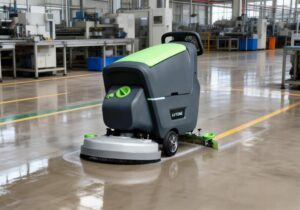
Healthcare wings, classrooms and office suites are divided into rooms, doorways and corners. A compact walk-behind finishes a room in one direction; the LT-S530X walk-behind scrubber clears 0.8 m aisles with a 50 cm body, works at up to 2,100 m²/h and carries 62 + 65 L tanks. Specifications are listed on the cleaning equipment range page.
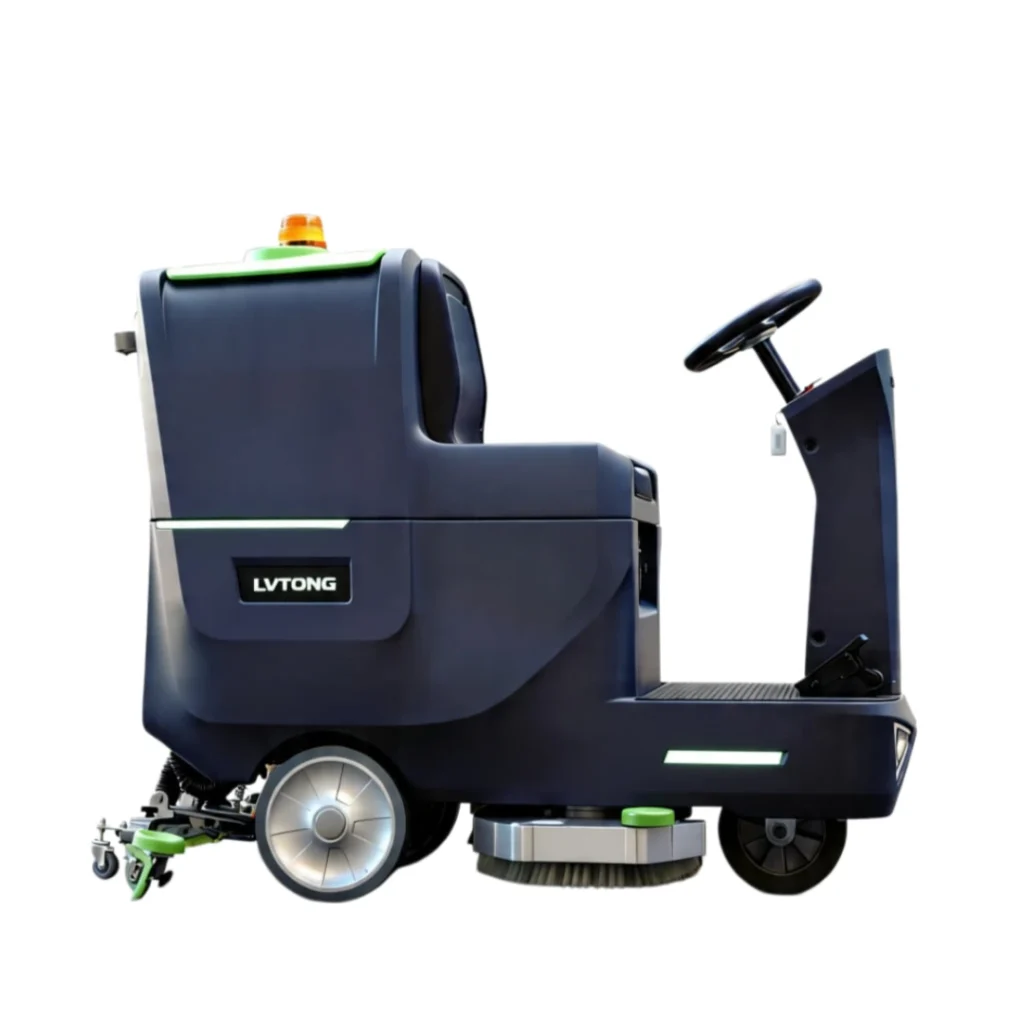
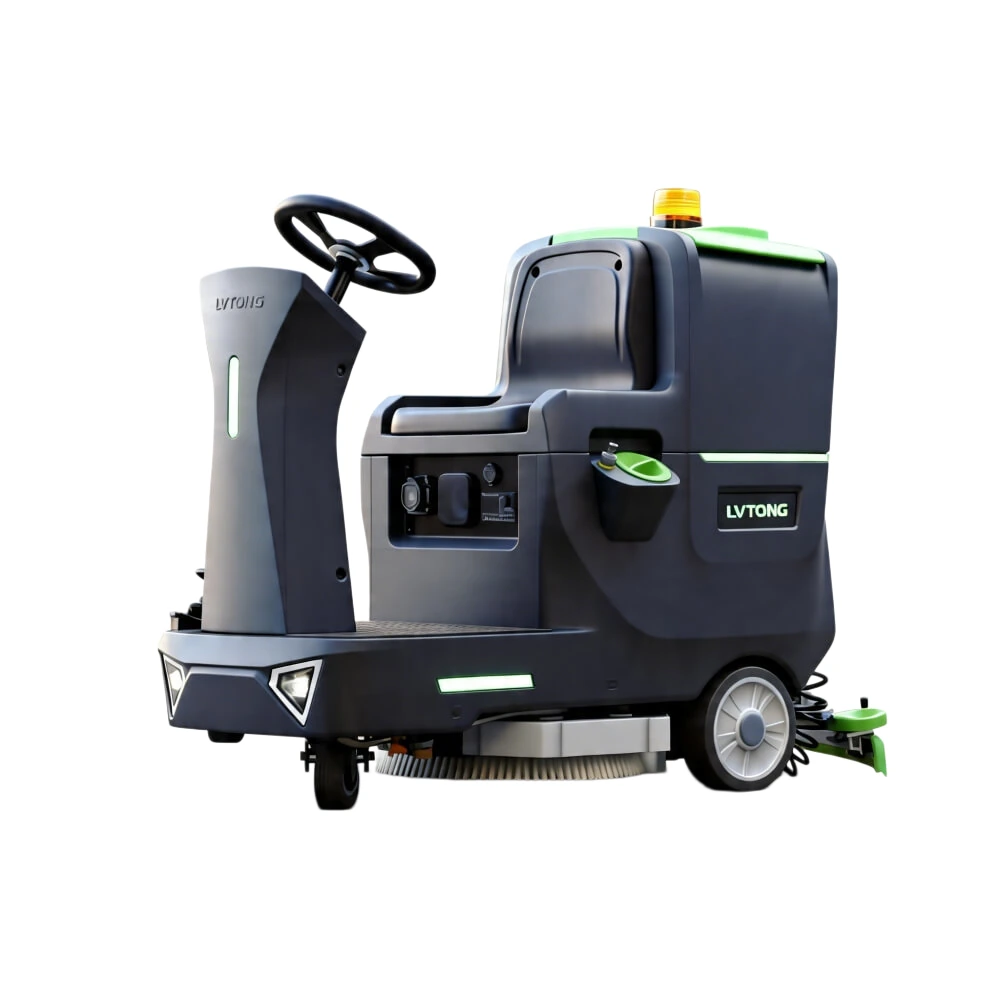
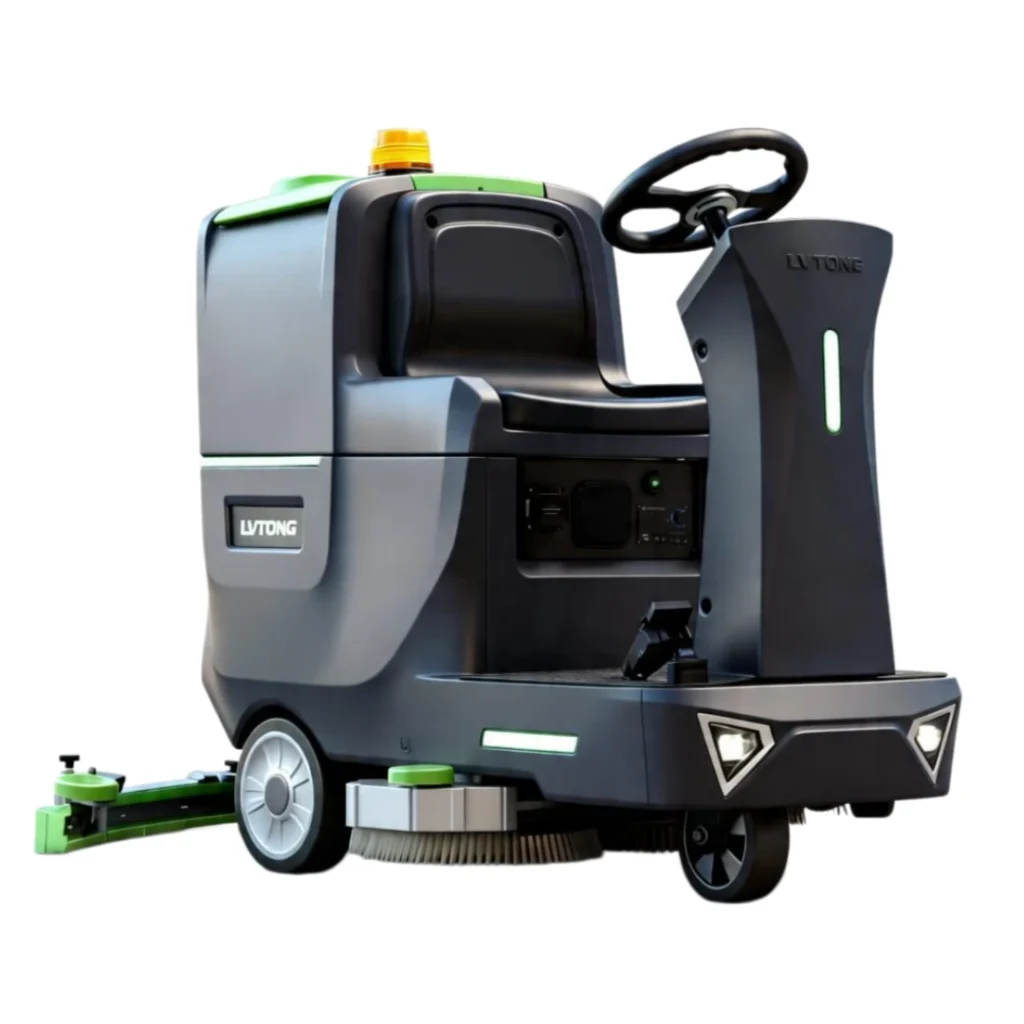
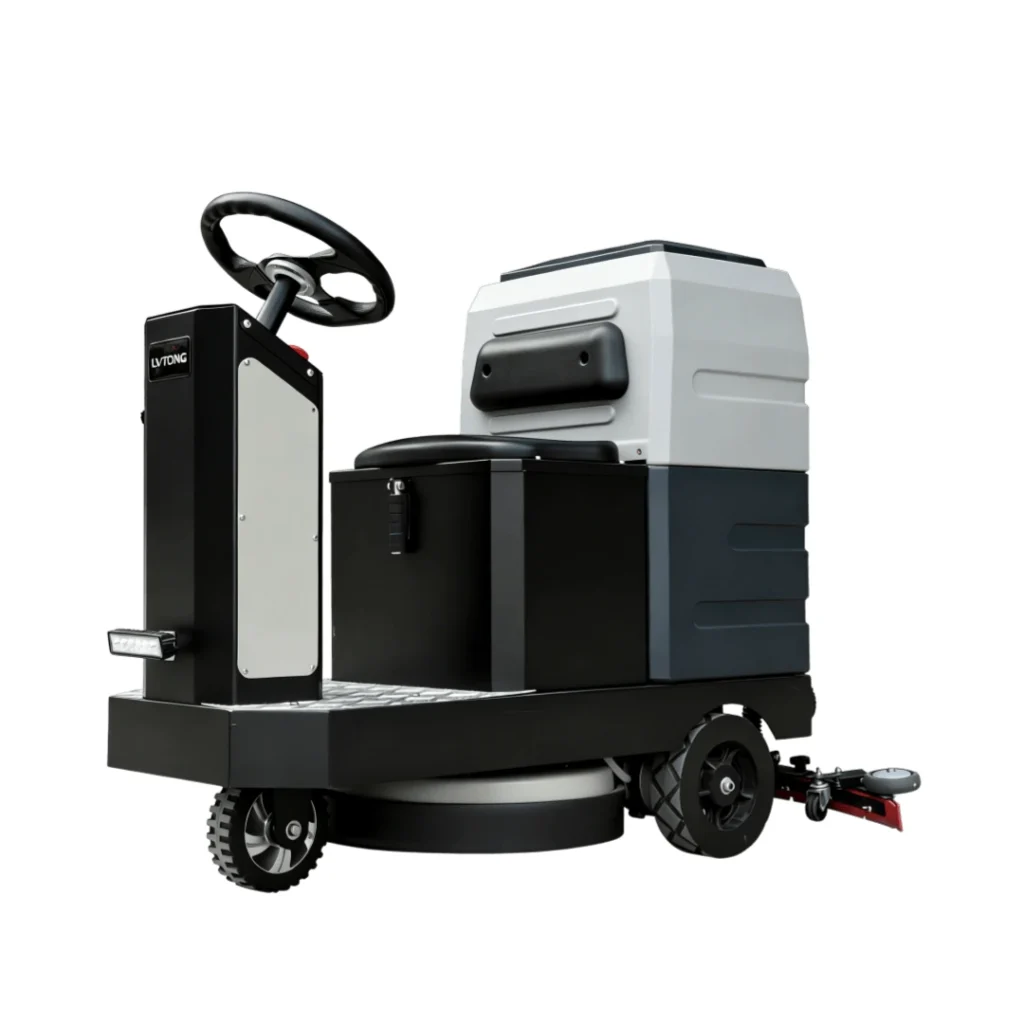
Where vinyl runs as one continuous surface — supermarket sales floors, hospital corridors, school halls — a ride-on keeps pace without leaving a wet edge between passes. The LT-S860X ride-on scrubber washes, vacuums and dries in a single pass over a 5-hour battery life, which shortens the window in which solution sits on a seam. Buyers comparing vinyl flooring cleaning machines across a portfolio should size to the longest run and the tank’s dump interval.
Routine by Facility Type
The material sets the limits, but the facility sets the frequency — clinical, education, retail and office vinyl differ in traffic, appearance tolerance and chemical rules.
Healthcare
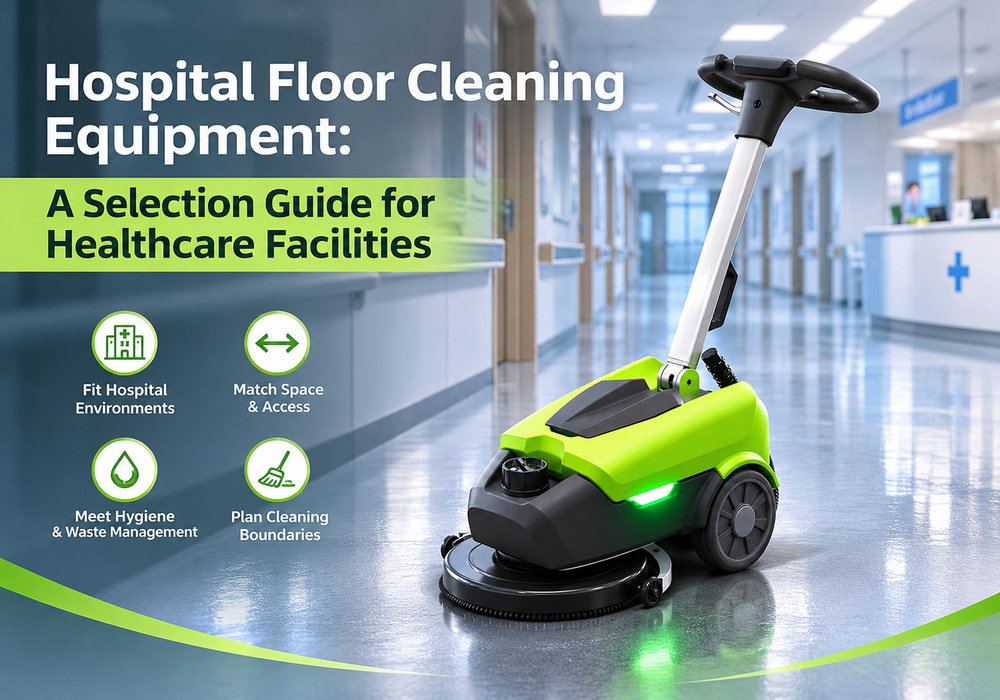
Sheet vinyl with heat-welded seams dominates patient areas because it is cleanable and joint-free. Two habits matter: low solution volume, so water never travels toward the seam, and a routine matched to hygiene protocol. Our floor care guidance for healthcare facilities follows the same method.
Education and campus
Finish-coated VCT remains the most common classroom floor. The machine should support the finish cycle rather than fight it — red pads between recoat cycles, stripping only for the scheduled deep clean.
Retail, supermarkets and offices
Retail vinyl is appearance-critical: remove loose debris first, then run slow, overlapping passes with immediate pickup. Office vinyl carries lighter traffic but shares the same air-quality constraints.
Slip Resistance: the Safety Question Under Vinyl
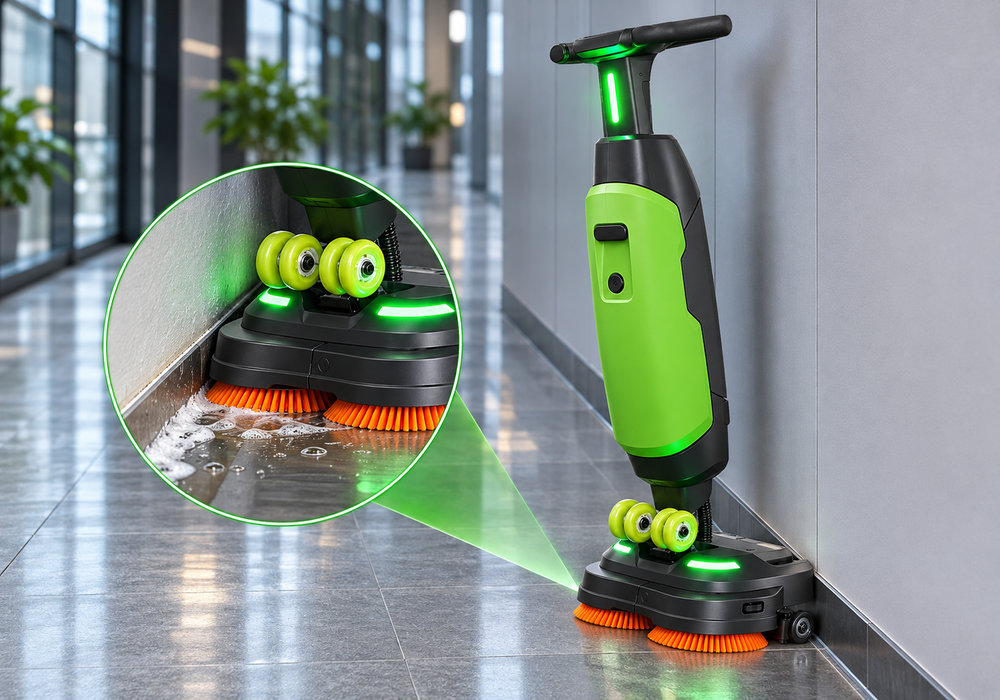
Cleaning changes slip resistance in both directions — removing finish can leave wet VCT slick, and leaving detergent residue makes any vinyl surface slippery.
Friction is measured on the finished floor, not the sample, which is why routine matters as much as specification. Frameworks published by the National Floor Safety Institute express performance as a coefficient of friction under wet and dry conditions.
Where vinyl sits in a wet area, confirm its rated wet performance before changing cleaner or finish. A floor that feels slippery after cleaning signals a rinse problem, not a reason to add more product. In the United States, walking surfaces are an employer obligation under OSHA 29 CFR 1910 Subpart D.
Six Mistakes That Damage Vinyl Floors
Most vinyl damage follows six predictable mistakes, and five are habits or settings rather than the wrong machine.
- Running a stiff brush or a stripping pad as the daily routine.
- Leaving solution at the edges, where pickup misses the last 50 mm.
- Skipping squeegee inspection until streaks appear; a worn blade leaves a film that looks like dried cleaner.
- Using high-alkaline chemistry on linoleum or on finish-coated VCT.
- Overfilling the solution tank, or continuing with a full recovery tank.
- Sizing to total facility area instead of the longest continuous vinyl run.
What to Specify in an RFQ for a Vinyl Floor Scrubber
Send the floor material, the largest continuous area, your narrowest door and aisle, and the cleaning window — a supplier who cannot work from those inputs is guessing.
- Scrub path in millimetres, and whether it clears your narrowest aisle and doorway.
- Adjustable solution flow range, including the low end, not just the maximum.
- Brush or pad system, with a pad driver option for finish-coated VCT.
- Recovery tank volume against your dump interval and floor length.
- Squeegee width relative to scrub path, with blades available locally.
- Battery runtime for your largest area in one cycle, plus charge time and service.
Procurement teams comparing commercial vinyl floor cleaning machines across sites should score candidates on those six points, and ask for the safety file: whether the machine is built to the floor-treatment standard IEC 60335-2-72, and which certification body such as UL marked the electrics. LVTONG manufactures lithium-battery walk-behind and ride-on scrubbers and works from specifications rather than brochure claims — reach the team through the floor scrubber supplier page.
Frequently Asked Questions
Can you use a floor scrubber on vinyl plank flooring?
Yes — a floor scrubber for vinyl floors needs a soft brush or pad, reduced flow and immediate pickup. LVT and LVP wear layers are thin and printed, so abrasive brushes and high down-pressure dull them permanently.
How often should vinyl floors be machine cleaned?
Frequency follows traffic, not material. High-traffic retail and healthcare vinyl gets a vinyl floor scrubbing machine daily, classrooms daily to twice weekly with the finish programme, and low-traffic office vinyl two or three times a week.
Does a floor scrubber damage the finish on VCT?
The machine does not; the wrong pad and pressure do. A soft brush or red pad preserves the finish, while stripping pads and strong alkaline products remove it and force an early recoat.
Is a walk-behind or a ride-on machine better for vinyl?
Walk-behind wins where vinyl is divided into rooms and aisles; ride-on wins on one continuous surface, such as supermarket sales floors and hospital corridors.
Will cleaning change how slippery a vinyl floor is?
Yes, in both directions. Removed finish or detergent residue can raise wet slip risk, which is why rinse quality and squeegee condition belong in the routine. Confirm the rated wet performance before changing cleaner or finish.
Next Step: Match the Machine to the Floor You Actually Have
Send your floor material, the largest continuous vinyl area and your cleaning window, and we will map the machine class, scrub path and brush configuration that fits, including a first-pass test protocol.