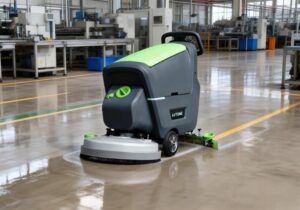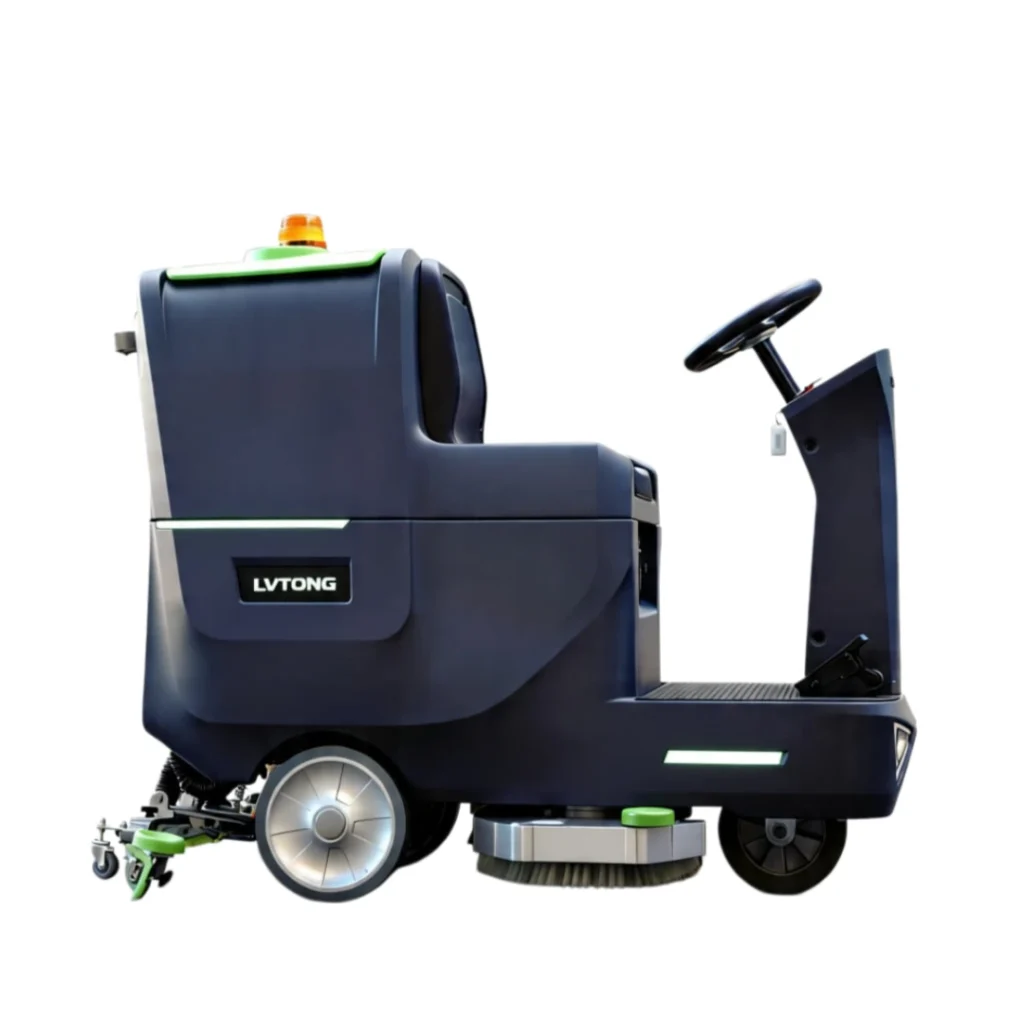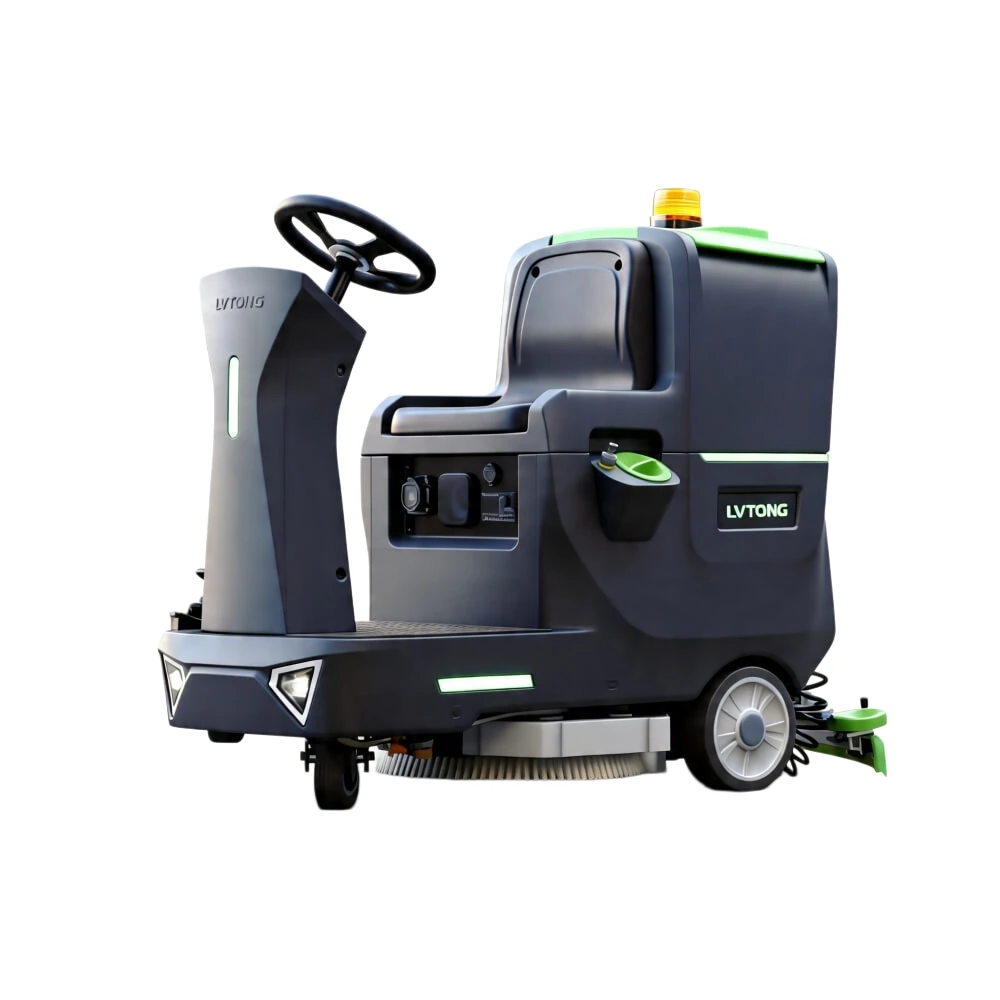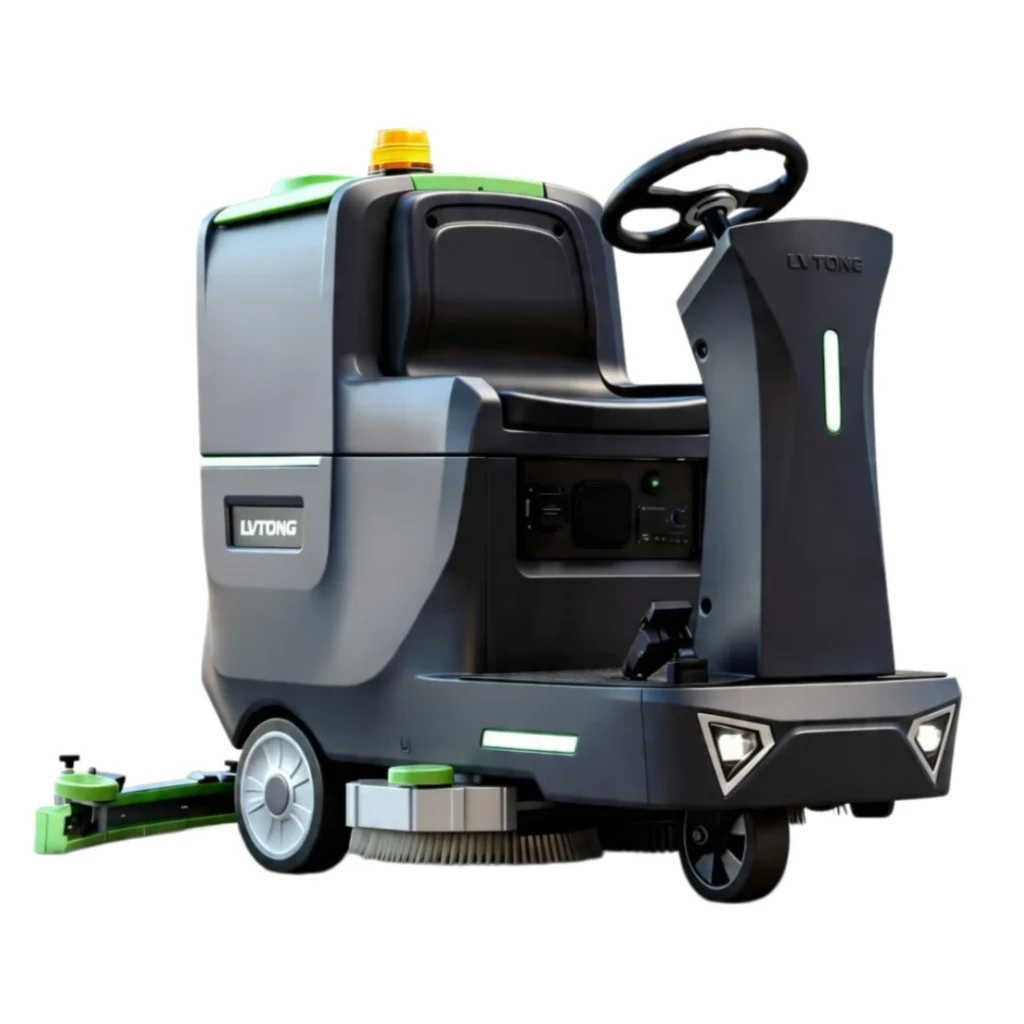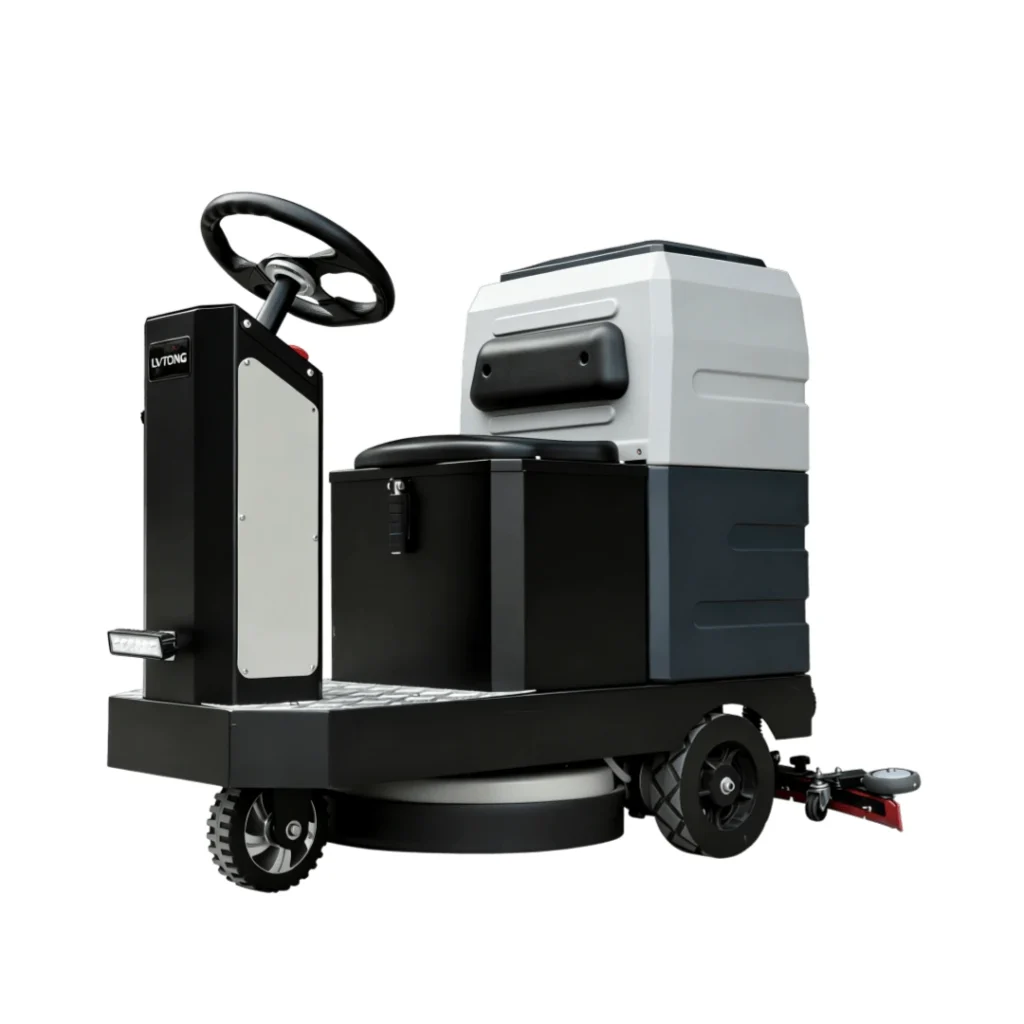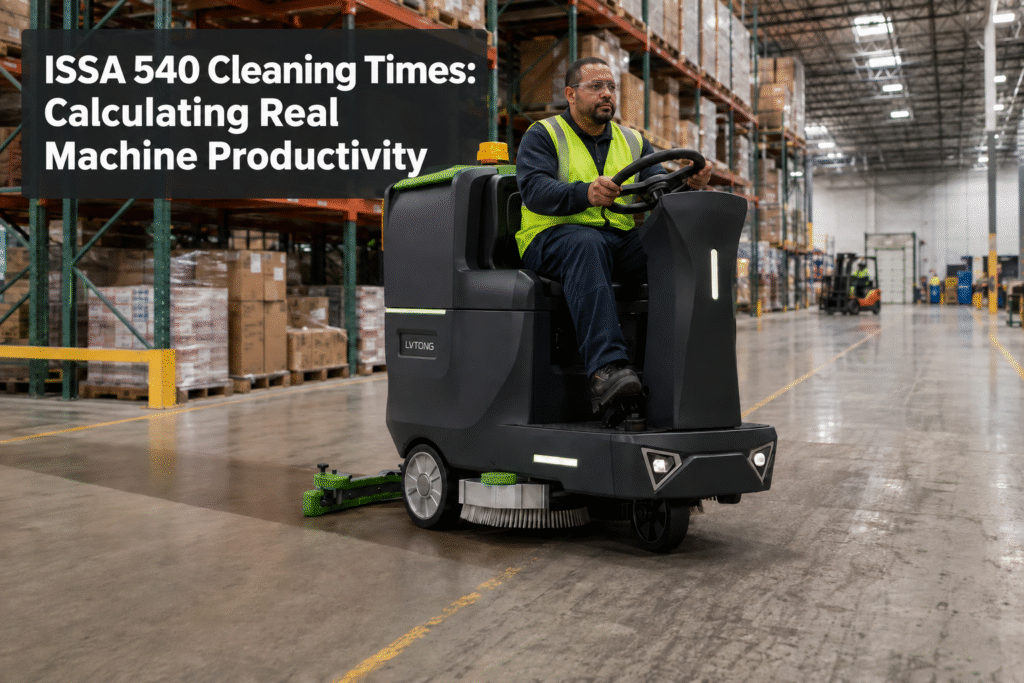
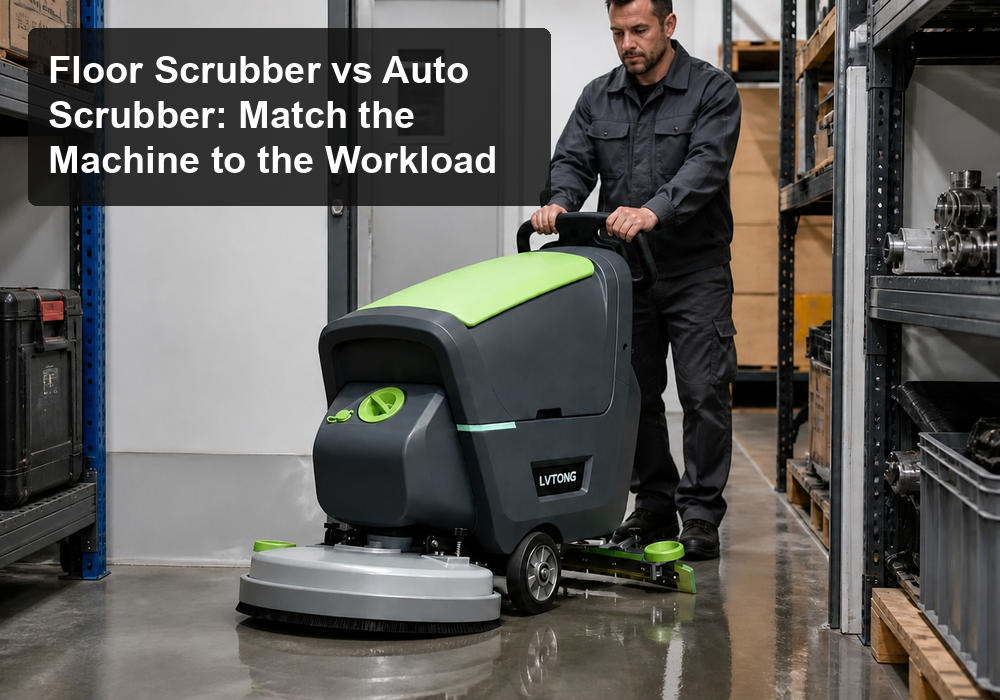
An electric floor scrubber machine washes, scrubs, recovers dirty water, and dries a hard floor in one continuous process. Compared with manual mopping, it can improve cleaning consistency, reduce repeated labor, and leave less residual water on the floor.
However, the largest or fastest machine is not automatically the most efficient choice.
The right electric floor scrubber depends on the usable cleaning area, aisle width, number of obstacles, floor material, soil level, available cleaning time, and access to charging or power outlets. Buyers should compare practical cleaning coverage rather than relying only on the maximum productivity shown on a specification sheet.
This guide explains how to evaluate cleaning width, real productivity, battery configuration, brush systems, tank capacity, water recovery, maintenance requirements, and total operating cost.
Quick Answer:
Choose an electric floor scrubber machine based on the usable cleaning area, aisle width, floor type, soil level, and required operating time. Compact walk-behind scrubbers are generally better for narrow or divided spaces, while larger self-propelled or ride-on machines are more efficient on long, open cleaning routes. Compare practical coverage, tank capacity, brush system, battery runtime, water recovery, maintenance access, and total operating cost—not theoretical productivity alone.
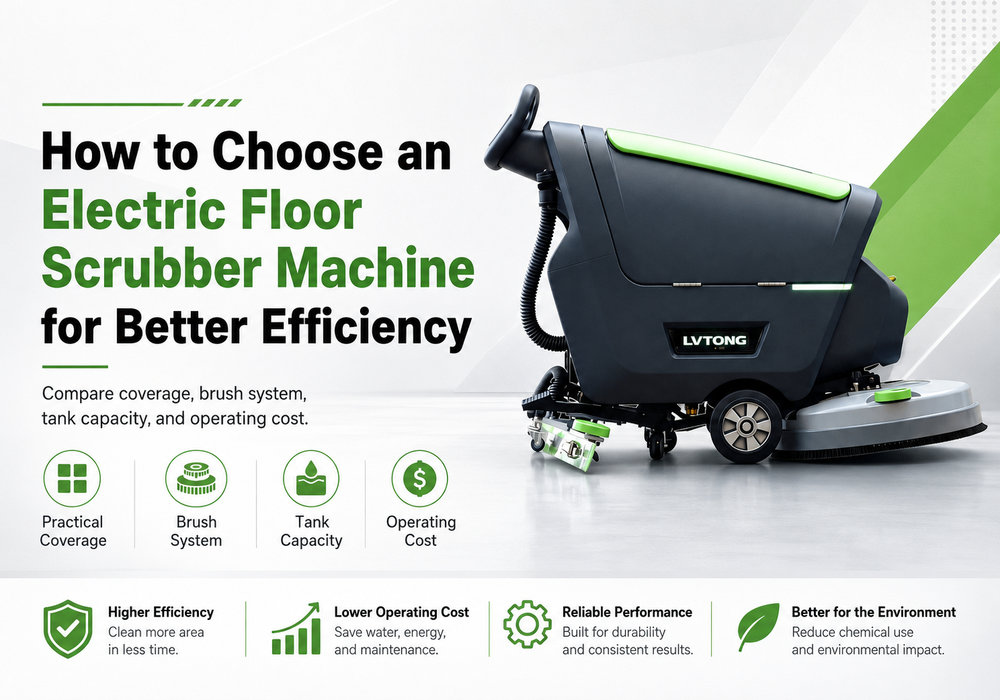
Compare practical coverage, brush system, tank capacity, and operating cost to choose a more efficient electric floor scrubber machine.
For most commercial facilities, the best electric floor scrubber machine is determined by floor type, cleaning route, brush system, battery runtime, water recovery, and long-term operating cost rather than purchase price alone.
Electric Floor Scrubber Buying Checklist
Before purchasing, compare:
- Cleaning area
- Floor type
- Brush type
- Cleaning width
- Brush pressure
- Tank capacity
- Battery runtime
- Water recovery
- Maintenance requirements
- Spare-parts availability
- Warranty
- Total cost of ownership
Electric Floor Scrubber Machine Selection at a Glance
Use the following table as an initial reference. Final machine selection should be based on an on-site assessment.
| Cleaning environment | Suitable configuration | Main selection priority |
|---|---|---|
| Narrow aisles, small rooms, or many obstacles | Compact walk-behind unit | Maneuverability, machine width, turning space |
| Medium-sized facilities with mixed layouts | Self-propelled walk-behind unit | Practical productivity, tank capacity, operator effort |
| Large and mostly open floors | Ride-on electric scrubber | Cleaning path, runtime, travel speed, recovery capacity |
| Quiet public or occupied areas | Low-noise electric model | Noise level, water recovery, safety controls |
| Rough, textured, or debris-covered floors | Cylindrical-brush configuration | Debris collection and surface contact |
| Smooth floors requiring routine maintenance | Disc-brush configuration | Pad availability, brush pressure, operating cost |
| Areas without convenient charging access | Corded or replaceable-battery configuration | Power availability and shift schedule |
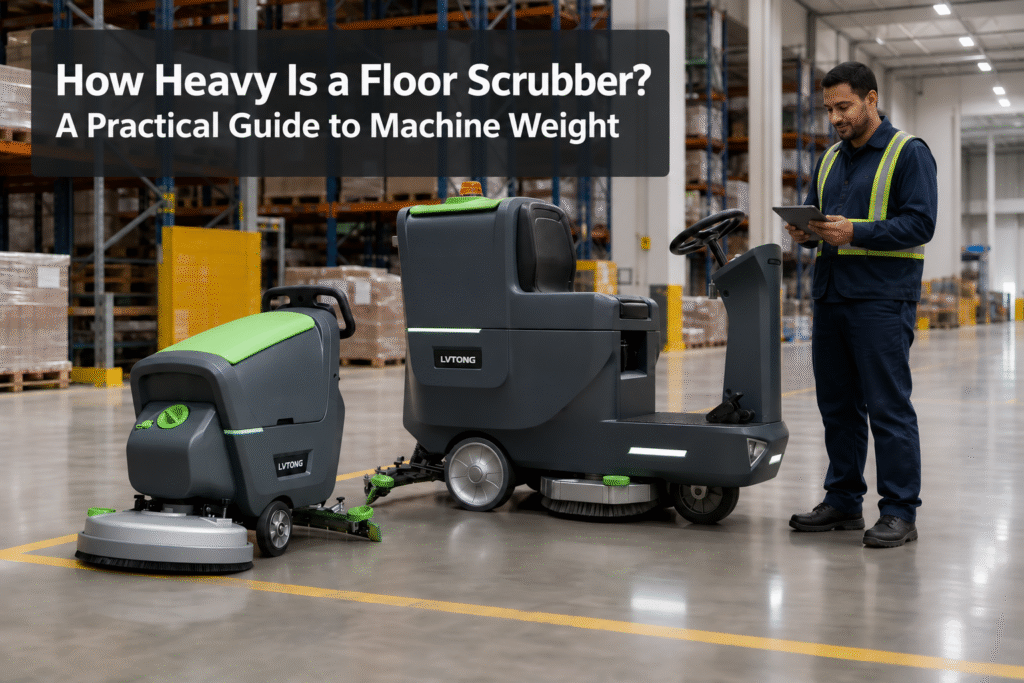
A walk-behind floor scrubber machine is usually more suitable for narrow aisles, divided rooms, and facilities with frequent turns. For large, mostly open areas, ride-on floor scrubber machines can reduce operator fatigue and increase practical coverage. A practical selection process starts with the facility, not with the machine brochure.
What Is an Electric Floor Scrubber Machine?
An electric floor scrubber machine is powered cleaning equipment designed to complete four main functions:
- Dispense water and cleaning solution onto the floor.
- Agitate dirt with a brush or floor pad.
- Collect contaminated water through a vacuum system.
- Use a squeegee to leave the floor relatively dry.
Most industrial electric floor scrubbers use two separate tanks. The solution tank stores clean water and detergent, while the recovery tank holds the wastewater collected from the floor.
Keeping clean and dirty water separate helps maintain consistent cleaning performance throughout the work cycle.
Electric scrubbers may be corded or battery-powered. Battery-operated machines provide greater mobility, while corded machines can operate continuously when suitable electrical outlets are available.

How to Calculate Real Cleaning Productivity
Cleaning productivity is one of the most important specifications, but it is also one of the most commonly misunderstood.
Manufacturers normally publish a theoretical coverage rate. This number assumes that the machine travels continuously in a straight line without stopping, turning, refilling, draining, or repeating an area.
Actual productivity is always lower.
Theoretical Coverage in Square Feet
The theoretical coverage rate can be calculated with this formula:
Theoretical coverage in sq ft/h = cleaning path in inches × travel speed in mph × 5,280 ÷ 12
For example, a machine with a 22-inch cleaning path traveling at 2.5 mph has the following theoretical productivity:
22 × 2.5 × 5,280 ÷ 12 = 24,200 sq ft/h
The correct theoretical rate is therefore 24,200 square feet per hour.
If the same machine operates at 70% practical efficiency:
24,200 × 0.70 = 16,940 sq ft/h
In a more congested area operating at 65% efficiency:
24,200 × 0.65 = 15,730 sq ft/h
These practical figures are more useful for staff scheduling and machine comparison.
Theoretical Coverage in Square Meters
For metric specifications, use:
Theoretical coverage in m²/h = cleaning width in meters × travel speed in km/h × 1,000
For example, a machine with a 0.55-meter cleaning path traveling at 4 km/h has a theoretical rate of:
0.55 × 4 × 1,000 = 2,200 m²/h
At 70% practical efficiency, the expected output would be:
2,200 × 0.70 = 1,540 m²/h
Practical Efficiency Factors
The following ranges can be used as starting assumptions for planning. Actual results should be verified at the facility.
| Operating environment | Suggested planning factor |
|---|---|
| Large, open, and mostly unobstructed floor | 75%–85% |
| Mixed layout with moderate traffic | 60%–75% |
| Congested floor with shelving or equipment | 45%–60% |
| Areas requiring repeated heavy scrubbing | Below 50% |
Practical productivity is affected by:
- Turning and overlapping cleaning paths
- Furniture, shelving, columns, and machinery
- Pedestrian or vehicle traffic
- Water refilling and wastewater disposal
- Battery charging or replacement
- Heavy soil requiring slower travel
- Repeated passes over difficult stains
- Operator skill and route planning
When comparing two machines, apply the same practical efficiency factor to both. Comparing one machine’s theoretical output with another machine’s field output produces a misleading result.

Seven Factors That Determine the Right Machine
1. Usable Floor Area and Layout
Total building size is not the same as usable cleaning area.
A 30,000-square-foot building may contain offices, shelves, fixed machinery, storage racks, stairs, and restricted zones. The actual floor area accessible to a scrubber may be much smaller.
Before selecting a machine, measure:
- Total cleanable floor area
- Minimum aisle width
- Narrowest doorway
- Elevator dimensions and capacity
- Turning space at aisle ends
- Floor slopes and ramps
- Distance to water and drainage points
- Distance to the charging area
A compact machine may outperform a larger unit when the operator must frequently reverse, reposition, or make multi-point turns.
2. Cleaning Path and Machine Width
Cleaning path refers to the width covered by the brush or pad in one pass. A wider cleaning path can increase theoretical productivity, but it also increases the space needed for maneuvering.
Machine body width, squeegee width, and turning radius must also be checked.
The cleaning deck may fit through a doorway while the rear squeegee does not. This is a common issue when buyers compare only the nominal brush width.
A wider machine is most useful when:
- The floor is open and unobstructed.
- Long straight cleaning routes are available.
- Doorways and aisles provide sufficient clearance.
- The machine can turn without repeated repositioning.
A narrower machine is usually more effective in divided facilities, retail aisles, workshops, clinics, classrooms, and spaces containing fixed equipment.
3. Solution and Recovery Tank Capacity
Larger tanks reduce the number of refill and drain stops, but they also increase machine size and weight.
Tank capacity should match the cleaning route rather than being treated as an isolated specification.
Consider:
- How much water the machine dispenses per minute
- Whether water flow can be adjusted
- Distance to the filling point
- Distance to the wastewater drain
- Floor load limits
- Required operating time between stops
- Ease of cleaning the inside of the recovery tank
The recovery tank should have sufficient capacity for the expected water pickup. If it fills before the solution tank is empty, the operator must interrupt the route and drain the machine.
Tank design also affects maintenance. Wide openings, smooth internal surfaces, accessible filters, and simple drain hoses can reduce daily cleaning time.
4. Brush or Pad System
The brush system should match the floor texture and the type of soil being removed.
Disc Brushes
Disc brushes rotate horizontally against the floor. They are widely used for routine cleaning on smooth surfaces.
Common applications include:
- Sealed concrete
- Ceramic tile
- Epoxy floors
- Vinyl composition tile
- Terrazzo
- Marble and other finished hard floors
Disc systems generally offer a wide selection of brushes and pads. This makes them practical for facilities that perform both routine cleaning and occasional deeper scrubbing.
Cylindrical Brushes
Cylindrical brushes rotate horizontally in the direction of travel. They can scrub the floor while collecting small loose debris.
They are often suitable for:
- Textured surfaces
- Uneven floors
- Grouted tile
- Production areas with small debris
- Floors that would otherwise require pre-sweeping
A cylindrical system can reduce the need for a separate dry-cleaning pass, but the debris tray and brush chamber require regular cleaning.
Orbital Systems
Orbital machines use a high-speed oscillating pad movement rather than conventional circular brush rotation.
They may be useful for:
- Low-moisture cleaning
- Floor finish preparation
- Chemical-free or reduced-chemical processes
- Cleaning close to edges
- Applications requiring controlled pad movement
The best system depends on the floor finish, soil type, available pads, maintenance process, and desired cleaning result.
5. Corded or Battery-Powered Operation
Both power configurations have advantages.
| Factor | Corded machine | Battery-powered machine |
|---|---|---|
| Mobility | Limited by cable length | High |
| Continuous operation | Possible with electrical access | Limited by usable runtime |
| Charging time | Not required | Required |
| Cable management | Required | Not required |
| Initial cost | Often lower | Often higher |
| Best use | Compact areas near outlets | Larger or divided facilities |
Battery chemistry, charging habits, operating load, and maintenance all affect floor scrubber battery life and long-term replacement cost. A corded electric floor scrubber may be suitable for small spaces where continuous power is available and cable control does not create a safety problem.
A battery-powered electric floor scrubber machine is generally more practical in warehouses, factories, schools, shopping areas, and other locations where the operator must move between multiple zones.
When evaluating a battery system, check:
- Usable runtime under normal brush and vacuum load
- Charging time
- Charger voltage compatibility
- Battery type
- Expected cycle life
- Replacement cost
- Availability of local battery service
- Whether opportunity charging is permitted
- Performance near the end of the discharge cycle
Do not compare battery systems based only on amp-hour capacity. Voltage, machine load, battery chemistry, discharge limits, and control settings also affect usable operating time.
6. Water Recovery and Drying Performance
A floor scrubber does not complete its job when the brush stops. It must also collect the wastewater effectively.
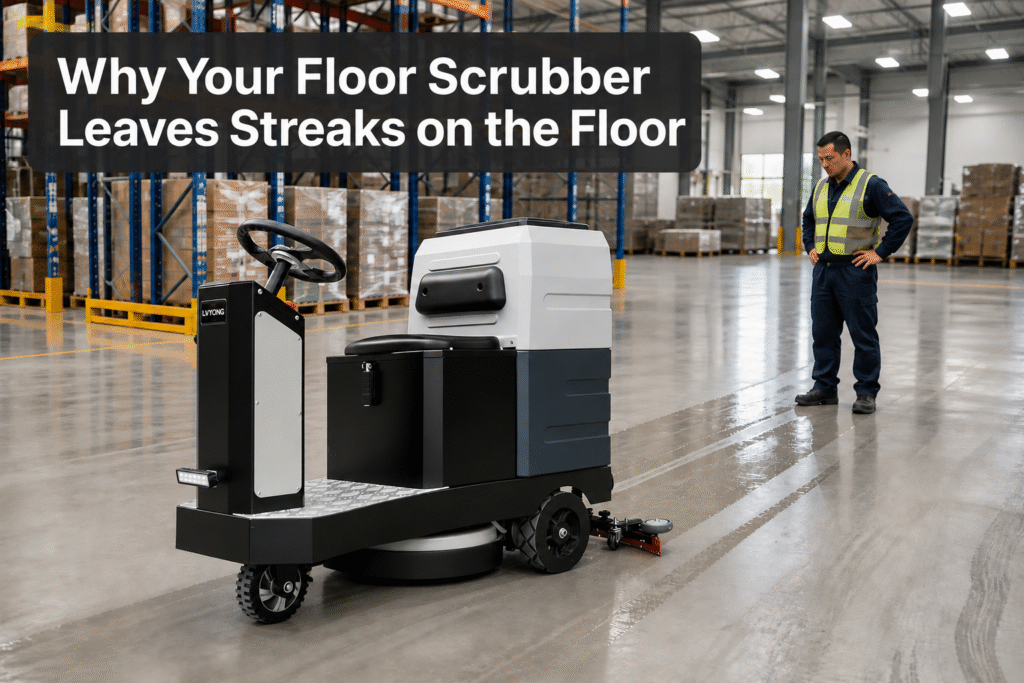
Poor water recovery can leave:
- Wet trails
- Curved water marks
- Streaks
- Dirty solution near walls
- Slip hazards
- Additional manual drying work
Water recovery depends on the condition and design of:
- Squeegee blades
- Vacuum motor
- Suction hose
- Recovery tank seals
- Float and shutoff system
- Squeegee angle
- Floor contact pressure
The squeegee should maintain even contact with the floor during straight travel and turns. Replacement blades should also be locally available and easy to install.
In facilities with public traffic, drying performance may be more important than maximum scrubbing speed.
7. Maintenance and Service Availability
A low purchase price does not necessarily produce a low operating cost.
Before purchasing an electric floor scrubber machine, confirm the availability of:
- Brushes and pads
- Squeegee blades
- Vacuum hoses
- Filters
- Drain hoses
- Wheels and tires
- Electrical controls
- Battery chargers
- Replacement batteries
- Technical manuals
- Remote or local service support
Consumable parts should be easy to inspect and replace. Complicated daily maintenance increases the risk that operators will skip essential procedures. Reliable cleaning equipment maintenance and after-sales support can reduce downtime and help the machine maintain consistent cleaning performance.

How to Match the Machine to the Floor
Different surfaces require different combinations of brush material, pad type, pressure, detergent, and water flow.
| Floor surface | General starting configuration | Main caution |
|---|---|---|
| Smooth sealed concrete | Disc brush or suitable pad | Avoid unnecessary pressure on coatings |
| Rough concrete | More aggressive brush | Test for surface wear |
| Epoxy floor | Non-damaging brush or pad | Follow coating supplier guidance |
| Ceramic tile | Disc or cylindrical system | Check grout condition |
| Textured tile | Cylindrical brush | Confirm full contact with recesses |
| Vinyl flooring | Softer pad and controlled pressure | Avoid damaging the finish |
| Marble or terrazzo | Surface-specific pad | Test in an inconspicuous area |
| Oily industrial floor | Compatible brush and detergent | Control chemical dosage and wastewater |
Always test the selected brush, pad, and cleaning solution on a small area before full operation.
Operators should also select a compatible floor scrubber cleaning solution based on the floor material, soil type, pH, and dilution requirements.
More brush pressure does not always produce better cleaning. Excessive pressure can increase battery consumption, wear brushes faster, damage coatings, and place additional load on drive components.
The correct combination of chemistry, dwell time, agitation, and water recovery is normally more effective than relying on pressure alone.
Which Smart Features Improve Efficiency?
Advanced controls can improve consistency, but only when they solve a real operational problem.
Useful features may include:
- Adjustable solution flow
- ECO cleaning mode
- Adjustable brush pressure
- One-touch operating controls
- Battery charge indicators
- Low-solution alerts
- Recovery-tank full alerts
- Maintenance reminders
- Error-code displays
- Preset operator modes
- Speed control
- Automatic brush lifting
- Automatic water shutoff when stopped
- Key, card, or access-code control
- Usage or location monitoring
For multi-operator fleets, preset modes can prevent excessive water use, unnecessary brush pressure, and inconsistent results.
For smaller facilities, simple controls and easy maintenance may provide more value than a complex connected system.
How to Compare Total Operating Cost
The purchase price is only one part of the cost. A complete industrial floor scrubber price comparison should include machine configuration, battery type, consumables, labor savings, and expected downtime.
A more complete calculation is:
Total operating cost = labor + energy + water + chemicals + consumables + maintenance + battery replacement + downtime
Labor
Labor is often the largest operating expense. Calculate how long the machine takes to complete the real cleaning route, including:
- Preparation
- Filling
- Cleaning
- Draining
- Rinsing
- Battery charging
- Daily inspection
A machine with higher theoretical productivity may not reduce labor if it is difficult to turn, transport, fill, or clean.
Water and Detergent
Adjustable solution flow can reduce water and chemical use during light-duty cleaning.
Using more detergent than required does not necessarily improve results. Excessive chemical use may leave residue, increase rinsing requirements, raise operating costs, and create more wastewater.
Consumable Parts
Include the expected replacement cost of:
- Brushes
- Pads
- Pad drivers
- Squeegee blades
- Filters
- Hoses
- Wheels
- Batteries
A less expensive machine may cost more over time if replacement parts are difficult to obtain or require long delivery periods.
Downtime
Downtime includes both repair time and the operational effect of an unavailable machine.
Ask the supplier:
- Which parts are normally stocked?
- What is the typical spare-parts lead time?
- Is remote troubleshooting available?
- Can common repairs be completed by local technicians?
- Which parts are covered by warranty?
- Are service manuals and wiring diagrams available?
The lowest total cost usually comes from a machine that fits the route, is easy to maintain, and has reliable parts support.
Example LVTONG Electric Floor Scrubber Configurations
The following models illustrate how machine configurations can differ. Published specifications should be confirmed against the final quotation because battery, charger, brush, and regional configurations may vary.
| Model | Configuration | Published productivity | Tank information | Suitable selection context |
|---|---|---|---|---|
| LVTONG LT-S530X | Industrial walk-behind scrubber | Up to 2,100 m²/h | 62 L solution / 65 L recovery | Divided facilities, narrow routes, medium cleaning areas |
| LVTONG Q5 | Compact walk-behind auto scrubber | Approximately 1,980 m²/h | 50 L tank specification | Smaller facilities, workshops, stores, food production areas |
| LVTONG LT-S560X | 560 mm ride-on scrubber | Up to 2,100 m²/h | 85 L solution / 90 L recovery | Larger routes where operator comfort and tank capacity are priorities |
These machines should not be compared only by the published productivity figure.
For example, a compact walk-behind machine may complete a congested route faster because it can pass through narrow aisles and turn with fewer adjustments. A ride-on unit may provide better operator comfort and fewer tank stops on longer, more open routes.
The appropriate model depends on the complete operating environment.
Common Electric Floor Scrubber Selection Mistakes
Choosing Only by Maximum Productivity
Theoretical coverage is useful for comparison, but it does not represent actual output in an occupied facility.
Apply a realistic efficiency factor and include refill, draining, and maintenance time.
Buying a Machine That Is Too Large
An oversized machine may have difficulty entering doorways, turning between racks, reaching corners, or using existing elevators.
Measure the complete route before selecting the cleaning path.
Ignoring Squeegee Width
The squeegee is usually wider than the brush deck. Buyers should verify the machine’s maximum working width, not only its nominal cleaning width.
Focusing Only on Brush Pressure
High brush pressure can be useful for certain soils, but excessive pressure increases wear and energy consumption.
Brush type, cleaning solution, travel speed, and dwell time should be evaluated together.
Selecting a Battery by Runtime Claims Alone
Runtime depends on machine load and operating conditions. Request test conditions and confirm whether the quoted time includes the brush, vacuum, and drive systems operating simultaneously.
Ignoring Daily Maintenance Access
Difficult-to-clean tanks, filters, hoses, and squeegees increase maintenance time and may reduce machine reliability.
Comparing Purchase Price Without Parts Cost
Ask for the prices of common consumables and major replacement components before placing an order.
Accepting General Certification Statements
Request certificates for the specific model and configuration being purchased. Check the issuing organization, certificate scope, applicable standard, model number, and validity period.
A company-level management certificate should not be treated as proof that every machine has the same product certification.
Electric Floor Scrubber Buyer Checklist
Before requesting a quotation, prepare the following information:
- Country and operating voltage
- Total usable cleaning area
- Floor type
- Main type of dirt or contamination
- Minimum aisle width
- Narrowest doorway
- Required cleaning time
- Number of shifts per day
- Availability of electrical outlets
- Availability of a charging room
- Water filling and drainage locations
- Noise restrictions
- Maximum acceptable machine size
- Required battery chemistry
- Required accessories
- Local certification requirements
- Expected spare-parts support
- Preferred warranty coverage
Providing complete site information allows the supplier to recommend a more accurate configuration.

Frequently Asked Questions
What is the main benefit of an electric floor scrubber machine?
Its main benefit is the ability to apply cleaning solution, scrub the floor, recover wastewater, and dry the surface in one process. This reduces repeated manual steps and can improve cleaning consistency.
How many square feet can an electric floor scrubber clean per hour?
The result depends on cleaning width, travel speed, layout, soil level, and operator efficiency. A machine with a 22-inch cleaning path traveling at 2.5 mph has a theoretical productivity of 24,200 sq ft/h. At 70% practical efficiency, the expected output is approximately 16,940 sq ft/h.
Is a battery-powered machine better than a corded machine?
A battery-powered machine is generally better for mobility and multi-zone cleaning. A corded machine may be suitable for smaller areas where electrical outlets are readily available and the cable can be managed safely.
Which brush is suitable for smooth floors?
A disc brush or compatible floor pad is commonly used on smooth sealed floors. The correct material depends on the floor finish, dirt level, and whether the task is routine cleaning, deep scrubbing, or finish preparation.
Which brush is suitable for textured floors?
A cylindrical brush is often effective on textured or uneven floors because its bristles can reach recessed areas. It may also collect small loose debris during the scrubbing process.
Should I choose a walk-behind or ride-on configuration?
Choose based on layout and operating time rather than area alone. Walk-behind machines are generally easier to maneuver in divided or congested spaces. Ride-on machines can improve comfort and productivity on long, open cleaning routes.
How can I reduce the operating cost?
Select a machine that fits the route, use the correct brush and detergent, control water flow, train operators, complete daily maintenance, and keep essential consumable parts in stock.
What specifications should I confirm before ordering?
Confirm cleaning path, total machine width, squeegee width, practical productivity, tank capacity, battery type, runtime test conditions, charging time, voltage, noise level, turning radius, included accessories, warranty, and parts availability.
Can an electric floor scrubber clean concrete, tile, epoxy, and marble?
Many electric scrubbers can clean these surfaces when fitted with the correct brush or pad. The surface finish, coating condition, chemical compatibility, and pressure setting must be evaluated before full operation.
How often should an electric floor scrubber be maintained?
The tanks, squeegee, brush, and exterior should be inspected and cleaned after use. Batteries, filters, hoses, wheels, and electrical components should be checked according to the manufacturer’s maintenance schedule.
Is an electric floor scrubber better than manual mopping?
Yes. An electric floor scrubber applies cleaning solution, scrubs the floor, and recovers dirty water in one pass, helping improve cleaning productivity while reducing labor intensity and wet-floor risks.
Which electric floor scrubber is best for industrial facilities?
Industrial facilities usually benefit from electric floor scrubbers with larger tank capacity, longer battery runtime, stronger brush pressure, and reliable water recovery. The ideal model depends on floor type, facility size, and daily operating hours.
Buying Recommendations
Different commercial facilities require different electric floor scrubber machines.
- Choose a compact walk-behind electric floor scrubber for retail stores, restaurants, schools, and offices.
- Choose a self-propelled model for medium warehouses and manufacturing workshops.
- Choose a ride-on electric floor scrubber for airports, logistics centers, shopping malls, and large factories.
- Choose a lithium battery model for multi-shift cleaning or where fast charging is important.
- Choose a machine with higher brush pressure for heavy grease, tire marks, or textured concrete floors.
Final Selection Advice
The most efficient electric floor scrubber machine is not necessarily the model with the highest speed, widest brush, or largest battery.
It is the machine that can complete the actual cleaning route with minimal turning, refilling, charging, repeated passes, and downtime.
Before purchasing, calculate practical productivity, measure every narrow point in the route, test the brush system on the real floor, and compare long-term parts and maintenance costs.
For a more accurate recommendation, provide LVTONG with your cleanable area, aisle width, floor material, soil type, operating hours, voltage, battery preference, and local certification requirements. The final machine configuration can then be matched to the facility rather than selected from a single headline specification.