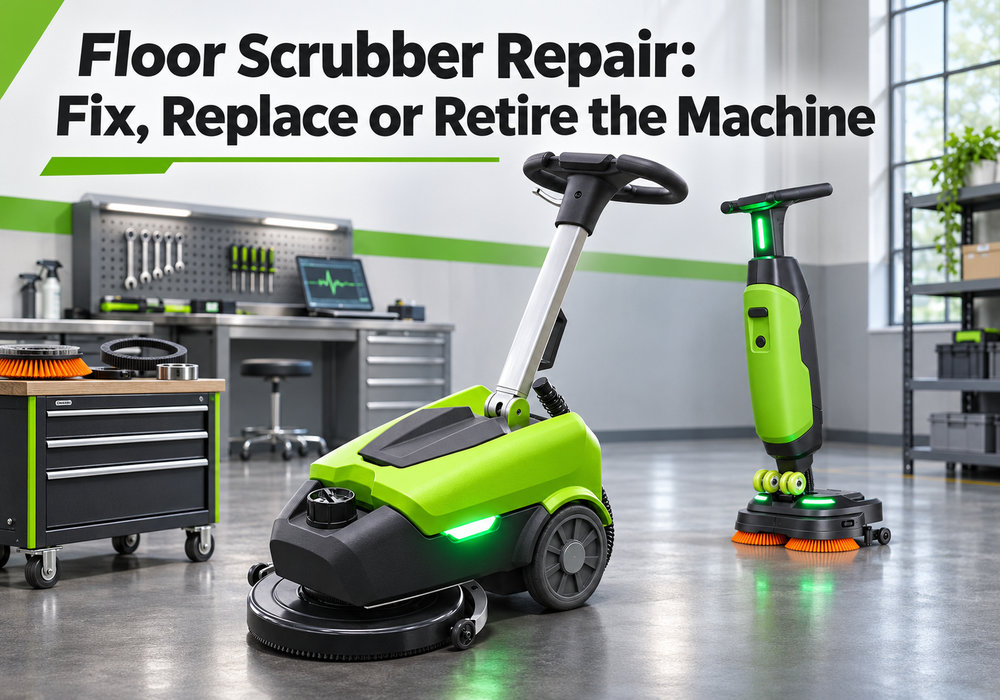
A floor scrubber repair is rarely a simple yes or no. The invoice in front of you is only one of four numbers that decide the answer, and it is usually the smallest. Some failures are cheap to fix and expensive to ignore; others are a careful repair buying six months on a machine that should have been retired. The difference is arithmetic, not instinct.
QUICK ANSWER
Approve the repair when the quoted cost, spread over the months of life it actually returns, is smaller than the net cost of replacement plus the downtime you avoid.
- Age and hours matter less than condition. A four-year-old machine in a clean warehouse often has more life left than a two-year-old machine that has been run in a foundry.
- Downtime is the number nobody puts on the quote. One stopped scrubber in a shift-driven facility costs more per day than most repair invoices.
- Parts availability decides feasibility. If the controller or the drive motor is discontinued, the repair is a promise nobody can keep.
- Service quality shows in the questions. A provider who asks for the serial number and the symptom history before quoting is a different animal from one who quotes a flat fee by phone.
This guide gives you the four-number test, the failure matrix, the six questions to ask before you sign, and the service brief to send instead of a panicked phone call.
What a floor scrubber repair call actually covers
A quote is only comparable when it lists diagnostics, travel, labour, parts and the return visit separately — a lump-sum figure hides which of those you are paying twice for.
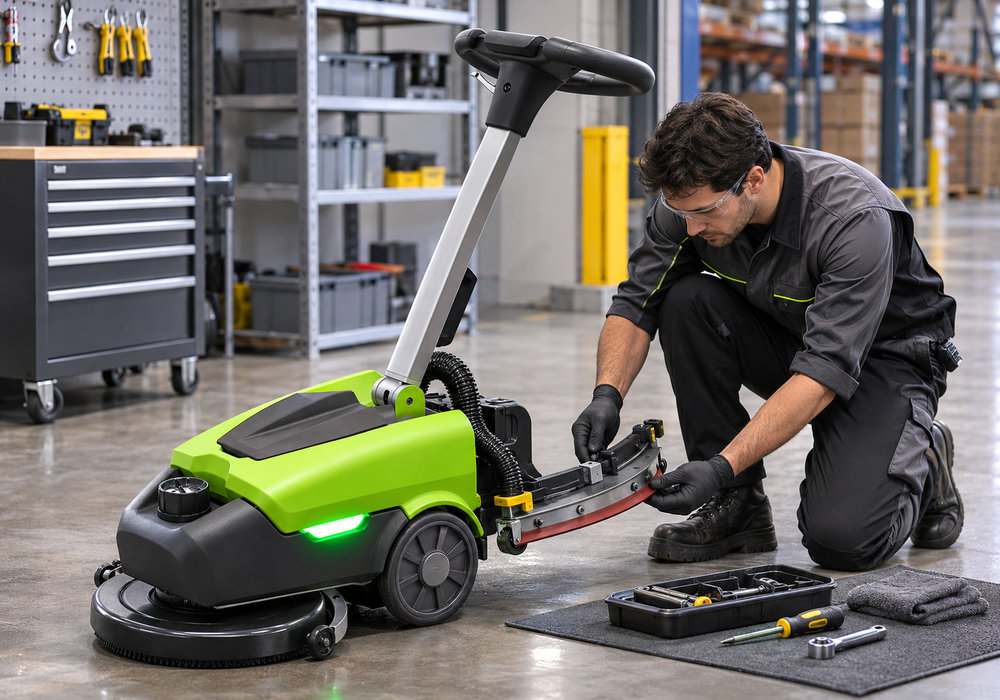
Commercial service runs through three channels that price differently. Mobile service comes to your site: you pay travel and keep the machine in place, which matters for a ride-on unit. Workshop service moves it to a bench — cheaper per hour, plus transport and days of downtime. Manufacturer support, routed through the importer or distributor, is where a controller or drive fault still under warranty belongs. Any provider asked to repair commercial floor cleaning equipment should quote all three so the numbers are comparable.
Confirm what the diagnostic fee buys, whether it is credited, and whether a second visit after a failed attempt is charged. The same logic applies when you vet a manufacturer or its service partner: scope first, price second. Machine certification is separate, covered by IEC 60335-2-72 for commercial floor-treatment machines. When a service auto scrubber is quoted, ask which channel the provider actually operates — many subcontract the workshop.
The four-number test for floor scrubber repair or replacement
Repair wins when the quote, divided by the months of service it genuinely returns, is lower than the monthly cost of a replacement plus the downtime you would carry while swapping machines.
The first is the all-in repair quote, including the second visit you will likely need. The second is replacement cost net of what the machine would fetch used — not list price, and not zero. The third is downtime cost per day, which most operators have never calculated. The fourth is remaining life in months, the number with the widest error bar.
In one line: if the quote divided by months of added life is smaller than net replacement cost divided by service life, repair is rational. If it also avoids ten days of downtime, add that saving before you compare. When a repair returns only a few months the arithmetic collapses, which is why honest providers tell you to stop.
A decision matrix by failure type
Failures split into three groups: wear parts that are always worth replacing, electrical faults where parts availability decides everything, and structural damage where repair is throwing money at a shell.
| Failure | Typical age | Verdict |
|---|---|---|
| Squeegee blade, brush or pad wear | Any | Always — consumable; check the wear pattern |
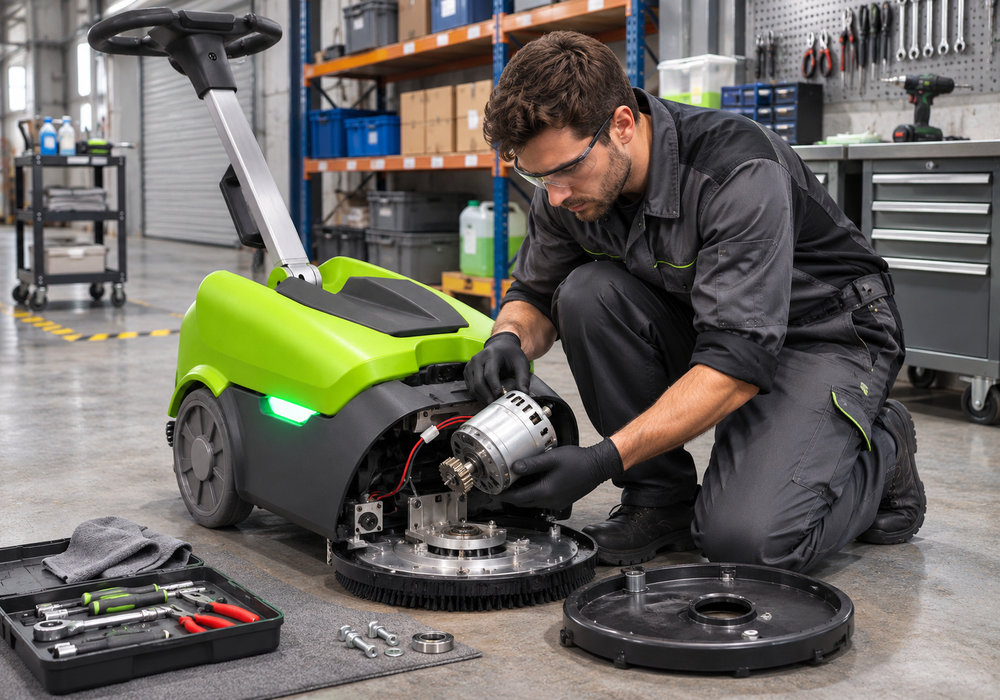
| Brush motor or vacuum motor | 3+ years | standon floor scrubbers repair is routine: replace the motor, keep the machine |
| Controller or drive board | 4+ years | Only if the board is still in production |
| Battery pack losing runtime | 2–5 years | Replace the pack, not the machine |
| Tank cracks, frame corrosion | 5+ years | Usually retire; welded repairs return |
| Water ingress into wiring | Any | Fix the cause, not just the harness |
Six questions before you approve the quote
The questions are about risk transfer: what is guaranteed, for how long, and who pays if the fault returns.
- Is the diagnostic fee credited against the repair? A fee that disappears once you approve is normal; one that stacks on top is a warning.
- Are the parts OEM or equivalent? Ask for part numbers in writing and check them against the list for your model.
- What is warranted — parts, labour, or both? Labour-only cover leaves you paying for the second part.
- How long is the repair warranted? Thirty days is a diagnostic; ninety days or a defined number of operating hours is a repair.
- Will I get the old parts back? Useful if you suspect a part was swapped without need.
- What happens if the fault returns in a week? Get the answer before you sign, not after.
These six questions are also the cheapest filter for a scrubber service provider: the ones who answer in writing are the ones who will still answer the phone in month nine. Electrical components inside the machine should carry recognised certification; UL listing on a replacement controller is a reasonable minimum ask.
What a service contract should actually promise
Buy response time and parts availability, not visits — four inspections a year with no response window solves the wrong problem.
Four clauses decide it. Response time defines how many days you run with a machine down — write it in hours, with a consequence if missed. Parts availability should name the components held in local stock, because a responsive technician with no motor on the shelf is still a two-week wait. Labour warranty should match parts warranty. Exclusions should be readable; if you cannot understand them, that is the finding.
For a single machine, a contract is often unnecessary — a pay-per-visit arrangement with a documented labour rate is enough. For a fleet, the arithmetic changes, and the same logic that governs fleet lifecycle planning governs service cover: you are buying avoided downtime, and it should be priced against it. Whatever is agreed, keep it consistent with the machine’s warranty terms so that one does not quietly void the other.
Downtime is the cost that decides
If a stopped machine displaces labour or delays a shift, the daily cost of downtime usually dwarfs the difference between two repair quotes — which is why the cheapest quote is often the most expensive decision.
Downtime cost per day has three parts: labour hours still paid while the floor is not cleaned, overtime or contractor cost of catching up, and service-level exposure with a client. Add the management hours nobody counts. Run that against the days a provider needs, and the choice between a two-day repair at a higher price and a ten-day repair at a lower one usually makes itself.
Two levers cut the exposure without touching the repair. Keep one spare sized for your critical zone, or rent during the window, and schedule non-urgent work against your slow shift. Both belong in the same plan as the service contract, and any scrubber service provider worth keeping will help you plan them.
Three cases where repair is the wrong answer
Retire when the frame is corroded, the controller is out of production, or the quote exceeds roughly half the net replacement cost — structural, not sentimental.
Corrosion is the clearest signal: a soft frame, a cracked tank or repeatedly wet wiring accepts a repair and returns with a different fault inside months. An obsolete controller is the second — once a board is out of production, a repair is a scavenged part with an unknown history. The third is arithmetic: when the quote approaches half the net cost of replacement, remaining life rarely justifies it.
This is also the honest answer to which floor cleaning machine has the easiest maintenance: the one whose wear parts are accessible without lifting the tank, and whose electrical components are still in production. Buy for that, and the repair decisions later become smaller.
DIY or technician: where the line sits
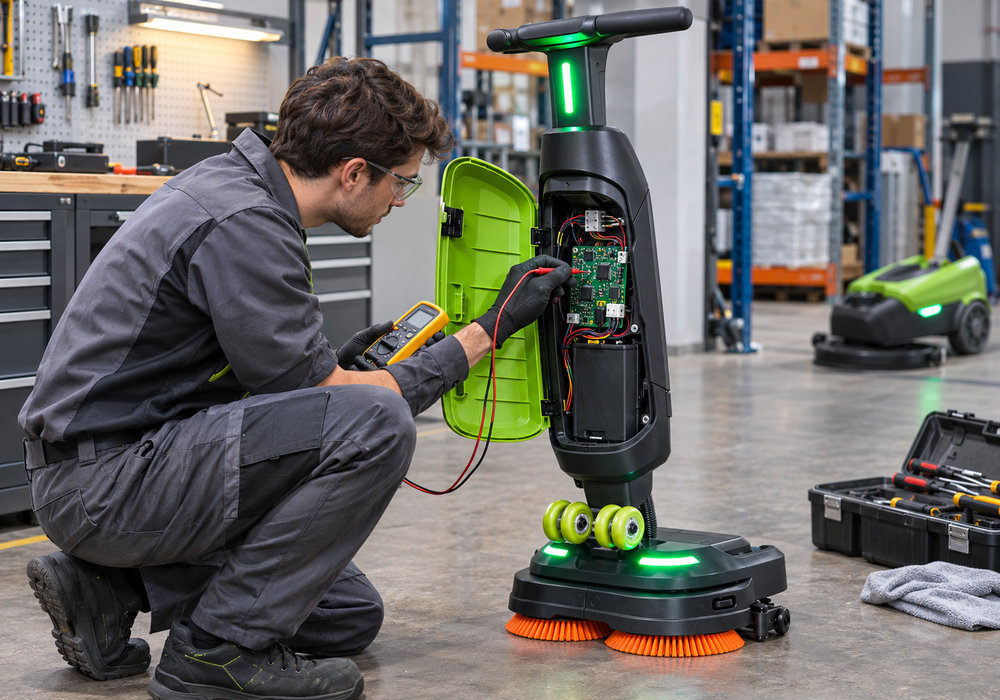
Brushes, squeegees, hoses and filters are owner-serviceable; battery packs, controllers, drive systems and anything requiring the machine lifted are not — and touching them usually costs the warranty.
The owner-serviceable list is short: squeegee blade, brushes and pads, blocked hoses, filters, and battery water level on flooded packs. The technician list starts above 24 volts DC, at anything needing the tank lifted off the frame, and at any controller or drive motor.
One detail gets missed. Washing parts or flushing a tank in a yard sends the water somewhere, and wash water from equipment servicing falls under discharge rules in many jurisdictions — the EPA NPDES program is the reference point in the United States. Do this indoors into a sanitary drain, or into a settling arrangement you can describe if asked. The routine side of upkeep is covered in the maintenance checklist; the repair side starts where that checklist stops.
The six-line service brief to send instead of a phone call
A written brief gets a written quote, and a written quote is the only thing you can compare across providers.
Six lines are enough: model and serial number; the symptom and when it appears (cold start, full tank, under load); hours and the surface it works on; what you have already checked; the response window you need and the days you can live without it; who approves the spend and up to what ceiling. Send it to two or three providers and compare line by line, not totals.
When you need model-specific part numbers, dimensions or a service contact for a machine you are specifying, send the requirement to the factory with the serial number attached. It shortens the diagnostic loop and removes the guesswork that inflates quotes.
Frequently Asked Questions
How much does a floor scrubber repair cost?
There is no single figure: cost depends on the fault, the parts channel and whether service happens on site or in a workshop. What you can control is structure — diagnostics, travel, labour and parts as separate lines, and whether the diagnostic fee is credited. A quote you can read beats a total you cannot.
Is it worth repairing a six-year-old scrubber?
Age alone does not decide it. Run the four-number test: quote against months of life returned, net replacement cost, downtime avoided, parts availability. A six-year-old machine with a worn motor and a sound frame is often worth repairing; a three-year-old with a corroded frame and a discontinued controller usually is not.
Can I repair my own scrubber?
Consumables yes, electrical systems no. Blades, brushes, hoses and filters are owner-serviceable. Battery packs, controllers, drive motors and anything needing the tank lifted belong to a technician, for safety and because unqualified work generally voids the warranty. If a job sits on the line, ask for the service documentation for your model.
How long does floor cleaning equipment repair take?
Parts availability decides it far more than labour. A wear part held in local stock is a same-week job; a controller that must be ordered is a lead time, not a repair. Ask any provider to state the lead time for the specific part before approving work, and plan against that number rather than the visit date.
Do I need a service contract?
For one machine, usually not — a documented labour rate and pay-per-visit is simpler. For a fleet, a contract that fixes response time and local parts stock is buying avoided downtime, and it should be judged on those two clauses, not on the number of scheduled visits.