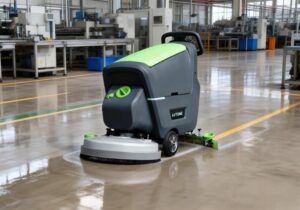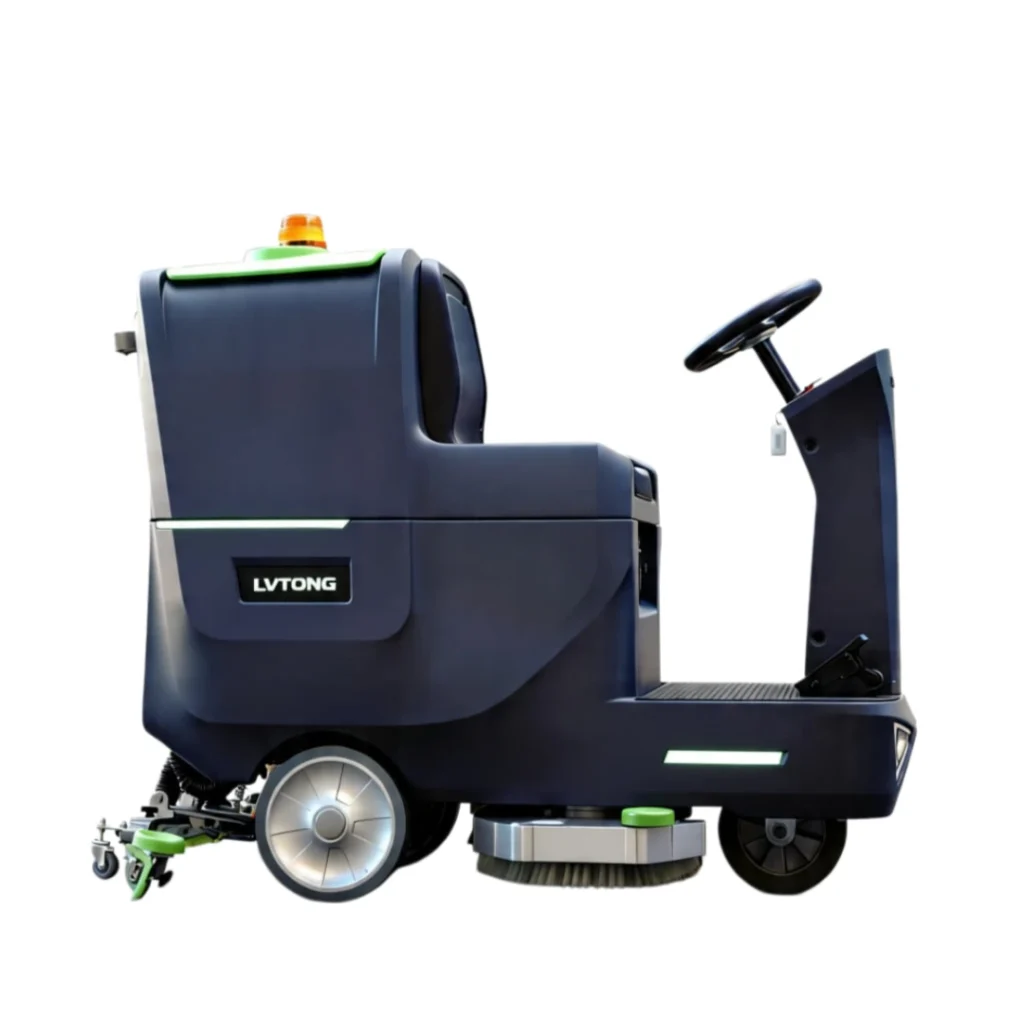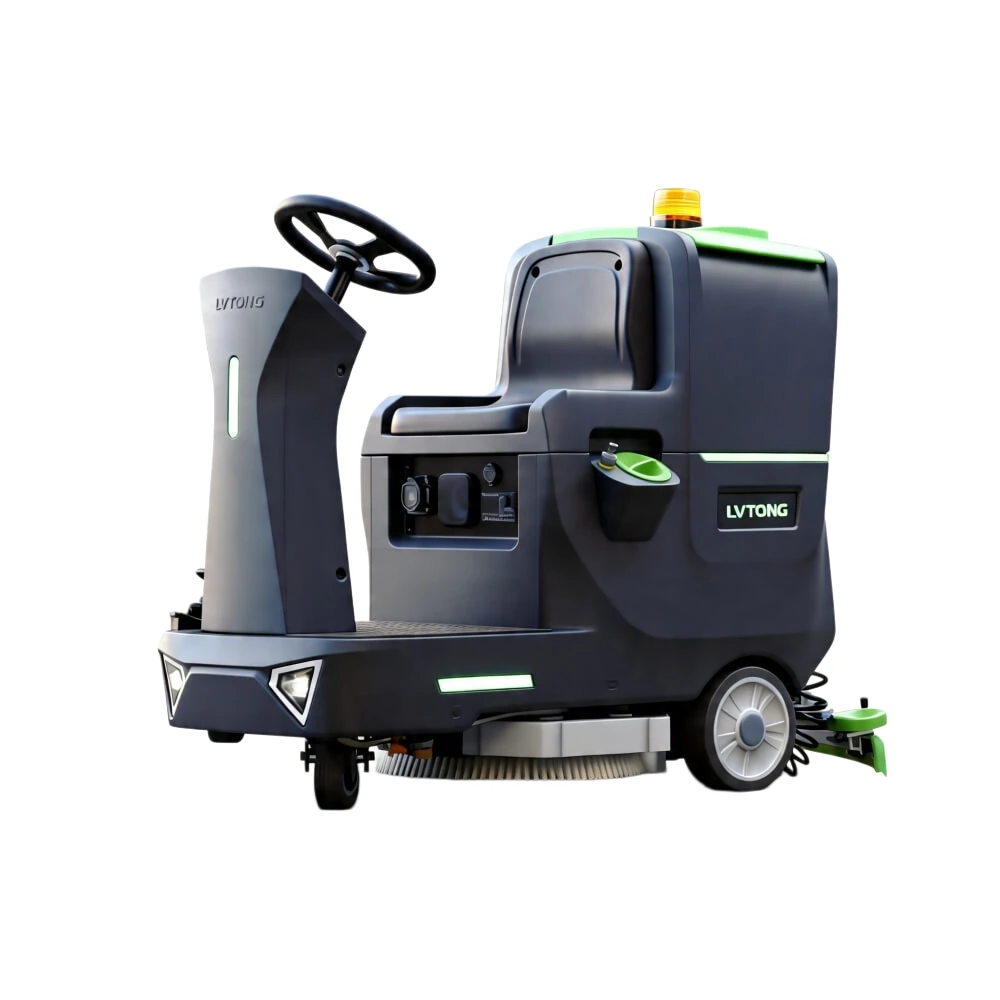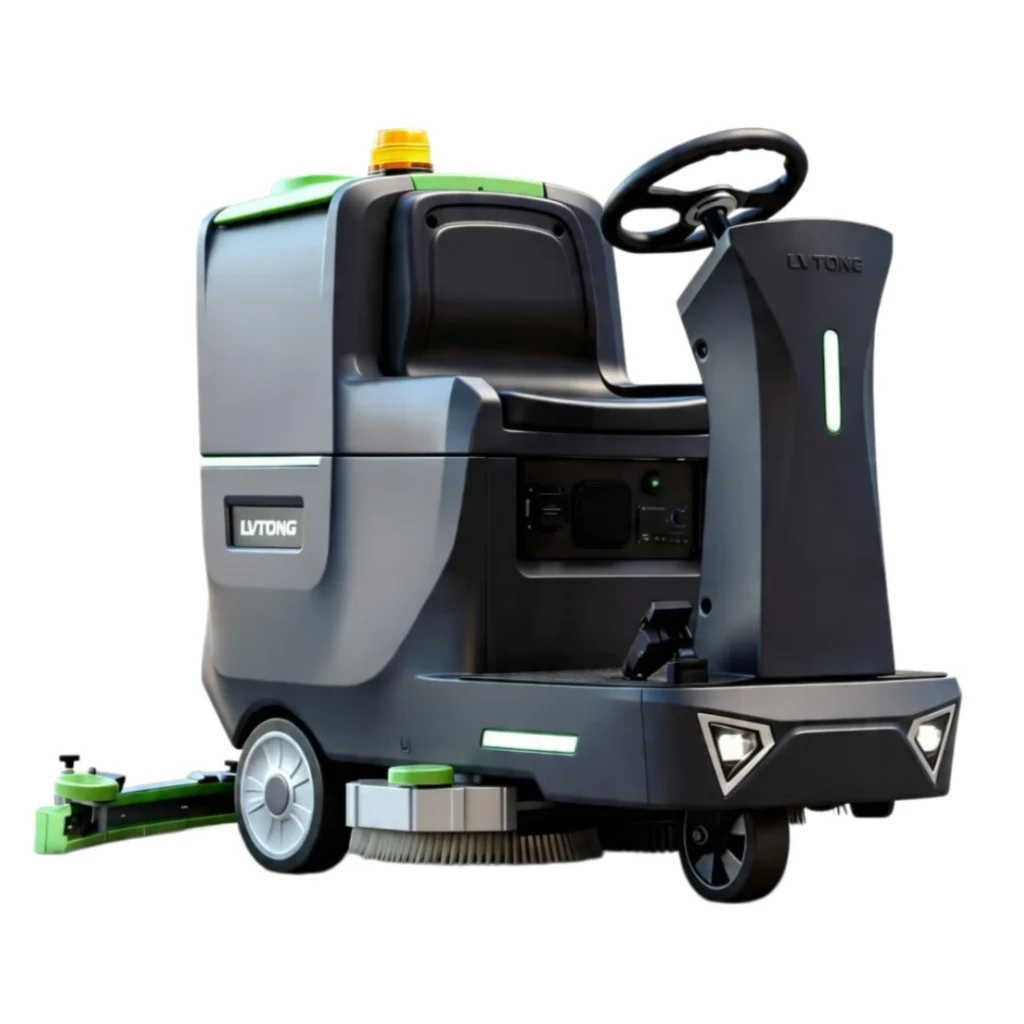
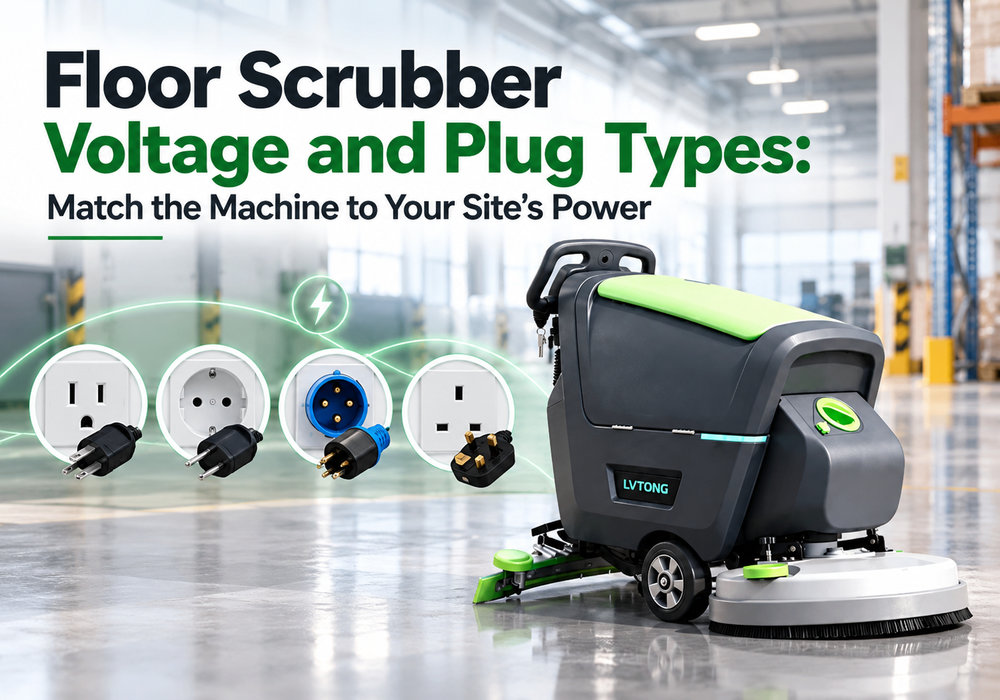
Quick Answer: What Is the Best Walk-Behind Floor Scrubber?
The best walk-behind floor scrubber is the model that matches your facility size, floor type, cleaning path, tank capacity, battery runtime, brush system, and water recovery needs. For small and medium commercial spaces, a compact walk-behind scrubber with strong suction and easy maneuverability is usually the best choice. For textured floors, heavy soil, or grout lines, choose a model with higher down pressure and the right brush type.
Choosing the best walk-behind floor scrubber requires more than comparing machine size or upfront price. A suitable model should match your cleaning area, floor surface, soil level, cleaning frequency, battery runtime, tank capacity, brush system, and water recovery performance. For small and medium commercial facilities, walk-behind floor scrubbers are often preferred because they provide strong cleaning performance while remaining easier to maneuver around aisles, shelves, machinery, and tight corners.
This guide explains how to compare walk-behind floor scrubbers by cleaning path width, real-world productivity, down pressure, brush type, tank size, battery technology, squeegee performance, floor type, and long-term operating value.
In most commercial facilities, the best walk-behind floor scrubber is determined by cleaning route, floor condition, maneuverability, water recovery, and total operating efficiency rather than machine size or purchase price alone.
How to Use This Walk-Behind Floor Scrubber Guide
This guide is designed for facility managers, cleaning contractors, warehouse operators, school maintenance teams, supermarket managers and procurement buyers who need to choose a practical walk-behind floor scrubber for small and medium cleaning areas.
Instead of selecting a machine only by price, tank size or cleaning width, buyers should start with the actual cleaning route.
Before comparing models, confirm:
Cleanable floor area.
Narrowest aisle or doorway width.
Turning space around shelves, machines, counters or furniture.
Floor material, such as concrete, epoxy, tile, vinyl or polished floor.
Main soil type, such as dust, grease, tire marks, food residue or daily dirt.
Daily cleaning frequency and available cleaning time.
Battery runtime and charging conditions.
Water recovery and drying requirements.
The best walk-behind floor scrubber is the machine that fits your actual facility layout, cleans effectively in one pass, recovers dirty water reliably and can be maintained easily over long-term use.
What Defines the Best Walk-Behind Floor Scrubber?
A walk-behind floor scrubber is a compact floor cleaning machine operated by a person walking behind the unit. It applies cleaning solution, scrubs the floor with a brush or pad, and recovers dirty water through a squeegee and vacuum system in one pass. The best model is not always the largest one; it is the machine that fits the facility layout, floor type, cleaning route, and operator workload.
A walk-behind floor scrubber usually performs three cleaning actions in one pass:
| Function | What It Does | Why It Matters |
|---|---|---|
| Solution delivery | Releases clean water and detergent onto the floor | Helps loosen dirt, grease, dust, and stains |
| Mechanical scrubbing | Uses disc, cylindrical, or orbital brushes to agitate the surface | Improves cleaning performance on concrete, tile, epoxy, vinyl, and grout lines |
| Water recovery | Uses vacuum suction and a squeegee to collect dirty water | Leaves floors drier, safer, and ready for traffic faster |
Walk-Behind Floor Scrubber vs Traditional Mop
A walk-behind floor scrubber is often used as an upgrade from traditional mop-and-bucket cleaning in commercial and industrial facilities.
| Cleaning Factor | Traditional Mop | Walk-Behind Floor Scrubber | Why It Matters |
|---|---|---|---|
| Cleaning process | Manual mopping, rinsing and repeated water changes | Solution delivery, mechanical scrubbing and dirty-water recovery in one pass | Reduces repeated manual work and improves cleaning consistency |
| Cleaning speed | Slower for large areas or repeated daily cleaning | Faster and more consistent for commercial floors | Helps facilities clean more area in less time |
| Drying time | Longer drying time and higher wet-floor risk | Faster water recovery and shorter drying time | Improves floor safety in busy facilities |
| Cleaning quality | Depends heavily on operator effort and mop condition | More consistent brush pressure, water control and recovery | Delivers more stable results across different operators |
| Labor intensity | Requires more physical effort and repeated manual work | Reduces operator fatigue during daily floor cleaning | Useful for schools, hospitals, supermarkets, offices and workshops |
| Water and chemical control | Less controlled and often inconsistent | Easier to manage water flow and detergent use | Helps reduce waste and maintain repeatable cleaning standards |
| Hygiene management | Dirty mop water may spread soil across the floor | Dirty water is recovered into the recovery tank | Supports cleaner floor maintenance in professional environments |
| Best use case | Very small areas, spot cleaning or occasional cleaning | Schools, hospitals, supermarkets, restaurants, offices, workshops and small warehouses | Helps buyers decide when a scrubber is worth replacing manual mopping |
For professional facilities, a walk-behind floor scrubber is not only a cleaning tool. It helps improve cleaning consistency, reduce operator fatigue, lower wet-floor risks and make daily floor maintenance easier to manage.
Key Specs to Compare Before Buying a Walk-Behind Floor Scrubber
When comparing walk-behind floor scrubbers, buyers should look beyond cleaning path width alone. The best machine should balance productivity, maneuverability, water recovery, brush performance, battery runtime, and maintenance convenience.
| Spec | What to Check | Best For |
|---|---|---|
| Cleaning path width | 17–34 inches depending on model size | Wider paths improve productivity; narrower paths improve maneuverability |
| Real-world productivity | Usually lower than theoretical productivity due to turning, refilling, and obstacles | Helps estimate actual cleaning time |
| Down pressure | Light pressure for daily cleaning; higher pressure for heavy soil | Concrete, tile, grout lines, tire marks, and greasy floors |
| Tank capacity | Solution and recovery tank size | Larger tanks reduce refill and drain frequency |
| Battery runtime | Runtime per charge and charging time | Long shifts, multi-zone cleaning, and facilities with limited downtime |
| Brush type | Disc, cylindrical, or orbital deck | Match the machine to floor surface and soil level |
| Squeegee performance | Curved or V-shaped squeegee, blade material, adjustment method | Strong water recovery and fewer wet streaks |
| Maintenance access | Brush, squeegee, battery, filter, and tank access | Reduces downtime and service difficulty |
Cleaning Path Width and Real-World Productivity
Theoretical productivity shows how much floor area a walk-behind scrubber can cover under ideal conditions. It can be estimated with the following formula:
Theoretical Productivity sq ft/hr = Scrub Path in × Operating Speed mph × 5,280 ÷ 12
In real facilities, actual productivity is usually lower because operators need time for turning, slowing down around obstacles, refilling solution tanks, draining recovery tanks, and replacing brushes or pads. For this reason, buyers should compare both theoretical productivity and real-world cleaning routes before choosing a walk-behind floor scrubber
Down Pressure and Scrubbing Power
Down pressure shows how strongly the scrub deck presses the brush or pad against the floor. Light down pressure is suitable for daily cleaning on smooth sealed floors, while higher down pressure is useful for rough concrete, tire marks, greasy soil, textured tile, and grout lines.
However, more pressure is not always better. Sensitive floors may require softer pads, lower pressure, and the right cleaning solution to avoid surface damage.
Squeegee Performance and Water Recovery
Vacuum strength and squeegee design affect how much dirty water the machine can recover after scrubbing. Strong water recovery helps reduce wet-floor risks, prevents streaks, and allows cleaned areas to return to service faster. When comparing walk-behind floor scrubbers, check not only vacuum power but also squeegee shape, blade material, and adjustment convenience.
Why Walk-Behind Floor Scrubbers Are Ideal for Small and Medium Spaces
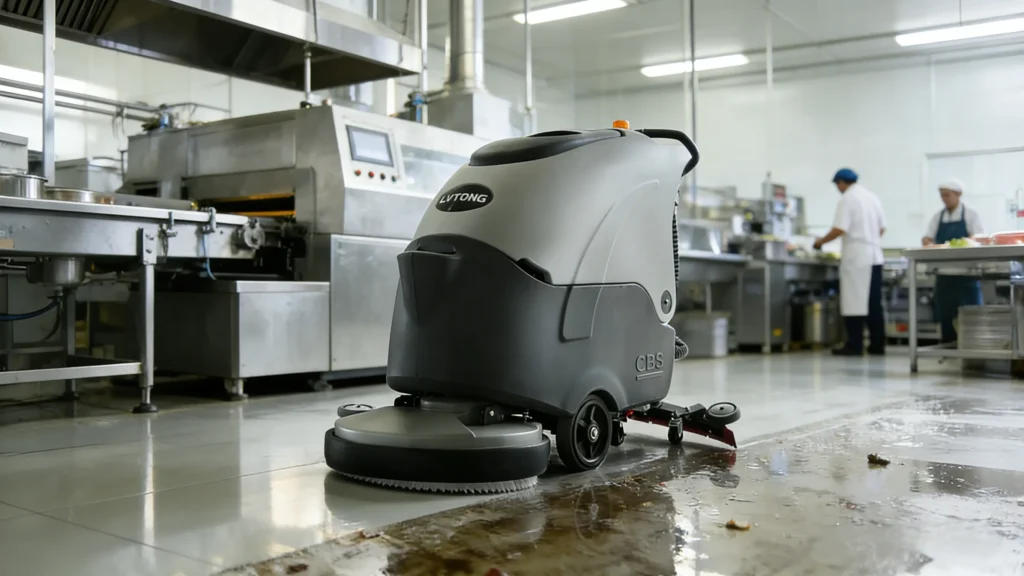
Walk-behind floor scrubbers are especially useful in facilities where maneuverability matters more than maximum driving speed. They are commonly used in warehouses, supermarkets, restaurants, schools, hospitals, workshops, food processing areas, and buildings with aisles, equipment, shelves, or divided rooms.
| Facility Challenge | Why a Walk-Behind Scrubber Helps |
|---|---|
| Narrow aisles | Compact machines can move through tighter paths |
| Shelves, furniture, or machinery | Operators can steer more precisely around obstacles |
| Mixed floor layouts | Walk-behind scrubbers adapt better to changing routes |
| Small storage areas | Easier to park, store, and maintain |
| Corners and edges | Better access than many larger ride-on machines |
| Medium cleaning routes | Provides stronger productivity than manual mopping without requiring large turning space |
For small and medium commercial spaces, walk-behind floor scrubbers provide a practical balance between cleaning efficiency, machine control, storage convenience, and operator flexibility.
Confined Space Cleaning Checklist
Walk-behind floor scrubbers are especially useful when a standard or ride-on floor scrubber cannot move safely through the cleaning route. For tight spaces, maneuverability is usually more important than maximum cleaning width.
| Confined Cleaning Area | Common Examples | What Buyers Should Check | Why It Matters |
|---|---|---|---|
| Doorways | Storage rooms, kitchens, offices, hospital rooms, school corridors | Compare the machine width with the narrowest doorway | Confirms whether the scrubber can enter the cleaning area safely |
| Narrow aisles | Retail aisles, warehouse aisles, supermarket shelves, stock rooms | Measure the space between shelves, racks, counters or machines | Prevents collision, poor turning and inefficient cleaning |
| Turning areas | Corridor ends, corners, checkout lanes, workshop passages | Check whether the scrubber can turn without repeated reversing | Helps avoid choosing a machine that cannot complete the route smoothly |
| Storage and charging area | Equipment rooms, janitor rooms, warehouse corners, back-of-house areas | Confirm storage room size, charging location and ventilation | Ensures the machine can be parked, charged and maintained safely |
| Obstacles | Furniture, medical equipment, pallets, displays, machines, restaurant equipment | Identify fixed and movable obstacles along the cleaning route | Determines whether a compact walk-behind scrubber is required |
| Floor traffic | Customers, patients, students, workers, forklifts or service carts | Consider cleaning time, pedestrian movement and drying requirements | Affects operator safety, drying speed and daily cleaning schedule |
| Floor surface | Tile, concrete, epoxy, vinyl, polished floor or coated floor | Match brush or pad type to the floor material | Improves cleaning performance and reduces the risk of floor damage |
| Soil type | Dust, food residue, grease, footprints, tire marks or daily dirt | Check whether the machine has suitable brush pressure and water recovery | Ensures the scrubber can clean the actual contamination effectively |
For confined spaces, a compact walk-behind floor scrubber with reliable water recovery can clean narrow areas more safely and efficiently than an oversized machine.
How to Measure Your Facility Before Choosing a Walk-Behind Floor Scrubber
Before choosing a walk-behind floor scrubber, buyers should measure the real cleaning route instead of relying only on the total floor area.
A compact scrubber must be able to enter the cleaning zone, pass through the narrowest aisle, turn safely, and return to the storage or charging area without damaging walls, shelves, doors, machines, or furniture.
| Measurement Point | What to Measure | Why It Matters |
|---|---|---|
| Narrowest doorway | Measure the usable opening inside the door frame, including handles, rails, or other obstacles | Confirms whether the scrubber can enter rooms, kitchens, clinics, storage areas, or corridors |
| Narrowest aisle | Measure the tightest space between shelves, racks, counters, machines, beds, or pallets | Prevents collision and poor cleaning efficiency in narrow routes |
| Turning space | Check whether the scrubber can turn at corridor ends, corners, checkout lanes, workshops, and loading areas | A machine that can pass through an aisle may still fail if it cannot turn safely |
| Storage area | Measure the storage room, charging area, and space needed for filling, draining, and maintenance | Ensures the machine can be parked, charged, emptied, and inspected after use |
| Cleaning route length | Estimate the actual route operators clean each day, not just the building size | Helps compare tank capacity, battery runtime, operator workload, and real productivity |
| Floor traffic | Check whether cleaning happens around customers, patients, students, workers, forklifts, or service carts | Helps decide machine size, drying performance, noise level, and cleaning schedule |
The best walk-behind floor scrubber for tight spaces is not always the smallest model. It is the machine that fits the narrowest point of the facility while still providing enough cleaning width, tank capacity, battery runtime, and water recovery for the daily cleaning route.
Walk-Behind Floor Scrubber Case Study: Warehouse Cleaning Efficiency
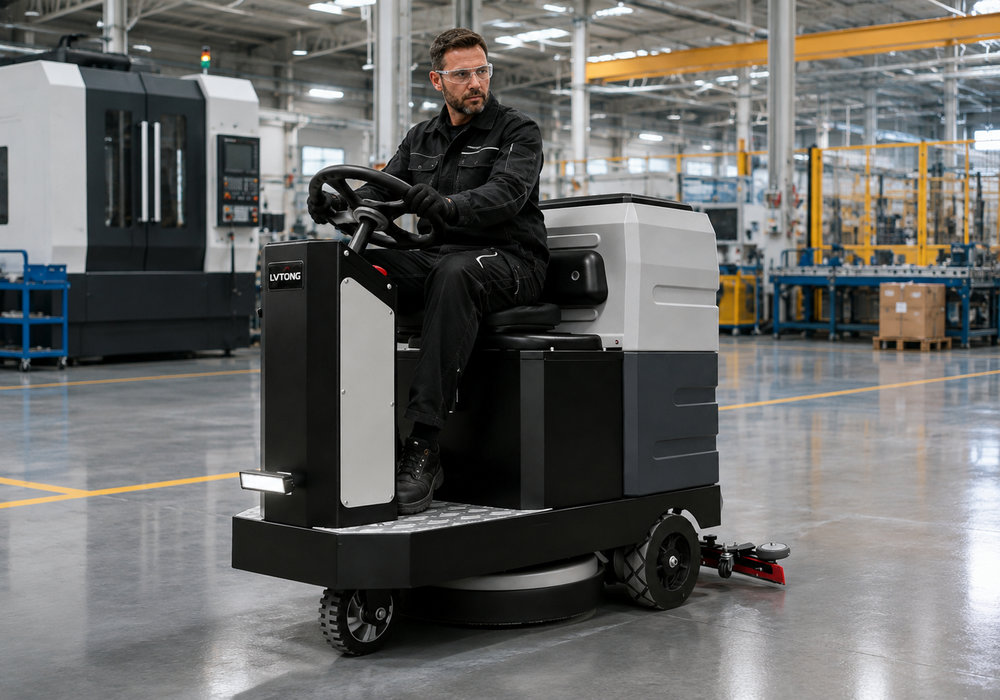
A regional distribution warehouse needed to remove daily tire marks and fine dust from polished concrete floors. Manual cleaning required long working hours and often left floors wet for extended periods.
Solution: The facility used an LVTONG LT-S530X walk-behind floor scrubber with a 530 mm cleaning path, large-capacity tanks, and a high-density disc brush.
Observed improvements included:
- Shorter daily cleaning time compared with manual mopping
- Better removal of embedded tire marks and fine dust
- Faster water recovery through vacuum suction and curved squeegee design
- Cleaner and drier floors after each cleaning route
- Lower physical workload for cleaning staff
This example shows why buyers should compare not only the cleaning path width, but also brush type, tank capacity, suction performance, and real-world maneuverability.
Walk-Behind vs Ride-On Floor Scrubber: Which Should You Choose?
Walk-behind and ride-on floor scrubbers serve different cleaning needs. The right choice depends on floor area, layout, cleaning route, operator workload, and available storage space.
| Factor | Walk-Behind Floor Scrubber | Ride-On Floor Scrubber |
|---|---|---|
| Operator position | Operator walks behind the machine | Operator sits on the machine |
| Best for | Small and medium spaces, aisles, rooms, and obstacles | Large open areas and long cleaning routes |
| Maneuverability | Higher | Lower in tight spaces |
| Productivity | Moderate to high | Higher in large open areas |
| Storage space | Smaller | Larger |
| Operator fatigue | Moderate depending on route length | Lower during long shifts |
| Upfront cost | Usually lower | Usually higher |
| Best choice when | The facility has tight turns, shelves, equipment, or divided rooms | The facility has wide open floors and long continuous cleaning routes |
Choose a walk-behind floor scrubber when maneuverability, access, and flexible route cleaning are more important. Choose a ride-on floor scrubber when the cleaning area is large, open, and requires maximum productivity over long shifts.
Walk-Behind or Ride-On: Facility-Based Decision Table
| Facility Condition | Better Starting Point | Reason |
|---|---|---|
| Small rooms, narrow aisles or divided areas | Walk-behind floor scrubber | Easier to turn, store and control in compact layouts |
| Retail stores, supermarkets and checkout lanes | Compact walk-behind floor scrubber | Better maneuverability around shelves, displays and customers |
| Schools, clinics, offices and corridors | Walk-behind floor scrubber | Suitable for controlled routes, low-noise cleaning and fast water recovery |
| Small warehouses and workshops | Walk-behind floor scrubber | Works well around racks, machines, pallets and loading areas |
| Medium facilities with mixed open and narrow areas | Walk-behind or compact ride-on scrubber | Choice depends on route length, turning space and operator workload |
| Large open warehouses, factories and logistics centers | Ride-on floor scrubber | Higher productivity, larger tanks and lower operator fatigue on long routes |
| Facilities with both open halls and small rooms | Hybrid cleaning fleet | Ride-on scrubbers handle open areas, while walk-behind scrubbers clean tight spaces |
A walk-behind scrubber is usually the right choice when flexibility, access and detailed cleaning matter most. A ride-on scrubber is usually the right choice when the facility has long open routes and labor reduction is the main priority.
When a Hybrid Scrubber Fleet Makes Sense
Some large commercial or industrial facilities should not choose only one machine type.
A hybrid cleaning fleet may be more efficient when the site includes both wide open floors and many small or congested areas.
For example, a ride-on floor scrubber can clean large corridors, warehouse aisles, parking areas or production floors, while a walk-behind floor scrubber can clean restrooms, elevators, corners, checkout lanes, equipment areas, storage rooms and narrow passages.
This strategy helps facilities balance productivity and precision. The ride-on scrubber improves coverage speed in open areas, while the walk-behind scrubber protects cleaning quality in tight spaces.
A hybrid fleet is worth considering when:
The building has both open halls and divided rooms.
Operators lose time switching between large and narrow areas.
A large ride-on machine cannot reach corners, edges or compact zones.
Cleaning must be completed within a limited daily or night cleaning window.
The facility wants to reduce labor time without sacrificing detailed cleaning coverage.
Key Components of a High-Performance Walk-Behind Floor Scrubber
A high-performance walk-behind floor scrubber is not defined by one feature alone. Buyers should evaluate the tank system, brush deck, battery, drive system, squeegee, and maintenance design together.
Tank Size and Refill Frequency
Tank size affects how often operators need to stop for refilling and draining. A larger solution tank allows longer cleaning routes, while a larger recovery tank helps collect more dirty water before disposal. For small facilities, compact tanks may be enough. For medium commercial areas, larger tanks can reduce downtime and improve cleaning efficiency.
| Tank Feature | Why It Matters |
|---|---|
| Solution tank | Holds clean water and detergent for scrubbing |
| Recovery tank | Collects dirty water after suction recovery |
| Larger tank capacity | Reduces refill and drain stops |
| Easy-drain design | Saves operator time after cleaning |
| Chemical dosing system | Helps control detergent use and cleaning consistency |
Brush and Deck Types for Walk-Behind Floor Scrubbers
Different brush and deck types are designed for different floor surfaces and cleaning tasks.
| Deck Type | Best Application | Key Benefits |
|---|---|---|
| Disc brush / pad | Daily cleaning on smooth concrete, epoxy, vinyl, and sealed floors | Cost-effective, versatile, easy to maintain |
| Cylindrical brush | Textured floors, tile and grout, uneven surfaces, light debris | Scrubs and collects light debris in one pass |
| Orbital deck | Deep cleaning, finish removal, chemical reduction | Uses vibration for consistent contact and may reduce chemical use |
| Single brush deck | Compact spaces and efficient daily cleaning | Simple structure, lower maintenance, and easy operation |
If your facility includes tile, grout, uneven floors, or textured surfaces, the brush type becomes especially important. A disc brush is suitable for many smooth floors, while cylindrical or orbital systems may perform better on rougher surfaces or deeper soil.ve.
Highly Efficient Single Brush Walk-Behind Floor Scrubbers
A single brush walk-behind floor scrubber is often a practical choice for small and medium commercial facilities. It has a simpler scrub deck, easier maintenance, and good maneuverability in aisles, rooms, and narrow passages.
For buyers searching for a highly efficient single brush floor scrubber, the key is to compare cleaning path width, brush pressure, water recovery, battery runtime, and tank capacity rather than only looking at machine size.
Power and Propulsion Systems
Walk-behind floor scrubbers may use different drive systems depending on the application.
| Propulsion Type | Description | Best For |
|---|---|---|
| Manual guidance | Operator controls and pushes the machine | Small spaces and budget-sensitive use |
| Pad-assist drive | Brush rotation helps move the machine forward | Medium daily cleaning routes |
| Self-propelled drive | Powered drive system moves the machine | Larger routes, longer shifts, and reduced operator fatigue |
Self-propelled walk-behind floor scrubbers are often more comfortable for longer routes, while compact manual or pad-assist models may be enough for smaller facilities.
Squeegee Performance and Water Recovery Matter as Much as the Brush
Buyers often focus on brushes, pads, and cleaning path width, but squeegee performance is just as important. A well-designed curved or V-shaped squeegee helps recover dirty water after scrubbing, reducing wet patches, streaks, and slip risks.
When comparing walk-behind scrubbers, check the squeegee blade material, adjustment method, replacement process, and corner recovery performance. Soft rubber blades are suitable for smooth floors, while more durable blade materials may be better for oily or abrasive environments.
Poor water recovery can leave streaks, damp patches, and safety risks. That is why the best walk-behind floor scrubber should combine effective scrubbing with strong suction and reliable squeegee contact.
Walk-Behind Floor Scrubber Battery Runtime and Charging Options
Battery performance affects how long the machine can clean before charging. Buyers should compare runtime, charging time, maintenance needs, and long-term battery cost.
| Battery Type | Typical Runtime | Maintenance | Upfront Cost | Best For |
|---|---|---|---|---|
| Wet lead-acid | 3–4 hours | High; requires water checks | Lower | Budget-sensitive operations with maintenance staff |
| AGM / sealed battery | 4–5 hours | Low | Medium | Standard commercial cleaning |
| Lithium battery | 5–6+ hours | Minimal | Higher | High-use facilities, faster charging, and multi-shift cleaning |
Battery runtime should be compared with the actual cleaning route. A machine with long runtime is useful only when its tank capacity, brush system, and water recovery performance also match the facility. For multi-shift cleaning or sites with limited downtime, lithium battery walk-behind scrubbers can reduce charging and maintenance interruptions.
Many facilities now choose walk-behind scrubbers with maintenance-free battery systems because they help reduce charging pressure, maintenance work, and downtime during daily cleaning.
Battery Selection Should Match the Cleaning Schedule
Battery choice should be based on how and when the machine is used.
For occasional or low-frequency cleaning, an AGM or sealed battery may be enough because it offers lower maintenance than wet lead-acid batteries and keeps the initial investment under control.
For high-traffic facilities, multi-shift cleaning, supermarkets, hospitals, schools, logistics centers and sites with short charging windows, lithium batteries may be more practical because they support faster charging, lower maintenance and more flexible use during the day.
Buyers should compare:
Charging time.
Expected runtime per shift.
Battery replacement cost.
Maintenance requirements.
Charging room conditions.
Whether partial charging is needed.
Whether the scrubber must be used across multiple shifts.
A longer battery runtime is useful only when the machine also has enough tank capacity, suitable brush performance and reliable water recovery for the actual cleaning route.
Best Walk-Behind Floor Scrubber by Floor Type
Walk-behind floor scrubbers can clean many commercial floor surfaces when fitted with the right brush, pad, pressure, and cleaning solution.
| Floor Type | Recommended Setup | Why |
|---|---|---|
| Smooth concrete | Disc brush or pad | Suitable for daily dust and dirt removal |
| Polished concrete | Soft pad and proper water recovery | Helps avoid streaks and surface damage |
| Epoxy floor | Disc brush or soft pad | Maintains clean appearance with controlled pressure |
| Tile and grout | Cylindrical brush or higher down pressure | Improves contact with grout lines and textured surfaces |
| Vinyl floor | Soft pad or light brush | Protects softer floor surfaces |
| Greasy floors | Strong suction, suitable brush, and correct detergent | Improves safety and water recovery |
| Rough or textured floor | Cylindrical brush | Reaches uneven surfaces more effectively |
The best setup depends on the actual floor condition. Smooth sealed floors usually need less pressure, while rough concrete, tile grout, and greasy floors often require stronger scrubbing and better water recovery.
Walk-Behind Floor Scrubber Reviews: What Buyers Should Check
When reading walk-behind floor scrubber reviews or comparing supplier recommendations, focus on practical performance instead of only looking at brand names or price. A reliable review should explain how the machine performs in real cleaning routes, not just under ideal conditions.
| Review Factor | What to Check |
|---|---|
| Cleaning result | Does it remove dust, tire marks, grease, or grout soil in one pass? |
| Drying performance | Does the squeegee leave streaks or wet patches? |
| Battery runtime | Can the machine finish the full cleaning route per charge? |
| Tank capacity | Does the operator stop too often to refill or drain? |
| Maneuverability | Can it turn around shelves, machines, doors, and corners? |
| Brush system | Does it match concrete, tile, epoxy, vinyl, or textured floors? |
| Maintenance | Are brushes, squeegees, batteries, and filters easy to replace? |
| After-sales support | Are spare parts and technical support available? |
This checklist helps buyers evaluate walk-behind floor scrubbers based on real operating needs rather than only advertised productivity.
On-Site Demonstration Checklist Before Buying
Before buying a walk-behind floor scrubber, buyers should test the machine under real working conditions instead of relying only on catalog specifications.
During the demonstration, check:
Can the machine pass through the narrowest doorway or aisle?
Can it turn safely around shelves, machines, beds, counters or pallets?
Does the brush or pad remove the actual dirt, grease, dust or tire marks?
Does the squeegee recover dirty water without leaving streaks or wet patches?
Can the operator control the machine comfortably for the full cleaning route?
How often does the machine need to stop for refilling or draining?
Is the noise level acceptable for daytime cleaning?
Are brushes, squeegee blades, batteries and filters easy to inspect and replace?
Can the supplier provide spare parts, training and technical support after delivery?
A walk-behind floor scrubber should be tested in the real cleaning area whenever possible. The best model is the one that cleans the actual floor consistently, fits the route and remains easy to maintain after purchase.
Walk-Behind Floor Scrubber Demonstration Scorecard
During a product demonstration, buyers should compare each walk-behind floor scrubber under the same facility conditions. Use the same floor surface, same soil type, same cleaning route, and same operator speed whenever possible.
| Test Area | What to Check | Good Result |
|---|---|---|
| Access | Can the machine pass through the narrowest doorway and aisle? | The scrubber moves through the route without collision or repeated repositioning |
| Turning | Can it turn around corners, racks, counters, pallets, beds, or machines? | The operator can complete turns safely and smoothly |
| Cleaning result | Does the brush or pad remove actual dirt, grease, footprints, tire marks, or food residue? | The floor is visibly cleaner after one normal cleaning pass |
| Water recovery | Does the squeegee collect dirty water without streaks or wet patches? | The cleaned floor dries quickly and is safer for traffic |
| Runtime | Can the battery support the planned cleaning route? | The scrubber completes the required area without unexpected charging interruption |
| Tank capacity | How often does the operator need to refill clean water or drain dirty water? | Tank stops do not interrupt the normal cleaning schedule too frequently |
| Operator comfort | Can the operator control the machine comfortably during the full route? | Controls, handle position, visibility, and steering feel practical |
| Noise level | Is the machine suitable for daytime cleaning in public or occupied spaces? | Noise does not disturb customers, patients, students, office workers, or staff |
| Maintenance access | Can brushes, pads, squeegees, batteries, filters, and tanks be inspected easily? | Daily maintenance can be completed quickly after use |
| Supplier support | Can the supplier provide spare parts, training, and technical guidance? | Buyers know how to get support after delivery |
A demonstration should prove that the machine fits the real cleaning environment. The right walk-behind floor scrubber should clean effectively, recover water reliably, fit the facility route, and remain easy to maintain after purchase.
Common Mistakes When Choosing a Walk-Behind Floor Scrubber
Even experienced buyers may choose the wrong machine if they focus on only one specification. Avoid these common mistakes before buying a walk-behind floor scrubber.
| Mistake | Why It Matters |
|---|---|
| Choosing only by cleaning path width | A wider path may reduce maneuverability in tight spaces |
| Ignoring tank size | Small tanks can increase refill and drain frequency |
| Focusing only on battery runtime | Runtime is less useful if the tank or brush system does not match the route |
| Using the wrong brush type | Wrong brushes may damage floors or fail to remove soil |
| Overlooking squeegee design | Poor water recovery leaves streaks and wet patches |
| Buying only by price | Low-cost machines may have weaker parts support and shorter service life |
| Ignoring operator comfort | Hard-to-use machines reduce cleaning consistency |
| Not checking spare parts support | Brushes, squeegees, filters, and batteries need long-term availability |
Total Operating Cost Matters More Than Purchase Price
A walk-behind floor scrubber should not be evaluated only by its upfront price. A low-cost machine may become expensive if it increases labor time, leaves floors wet, requires frequent refilling, uses the wrong brush system, or has limited spare parts support.
Professional buyers should compare the complete operating cost.
| Cost Factor | What Buyers Should Check | Why It Matters |
|---|---|---|
| Labor time | How long does the operator need to finish the daily cleaning route? | Faster cleaning can reduce repeated manual work and improve cleaning efficiency |
| Refill and drain time | How often must the operator stop to refill clean water or empty recovery water? | Frequent stops reduce practical productivity |
| Battery cost | What is the battery type, runtime, charging time, and replacement cost? | Battery performance affects daily availability and long-term cost |
| Brush and pad cost | Are suitable brushes or pads available for the floor type? | Wrong consumables may reduce cleaning quality or damage floors |
| Squeegee blade cost | Are replacement blades easy to buy and replace? | Poor squeegee performance can leave wet floors and safety risks |
| Maintenance time | Can operators clean tanks, brushes, filters, and squeegees quickly? | Simple maintenance helps reduce downtime |
| Spare parts availability | Are batteries, chargers, filters, hoses, brushes, and squeegees available after purchase? | Parts delays can stop the machine from working |
| Service support | Does the supplier provide operation guidance, troubleshooting, and after-sales support? | Support affects long-term reliability and user confidence |
The most valuable walk-behind floor scrubber is not simply the cheapest machine. It is the machine that reduces cleaning time, controls maintenance cost, keeps floors drier, and stays available for daily use.
Which LVTONG Walk-Behind Floor Scrubber Should Buyers Review?
LVTONG offers walk-behind floor scrubber machines for different commercial and industrial cleaning needs.
For compact commercial areas, narrow aisles, restaurants, schools, small supermarkets and light-duty daily cleaning, buyers can review compact walk-behind models such as the Q5.
For factories, workshops, warehouses, hospitals, supermarkets and medium commercial facilities that need stronger cleaning performance, larger tank capacity and reliable water recovery, buyers can compare models such as the LT-S530X.
Before requesting a quote, prepare your cleaning area, aisle width, floor material, soil type, cleaning frequency, battery runtime requirement and preferred brush or pad configuration.
You can also visit LVTONG’s walk-behind floor scrubber machine category to compare available models, specifications and suitable applications.
What Information Should You Provide Before Requesting a Walk-Behind Floor Scrubber Quote?
To help LVTONG recommend a suitable walk-behind floor scrubber, buyers should provide practical cleaning information instead of asking only for a general price.
| Information to Provide | Example Details | Why It Helps |
|---|---|---|
| Facility type | School, hospital, supermarket, restaurant, warehouse, workshop, office, or logistics facility | Helps match the machine to the cleaning environment |
| Cleanable floor area | Total area cleaned per day or per shift | Helps estimate cleaning path width, tank capacity, and battery runtime |
| Narrowest aisle or doorway | Doorway width, aisle width, corridor width, or turning space | Helps avoid recommending a machine that is too large |
| Floor material | Concrete, epoxy, tile, vinyl, polished floor, grout, or coated floor | Helps choose brush type, pad type, and pressure level |
| Main soil type | Dust, grease, tire marks, food residue, footprints, daily dirt, or industrial soil | Helps match brush pressure, detergent use, and water recovery |
| Cleaning frequency | Occasional, daily, multiple times per day, or multi-shift cleaning | Helps evaluate battery type and maintenance needs |
| Available cleaning time | Daytime cleaning, night cleaning, short cleaning window, or after-hours cleaning | Helps decide noise level, drying speed, and runtime requirements |
| Storage and charging conditions | Storage room size, charging area, ventilation, and power supply | Helps confirm battery and charger suitability |
| Operator requirements | Manual guidance, pad-assist drive, self-propelled drive, or lower operator fatigue | Helps match machine operation style to staff workload |
| Destination market | Country, voltage requirement, documentation needs, and after-sales expectations | Helps confirm configuration, delivery, and support requirements |
Providing this information allows LVTONG to recommend a walk-behind floor scrubber that fits the real facility layout, cleaning task, and operating schedule.
You can also review LVTONG’s walk-behind floor scrubber machine category to compare available models, specifications, and suitable applications.
Walk-Behind Floor Scrubber FAQs
What is the best walk-behind floor scrubber?
The best walk-behind floor scrubber is the model that matches your facility size, floor type, soil level, cleaning frequency, battery runtime, tank capacity, brush type, and water recovery needs. For most small and medium commercial spaces, a compact model with strong suction, easy maneuverability, and suitable brush pressure is a practical choice.
How do I choose the best walk-behind floor scrubber?
Compare cleaning path width, tank size, battery runtime, brush type, down pressure, squeegee performance, maintenance access, and after-sales support. The right machine should fit your aisles, doors, storage area, and daily cleaning route.
What size walk-behind floor scrubber do I need?
Small spaces usually need compact machines with narrow cleaning paths. Medium commercial areas may require a wider cleaning path and larger tanks. The machine should be wide enough to improve productivity but still narrow enough to pass through doors, aisles, and congested areas.
Are walk-behind floor scrubbers good for warehouses?
Yes. Walk-behind floor scrubbers are useful for small and medium warehouses, especially where operators need to clean around shelves, pallets, machinery, doors, and loading areas. For very large open warehouses, a ride-on scrubber may be more efficient.
What is the difference between a walk-behind scrubber and a ride-on scrubber?
A walk-behind scrubber is operated by a person walking behind the machine, making it better for tight spaces and flexible routes. A ride-on scrubber allows the operator to sit on the machine and is usually better for large open areas and long cleaning shifts.
What floor types can a walk-behind scrubber clean?
Walk-behind floor scrubbers can clean concrete, epoxy, tile, grout, vinyl, polished concrete, and many sealed commercial floors when fitted with the right brush or pad. Sensitive floors may require softer pads and lower pressure.
How important is squeegee performance?
Squeegee performance is very important because it controls how much dirty water is recovered after scrubbing. A good squeegee helps reduce wet streaks, slip risks, and drying time.
Is a walk-behind floor scrubber better than manual mopping?
For most commercial facilities, yes. A walk-behind floor scrubber can scrub, recover dirty water, and dry the floor in one pass, helping improve cleaning efficiency while reducing operator fatigue and wet-floor risks.
What is the best battery for a walk-behind floor scrubber?
Lithium batteries are generally preferred for long operating hours, fast charging, and minimal maintenance. AGM batteries provide a balance between cost and maintenance, while wet lead-acid batteries remain suitable for budget-conscious operations with regular maintenance schedules.
Buying Recommendations
Different facilities require different walk-behind floor scrubbers.
- Choose a compact walk-behind floor scrubber if your facility has narrow aisles, multiple rooms, or limited storage space.
- Choose a self-propelled model if operators clean for several hours each day and need reduced physical effort.
- Choose a lithium battery model for multi-shift operation or where fast charging is important.
- Choose a cylindrical brush model for textured floors, grout lines, or heavy soil.
- Choose a disc brush model for smooth concrete, epoxy, vinyl, and general daily cleaning.
Conclusion: How to Choose the Right Walk-Behind Floor Scrubber
Choosing the best walk-behind floor scrubber is not about selecting the biggest or most expensive machine. The right choice depends on your facility size, floor type, cleaning route, tank capacity, battery runtime, brush system, down pressure, squeegee performance, maintenance needs, and long-term service support.
For tight aisles, small rooms, restaurants, schools, supermarkets, workshops, and medium commercial spaces, a walk-behind scrubber can provide a strong balance of cleaning performance and maneuverability. For larger open spaces with long cleaning routes, buyers may also compare ride-on scrubbers.
LVTONG provides walk-behind floor scrubber models for different cleaning areas, floor surfaces, and operating needs. Contact the LVTONG team for a space-specific recommendation based on your facility layout, cleaning frequency, and floor condition.