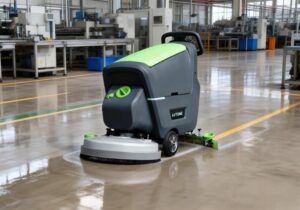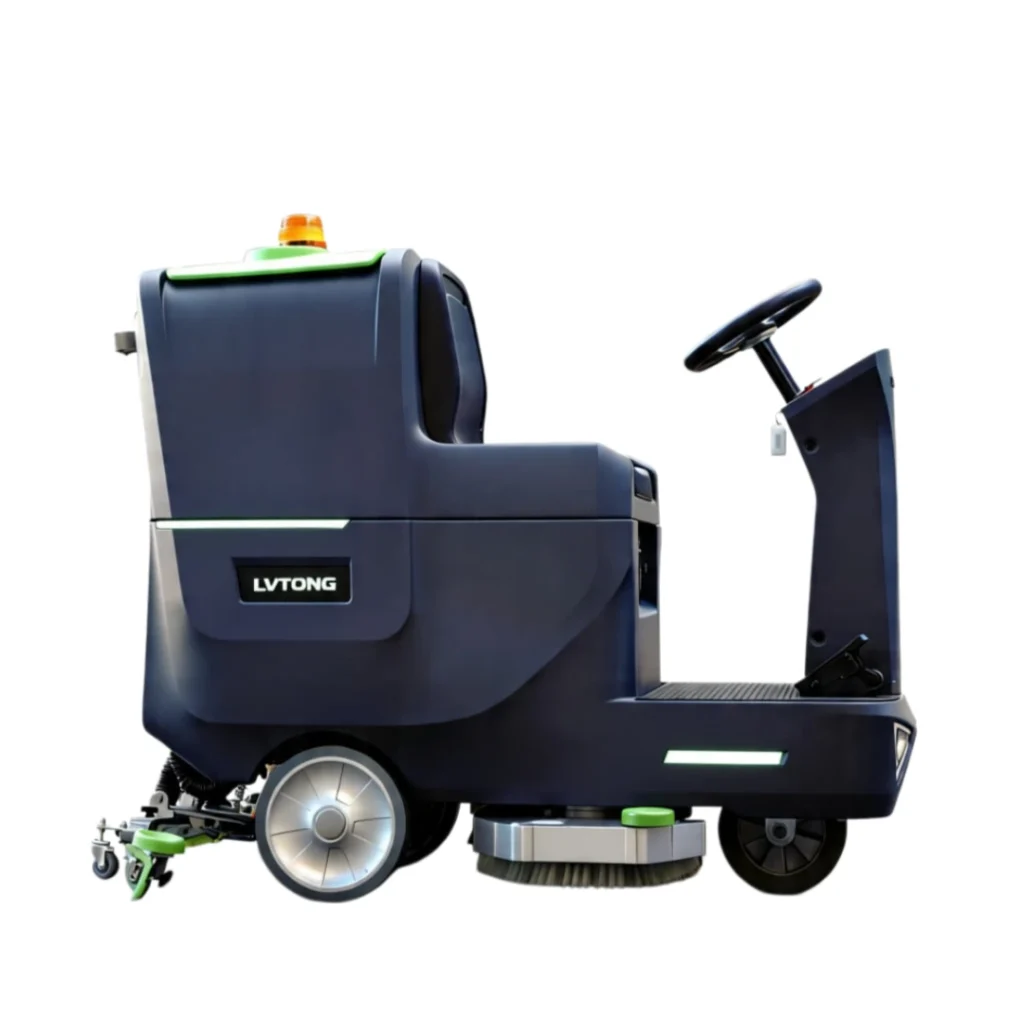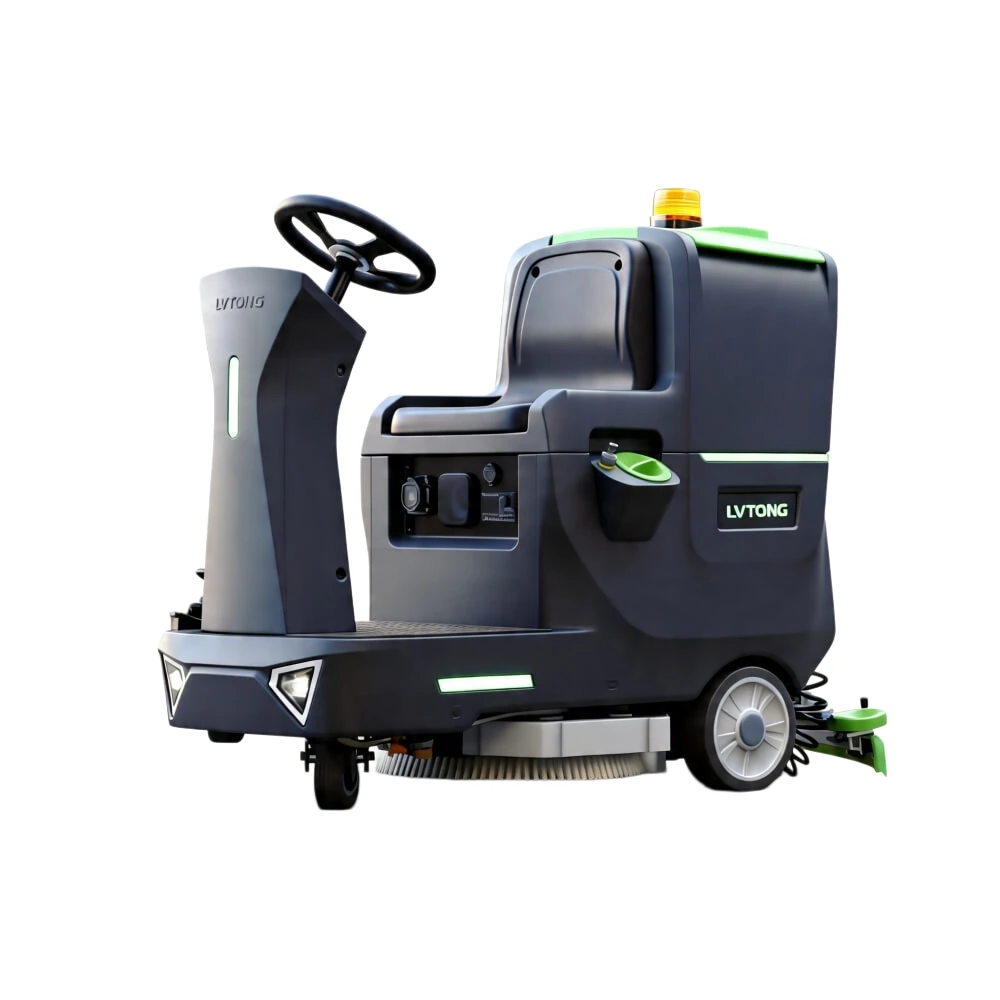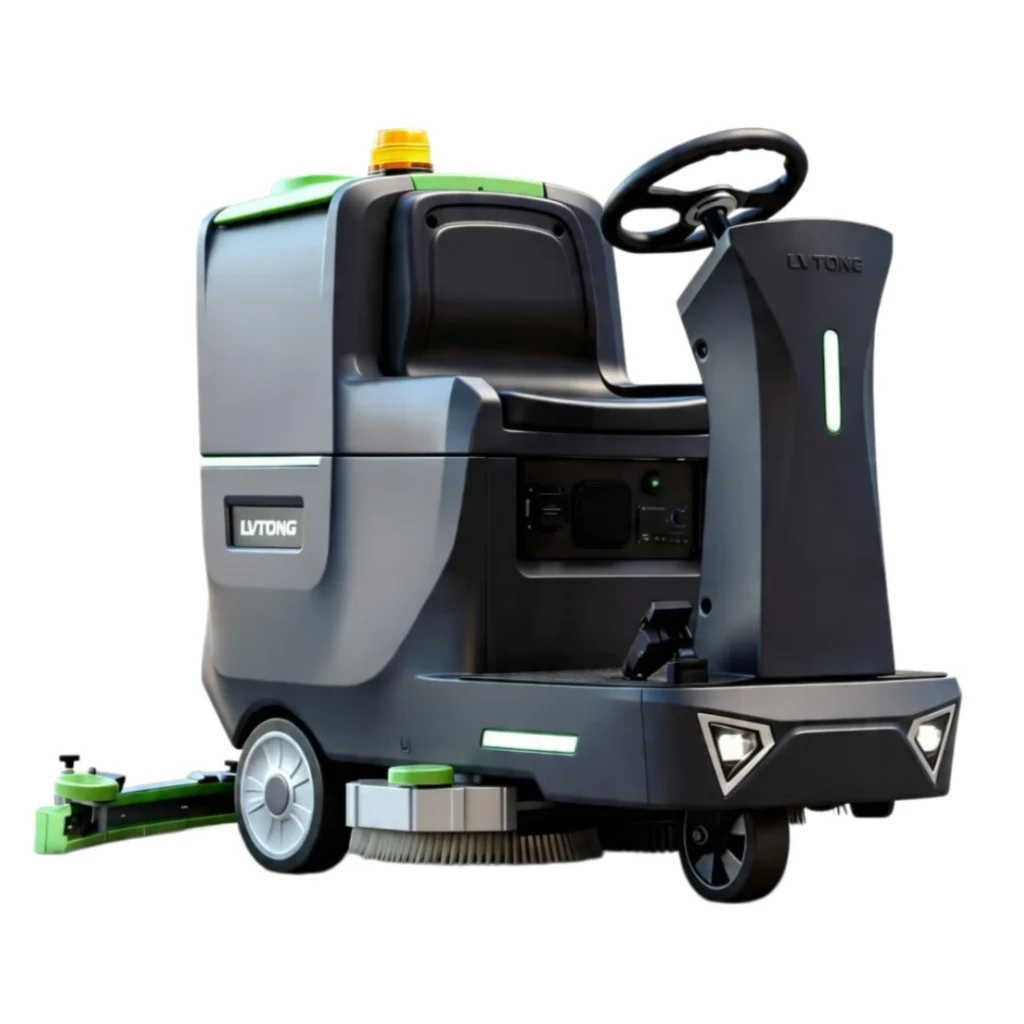
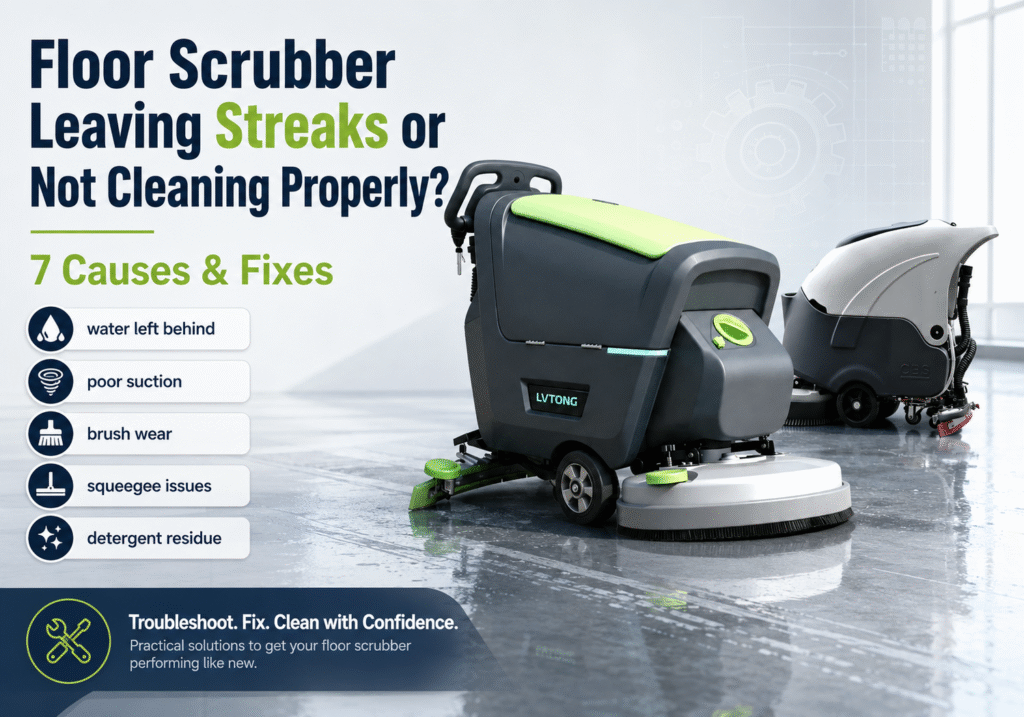
Choosing the right floor scrubber is an important decision for factories, warehouses, commercial buildings, hospitals, logistics centers, parking facilities, and other professional cleaning environments.
The best machine is not simply the largest, most powerful, or least expensive model. A floor scrubber directly affects cleaning productivity, labor requirements, floor safety, operating costs, maintenance workload, and equipment utilization.
Many buyers therefore ask the same question:
How do you choose a floor scrubber that actually fits your facility?
The answer depends on several factors, including cleaning area, floor type, cleaning frequency, operating hours, labor availability, maneuverability, battery runtime, tank capacity, and long-term maintenance requirements.
This guide explains how to choose a floor scrubber by comparing industrial and electric models and showing which factors matter most before purchasing.
Quick Answer: How to Choose a Floor Scrubber
Choose a floor scrubber based on your actual cleaning workload, not only on machine size or advertised productivity.
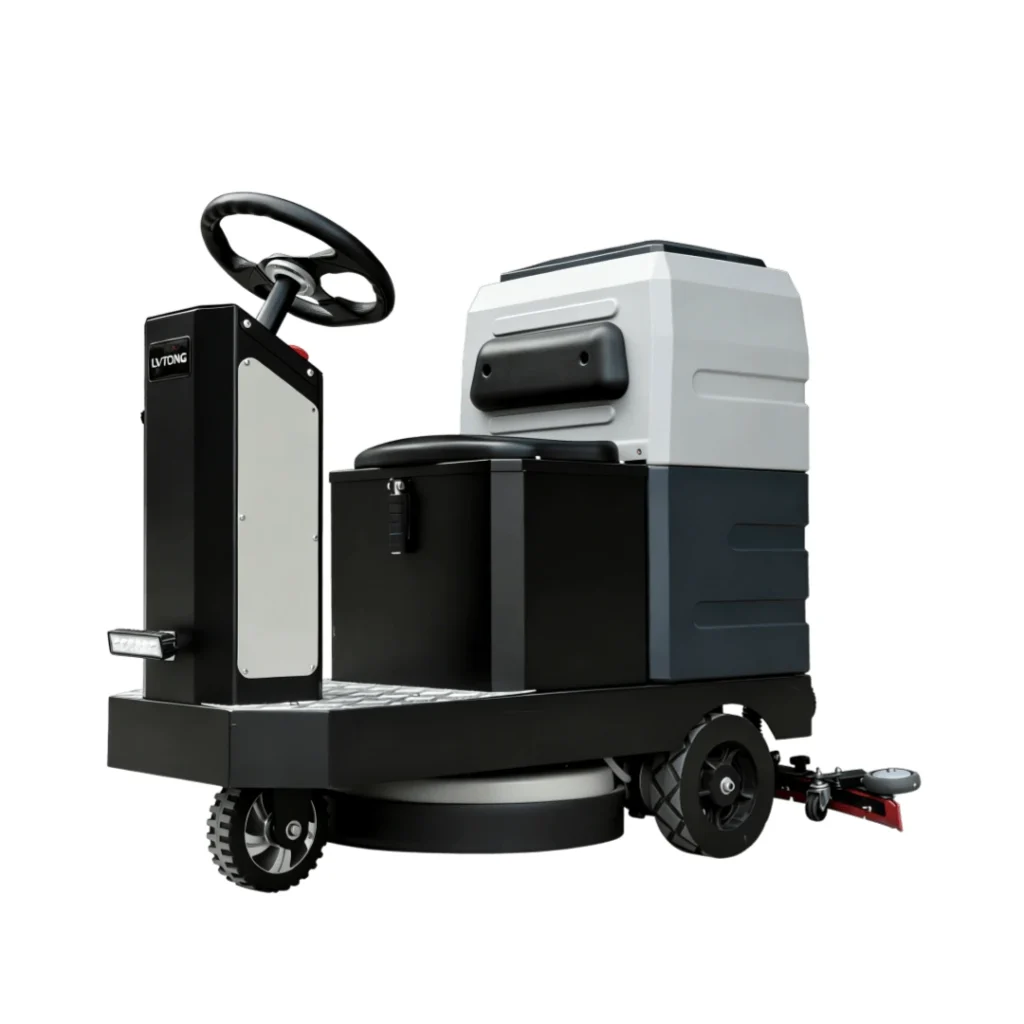
An industrial floor scrubber is generally more suitable for large factories, warehouses, logistics centers, parking garages, and facilities that require high productivity or frequent cleaning.
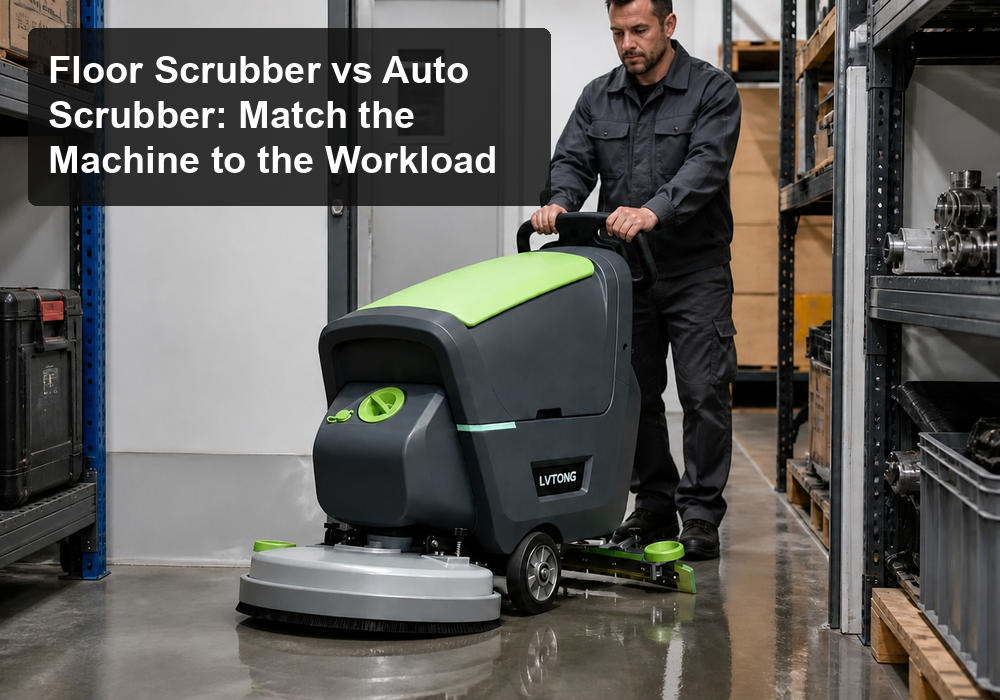
An electric floor scrubber is often better for smaller or medium-sized commercial spaces where maneuverability, ease of operation, compact dimensions, and lower initial investment are more important.
Before buying, compare:
- Cleaning area per shift
- Floor type
- Soil level
- Cleaning frequency
- Required operating time
- Battery runtime
- Tank capacity
- Aisle width
- Water recovery
- Operator requirements
- Maintenance and service support
- Total cost of ownership
The right floor scrubber is the machine that can complete the required cleaning route reliably with the least unnecessary downtime.
What Is a Floor Scrubber and How Does It Work?
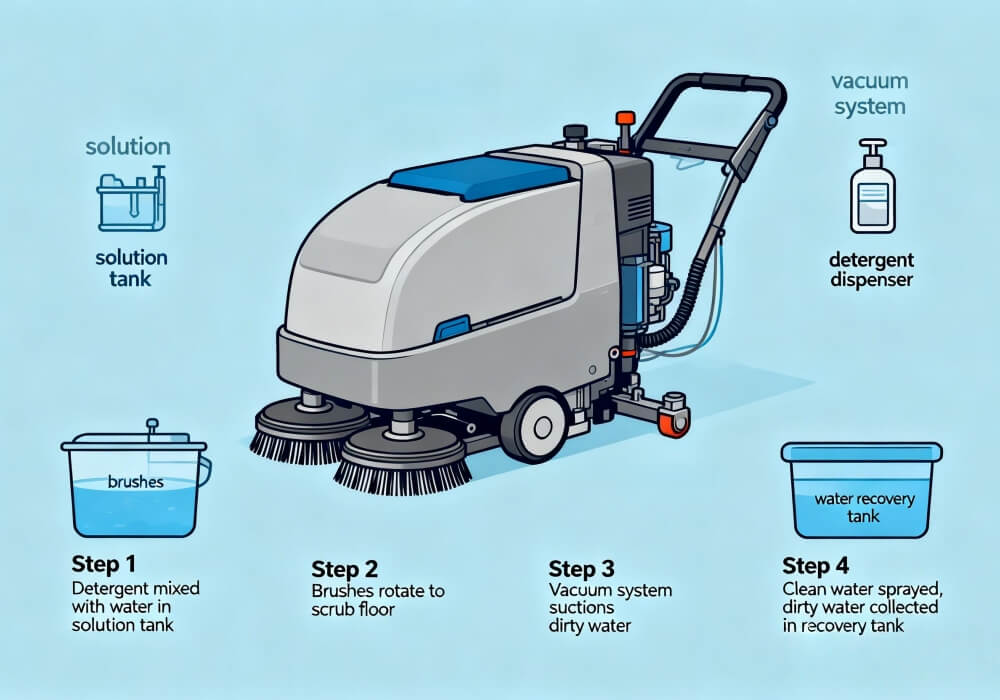
A floor scrubber is a professional floor cleaning machine that combines water, cleaning solution, brushes or pads, and a vacuum recovery system.
Unlike traditional mopping, a floor scrubber can wash, scrub, collect dirty water, and leave the floor significantly drier in one cleaning process.
A typical cleaning cycle works as follows:
- Clean water or cleaning solution is delivered to the floor.
- Rotating brushes or pads loosen dirt and contamination.
- A squeegee collects dirty water behind the scrub deck.
- The vacuum system transfers the wastewater into the recovery tank.
This process can improve cleaning consistency, reduce manual labor, and help facilities clean larger floor areas more efficiently.
Step 1: Evaluate Your Cleaning Area
The first step in learning how to choose a floor scrubber is understanding how much floor must actually be cleaned.
Do not base the decision only on the total building size.
A 20,000 m² warehouse may only require selected aisles to be cleaned daily, while a smaller factory may require several cleaning passes because of oil, dust, tire marks, or production residue.
Small and Medium Cleaning Areas
For environments such as:
- Offices
- Clinics
- Retail stores
- Schools
- Restaurants
- Small commercial buildings
a compact or electric floor scrubber may provide enough productivity.
Advantages can include:
- Easier maneuverability
- Smaller storage requirement
- Simpler operation
- Lower initial investment
- Better access to narrow areas
Large Industrial Areas
For:
- Factories
- Warehouses
- Manufacturing plants
- Logistics centers
- Parking garages
- Large commercial facilities
an industrial floor scrubber is often more suitable.
These applications typically require:
- Higher practical productivity
- Larger solution and recovery tanks
- Longer operating periods
- Stronger cleaning performance
- Reduced refill and dumping frequency
The machine should be sized around the real cleaning route rather than the building area alone.
Step 2: Consider Cleaning Frequency and Operating Hours
Cleaning frequency has a major impact on machine selection.
A floor scrubber used once or twice per week has very different operating requirements from a machine used every day or across multiple shifts.
High-Frequency Cleaning
Facilities such as factories, distribution centers, busy warehouses, and transportation sites may require:
- Daily operation
- Long cleaning routes
- Multiple cleaning cycles
- Higher machine utilization
- Reliable battery performance
- Reduced downtime
In these conditions, an industrial or heavy-duty machine may provide better long-term value.
Occasional or Flexible Cleaning
Smaller facilities may prioritize:
- Compact dimensions
- Easy storage
- Simple controls
- Flexible cleaning schedules
- Lower acquisition cost
An electric floor scrubber can be more practical in these applications.
Step 3: Compare Industrial and Electric Floor Scrubbers
The terms “industrial” and “electric” can overlap because many industrial floor scrubbers are also battery-powered or electrically driven.
For purchasing purposes, however, buyers often use these terms to distinguish larger, heavy-duty machines from more compact electric cleaning equipment.
The comparison below focuses on that practical distinction.
| Factor | Industrial Floor Scrubber | Electric Floor Scrubber |
|---|---|---|
| Typical application | Factories, warehouses, logistics centers | Offices, shops, hospitals, schools |
| Cleaning area | Large | Small to medium |
| Cleaning frequency | Daily / high frequency | Occasional to daily |
| Productivity | Higher | Moderate |
| Tank capacity | Usually larger | Usually smaller |
| Maneuverability | Best in larger spaces | Better in tighter areas |
| Storage requirement | Larger | Smaller |
| Initial investment | Usually higher | Usually lower |
| Operator training | More important | Often simpler |
| Best advantage | High productivity and capacity | Flexibility and accessibility |
This comparison should be used as a starting point, not as an absolute rule.
If you are also deciding between compact, walk-behind, stand-on, ride-on, or robotic configurations, compare the main types of floor scrubbers before selecting the machine format.
A compact machine can still be used in an industrial environment if the cleaning route is small or highly congested, while a larger commercial building may justify a ride-on scrubber if the floor area is extensive.
Step 4: When Should You Choose an Industrial Floor Scrubber?
An industrial floor scrubber is designed for demanding cleaning environments where productivity, capacity, and reliability are important.
Typical Applications
Industrial models are commonly used in:
- Manufacturing plants
- Warehouses
- Logistics centers
- Distribution facilities
- Parking garages
- Transportation hubs
- Large commercial buildings
Main Advantages
Higher Cleaning Productivity
Industrial machines can clean larger areas in less time, especially when used on open floors with long cleaning routes.
Larger Tank Capacity
Larger solution and recovery tanks can reduce the time spent refilling clean water and emptying wastewater.
Better Suitability for Frequent Use
Machines designed for demanding applications are generally better suited to repeated daily operation.
Reduced Manual Cleaning Labor
Higher productivity can allow cleaning teams to cover larger areas with fewer manual passes.
Possible Limitations
Industrial machines can also involve:
- Higher initial investment
- Larger storage requirements
- More operator training
- More complex maintenance
- Higher replacement-part costs
For this reason, a large industrial machine is not always the best choice for every facility.
Step 5: When Should You Choose an Electric Floor Scrubber?
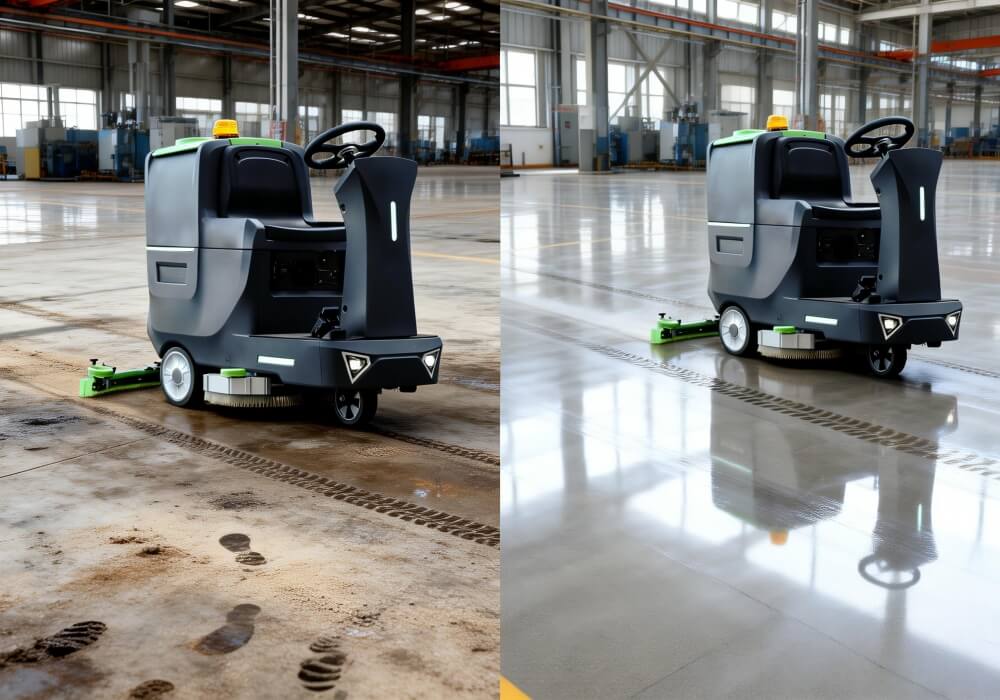
An electric floor scrubber is often suitable when flexibility and maneuverability are more important than maximum coverage.
Typical Applications
Electric floor scrubbers are commonly used in:
- Hospitals
- Schools
- Offices
- Retail stores
- Shopping centers
- Clinics
- Restaurants
- Smaller warehouses
Main Advantages
Easier Maneuverability
Compact electric models can work more efficiently around:
- Tight corners
- Shelving
- Furniture
- Narrow aisles
- Pedestrian areas
Easier Operation
Many smaller machines have straightforward controls and require less operator training.
Lower Initial Investment
For facilities with modest cleaning requirements, a smaller electric machine may provide a more economical solution.
Possible Limitations
Depending on the machine, limitations may include:
- Smaller tanks
- Shorter cleaning routes between refills
- Lower practical productivity
- Lower suitability for very demanding industrial contamination
- More operator walking time
The correct choice depends on actual operating conditions rather than machine category alone.
Step 6: Match the Machine to the Floor Type
Floor type affects brush selection, pad choice, pressure, water flow, and cleaning solution.
Concrete Floors
Concrete is common in factories, warehouses, and parking facilities.
Consider:
- Soil level
- Surface roughness
- Tire marks
- Oil contamination
- Appropriate brush or pad
- Water recovery
Heavily contaminated concrete may require stronger scrubbing action than smooth commercial floors.
If concrete is your primary floor surface, our guide to scrubbing concrete floors explains brush and pad selection, cleaning procedures, soil conditions, and common mistakes in more detail.
Tile Floors
Tile is common in:
- Hospitals
- Shopping centers
- Schools
- Retail environments
Important considerations include:
- Grout condition
- Brush or pad compatibility
- Solution flow
- Water pickup
- Floor finish
Epoxy Floors
Epoxy floors are common in industrial facilities.
The machine should use a brush or pad and pressure setting suitable for the coating.
Excessive aggression can reduce floor-finish life, while insufficient scrubbing can leave contamination behind.
Marble and Other Sensitive Floors
Polished surfaces may require:
- Softer pads
- Controlled pressure
- Appropriate detergent
- Strong water recovery
Always match the cleaning system to the floor manufacturer’s recommendations where applicable.
Step 7: Evaluate Practical Productivity, Not Just Theoretical Productivity
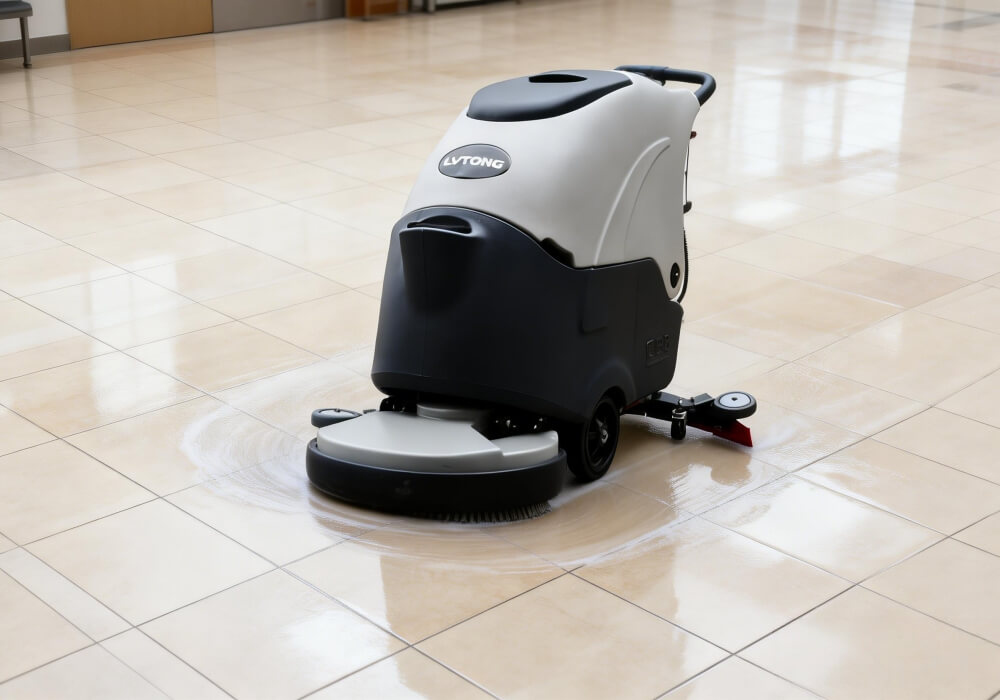
A specification sheet may list a high square-meter-per-hour cleaning rate.
However, real facilities include:
- Turns
- Obstacles
- Pedestrian traffic
- Forklifts
- Refilling
- Wastewater dumping
- Battery charging
- Operator stops
- Narrow aisles
- Repeated passes
Therefore:
Theoretical productivity is not the same as actual cleaning productivity.
To understand how cleaning width, brush performance, suction, battery capacity, and working efficiency affect real-world output, review our floor scrubber performance specifications guide.
When comparing models, ask:
- How much floor can the machine realistically clean per shift?
- How often must the tank be refilled?
- How often must wastewater be dumped?
- Can the machine complete the route on one charge?
- Can it turn efficiently in the available aisle width?
- Does it require repeated passes on difficult soil?
A slightly smaller machine may outperform a larger model if it fits the facility layout better.
Step 8: Check Battery Runtime and Charging Requirements
Battery performance is especially important for cordless floor scrubbers.
Before purchasing, compare:
- Manufacturer-rated runtime
- Cleaning time required per shift
- Charging time
- Available charging window
- Battery maintenance requirements
- Battery replacement cost
- Multi-shift requirements
A machine that cannot complete the required cleaning route without charging interruptions may create operational delays even if its cleaning performance is strong.
For multi-shift facilities, charging flexibility can become just as important as cleaning width.
For a deeper comparison of battery type, runtime, charging requirements, cycle life, and replacement considerations, see our floor scrubber battery life guide.
Step 9: Compare Tank Capacity
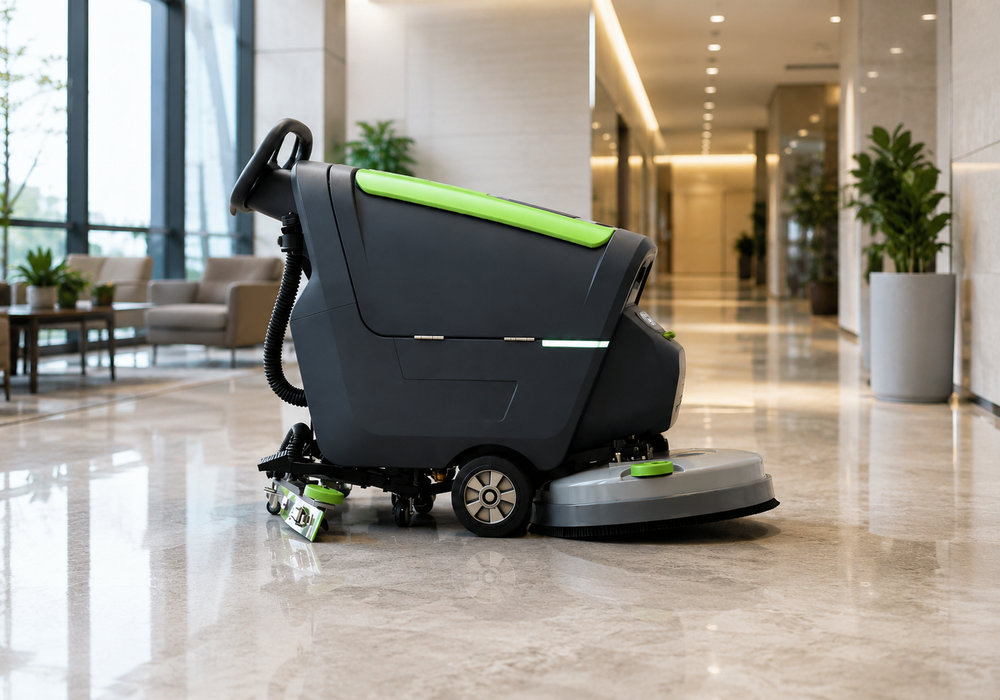
Larger tanks can reduce interruptions, but tank size should be evaluated together with machine dimensions and maneuverability.
A larger tank may be valuable in:
- Open warehouses
- Factories
- Large parking facilities
- Distribution centers
A smaller tank may be acceptable in:
- Offices
- Hospitals
- Retail areas
- Compact commercial facilities
especially when refill points are nearby.
Ask:
- How many times will the operator refill during one shift?
- How far is the water source?
- Where is wastewater disposed?
- Does a larger machine still fit the narrowest part of the route?
The best tank size is the one that reduces downtime without making the machine unnecessarily difficult to use.
Step 10: Evaluate Water Recovery and Floor Drying
Cleaning performance is not only about removing dirt.
The machine must also collect dirty water effectively.
Poor water recovery can result in:
- Wet trails
- Streaks
- Slip hazards
- Longer drying times
- Repeat cleaning
Check:
- Squeegee design
- Vacuum performance
- Recovery hose
- Tank sealing
- Water pickup during turns
For hospitals, shopping centers, factories, warehouses, and other occupied facilities, effective water recovery is especially important because traffic may return shortly after cleaning.
Step 11: Consider Total Cost of Ownership
Many buyers compare floor scrubbers only by purchase price.
That can be misleading.
A more useful comparison includes the total cost of ownership.
Initial Cost
Includes:
- Machine purchase
- Battery
- Charger
- Accessories
Operating Cost
Includes:
- Labor
- Electricity
- Water
- Cleaning chemicals
- Brushes and pads
- Squeegee blades
Maintenance Cost
Includes:
- Routine service
- Replacement parts
- Battery replacement
- Technician support
- Downtime
Productivity Value
A more productive machine may cost more initially but can reduce:
- Labor hours
- Cleaning time
- Repeat cleaning
- Operational interruptions
The least expensive machine is not necessarily the lowest-cost machine over its service life.
Step 12: Evaluate Maintenance and After-Sales Support
Machine performance also depends on serviceability.
Before choosing a supplier or model, ask:
- Are consumables easy to obtain?
- Are replacement parts available?
- Can operators replace brushes and squeegees easily?
- Is technical support available?
- Are manuals and troubleshooting information provided?
- Is operator training available?
- How are warranty and service issues handled?
For facilities that rely on daily cleaning, equipment downtime can cost more than the difference between two machine purchase prices.
Before purchasing, it is also useful to understand the routine service workload. Our commercial floor scrubber maintenance checklist covers daily, weekly, monthly, and periodic inspection tasks.
Industrial vs Electric Floor Scrubber: Pros and Cons
Industrial Floor Scrubber Pros
- Higher productivity
- Better for large areas
- Larger tank capacity
- Suitable for demanding cleaning schedules
- Can reduce labor requirements
Industrial Floor Scrubber Cons
- Higher investment
- Larger storage requirement
- More operator training
- Potentially higher maintenance costs
Electric Floor Scrubber Pros
- Flexible operation
- Compact design
- Easier maneuverability
- Lower initial investment
- Suitable for smaller facilities
Electric Floor Scrubber Cons
- Lower productivity on very large floors
- Smaller tanks
- May require more operator time
- Not every compact model is suitable for heavy industrial soil
Common Floor Scrubber Problems to Consider Before Buying
Even a well-selected floor scrubber requires regular inspection and maintenance.
Common operating problems can include:
Poor Cleaning Performance
Possible causes:
- Worn brush or pad
- Incorrect pressure
- Incorrect detergent
- Insufficient solution flow
Water Left Behind
Possible causes:
- Dirty or worn squeegee
- Blocked recovery hose
- Poor tank sealing
- Vacuum-system problem
Reduced Runtime
Possible causes:
- Battery condition
- Charging problems
- Loose electrical connections
- Increased operating load
Brush Not Operating Correctly
Possible causes:
- Debris
- Incorrect installation
- Mechanical fault
- Electrical fault
These issues should not automatically be interpreted as reasons to replace the machine. Proper troubleshooting can often identify a simpler underlying cause.
These issues should not automatically be interpreted as reasons to replace the machine. If a machine already shows poor water pickup, brush problems, power faults, or abnormal noise, use our floor scrubber troubleshooting guide to identify the affected system before replacing parts.
A Simple Floor Scrubber Selection Checklist
Before requesting a quotation, prepare the following information:
| Selection Factor | Information to Provide |
|---|---|
| Facility type | Factory, warehouse, hospital, mall, etc. |
| Cleaning area | Area cleaned per shift |
| Floor type | Concrete, tile, epoxy, marble, etc. |
| Soil type | Dust, grease, tire marks, spills |
| Cleaning frequency | Daily, weekly, multi-shift |
| Working hours | Available cleaning time |
| Narrowest aisle | Minimum machine access width |
| Battery requirement | Expected runtime |
| Charging window | Time available between shifts |
| Water source | Refill location |
| Wastewater disposal | Dumping location |
| Traffic | Pedestrians, forklifts, carts |
| Special requirement | Low noise, ramps, tight turns, etc. |
Providing this information allows a supplier to recommend a machine based on your actual workload rather than simply recommending a larger model.
Frequently Asked Questions
How do I choose the right floor scrubber?
Choose a floor scrubber based on cleaning area, floor type, cleaning frequency, required productivity, aisle width, battery runtime, tank capacity, maintenance requirements, and budget.
The best machine should complete the required cleaning route efficiently without excessive refilling, charging, or operator downtime.
Which floor scrubber is best for warehouses?
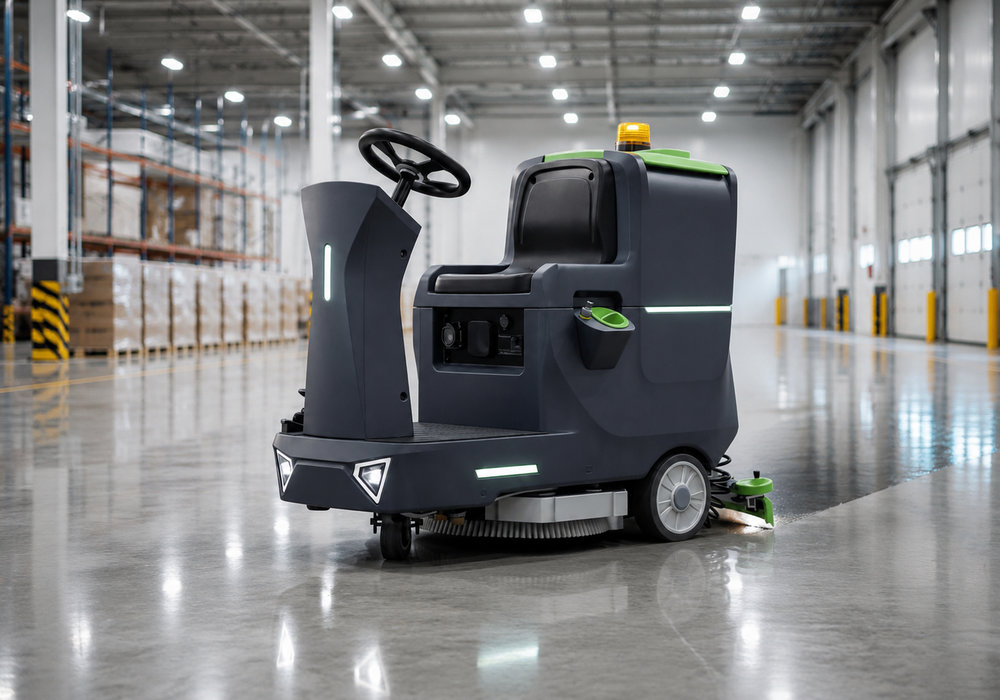
Large warehouses often benefit from industrial or ride-on floor scrubbers because they provide higher productivity and larger tank capacity.
However, warehouses with narrow aisles or dense racking may need a more compact machine.
The correct choice depends on actual floor area, aisle width, traffic, cleaning frequency, and charging requirements.
Is an electric floor scrubber suitable for commercial cleaning?
Yes.
Electric floor scrubbers are widely used in offices, hospitals, schools, shopping centers, retail stores, and other commercial environments.
Their suitability depends on cleaning area, floor conditions, runtime, maneuverability, and required productivity.
What size floor scrubber do I need?
The correct size depends on the area cleaned per shift, aisle width, obstacles, tank refill frequency, and available cleaning time.
Do not choose machine size based only on total building area.
What factors should I consider before buying a floor scrubber?
Important factors include:
- Cleaning area
- Floor type
- Cleaning frequency
- Practical productivity
- Cleaning width
- Tank capacity
- Battery runtime
- Water recovery
- Maneuverability
- Maintenance
- Parts availability
- After-sales support
Is a larger floor scrubber always better?
No.
Larger machines can improve productivity on open floors, but they may be inefficient in narrow aisles, elevators, congested areas, or facilities with many obstacles.
The best machine balances productivity with accessibility.
Should I choose a ride-on or walk-behind floor scrubber?
Ride-on machines are generally more suitable for large open areas and long cleaning routes.
Walk-behind machines are often better for smaller facilities, narrow aisles, and areas requiring frequent maneuvering.
The decision should be based on cleaning area, route layout, labor requirements, and available storage space.
How important is battery runtime when choosing a floor scrubber?
Battery runtime is important whenever the machine must complete a long cleaning route.
Compare expected runtime with the actual cleaning time required and the available charging window.
For multi-shift operation, charging flexibility becomes even more important.
Conclusion
Learning how to choose a floor scrubber means looking beyond machine size, price, or a single productivity figure.
The right floor scrubber should match your:
- Facility size
- Cleaning area per shift
- Floor type
- Soil conditions
- Cleaning frequency
- Working hours
- Aisle width
- Battery requirements
- Tank capacity
- Maintenance capability
- Budget
An industrial floor scrubber is often the better choice for large factories, warehouses, logistics centers, and demanding cleaning schedules.
An electric floor scrubber may provide better value when compact size, maneuverability, easier operation, and lower initial investment are more important.
The best machine is not automatically the most powerful one.
It is the machine that can complete your real cleaning route reliably, safely, and economically.
Need Help Choosing the Right Floor Scrubber?
If you are unsure which floor scrubber fits your facility, send LVTONG the following information:
- Facility type
- Cleaning area per shift
- Floor surface
- Soil condition
- Cleaning frequency
- Working hours
- Narrowest aisle
- Required battery runtime
- Available charging time
- Traffic conditions
LVTONG can use these operating conditions to help recommend a floor scrubber configuration that matches your actual cleaning requirements rather than simply selecting a machine by size or price.