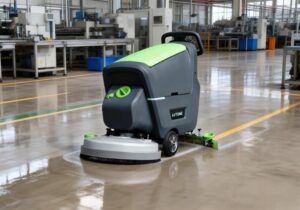
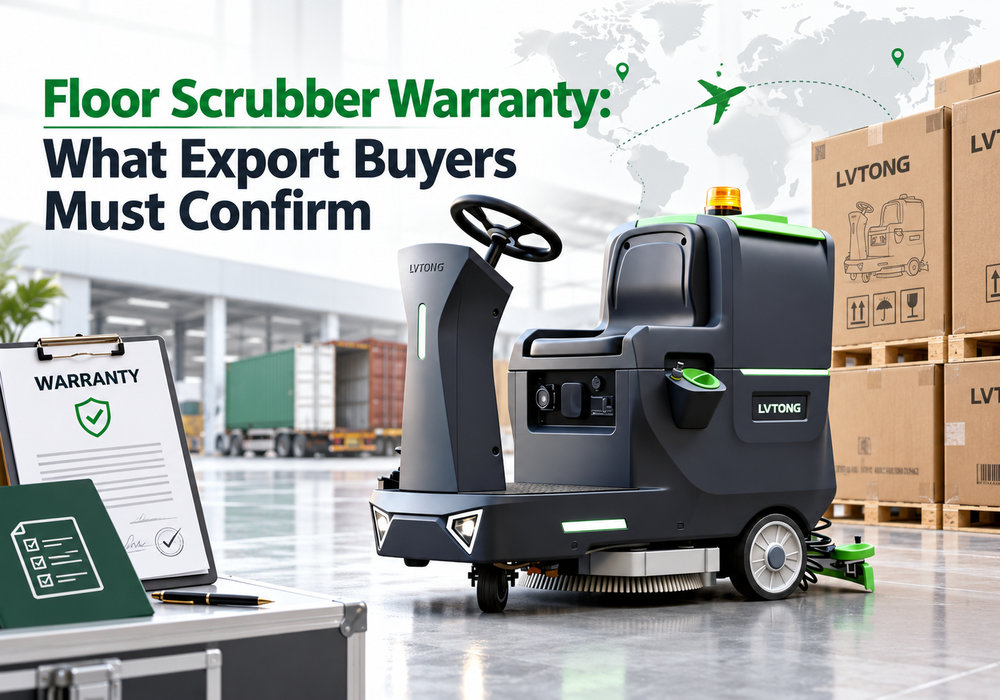
Choosing the best commercial floor sweeper requires more than comparing machine size or purchase price. The correct sweeper must match the facility layout, debris type, cleaning frequency, aisle width, dust-control requirements, available labor, and operating schedule.
Walk-behind sweepers provide close control and strong maneuverability in compact or divided spaces. Ride-on sweepers generally offer wider sweeping paths, larger hoppers, and greater operator comfort on long, open routes.
This guide explains the main types of commercial floor sweepers, compares ride-on and walk-behind machines, and provides a practical selection framework for warehouses, factories, retail facilities, workshops, and other commercial environments.
Quick Answer
A walk-behind commercial floor sweeper is usually the better choice for narrow, divided, or obstacle-heavy areas. A ride-on sweeper is generally more suitable for large, open routes where wider sweeping paths, larger hoppers, and reduced operator walking can shorten cleaning time. The final choice should be based on actual sweepable area, aisle width, debris type, dust-control requirements, hopper-emptying method, runtime, and labor cost—not total building size alone.

Which Commercial Floor Sweeper Is Best?
A walk-behind sweeper is generally the better choice for narrow, divided, or obstacle-heavy areas. A ride-on sweeper is usually more suitable for large, open, and continuous cleaning routes where wider sweeping paths, larger debris hoppers, and reduced operator walking can improve productivity.
However, facility size alone should not determine the decision. The best commercial floor sweeper is the machine that can complete the required route within the available time while controlling dust, collecting the expected debris, fitting through the narrowest access points, and remaining economical over its service life.
What Does a Commercial Floor Sweeper Do?
A commercial floor sweeper uses side brushes, a main broom, and a collection hopper to remove dry dust and loose debris from hard floors.
Depending on the machine design, it may collect:
- Dust and fine particles
- Sand and grit
- Leaves
- Paper and packaging fragments
- Wood chips
- Food crumbs
- Light metal particles
- General warehouse debris
Some powered models also use vacuum-assisted dust control and filtration to reduce airborne particles during sweeping.
A floor sweeper is not the same as a floor scrubber. A sweeper collects dry, loose material, while a scrubber applies water or cleaning solution, agitates the floor, and recovers dirty liquid. For a detailed comparison of cleaning methods, debris types, water use, and final floor conditions, see our guide to floor scrubbers vs floor sweepers. Sticky residue, grease, oil, and embedded soil normally require scrubbing rather than sweeping.
Main Types of Commercial Floor Sweepers
Commercial floor sweepers can be divided into three main operating categories:
- Manual push sweepers
- Powered walk-behind sweepers
- Ride-on sweepers
Each category addresses a different combination of floor area, operator effort, debris volume, and productivity.
Manual Push Sweepers
A manual push sweeper uses the motion of the wheels to drive the brushes. It does not normally require a battery or fuel system.
Manual sweepers are suitable for:
- Small workshops
- Garages
- Store entrances
- Short corridors
- Small parking areas
- Light daily debris
- Areas without convenient charging access
Their main advantages are simple operation, low maintenance requirements, compact storage, and relatively low initial cost.
However, manual sweepers depend on the operator’s walking speed and physical effort. They normally have smaller hoppers and less advanced dust-control systems than powered machines.
A manual push sweeper is most effective when the cleaning route is short and debris levels are moderate.
Powered Walk-Behind Sweepers
A powered walk-behind sweeper uses a battery or engine to drive the brush system and, in many models, the machine itself. The operator walks behind the equipment and controls its direction.
Powered walk-behind sweepers are commonly used in:
- Retail stores
- Schools
- Workshops
- Small and medium warehouses
- Production areas
- Narrow factory aisles
- Loading zones
- Commercial parking areas
Their main advantage is maneuverability. The operator remains close to the sweeping path and can navigate around racks, machinery, columns, displays, and other obstacles.
Walk-behind sweepers also require less turning and storage space than most ride-on machines.
Their main limitations are operator walking, smaller hopper capacity, and lower coverage on long, open routes. A large facility with many narrow aisles may still benefit from a walk-behind machine, while a smaller but completely open facility may be suitable for a compact ride-on sweeper.
Ride-On Floor Sweepers
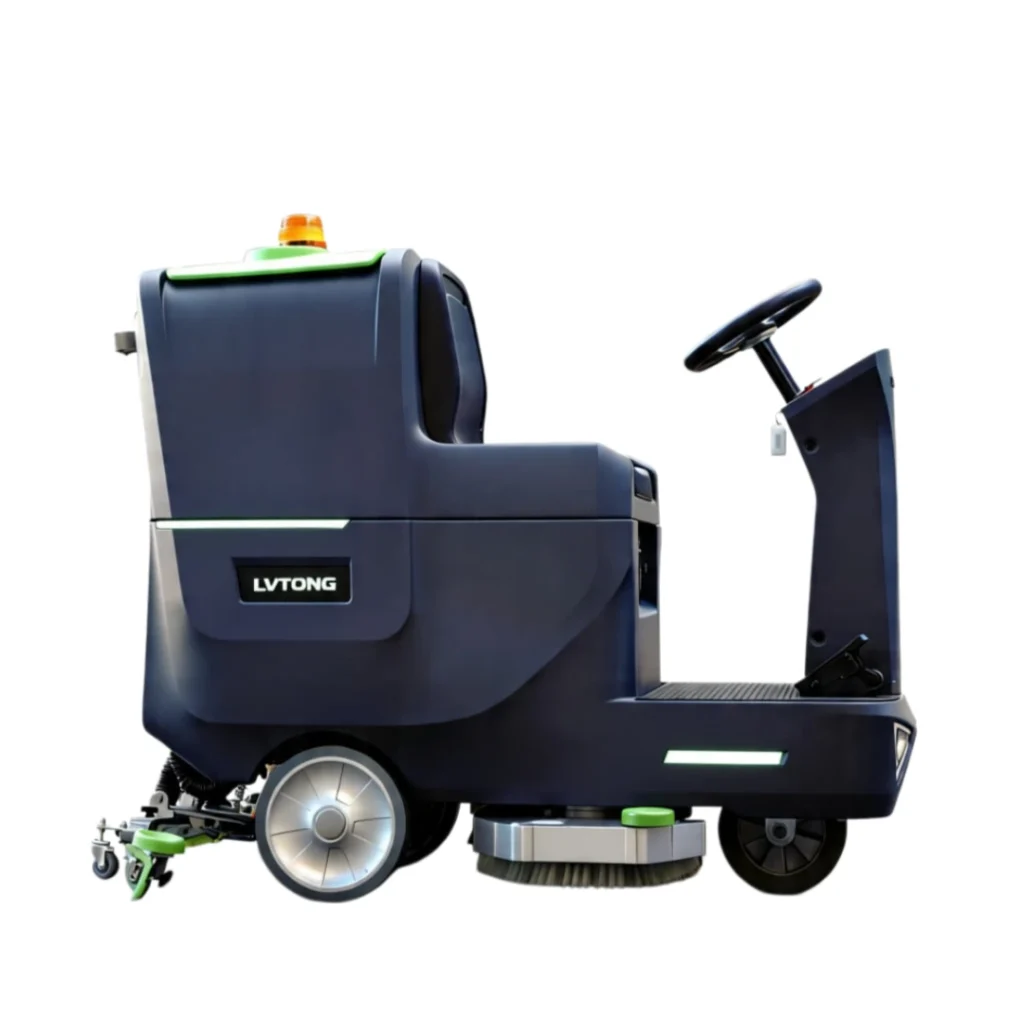
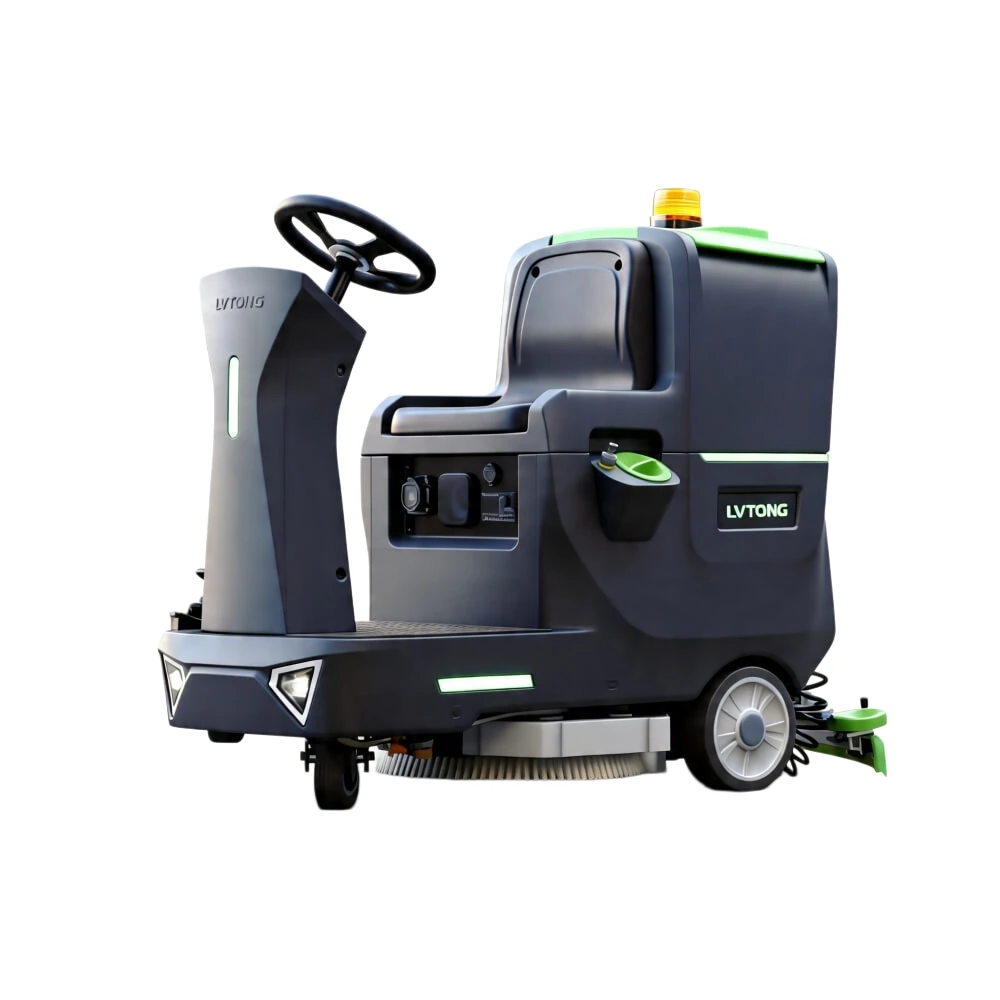
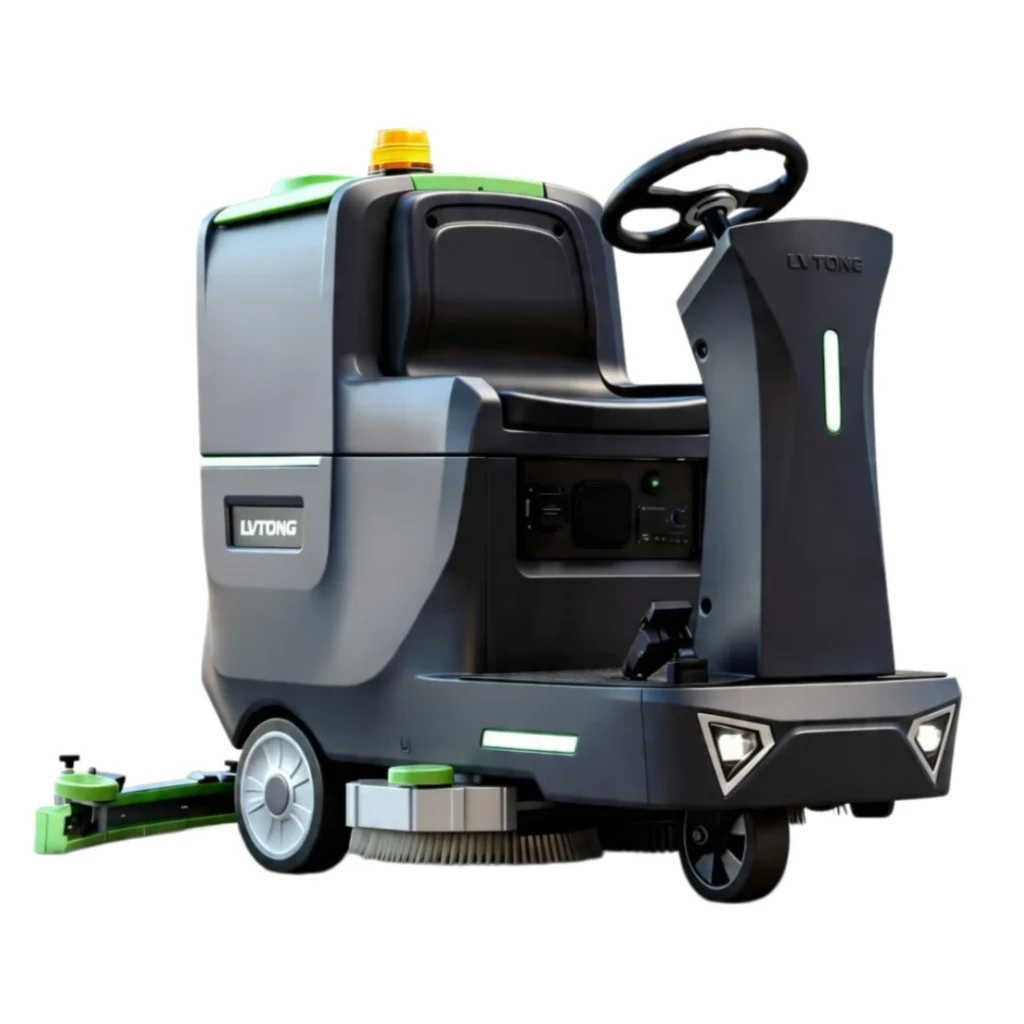
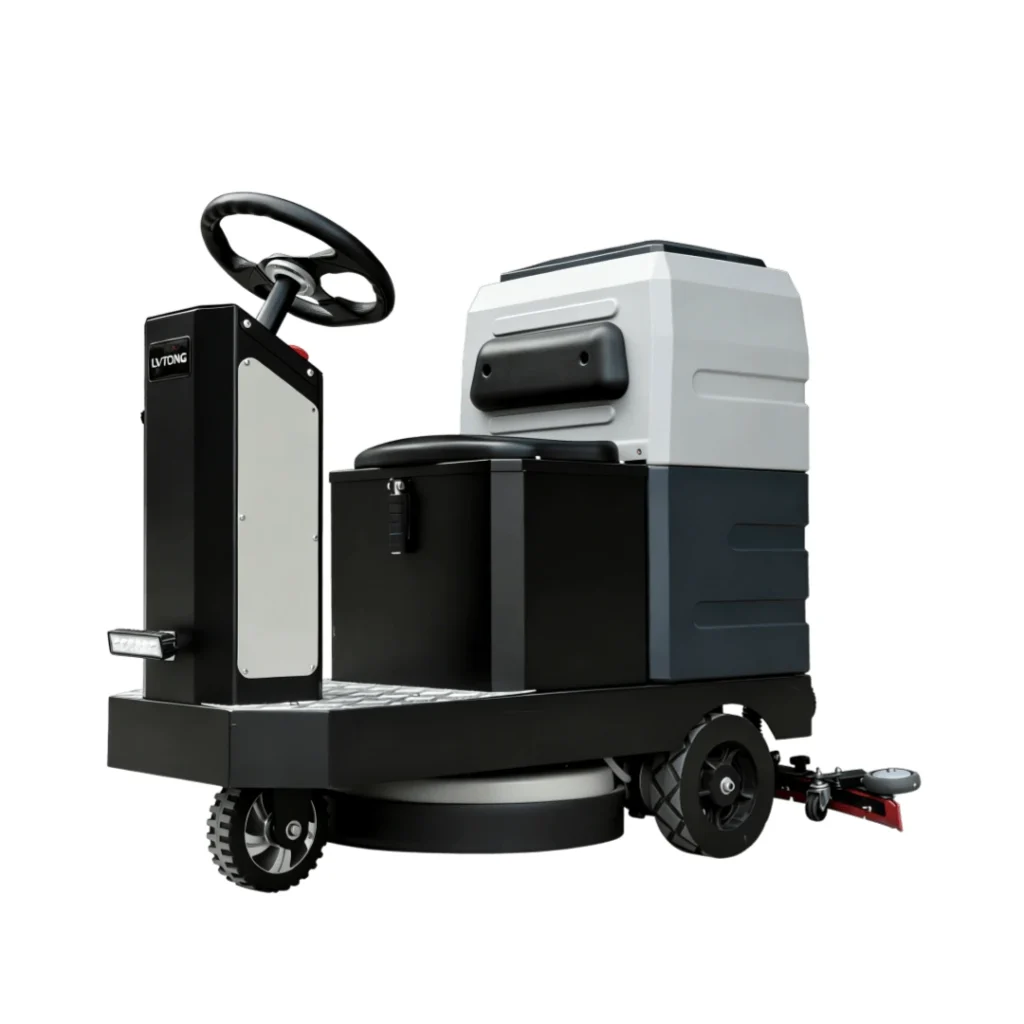
A ride-on floor sweeper allows the operator to sit and drive the machine. Ride-on models generally provide wider sweeping paths, larger collection hoppers, and higher travel speeds than walk-behind equipment.
They are commonly used in:
- Large warehouses
- Logistics centers
- Manufacturing plants
- Airports
- Distribution facilities
- Shopping centers
- Exhibition halls
- Parking facilities
- Outdoor industrial yards
The main advantage is productivity on long and continuous routes. The seated operating position also reduces the amount of walking required during extended shifts.
However, a ride-on sweeper requires adequate aisle width, turning space, storage, and charging or refueling infrastructure. It may be less effective in areas where the operator must repeatedly reverse, turn, or move around closely spaced obstacles.
Facilities with large or continuous cleaning routes can compare LVTONG ride-on sweeper models by sweeping width, hopper capacity, runtime, dust-control system, and intended application.

Ride-On vs Walk-Behind Sweeper: Quick Comparison
| Selection Factor | Walk-Behind Sweeper | Ride-On Sweeper |
|---|---|---|
| Best layout | Narrow, divided, or obstacle-heavy | Open, continuous, and long routes |
| Operator position | Walks behind the machine | Sits and drives |
| Maneuverability | High | Moderate in confined spaces |
| Sweeping path | Usually narrower | Usually wider |
| Hopper capacity | Usually smaller | Usually larger |
| Operator walking | Required | Minimal |
| Initial investment | Generally lower | Generally higher |
| Storage requirement | Lower | Higher |
| Long-shift comfort | Moderate | Higher |
| Best operational advantage | Control and access | Coverage and labor-hour reduction |
| Dust control | Depends on model and filter system | Depends on model and filter system |
| Hopper emptying | Often manual | Manual, assisted, or hydraulic depending on model |
Neither type is automatically better in every situation. The correct choice depends on how effectively the machine can operate within the actual cleaning route.
Operators who are new to seated sweeping equipment should review the ride-on sweeper operating guide before evaluating training, safety, brush adjustment, route planning, and daily operating requirements.
How to Choose the Best Commercial Floor Sweeper
1. Measure the Actual Sweeping Area
Do not select a sweeper using total building area alone.
A warehouse may include:
- Storage racks
- Offices
- Production machinery
- Carpeted sections
- Loading areas
- Restricted zones
- Spaces that require a different machine
Calculate the actual hard-floor area that must be swept during each cleaning cycle.
Also record:
- Cleaning frequency
- Available cleaning time
- Number of shifts
- Areas requiring repeated passes
- Distance between cleaning zones
- Time required to empty the hopper
A facility with a moderate total floor area but frequent sweeping requirements may justify a more productive machine than a larger facility cleaned only occasionally.
2. Measure Aisles, Doors, and Turning Space
Measure the complete cleaning route before selecting a machine.
Important dimensions include:
- Narrowest aisle
- Doorway width
- Elevator dimensions
- Space between racks
- Turning area at aisle ends
- Storage entrance
- Charging area
- Ramp width
- Loading-bay access
Compare these measurements with the machine’s:
- Total width
- Sweeping width
- Length
- Turning radius
- Height
- Side-brush extension
Do not use sweeping width alone. A machine may have a suitable cleaning path but still be unable to pass through a doorway or turn between storage racks.
3. Identify the Debris Type
Different debris places different demands on the broom, hopper, filtration system, and drive system.
Common commercial and industrial debris includes:
- Fine dust
- Sand
- Gravel
- Leaves
- Paper
- Plastic packaging
- Wood chips
- Food crumbs
- Metal shavings
- Pallet fragments
- Textile fibers
Fine dust requires effective filtration and vacuum-assisted dust control. Large or lightweight debris may require an adjustable front flap or large-debris collection feature.
Sharp metal objects, heavy stones, and wet or sticky material may require additional precautions or a different cleaning process.
Before purchasing, test the proposed machine with representative debris from the actual facility.
4. Evaluate Dust-Control Requirements
Sweeping can disturb fine particles and release them into the air if the machine does not have an effective dust-control system.
For indoor facilities, evaluate:
- Vacuum-assisted dust collection
- Filter surface area
- Filter material
- Filter-shaker system
- Side-brush dust control
- Sealing around the main broom chamber
- Optional high-efficiency filtration
- Filter access and cleaning requirements
Dust control is particularly important in:
- Warehouses storing packaged goods
- Food-related facilities
- Manufacturing plants
- Indoor parking structures
- Facilities with sensitive equipment
- Areas with employee or customer traffic
A wide sweeping path is not useful if the machine leaves airborne dust behind. For large sites that require vacuum-assisted dust collection, filtration, or outdoor sweeping, review our guide to industrial street sweepers and dust-control systems.
5. Compare Sweeping Width and Actual Productivity
Manufacturers often publish theoretical productivity based on sweeping width and travel speed.
Actual productivity is lower because real operations include:
- Turning
- Reversing
- Avoiding obstacles
- Moving between zones
- Emptying the hopper
- Cleaning the filter
- Repeating heavily soiled sections
- Inspecting the brushes
- Charging or refueling
- Operator breaks
A practical estimate should be based on the actual route rather than the maximum theoretical specification.
A larger ride-on sweeper may perform very efficiently on an open warehouse floor. The same machine may lose much of its advantage in narrow aisles requiring repeated turns.
A powered walk-behind sweeper may have a lower theoretical output but achieve better practical productivity in a divided layout.
6. Compare Hopper Capacity and Emptying Method
Hopper capacity affects how often the machine must stop.
However, capacity is not the only consideration. Also evaluate:
- Full hopper weight
- Hopper removal method
- Lifting height
- Operator strength required
- Dust exposure during emptying
- Use of wheels or handles
- Hydraulic dumping capability
- Dumping height
- Compatibility with waste containers
- Cleaning access
A very large manual hopper may become difficult to lift when full. In some facilities, a smaller hopper with an easy-empty design may be more practical.
For ride-on sweepers, hydraulic or high-dump systems may reduce manual handling, especially where collected debris must be emptied directly into industrial waste containers.

What Makes a Sweeper Easy to Empty?
An easy-emptying floor sweeper should allow the operator to remove debris without excessive lifting, bending, dust exposure, or machine disassembly.
Useful features may include:
- Ergonomic hopper handles
- Wheeled collection bins
- Low-lift removal
- Tool-free access
- Smooth internal hopper surfaces
- Dust-sealed hopper lids
- Hydraulic dumping
- High-dump capability
- Clear fill-level visibility
- Washable hopper components
When comparing machines, ask the operator to perform a complete hopper-emptying cycle.
The test should include:
- Removing or raising the hopper
- Carrying or moving it to the disposal point
- Emptying the debris
- Reinstalling the hopper
- Restarting the machine
This practical test may reveal differences that are not visible in a specification sheet.
Indoor vs Outdoor Commercial Sweepers
Indoor and outdoor environments create different requirements.
Indoor Sweeping
Indoor sweepers should prioritize:
- Low dust emissions
- Effective filtration
- Low noise
- Zero local exhaust emissions
- Compact turning
- Floor-marking prevention
- Safe operation around people and equipment
Battery-powered machines are commonly considered for enclosed facilities because they avoid local exhaust emissions.
Outdoor Sweeping
Outdoor sweepers may need:
- Higher traction
- Weather resistance
- Larger debris handling
- Stronger brooms
- Greater ground clearance
- Extended runtime
- Lighting and warning systems
- Dust suppression
- Ability to handle slopes or uneven surfaces
A machine designed mainly for smooth indoor floors may not be suitable for rough yards, uneven pavement, or heavy outdoor debris.
Confirm the manufacturer’s intended operating environment before purchase. Large distribution centers and logistics parks can also review LVTONG’s logistics cleaning equipment guide for warehouse floors, loading zones, parking areas, and outdoor transport routes.
Is a Ride-On Sweeper a Good Investment?
A ride-on sweeper can be a good investment when it reduces cleaning time and labor hours on large, continuous routes.
It may not provide the same return in narrow or congested facilities where the machine cannot use its full sweeping width or operating speed.
A simple investment analysis can use the following calculation:
Estimated Annual Labor Savings
Annual Labor Savings =
(Current Cleaning Hours − Projected Cleaning Hours)
× Labor Cost per Hour
× Annual Cleaning Cycles

For a warehouse-specific assessment of route coverage, labor requirements, dust control, and machine suitability, see [why warehouses use ride-on floor sweepers].
Simple Payback Period
Simple Payback Period =
Additional Equipment Investment
÷ Annual Net Savings
Annual net savings should account for:
- Labor-hour reduction
- Electricity or fuel
- Battery replacement
- Brushes
- Filters
- Tires
- Preventive maintenance
- Repairs
- Training
- Downtime
- Waste-disposal requirements
A reliable ROI calculation should use actual facility data rather than a general industry percentage.
Ride-On vs Walk-Behind Sweeper Cost
Walk-behind sweepers normally require a lower initial investment. They also require less storage space and may be simpler to transport between small cleaning zones.
Ride-on sweepers generally cost more because they may include:
- Larger batteries or engines
- Wider brush systems
- Larger hoppers
- Seated controls
- More complex drive systems
- Hydraulic dumping
- Advanced filtration
- Additional safety equipment
The correct cost comparison is not limited to purchase price.
Evaluate:
- Cost per cleaning hour
- Cost per square meter or square foot
- Operator labor
- Hopper-emptying time
- Filter-cleaning time
- Brush replacement
- Battery life
- Preventive maintenance
- Expected service life
- Parts availability
- Resale value
A lower-priced machine can become expensive if it requires significantly more labor or frequent downtime.
Best Sweeper Type by Facility
| Facility or Condition | Recommended Starting Type | Key Considerations |
|---|---|---|
| Small workshop | Manual or powered walk-behind | Debris type and storage |
| Retail store | Compact walk-behind | Noise, customers, and maneuverability |
| School corridor | Walk-behind | Safety, dust, and turning space |
| Narrow warehouse aisles | Powered walk-behind | Total width and turning radius |
| Medium open facility | Large walk-behind or compact ride-on | Route length and labor cost |
| Large warehouse | Ride-on | Hopper, filtration, and runtime |
| Manufacturing plant | Powered walk-behind or ride-on | Industrial debris and dust control |
| Logistics center | Ride-on | Continuous routes and operator hours |
| Indoor parking area | Ride-on | Dust, ramps, and ventilation |
| Outdoor yard | Outdoor-rated ride-on | Surface condition and weather |
| Mixed-layout facility | Combination fleet | Separate open and confined zones |
Airport facility teams can review LVTONG’s airport floor sweeper and cleaning equipment applications for terminals, freight areas, corridors, parking facilities, and other high-traffic zones.
Can One Facility Need More Than One Sweeper Type?
Yes. A combination fleet is often more effective than using one machine for every area.
For example:
- A ride-on sweeper can clean the main warehouse floor.
- A powered walk-behind sweeper can clean narrow aisles.
- A manual sweeper can handle small rooms or entrances.
- A floor scrubber can remove sticky residue after loose debris has been collected.
This approach allows each machine to operate in the environment where it is most effective.
A large ride-on machine should not be forced into confined areas, and a compact walk-behind unit should not be expected to clean an extensive open floor within an unrealistic time limit.
A mixed equipment fleet should follow a consistent inspection and support program. LVTONG’s cleaning equipment maintenance and service includes technical support, spare parts, troubleshooting, and after-sales assistance for sweepers and scrubbers.
LVTONG Commercial Floor Sweeper Options
LVTONG supplies commercial and industrial sweepers for different facility sizes, layouts, and debris conditions.
Walk-Behind Sweeper Options
Walk-behind sweepers are suitable for facilities requiring:
- High maneuverability
- Close operator control
- Narrow aisle access
- Compact storage
- Lower initial investment
- Short or divided cleaning routes
When comparing walk-behind models, evaluate whether the machine is manual, battery-powered, or self-propelled. These configurations differ significantly in productivity and operator effort.
1250 Ride-On Floor Sweeper
The LVTONG 1250 ride-on floor sweeper can be considered for facilities that need seated operation in a relatively compact ride-on format.
Potential applications include:
- Warehouses
- Workshops
- Commercial parking areas
- Retail facilities
- Manufacturing areas
Selection should be based on current sweeping width, hopper capacity, runtime, turning radius, filtration, and dumping specifications.
1950S Industrial Ride-On Sweeper
The LVTONG 1950S industrial ride-on sweeper is positioned for larger commercial and industrial sweeping routes.
It may be evaluated for facilities requiring:
- Wider coverage
- Longer operating periods
- Larger debris capacity
- Industrial dust collection
- Indoor or outdoor versatility
The correct configuration should be selected according to the debris type, surface condition, required filtration, and operating schedule.
LT-S2050SF Large Industrial Ride-On Sweeper
The LT-S2050SF large industrial ride-on sweeper is intended for high-coverage applications where cleaning routes are large, open, and continuous.
Potential applications include:
- Large warehouses
- Logistics hubs
- Manufacturing plants
- Distribution centers
- Industrial yards
Because product configurations can vary, buyers should compare the current specification sheet for sweeping width, practical productivity, hopper capacity, filter system, power source, runtime, and emptying method.

Common Mistakes When Choosing a Commercial Sweeper
1. Choosing by Building Size Alone
Total building area does not show how much floor must actually be swept or how complicated the route is.
2. Ignoring the Narrowest Access Point
A machine may fit the main floor but fail to pass through a doorway or turn at the end of an aisle.
3. Comparing Only Theoretical Productivity
Maximum square-meter or square-foot ratings do not include turning, hopper emptying, filter cleaning, or repeated passes.
4. Underestimating Fine Dust
A machine that collects visible debris but releases fine dust may create indoor air-quality problems.
5. Selecting the Largest Hopper Without Testing It
A large hopper may become difficult to remove or lift when full.
6. Comparing Purchase Price Only
Labor, filters, brushes, batteries, maintenance, and downtime can exceed the original price difference.
7. Using a Sweeper for Wet or Sticky Soil
Sweepers are primarily designed for dry loose debris. Grease, oil, and adhered soil generally require a scrubber or another treatment process.
8. Ignoring the Operator
Visibility, seat comfort, handle position, control layout, vibration, and emptying effort affect daily productivity.
Commercial Floor Sweeper Selection Checklist
Before requesting a quotation, collect the following information:
- Actual area swept per shift
- Cleaning frequency
- Narrowest aisle width
- Narrowest doorway
- Minimum turning space
- Indoor or outdoor operation
- Floor surface
- Debris type
- Debris volume
- Fine-dust requirements
- Required runtime
- Available charging or refueling area
- Preferred hopper-emptying method
- Available storage space
- Operator experience
- Target cleaning time
- Labor cost
- Maintenance support requirements
Providing this information allows the supplier to recommend a machine based on the real application rather than a general area estimate.
Frequently Asked Questions
What is the best commercial floor sweeper?
The best commercial floor sweeper is the machine that matches the facility’s layout, debris, dust-control requirements, available cleaning time, and labor model. Walk-behind sweepers are generally better for compact or divided spaces, while ride-on sweepers are usually more effective on long, open routes.
Should I choose a ride-on or walk-behind sweeper?
Choose a walk-behind sweeper when maneuverability and narrow access are priorities. Choose a ride-on sweeper when the route is large and open and reducing operator walking or cleaning time justifies the higher investment.
What size floor sweeper do I need?
The required size depends on actual sweeping area, aisle width, cleaning frequency, debris volume, hopper capacity, and available operating time. Total building area alone is not sufficient.
Is a ride-on sweeper worth the investment?
A ride-on sweeper may be worth the investment when labor-hour savings and higher practical productivity produce a reasonable payback period. The calculation should include maintenance, batteries or fuel, filters, brushes, and downtime.
What debris can a commercial floor sweeper collect?
Commercial sweepers can collect dry material such as dust, sand, leaves, paper, packaging fragments, wood chips, and general warehouse debris. Machine capability depends on the broom, hopper, intake design, and filtration system.
Which floor sweeper is best for fine dust?
A powered sweeper with vacuum-assisted dust control, effective chamber sealing, sufficient filter area, and a practical filter-cleaning system is generally preferable for fine dust. The exact filter specification should be matched to the facility’s air-quality requirements.
What makes a commercial sweeper easy to empty?
Useful features include ergonomic handles, wheeled hoppers, low lifting height, tool-free removal, hydraulic dumping, high-dump capability, and smooth hopper surfaces that release debris easily.
Can a floor sweeper remove oil or sticky stains?
No. A sweeper is primarily designed to remove dry, loose debris. Oil, grease, sticky residue, and embedded soil normally require a floor scrubber, detergent, or another surface-cleaning process.
Is a larger sweeper always more productive?
No. A larger machine can be highly productive on an open route but inefficient in narrow, divided, or obstacle-heavy areas. Practical productivity depends on how well the machine fits the layout.
Can one ride-on sweeper replace several walk-behind machines?
It may reduce the number of labor hours required on a large open floor, but there is no universal replacement ratio. The result must be calculated using actual route conditions, machine productivity, debris, and cleaning standards.
Can one facility use both ride-on and walk-behind sweepers?
Yes. A ride-on sweeper can clean large open areas, while a walk-behind machine handles aisles, corners, entrances, and congested zones. Mixed fleets are common in facilities with different cleaning environments.
Conclusion
Choosing the best commercial floor sweeper requires a structured comparison of route layout, debris, dust control, hopper capacity, operator requirements, productivity, and total cost.
Walk-behind sweepers provide strong maneuverability and close control in compact or divided spaces. Ride-on sweepers provide wider coverage, larger debris capacity, and reduced operator walking on long and open routes.
Do not rely on a single area threshold or theoretical productivity figure. Measure the actual cleaning route, test the machine with representative debris, evaluate the hopper-emptying process, and calculate operating cost using real labor and maintenance data.
To receive a suitable LVTONG sweeper recommendation, provide your floor area, narrowest aisle width, floor surface, debris type, cleaning frequency, required operating time, and indoor or outdoor conditions.
Contact LVTONG at cleaning@lvtong.com.cn to compare available commercial and industrial floor sweeper configurations.