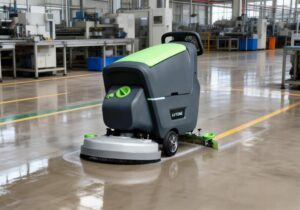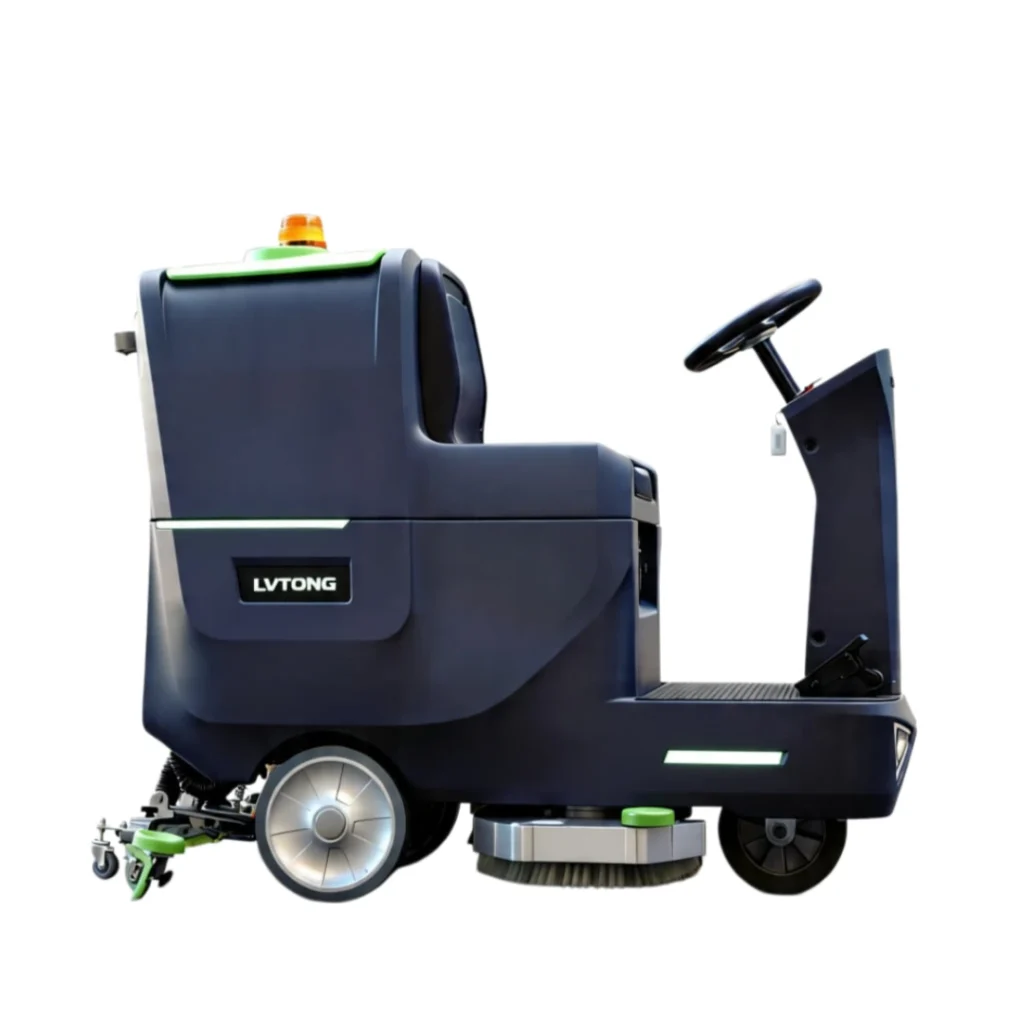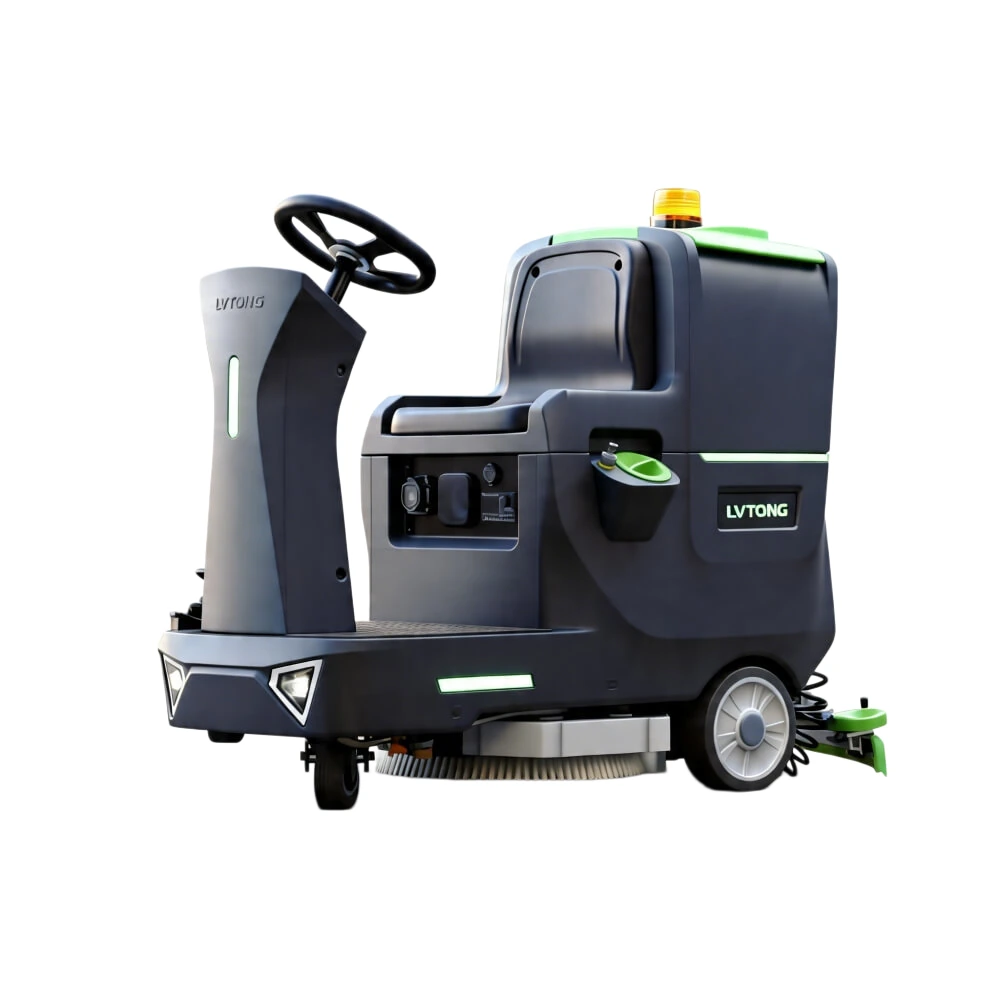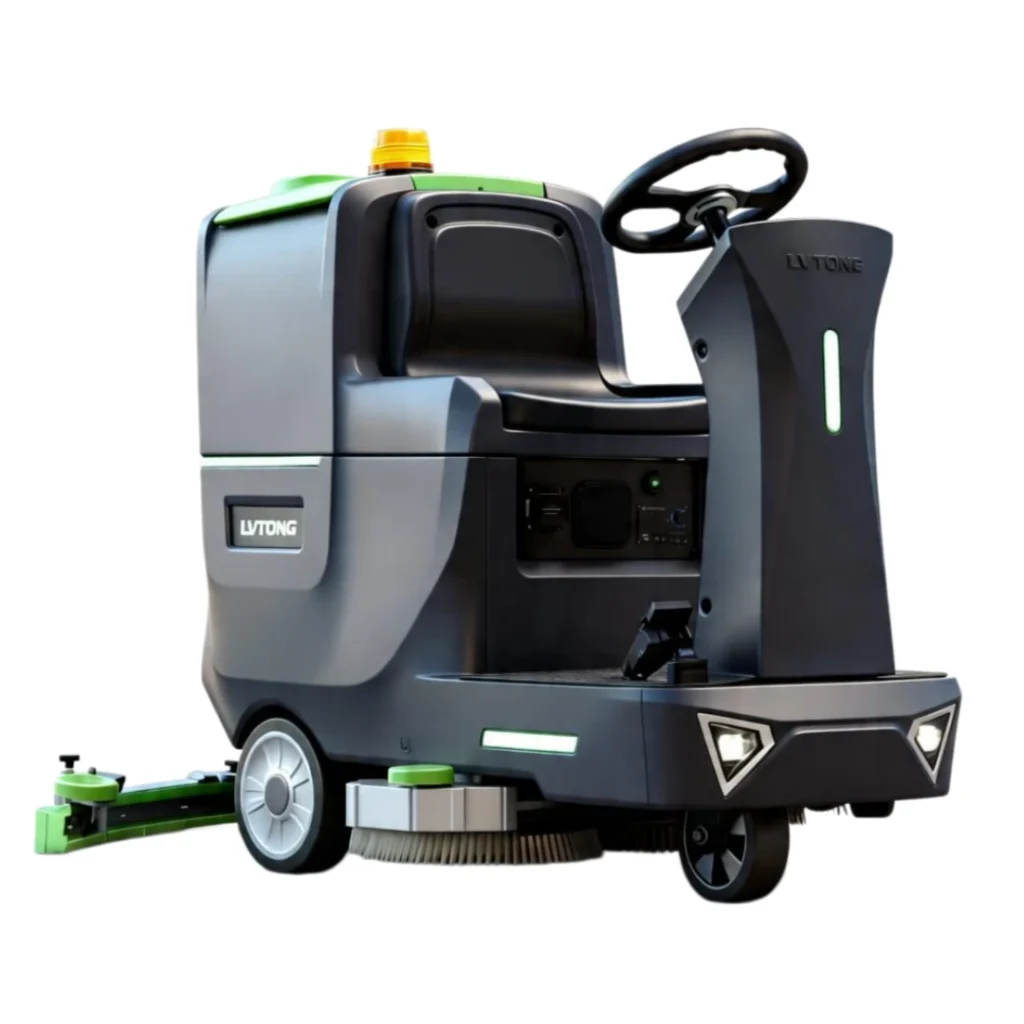


A battery powered floor sweeper replaces the cable reel, the fuel can and most of the manual pushing that traditional sweeping depends on. Because the entire machine runs on one lithium pack, the real purchase decision is not whether to choose battery power but how much runtime your site needs and where the recharge fits into the shift. This guide compares the four power routes, runs the runtime math on four published machine profiles, and closes with a six-line specification you can send to any supplier.
A battery powered floor sweeper is the right default for commercial sites above roughly 2,000 m², because battery power removes cable limits and exhaust rules while keeping a full shift on one charge.
- Runtime, not battery size, decides the purchase: published sweeper runtimes range from 3–5 hours on compact ride-on models to 5–8 hours on industrial ride-on sweepers.
- Lithium chemistry removes watering and equalizing routines and typically supports opportunity charging; verify cycle-life and charger compatibility per configuration.
- Runtime only pays when the hopper strategy matches it — a charged machine still stops when the hopper is full.
- Ask for the battery paperwork (cell and pack test reports, charger certificates) before signing, not after delivery.
The sections below stay on the power decision; the format choice and the specification-by-number purchase method are separate guides, linked where they belong.
What a battery powered floor sweeper actually replaces
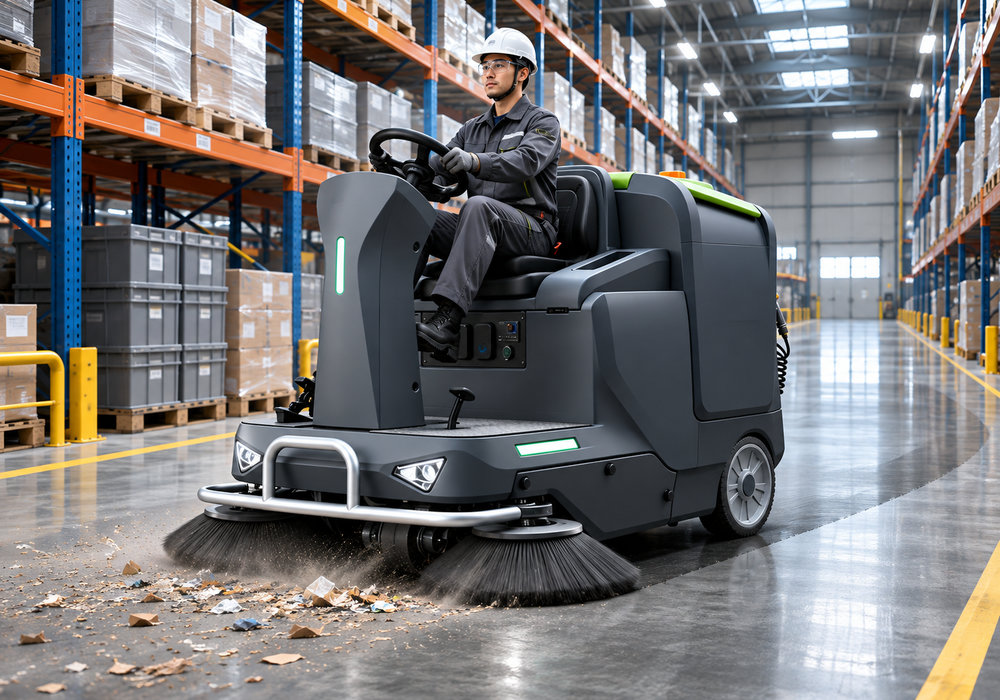
Battery power replaces three older power routes on commercial sweepers: human pushing, the mains cable and the on-board combustion engine.
Every commercial sweeping machine draws its power from one of four sources, and the route you pick decides the shift structure before any specification is read.
| Power route | Typical coverage class | Shift constraint | Where it fails |
|---|---|---|---|
| Manual push | Small rooms and tight corners | Operator stamina sets the pace | Above a few thousand m² per shift |
| Corded electric | Small indoor areas near outlets | Cable length and outlet positions | Open areas the cable never reaches; trip hazards |
| Fuel engine | Large outdoor lots | Fuel logistics and exhaust rules | Indoor use, emission-controlled zones, noise-sensitive hours |
| Battery (lithium) | 2,000 m² to 20,000+ m² per shift | Runtime window and charging window | Shifts longer than the runtime window without a planned recharge |
One declaration keeps the comparison honest: LVTONG builds lithium-battery machines only — no corded, no fuel sweeper. The routes above locate your current route, not our catalogue. A battery operated floor sweeper is a full machine category, and a compact electric floor sweeper machine with a small pack remains right for genuinely small sites.
The neighbouring electric-sweeper pages each stay in their lane: the industrial electric floor sweeper profile stays on one machine, the rent-versus-buy guide on ownership. This article owns the power-route decision.
Why sweeping duty cycles favor battery power
Sweeping is a coverage business: the machine must keep moving in long uninterrupted stretches, and that is exactly the duty profile battery power serves best.
Scrubbing work is interrupted by water logistics — refill stops, dump stops, squeegee checks. A sweeper has no solution tank, so those stops disappear and the bottleneck moves to two coupled limits: how long the pack lasts and how fast the hopper fills. Both limits are planned in hours, which is why the shift plan for a battery powered sweeper starts from hours, not watts, and why the battery is the scheduling core of the shift.
A battery powered sweeper also covers ground the other powered routes cannot: a 14,000 m²/h ride-on outruns any realistic cable reel within minutes, and fuel engines face indoor and emission restrictions. Battery power is the only route combining high coverage with indoor legality.
Lithium or lead-acid: the chemistry call behind the machine
For sweeping fleets the chemistry decision is mostly an operations decision: lithium removes watering, equalizing and full-discharge discipline from the daily routine.
Lead-acid packs need scheduled watering, equalizing charges and a ventilated charging room, and they penalize opportunity charging. Lithium packs drop those routines, accept partial charging in typical practice, and weigh less for the same energy. On a lithium battery floor sweeper, the daily routine shrinks to “plug in after the shift”.
Pack ratings are quoted per model — “24V 210Ah lithium pack” is a format example, not a spec this article can promise. The full chemistry framework is covered machine-agnostically in the battery selection guide; this article stays on the shift-level consequences.
Runtime math: matching hours to your site
Divide the area you must cover per shift by the machine’s effective coverage rate; if the result sits inside the published runtime window, one charge covers the shift.
Buyers keep asking how long the floor sweeper battery lasts on one charge; the honest answer is a published range plus your own arithmetic. Effective coverage is rated coverage derated for turning, overlaps and dump detours — plan at 50–70% of the rated figure.
| Machine (published specs) | Rated coverage | Published runtime | Hopper |
|---|---|---|---|
| 1250 ride-on floor sweeper | 8,500 m²/h | 3–5 h | confirm per configuration |
| LT-S1350S ride-on sweeper | 10,000 m²/h | confirm per configuration | 100 L |
| K2S-1950S industrial ride-on sweeper | 14,000 m²/h | 5–8 h | 160 L |
| LT-S2050SF industrial ride-on sweeper | 20,000 m²/h | 5–8 h | 180 L |
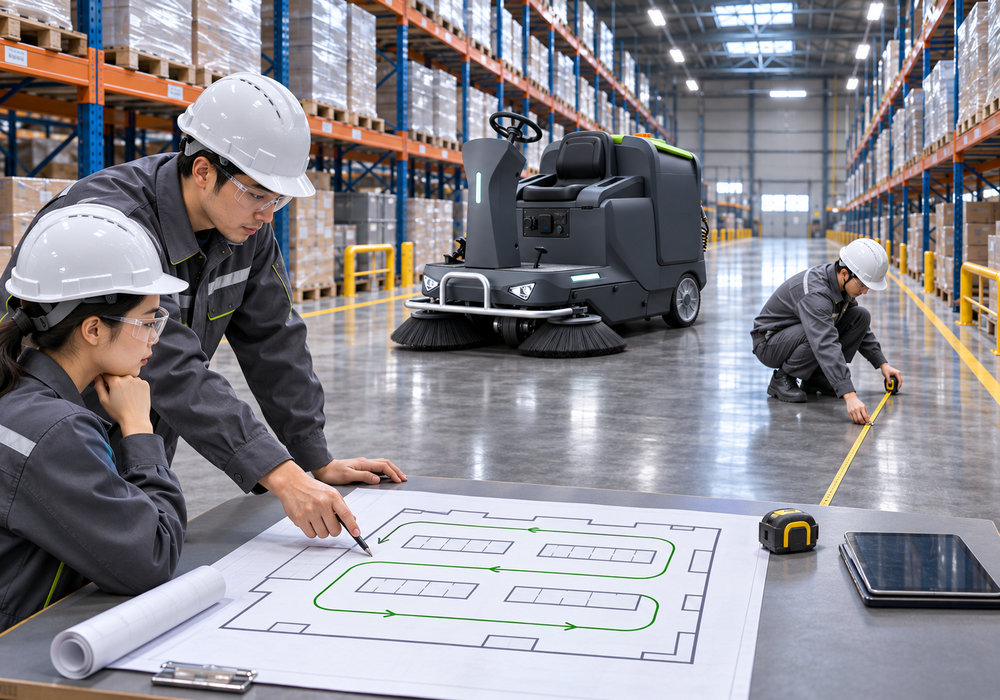
Worked example (illustrative): a 40,000 m² yard needs 40,000 ÷ (14,000 × 0.6) ≈ 4.8 hours — inside the K2S-1950S window, so one machine and one charge close the shift. At 60,000 m² the same math gives ≈ 7.1 hours, marginal: plan a mid-shift dump beside a charging point, a second shift, or the 20,000 m²/h machine. Run this arithmetic before comparing prices; it filters out machines impressive on datasheets and thin on your site.
Charging windows: plan the recharge around the shift
A sweeper that finishes at 14:00 must be charged before the next shift starts — the charging window is part of the schedule, not an afterthought.
Three rules cover most fleets. Overnight charging is the default: one machine, one charger, one off-shift window. Lithium packs typically accept opportunity charging during breaks, which can rescue a marginal runtime calculation — confirm that the charger and battery management system support it. Size the electrical supply before delivery day: charger input current ≈ output power ÷ (mains voltage × efficiency), so a representative 1.5 kW charger on 230 V draws roughly 7 A (illustrative) — one dedicated circuit, checked by an electrician.
The daily charging routine itself is the same across machine types and is laid out step by step in the charging operations guide.; this article stays on the sweeper-side window planning.
Hopper and runtime are coupled, not independent
Runtime only pays when the hopper strategy matches it: a fully charged machine with a full hopper stops sweeping anyway.
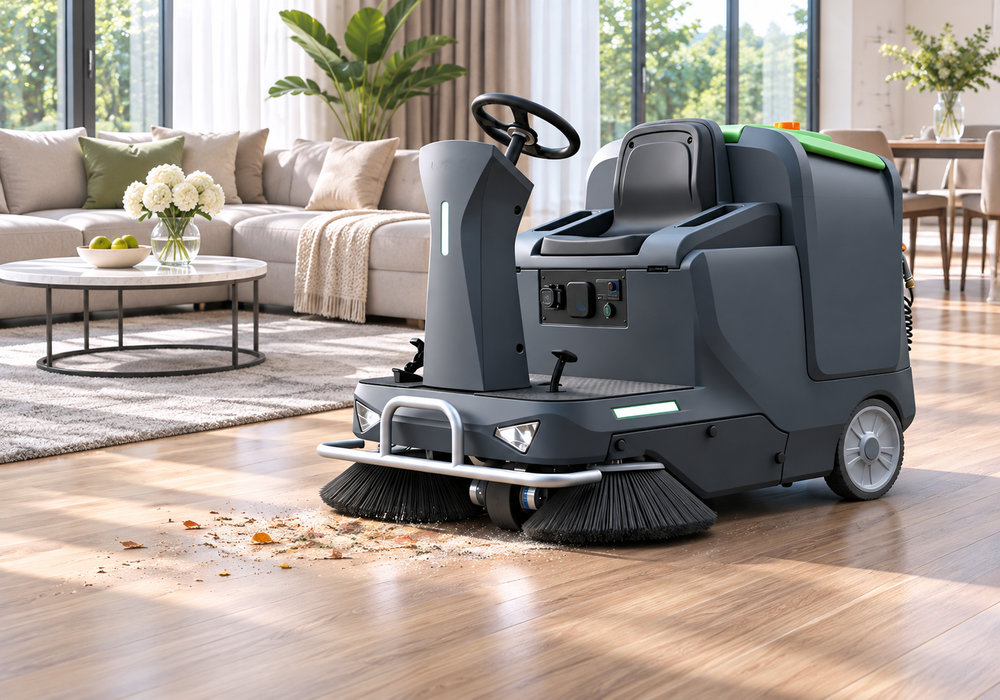
The published hopper volumes — 100 L, 160 L, 180 L on the industrial ride-on profiles above — set how much route fits between dump stops. Two site facts decide the coupling: dump-point distance and dump time. A five-hour runtime with a hopper that empties every forty minutes sends a growing share of the shift to the bin, and the effective coverage you planned quietly drops.
Practical rule: size the hopper so one full route between dump points fits inside it, and place the dump point inside the sweeping loop. The full number-by-number purchase method belongs to the professional floor sweeper selection guide — the specification layer on top of the power decision made here.
One ride-on or a crew of push sweepers
Above roughly 5,000 m² per shift, one battery ride-on sweeper usually replaces a multi-person push crew on labor cost, consistency and supervision alike.
Push machines are cheap per unit and slow per site: a push crew spreads coverage across operator stamina, and every absence reshapes the shift. A battery powered sweeper rated 8,500–20,000 m²/h concentrates the same work in one operator, and the runtime math above converts directly into labor hours saved (illustrative until you price your crew). Push machines keep real trade-offs — no charging infrastructure, tiny storage, no battery paperwork — and under a couple of thousand square meters they can win.
The six-factor format comparison is its own decision; use this section only for the labor-and-coverage angle, then take the format question to the dedicated walk-behind versus ride-on guide.
The six-line specification for a battery powered floor sweeper
Six lines in the purchase order remove most of the ambiguity around battery power: chemistry, pack rating, runtime target, charger, charge time and battery documents.
| Line | What to write | What to verify |
|---|---|---|
| 1. Battery chemistry | Lithium pack, chemistry stated | Cell brand and chemistry named in the quotation, not just “lithium” |
| 2. Pack rating | Voltage and capacity, e.g. 24V 210Ah class | Rating quoted per model; confirm against the runtime math, not the Ah number alone |
| 3. Runtime target | Hours needed on your site | Manufacturer confirms the published runtime window covers your derated math |
| 4. Charger and plug | Charger output, input current, plug standard per market | Input matches your circuits; plug conforms to the destination market’s standard (NEMA in North America and comparable bodies elsewhere) |
| 5. Charge time | Hours from planned end-of-shift state to full | Quoted per configuration; fits the window between shifts |
| 6. Battery documents | Test summaries and certificates listed by name | Cell/pack test reports and charger certificates issued by an accredited body such as UL; documents depend on model and target market |
Lines 1–3 reproduce the runtime math on paper, lines 4–5 decide whether the schedule survives a real shift, and line 6 is what customs, insurers and warranty claims ask for later.
Five mistakes buyers make with battery power
Most battery-power disappointments trace back to five avoidable mistakes, all preventable at specification time.
- Comparing battery size instead of runtime. A larger Ah number can still lose to a smaller pack on an efficient machine; the shift needs hours, not amp-hours.
- Leaving charge time out of the shift plan. A five-hour runtime with an eight-hour recharge cannot serve two shifts back to back.
- Assuming opportunity charging works by default. It is chemistry- and charger-dependent; get the confirmation in writing.
- Ignoring the hopper-runtime coupling. Runtime without dump-point planning produces a charged machine that stands still.
- Skipping the battery paperwork. The line-6 documents clear customs and support warranty claims; a battery sweeper bought without them is cheap on the invoice and expensive afterwards.
Charging area safety and certification paperwork
Charging areas and battery documents are the two compliance touchpoints of a battery sweeper fleet — both settled before delivery.
Set the charging area once: a dedicated space with clearances, no flammable storage, ventilation per the charger manual, and a reserved circuit. Fire-safety guidance for charging and battery storage is published by NFPA, and the machine-side electrical safety standard for powered floor machines is IEC 60335-2-72, available through the IEC webstore. For export shipments, add the battery transport documents to the same folder so the pack also clears the border without a second enquiry.
To have the runtime arithmetic checked against your own site numbers, send the area, debris profile and shift pattern through the contact page and the calculation comes back with machine options attached.
Frequently Asked Questions
How long does a battery powered floor sweeper run on one charge?
Published windows run from 3–5 hours on the compact 1250 to 5–8 hours on the industrial K2S-1950S and LT-S2050SF; the LT-S1350S window is confirmed per configuration. Re-check the floor sweeper battery against your derated coverage math, since a 5–8 h window can shrink at 60% effectiveness.
Is a battery operated floor sweeper practical for daily commercial use?
Yes — daily routes are what the category is built for. A lithium pack removes watering and equalizing, and a fixed charging window replaces fuel and cable logistics. Confirm the runtime window and opportunity-charging support per model.
Does a battery sweeper need a special charging room?
It needs a dedicated, ventilated charging area with clearances and its own circuit — the same discipline as any lithium-powered floor machine. Lead-acid fleets need stricter ventilation and watering; lithium removes most of that burden, but the area should still be fixed, marked and clear of storage.
What battery documents should an export buyer request?
Ask for the cell and pack test summaries, the charger certificate, and the transport documents accompanying lithium batteries; which apply depends on model and destination market, so request the list with the quotation and check it against the shipping papers.