Most wrong-machine purchases are class mistakes, not brand mistakes. The floor scrubber vs floor sweeper question reads like a product comparison; it is really a soil test. One machine lifts loose material off the surface and stores it dry. The other wets the surface, loosens what is stuck to it and pulls the dirty water back. Get that split wrong and every later decision — width, tank size, shift length — sits on the wrong base.

Short answer: the floor scrubber vs floor sweeper decision follows the soil, not the floor area. Loose, dry debris — dust, sand, grit, packaging fragments — belongs to a sweeper, which collects it dry at 8,500–20,000 m²/h with no water and no drying time. Bonded, wet soil — oil, grease, spills, tire marks, sticky residue — belongs to a scrubber, which applies solution, agitates it and recovers it behind a squeegee. Facilities that carry both run the two in sequence: sweep first, scrub second.
- Dry and loose → sweeper
- Bonded and wet → scrubber
- Both, in one pass → a combination machine, which is a separate specification
- Both, in sequence → two machines, one operator
Below: what each class can and cannot do, the eight differences, the soil matrix, and the cost lines.
What the Floor Scrubber vs Floor Sweeper Decision Really Turns On
The machine follows the soil: loose and dry goes to a sweeper, bonded and wet goes to a scrubber.
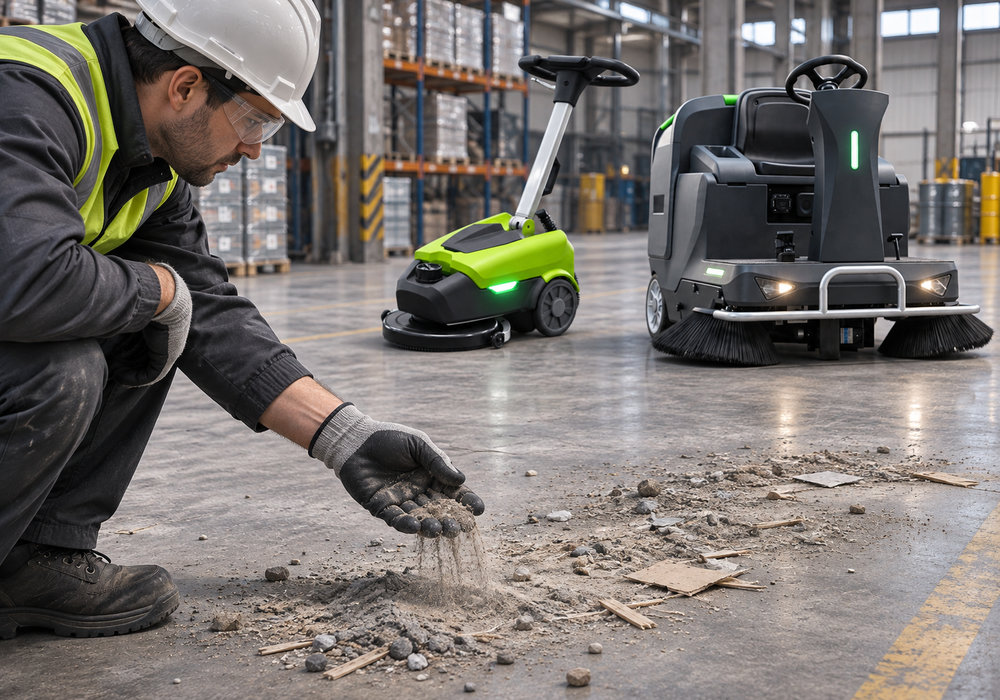
Run a hand test on three or four spots along the route. Pick up a handful. If it stays loose in your palm and moves with a breath, it is sweeper work — dust, sand, grit, packaging fragments, metal swarf. If it smears, darkens the surface or needs friction to shift, it is scrubber work — oil, grease, coolant, syrup, tire marks, food residue.
The second test is what happens after collection. A sweeper stores debris dry in a hopper and puts nothing back on the floor. A scrubber must lay water down, recover it, and leave a squeegee-dry edge, which means a solution tank, a recovery tank, a squeegee and a discharge point. Two waste routes, two operating disciplines.
What a Floor Scrubber Does That a Sweeper Cannot
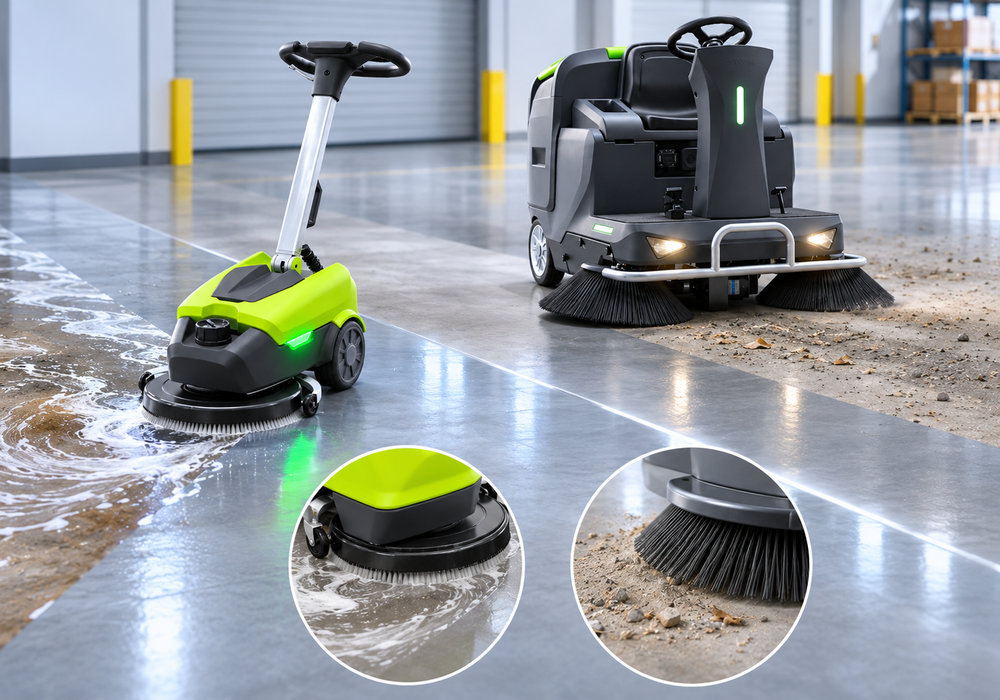
A scrubber is the only one of the two that removes soil bonded to the surface, because it applies chemistry, agitation and water before recovering the residue.
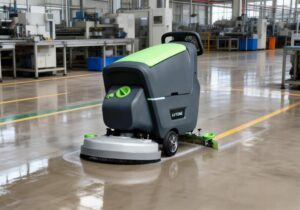
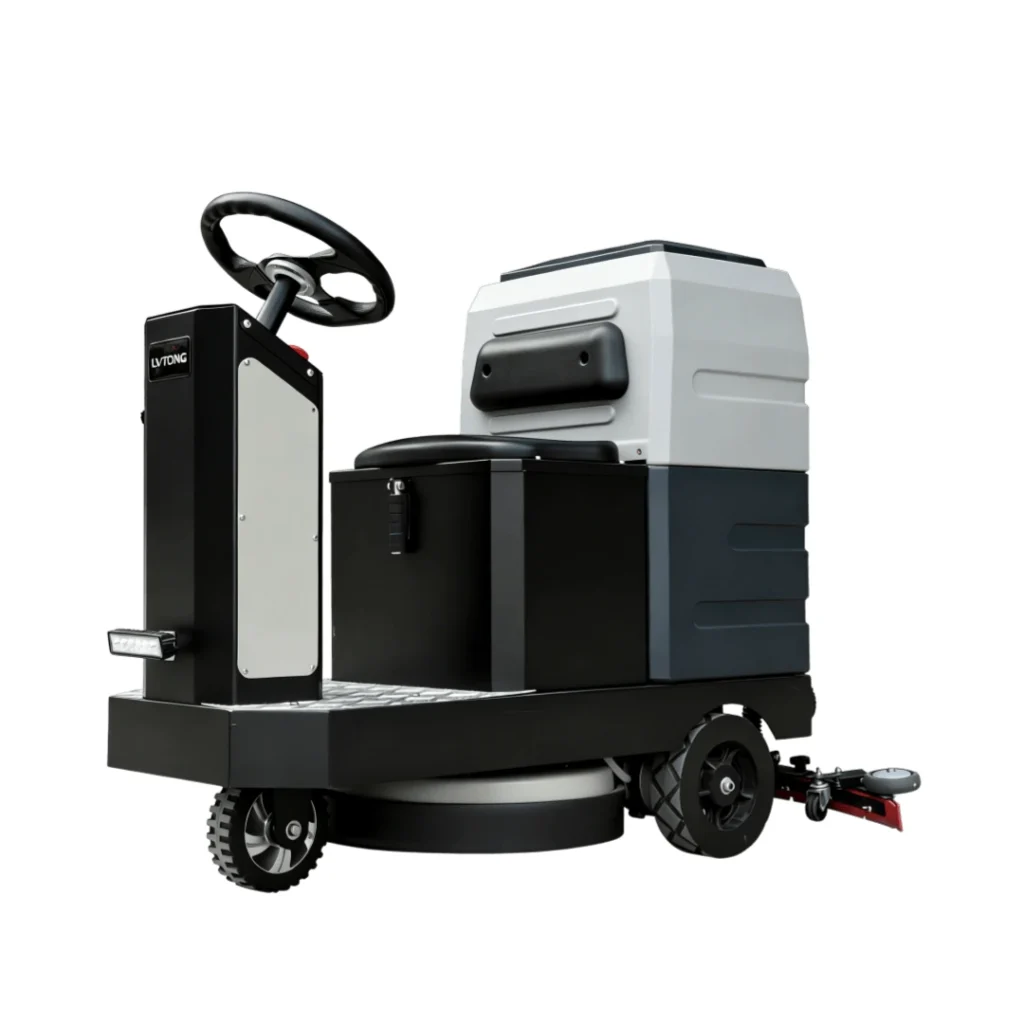
The sequence is fixed: solution meters onto the floor, the brush or cylindrical deck agitates the film, the squeegee lifts the dirty water, the recovery tank holds it. Because the machine controls all four steps, the result can be measured. A walk-behind unit such as the LT-S530X runs at 2,100 m²/h with 62 L of solution and a 65 L recovery tank, covering roughly 4,000 m² on one charge.
That water is also the limit: a scrubber needs a fill point, a discharge point and a drying window, and on a live floor the window usually binds first.
What a Floor Sweeper Does That a Scrubber Cannot
A sweeper moves volume: it clears loose debris at several times the hourly rate of a scrubber and never wets the floor.
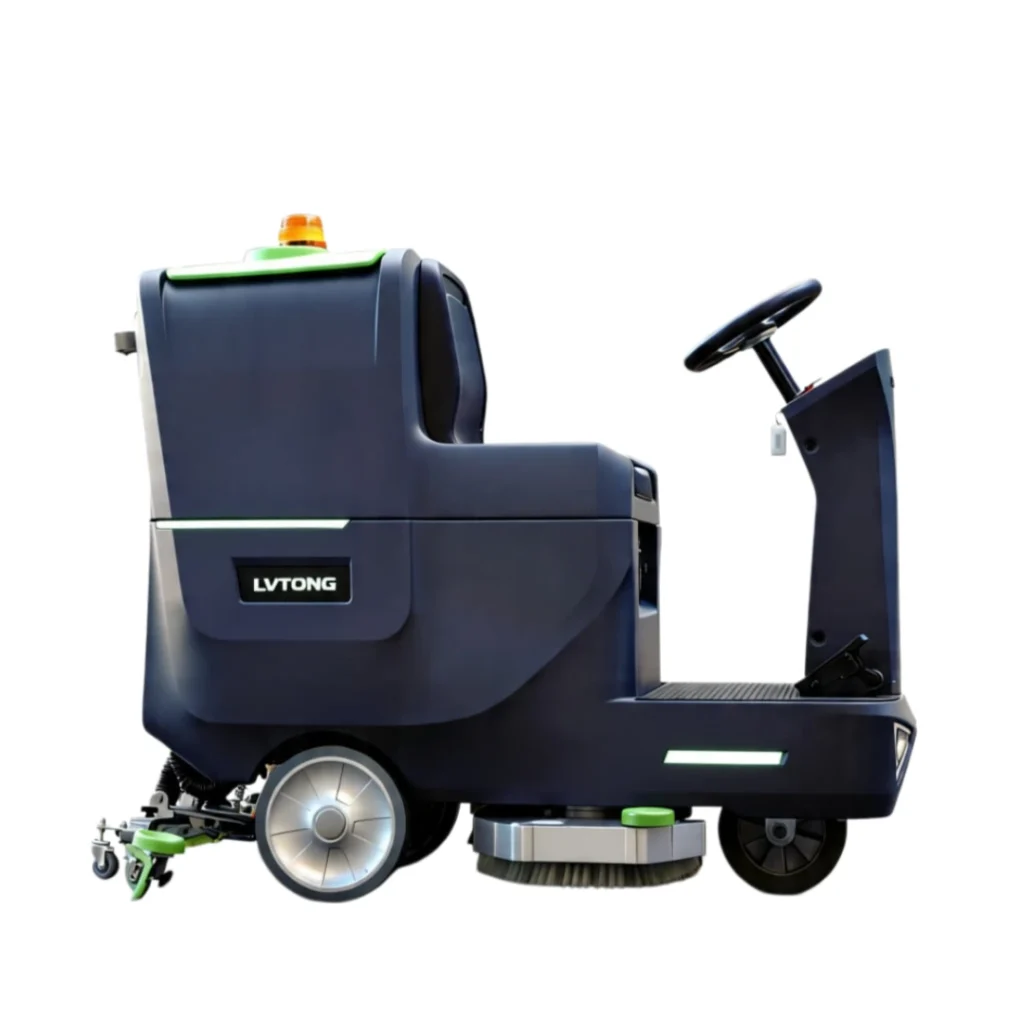
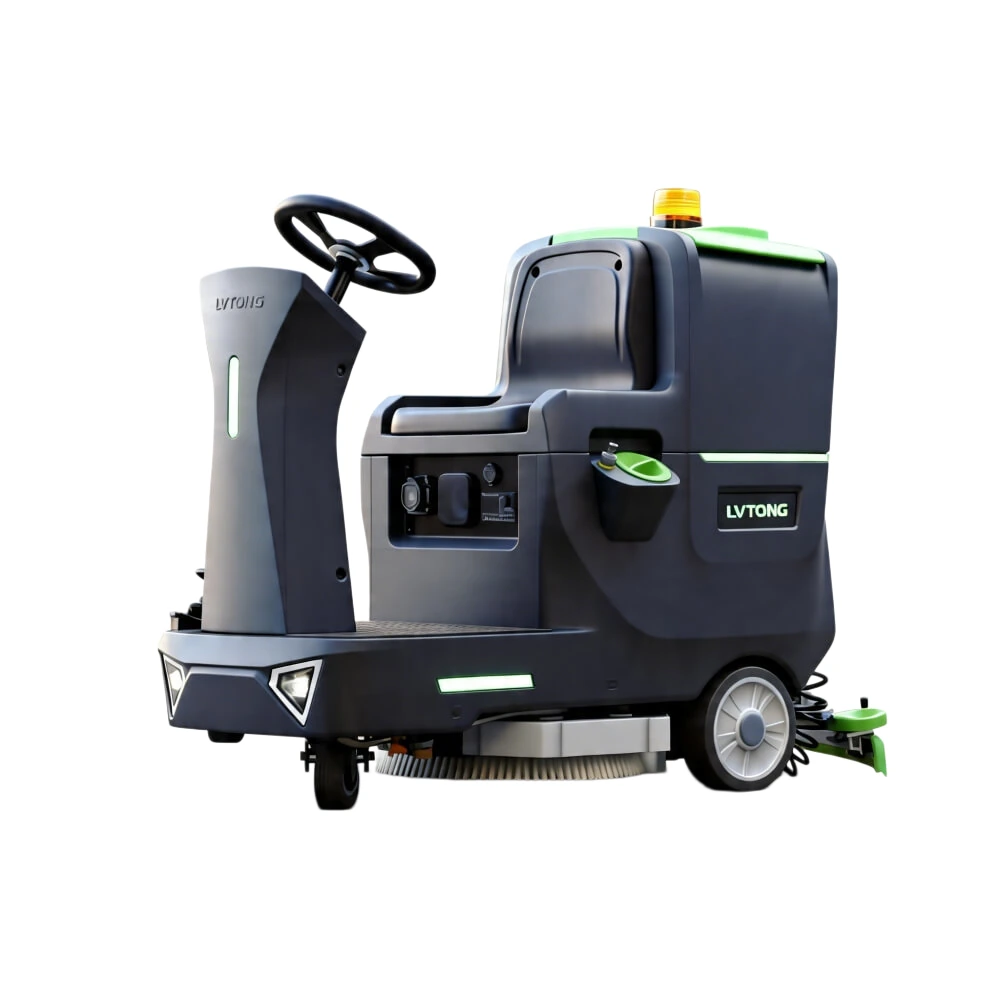
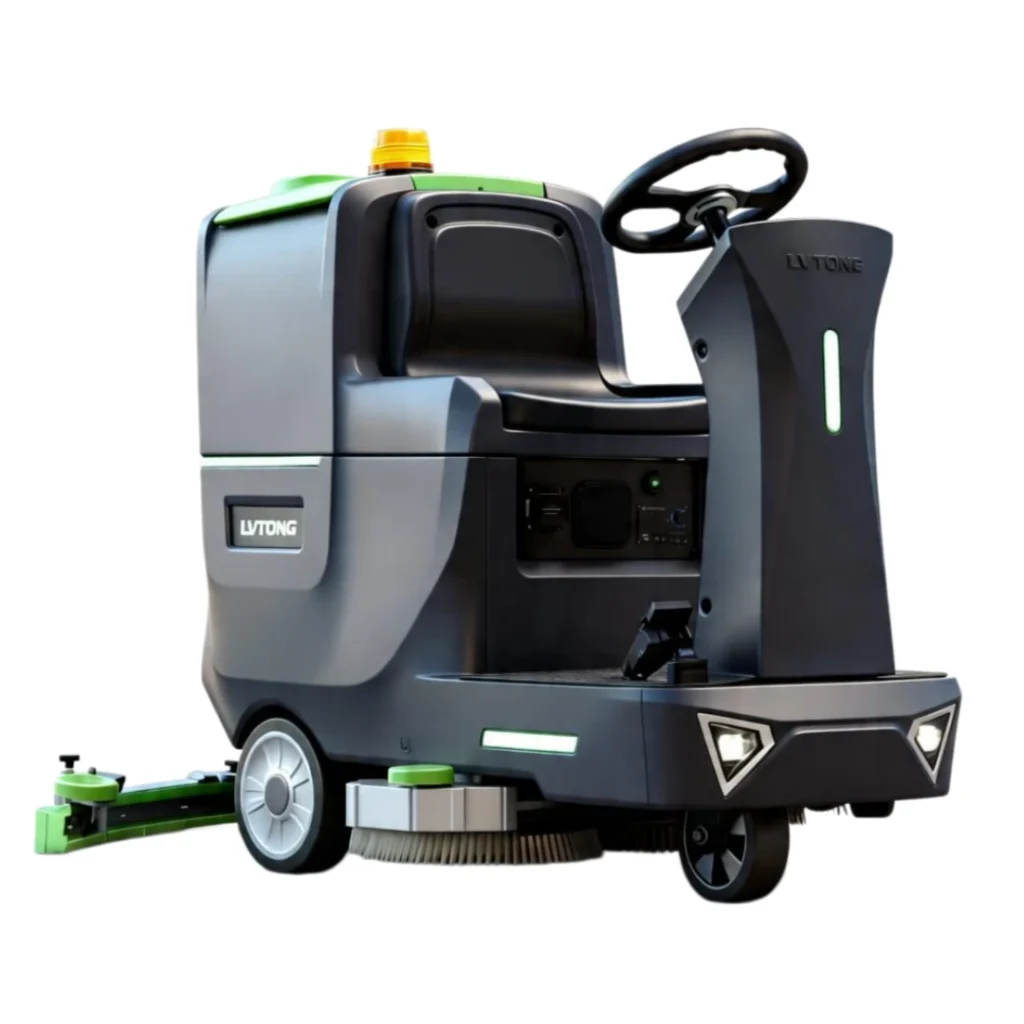
Debris capacity is why sweepers exist. A ride-on machine with a 100 L hopper (LT-S1350S) or a 160 L hopper (K2S-1950S) can run a full shift between empties, at 10,000 and 14,000 m²/h respectively. A scrubber’s recovery tank is measured in litres of water rather than litres of rubbish, so the same floor space produces far more stops.
The trade is dust. Sweeping vs vacuuming hard floors is not cosmetic: a sweeper that only brushes and throws debris into a hopper lifts fine particles back into the air unless the deck is enclosed and the filter is sized for the dust load.
Floor Scrubber vs Floor Sweeper: The Eight Differences That Matter
The floor scrubber vs floor sweeper difference comes down to eight lines, and only three of them usually change the buying decision: soil type, water route and debris capacity.
| Difference | Sweeper | Scrubber | Why it decides |
|---|---|---|---|
| Cleaning action | Mechanical: brushes lift and throw | Chemical, mechanical and water | Sets which soil it can remove at all |
| Soil type | Dry, loose, bulky | Bonded, oily, sticky, filmed | First filter on machine class |
| Water | None | Solution in, dirty water out | Adds fill, discharge and drying constraints |
| Waste handling | Hopper, dry, 100–160 L typical | Recovery tank, 62–65 L typical | Sets empties per shift |
| Floor compatibility | Safe on most hard surfaces; watch dust | Needs sealed or water-tolerant floors | Wrong pairing damages coating or joint fill |
| Productivity | 8,500–20,000 m²/h at ride-on sizes | 2,100 m²/h at walk-behind sizes | Sets labour hours per shift |
| Maintenance | Main brush, side brush, filter, hopper seal | Brush, squeegee blades, tanks, hoses | Different consumable curve |
| Cost of ownership | Lower water and chemistry, higher dust control | Higher water, chemistry and consumable cost | Decides TCO more than purchase price |
The rows that rarely change a decision are maintenance and purchase price. The rows that do are soil type, water route and debris capacity: they decide whether the machine can do the job at all.
Floor Scrubber vs Floor Sweeper: Which One Fits Your Soil Profile
Match the machine to the dominant soil on the route, then confirm the exception soil has a plan of its own.
| Dominant soil | Machine | Why | Verify before ordering |
|---|---|---|---|
| Dust, sand, grit tracked in from outside | Sweeper | Dry and bulky; wetting it turns it into mud | Filter area and deck sealing for the dust load |
| Packaging, cardboard, wrappers | Sweeper | Volume, not film | Hopper volume against the nearest dump point |
| Oil, grease, coolant | Scrubber | Needs chemistry and recovery | Brush pressure, squeegee type, discharge route |
| Food residue, sugar, syrup | Scrubber | Sticky film re-soils if only swept | Water temperature and defoamer handling |
| Tire marks, rubber transfer | Scrubber | Bonded, not loose | Brush type and pass count |
| Mixed: debris plus film | Both, in sequence | Sweeping first protects brush and squeegee | Sequence, staffing, storage for two machines |
| Fine dust in an enclosed space | Sweeper with dust control | Air quality is the binding constraint | Filtration class and ventilation rate |
One exception soil can justify a second machine; two usually justify a sequence, not a larger single machine. The floor scrubber and sweeper pairing only works when the sequence is written down and staffed.
Productivity Math: Why the Sweeper Looks Faster and the Scrubber Costs More per Hour
Hourly output alone is the wrong comparison; the cost difference sits in what happens between passes — fills, empties and drying.
Take a 10,000 m² floor. A ride-on sweeper rated at 10,000 m²/h covers it in about an hour plus empties. A walk-behind scrubber rated at 2,100 m²/h needs close to five hours, plus refills, dumps and the drying window before traffic returns. These are rated figures from product pages, not site results: overlap, obstacles and turns cut real output, so plan a margin and verify it on your route.
The second cost is consumable cycling: every recovery-tank empty and every refill is a stop. On a long route the number of stops, not the rated speed, sets the shift.
When You Need Both, and When a Combination Machine Is the Wrong Answer
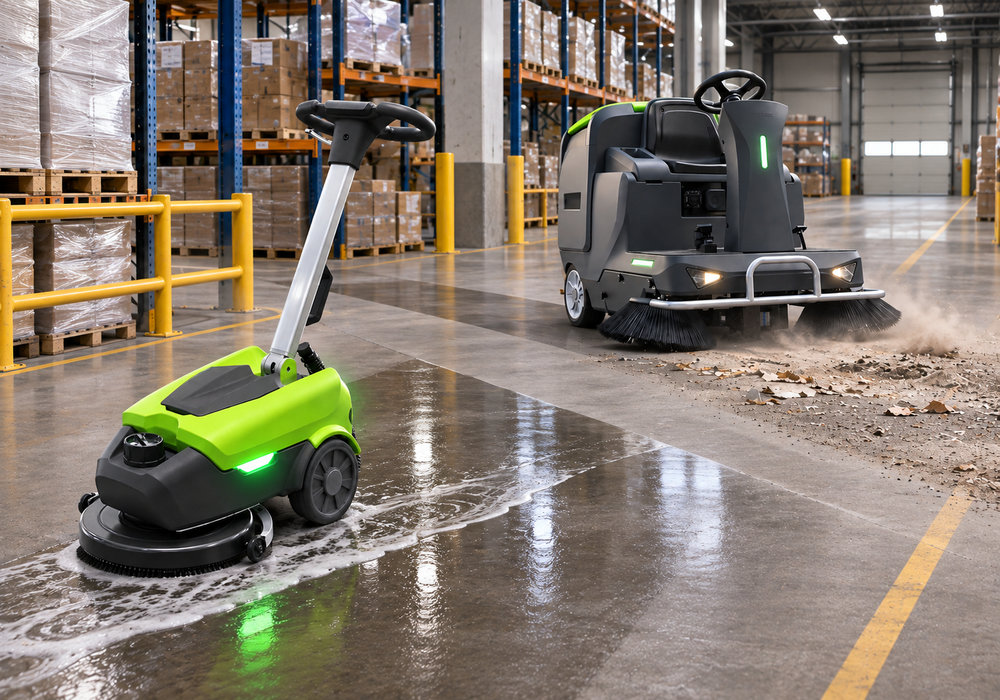
If the route carries both debris and film, run two machines in sequence unless a one-pass combination unit can be justified on labour alone.
Sweep first, scrub second. Loose debris destroys scrubber brushes and squeegee blades, and it is the cheapest failure to prevent. A two-machine sequence keeps each unit inside its design envelope and lets you scale one without replacing the other.
A combination machine does both in one pass and removes the double handling. It is also a different specification problem: deck, filtration, water and debris capacity trade against each other. We do not build one-piece combination units; if that is your shortlist, work through the sweeper-scrubber configuration guide before comparing prices.
Where Each Machine Fails: Floors, Dust and Water
Most failed purchases are not machine faults; they are floor, dust or discharge conditions the specification never checked.
Floor first. A scrubber on an unsealed or damaged coating drives water into the substrate, and on open joints it pushes dirty water in and leaves it there. A sweeper on a highly polished surface can leave brush marks and airborne dust. Both classes need the floor inspected before the model is chosen.
Dust second. Fine particulate that a dry sweeper lifts back into the air is a health issue, not a cosmetic one; the EPA indoor air quality guidance frames the exposure side. Water third: where a scrubber discharges to a drain or to ground, industrial stormwater rules apply, and the local limit binds.
Machine safety is the fourth. Floor treatment machines fall under IEC 60335-2-72, and a supplier who cannot point to a test report is asking you to take the claim on trust. Slip risk is the fifth: a wet film on a busy route turns a cleaning gain into a liability claim, so squeegee condition and drying time belong in the acceptance test next to slip-resistance practice.
Cost of Ownership: The Four Lines That Differ
Purchase price separates the two classes least; water, chemistry, consumables and labour separate them most.
| Cost line | Sweeper | Scrubber | How to compare |
|---|---|---|---|
| Purchase | Usually lower at equal width | Higher per square metre covered | Compare at equal route, not equal width |
| Consumables | Main brush, side brush, filter, hopper seal | Brush, squeegee blades, filter, hoses | Ask for a per-1,000-hour parts list |
| Water and chemistry | None | Solution, defoamer, discharge handling | Cost per 1,000 m² cleaned |
| Labour | Empties only | Fills, dumps, drying window | Stops per shift, not speed |
The honest comparison is cost per 1,000 m² cleaned on your route with your stops. Ask for it in writing: a quote that lists only machine price leaves the expensive half out.
Five Selection Mistakes That Show Up in Every Audit
All five are avoidable with a one-day trial on the real route.
- Buying on floor area instead of soil. Area sets size; soil sets class.
- Choosing by cleaning width. The widest machine that cannot reach the aisle is the most expensive one on site.
- Ignoring the fill and dump points. A 65 L recovery tank with no drain within reach becomes a manual job.
- Expecting one machine to handle both soil types. It will do one of them badly and the other not at all.
- Skipping the trial and the parts question. A machine with no local brush and squeegee supply is a countdown.
Start With the Soil Sample, Not the Brochure
Collect the debris, note where it comes from, and measure the route, not the building.
That evidence decides the class before any model is discussed. Fill points and dump points matter more than the rated speed on the datasheet.
If you are shortlisting both classes, send the soil profile and the route layout to our team and we will size the sweepers and floor scrubbers against it: request a route assessment. For the machine families themselves, start from the scrubber dryer range and the ride-on sweeper range.
Frequently Asked Questions
What is the main difference between a floor scrubber and a floor sweeper?
A floor sweeper collects loose, dry debris into a hopper. A floor scrubber applies solution, agitates attached soil and recovers the dirty water behind a squeegee. Sweepers handle dust and debris; scrubbers handle oil, grease and sticky film.
Can a floor scrubber pick up dry debris?
Some cylindrical scrubbers collect small particles in a debris tray, but a standard scrubber is not a replacement for a sweeper. Stones, packaging and heavy debris should be removed first; they damage brushes and squeegee blades.
Should I sweep before scrubbing?
Yes, whenever the floor carries sand, grit or packaging waste. Sweeping first protects the brush, squeegee and recovery system and improves the wet result at the same time.
Do I need both machines in a warehouse?
Only where the route carries both dry debris and bonded film. Warehouses dominated by dust and packaging need a sweeper; areas with spills and tire marks need a scrubber. Mixed sites usually run a sequence rather than buying a larger single machine.