
As a floor scrubber manufacturer, we recommend testing a candidate machine on the warehouse route it is expected to clean. Use the checks below to plan a trial on your warehouse route. The example results are hypothetical; base your buying decision on how the machine performs at your site. The result should support one clear purchasing decision:
|
Result |
Meaning |
|---|---|
|
Pass |
The machine completes the agreed route and all five checks meet the conditions set before testing. |
|
Configuration review |
A specific setting, required step, or test result needs confirmation, adjustment, or a retest before approval. |
|
Reject |
An unresolved critical problem prevents the machine from completing a required task within the agreed route and acceptable setup. |
The test applies to the proposed machine and the setup used during the trial, including the brush or pad, detergent, water flow, operating speed, battery, and charger.
A supplier demonstration or published warehouse case may help identify a candidate, but it cannot establish a Pass for your warehouse unless the machine completes your route under your agreed test conditions.
1. Test from Entry to Handover
Test the whole process, from the machine entering the warehouse to completing the work and handing over to the next operator. This includes cleaning, dirty-water recovery, refilling, draining, charging, and parking.
2. The representative small-warehouse route
The test route should represent the most restrictive conditions the machine will face during normal cleaning. Start at the narrowest doorway, continue through the tightest aisle, and include a turn beside fixed equipment. Keep pallets, columns, racks, stock, and other obstacles in their normal positions so the test reflects the operator’s actual working space.
Before testing, complete a route card for each candidate machine:
|
Required field |
Was aufgezeichnet werden soll |
|---|---|
|
Maschinenmodell |
Full model name and tested variant |
|
Test setup |
Brush or pad, detergent and dilution, water-flow setting, battery, charger, and any approved configuration change |
|
Test date |
Date of the route test |
|
Bottleneck clear width |
Actual unobstructed width in millimetres at the narrowest doorway, aisle, or other route restriction |
|
Available turning space |
Turning width or length in millimetres at the critical turn, including the fixed equipment beside it |
|
Maximum working width with the rear squeegee fitted |
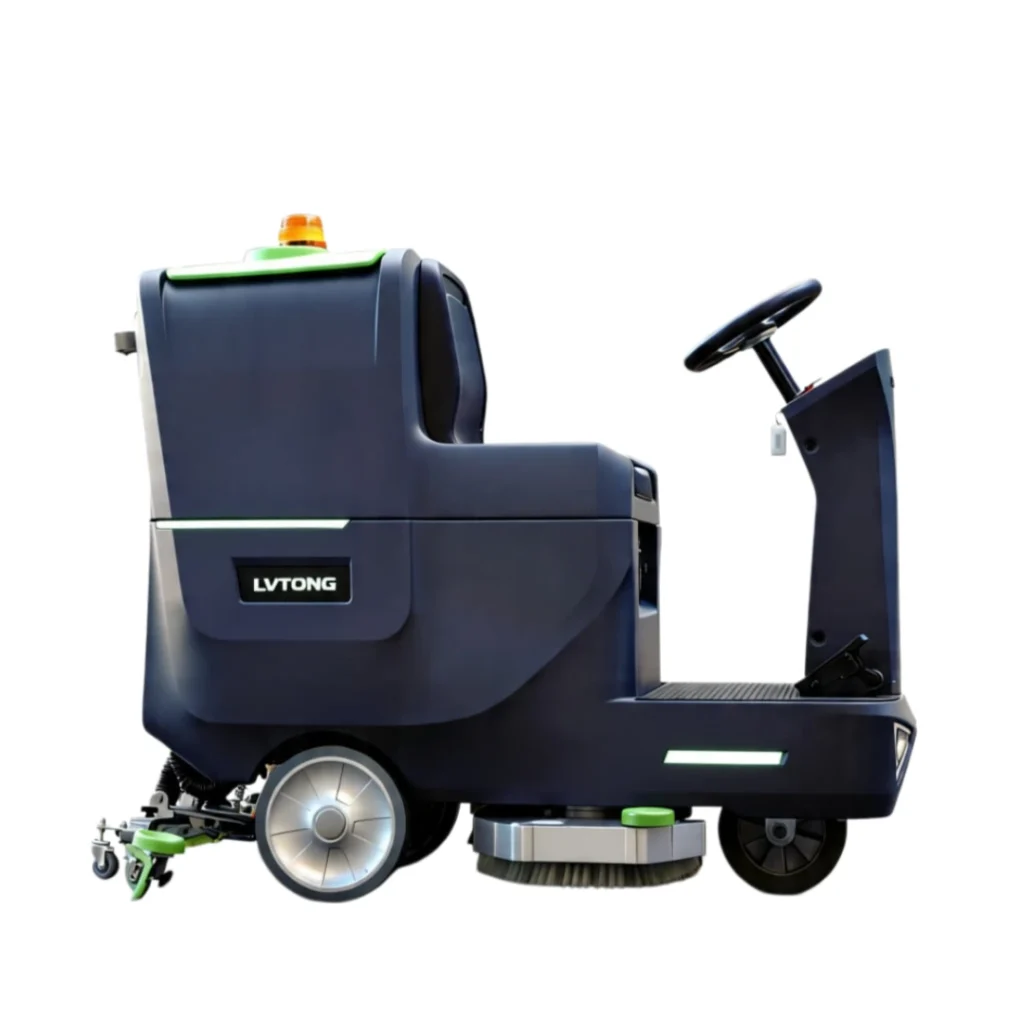
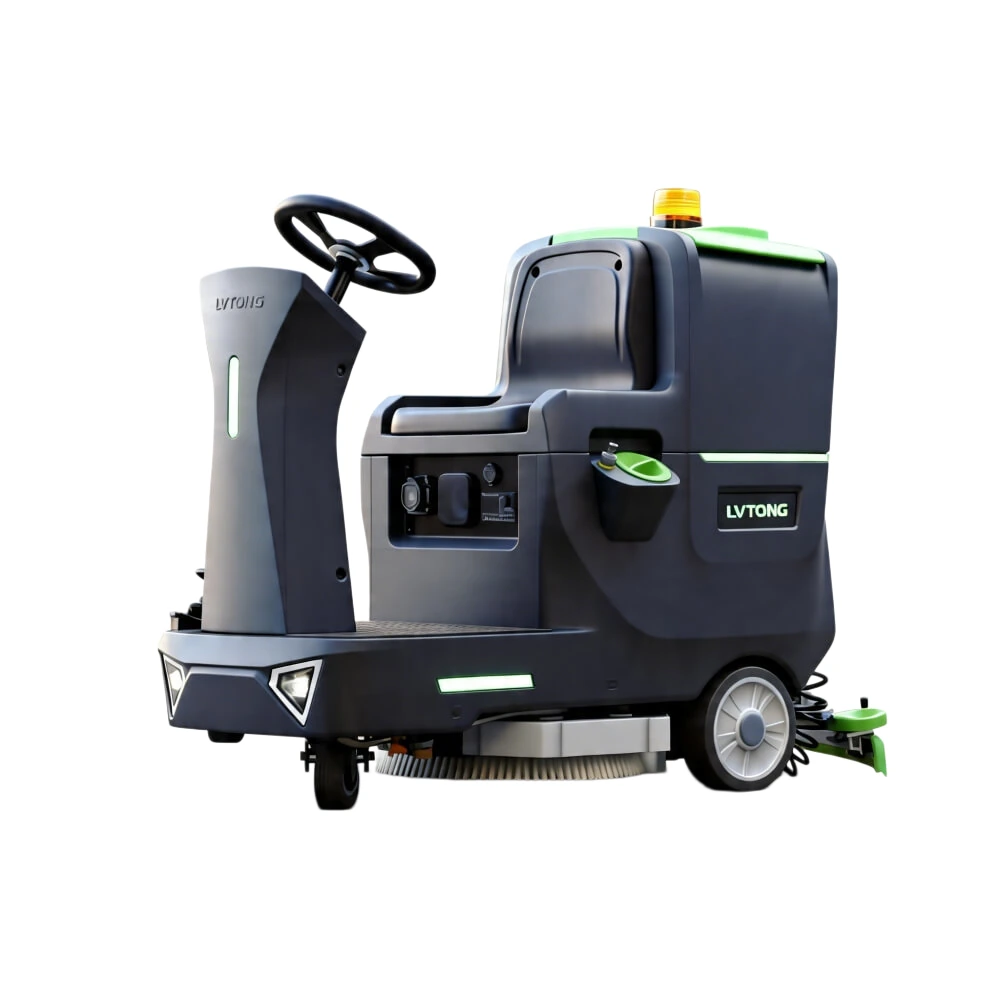
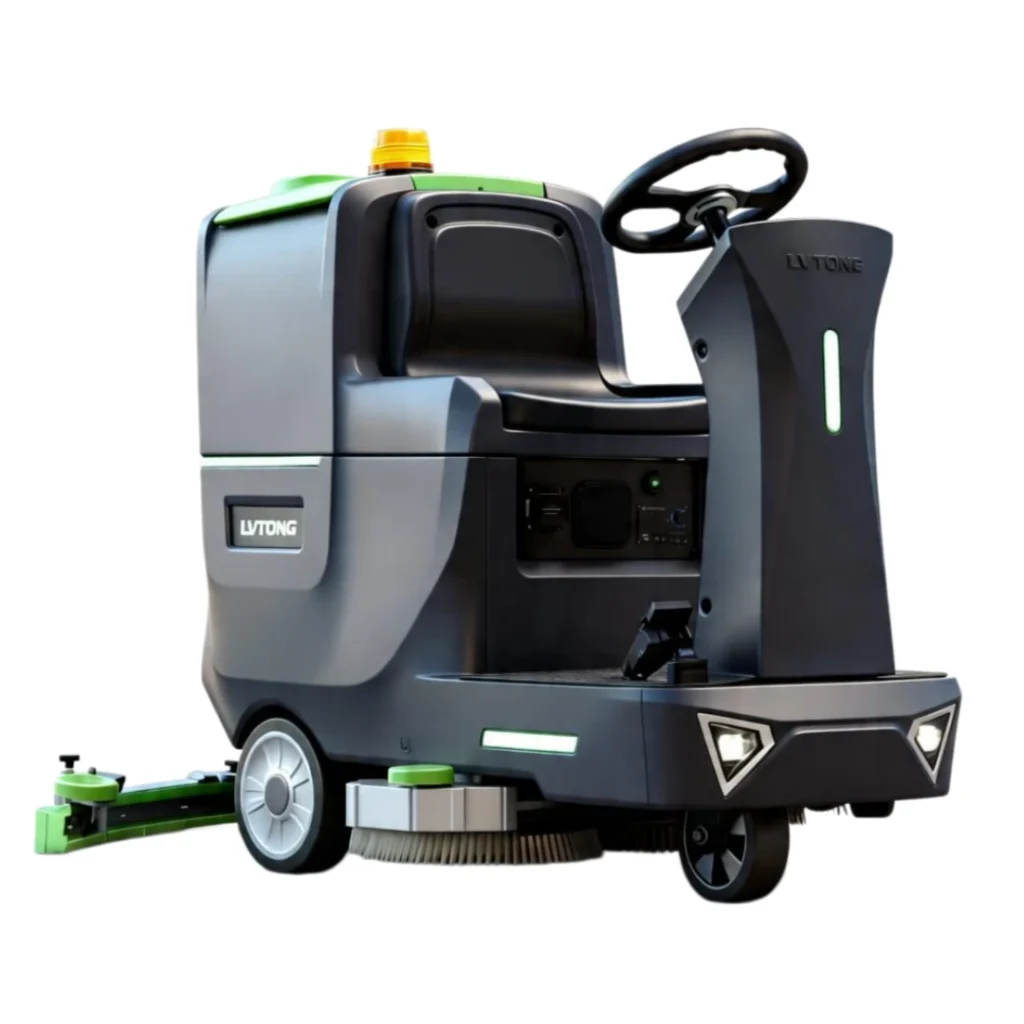
Widest measurement of the machine in its working condition, including the brush deck, rear squeegee, hoses, and other extensions |
|
Contact or reversing locations |
Exact location and reason for each contact, reverse, repositioning manoeuvre, or detour |
|
Route test result |
Record whether the candidate completed the doorway, aisle, and turning checks, including any contact, reversing, repositioning, or detour. |
Measure the bottleneck clear width at the actual narrowest point. Record the available turning space beside fixed equipment rather than relying on the machine’s advertised turning radius. Measure the candidate machine in the working condition used for the test. The maximum working width with the rear squeegee fitted must include any assembly that extends beyond the machine body.
The route should also include a representative dirty section containing the tire marks, dust, grease, residue, or other contamination the machine is expected to remove. Keep the starting soil comparable for each candidate. If a section has already been cleaned, record it separately and do not use it as the starting condition for another comparison.
After the cleaning section, continue the route to the clean-water supply and the approved wastewater discharge point, then finish at the planned charging and storage location. Mark these service stops on the route map together with any shared traffic crossings or restricted areas.
Der Leitfaden für Scheuersaugmaschinen für Lagerhallen addresses the earlier choice of machine type. This test begins once a candidate is available.
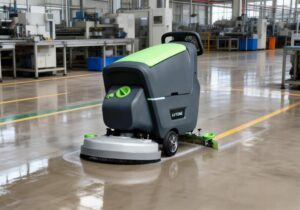
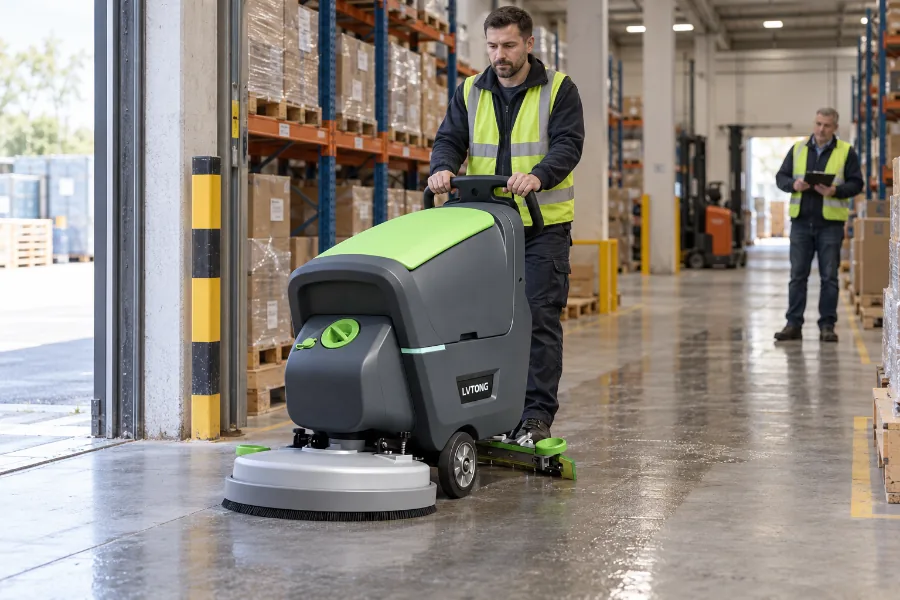
Der published warehouse case study describes polished concrete with daily tire marks and fine dust. The facility used an LT-S530X handgeführte Scheuersaugmaschine with a 530 mm cleaning path, large-capacity tanks, and a high-density disc brush. The case reports improved soil removal, water pickup, and floor dryness. However, it does not provide the site dimensions, test date, operating time, or a complete acceptance record. It therefore cannot establish a Pass for this warehouse or replace the route measurements and observations required for the candidate test.
3. Test Setup and Acceptance Criteria
Results from different candidates are comparable only under the same test conditions.
For a small-warehouse example, the setup card can begin with the LT-S530X handgeführte Scheuersaugmaschine. The card identifies the exact machine variant and test date, together with the brush or pad, battery, and charger combination shown in the applicable product page, quotation, or supporting product documentation. These items must be verified for the specific machine and should not be treated as standard configurations for every LT-S530X or every candidate model.
|
Test condition |
Agreed setup |
|---|---|
|
Boden |
Concrete, epoxy, tile, or another actual surface; note damaged or uneven areas |
|
Soil |
The representative dirt, tire marks, dust, grease, or residue present on the route |
|
Bürste oder Pad |
Exact type, condition, and intended setting recorded from the tested machine’s product information or quotation |
|
Reinigungslösung |
Product and dilution used for the test |
|
Wasserfluss |
Starting flow setting and any agreed adjustment |
|
Betriebsgeschwindigkeit |
Planned travel speed or operator pace for the route |
|
Operator |
One named primary operator for all candidate comparisons; second-operator handover logged separately |
|
Route |
The same entrance, aisles, turns, obstacles, and exit path |
|
Battery state |
Battery type or capacity, starting charge condition, and any charging step recorded for the tested unit |
|
Ladegerät |
Charger model or specification supplied for the tested battery, as confirmed by the product documentation or quotation |
|
Evidence owner |
Person responsible for the route notes and result log |
Detergent compatibility and foam control are covered in the Leitfaden für Reinigungslösungen für Bodenschrubber.
Before the trial, agree on the acceptable floor appearance, supported by a reference photo or sample area, and the maximum number of cleaning passes. The acceptance card also covers the no-contact requirement, allowed reversing or repositioning, immediate and later water-recovery check times, and permitted stops and their reasons.
The total time allowance includes refilling, wastewater discharge, and other agreed operating steps. These limits stay fixed during testing; any exceedance belongs in the result log with its cause.
Physical access requires completion without contact or a detour forced by the machine’s size. Water recovery means picking dirty water up from the floor. The rear squeegee is the rubber blade used for water pickup. Recovery is checked immediately behind it and again at the exact later time recorded on the card. The agreed limits exclude unresolved pooling, a continuous wet trail, and interruptions to pickup.
Battery capacity must cover the complete route without a power interruption. Refilling, wastewater discharge, charging, and parking must fit the planned shift without spills, blocked paths, skipped steps, or unplanned detours. For handover, the second operator completes the same steps without changing the configuration or omitting a task.
Keep the test record auditable
For any result we describe as tested by LVTONG, the test location, machine configuration, floor material, soil type, brush or pad, operating time, measurement method, and test date must be documented.
The setup card lists the configuration changes allowed during testing, such as an approved brush or water-flow adjustment. A revised setup starts a separate run, linking the floor result to the settings used. Moving fixed racks changes the agreed route and falls outside these configuration limits.
4. Route access before wet cleaning
During the dry run, the brush deck and rear squeegee stay fitted in their working positions. Clearance concerns the whole machine, including assemblies that extend beyond its body. A doorway may admit the chassis while the squeegee catches the frame; a turn may require repeated reversing beside a rack. The observer notes the location and cause of any contact or extra maneuver.
On the return leg, the log records any clearance problem at the refill, discharge, charging, and storage points.
5. Wet-cleaning and water-recovery observations
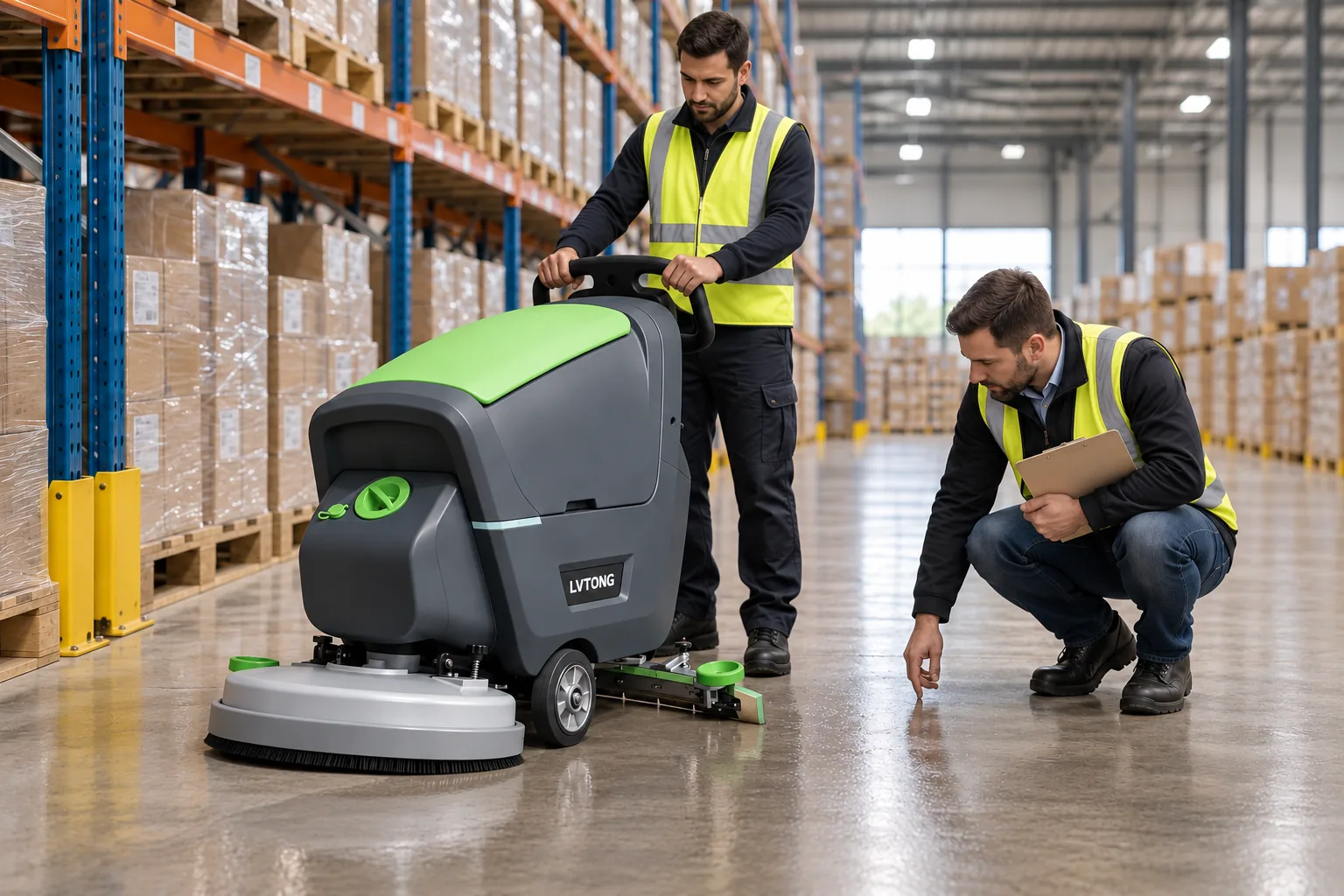
The wet run uses the actual floor after the same recorded preparation for each candidate, including normal sweeping or vacuuming and removal of damaging debris. After the planned pass count, remaining tire marks identify soil still on the floor, while missed strips and uneven water application locate gaps in cleaning coverage. A heavy-soil patch may need more work; the record pairs its final appearance with the passes and settings used.
At turns and edges, water may remain inside a turn or form a streak beside a rack even when pickup on the straight section is acceptable.
Repeated repositioning or slowing below the planned pace adds time and may prevent completion within the agreed cleaning period.
Floor observations immediately behind the squeegee and at the later checking time reveal whether a wet trail or pool remains. The observation notes foam, hose faults, and stops to empty the recovery tank. If foam appears or water pickup is interrupted, record where it occurs, the cleaning solution and dilution, the water-flow setting, the brush or pad, and the machine condition at that point. For example, an illustrative record might state: “Foam observed near the rack turn; pause required; verify detergent dilution and hose condition before repeating the same section.” This is a recording example, not a reported LVTONG test result.
These observations are assessed against the pickup limits agreed before testing and do not establish a drying-time guarantee for other floors.
Der OSHA-Standard für begehbare Arbeitsflächen provides general U.S. workplace context: employers must ensure that workplaces and walking-working surfaces are kept clean, orderly, and sanitary, and that the floor of each workroom is maintained in a clean and, to the extent feasible, dry condition. This general requirement does not establish a uniform drying-time threshold for every floor, machine, or test route. As part of our route acceptance process, we recommend testing the proposed setup on a small representative area before the full wet run. The agreed water-recovery limits must be recorded on the acceptance card. The Anleitung zum Schrubben von Betonböden explains the floor considerations.
6. The complete water and power workflow
Refilling reveals whether the operator can reach the tank from the water supply. At the approved wastewater point, hose reach and drain position determine whether discharge causes a spill, blocks an aisle, or requires an unplanned detour. The log captures the number and location of these interruptions.
Before the trial, the acceptance card sets the continuous runtime required for the planned work, the minimum indicated charge remaining after the full route, and the maximum charging time available before the next shift. These limits apply to the proposed battery and charger.
Battery evidence includes the starting charge, elapsed operating time, any power interruption, and the remaining charge shown at the end. The record states whether the full required route or only part of it was completed. Battery acceptance requires completing the full route without a power interruption, meeting the agreed runtime and remaining-charge limits, and recharging to the agreed starting level within the available window. Any required battery or charging check left unverified remains under Configuration review. The Leitfaden zur Akkulaufzeit von Scheuersaugmaschinen addresses compatibility.
Before storage, the operator empties or rinses the tanks, cleans the squeegee and recovery hose, secures the brush or pad, and connects the charger as required by the proposed setup. An inaccessible outlet prevents connection at the planned charging position. General care procedures remain in the Checkliste für die Wartung von Scheuersaugmaschinen.
7. Operator handover
The second operator receives the configuration card and follows the same route, including water handling and shutdown.
A pause to ask where wastewater goes, an unintended setting change, or a missed shutdown step pinpoints what the handover still lacks. The card or training can then address that particular location, setting, or action before the operator repeats the test.
8. Acceptance status
After the trial, compare each result with the conditions agreed in Section 3. Note what you observed, where the evidence is stored, who checked it, and whether the result is Pass, Configuration review, or Reject. This table is a hypothetical example, not an actual LVTONG test record. Bracketed fields are for site-specific limits. Pass assumes all agreed criteria are met.
|
Acceptance area |
Site-agreed acceptance criteria |
Hypothetical observation |
Example evidence reference |
Responsible role |
Example status |
|---|---|---|---|---|---|
|
Route access |
No contact or detour forced by the machine’s size; no more than [maximum additional reversals or repositioning manoeuvres]; complete within [agreed time]. |
No contact or size-related detour. Additional reversing and completion time stayed within the agreed limits. |
Route card and access photos |
Warehouse supervisor |
Pass |
|
Nassreinigung |
Reach the agreed floor appearance, defined by a reference photo or sample area, within [maximum cleaning passes]. |
The floor reached the agreed appearance within the permitted number of passes. |
Before-and-after photos and cleaning log |
Cleaning lead |
Pass |
|
Wasserrückgewinnung |
No unresolved pooling or continuous wet trail immediately behind the squeegee or at [agreed later check time]. |
Water remained beside the rack at the later check. The cause still needed investigation and a retest. |
Water-recovery observations and photos |
Supplier technician |
Configuration review |
|
Water and power workflow |
Complete the route within [agreed total time], with no more than [maximum unplanned stops] and no power interruptions. Meet the agreed runtime, remaining-charge, and charging-window requirements. |
The full route and all required battery and charging checks met the agreed criteria. One planned refill stop was completed without spills or blocked access. |
Route log, battery readings, and charging record |
Facility manager |
Pass |
|
Operator handover |
Complete the same route and shutdown steps without reminders, unapproved setting changes, or omitted tasks. |
The second operator needed a reminder before connecting the charger. Handover instructions or training needed adjustment before repeating the check. |
Handover checklist and observer notes |
Shift supervisor |
Configuration review |
In this example, the overall status is Configuration review because water recovery and operator handover still require follow-up.
Reject applies when an unresolved critical failure leaves a required task unachievable within the agreed route and acceptable configuration limits. With no such failure, Configuration review covers a specific adjustment awaiting confirmation or retesting, or an unverified required step. Pass requires all five acceptance areas to meet the conditions agreed before testing.
The completed record ends with the overall result and any open items, each linked to its location or supporting evidence. Enter Keiner when no open item remains.
9. Procurement conclusion
A Pass allows quotation or purchase review, with the purchase specification matching the configuration documented in the test record. Under Configuration review, approval stays on hold until the open item is resolved and the required check or retest is completed. A rejected candidate leaves the shortlist; a formally revised route requirement calls for a new acceptance test.
10. Supplier handoff
The supplier receives the route constraints, tested configuration, completed acceptance record, and confirmations still needed. The reply identifies the proposed change and the supporting specification or test evidence for each open item.
Häufig gestellte Fragen
What Should the Trial Appointment Include?
The appointment needs to cover setup, the planned route, and a review of the findings. Required checks extending beyond the visit need a follow-up arrangement agreed in advance.
Who should attend the trial besides the supplier?
Alongside the regular operator, include someone authorized to approve site arrangements and someone responsible for the purchasing decision. One person may cover both roles in a small warehouse. The second operator can join specifically for the handover check.
Can a rental machine be used for a longer pre-purchase trial?
Where available, an agreed rental period may allow observation across several normal cleaning cycles. The arrangement needs to identify the candidate configuration, trial period, training, and return process. Results from a substitute model apply only to that machine and setup. Availability and terms require confirmation with the provider.
Next step
Share your bottleneck clear widths, floor material, representative soil, cleaning shift and charging window, and candidate setup with us through our contact form.