
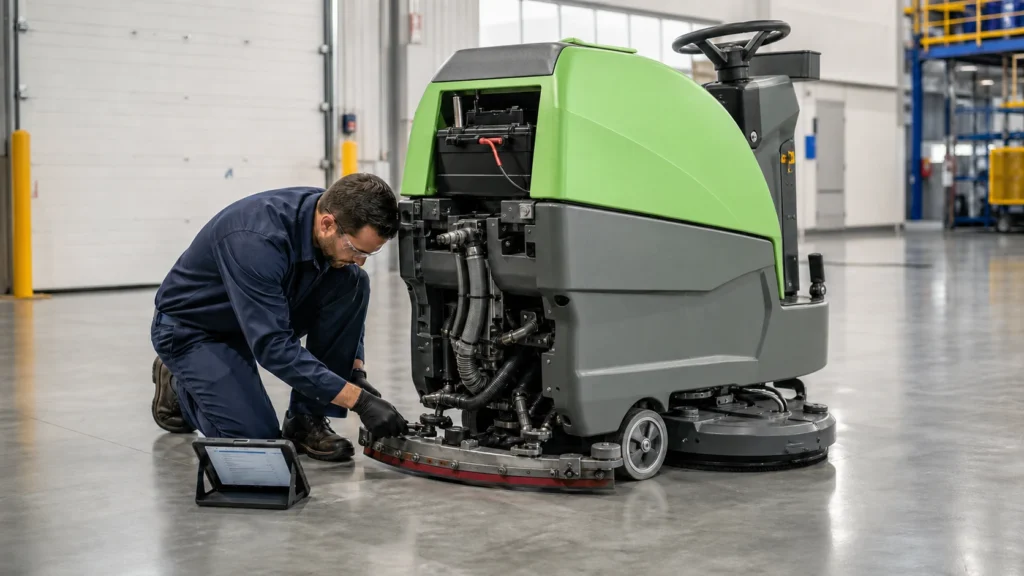
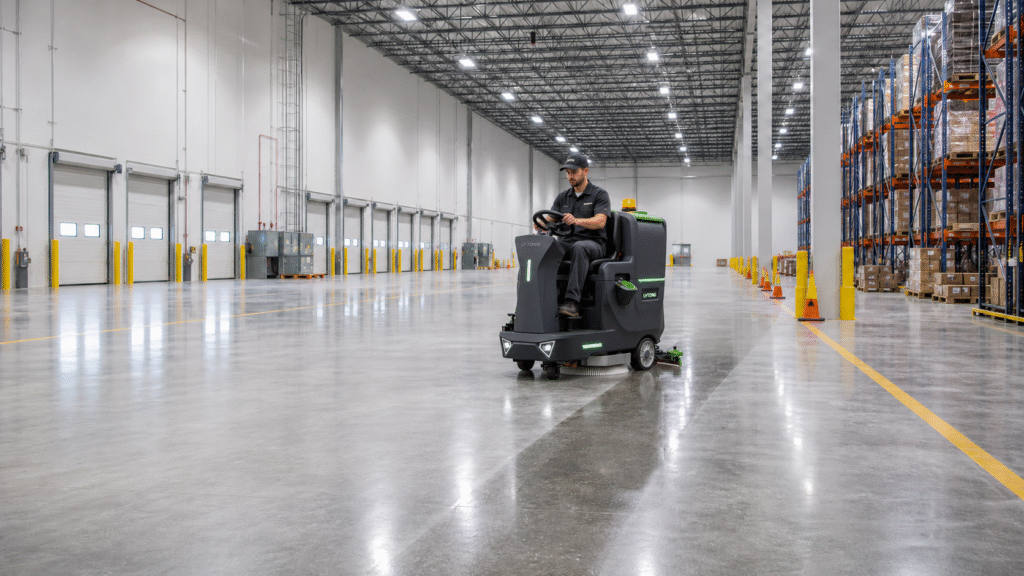
A consistent program built on matched methods, sized equipment, and traffic-based scheduling is what keeps floors in a large facility safe and clean. Warehouses, factories, hospitals, supermarkets, airports, and campuses each cover tens or hundreds of thousands of square feet, where every operational decision scales fast. Operations leaders across these environments work against the same constraint, keeping large floor systems clean and safe without burning labor hours or capital budget. The answer sits in floor-type-matched methods, equipment sized to the cleaning area, traffic-based scheduling, preventive controls, and the discipline to bring in specialists when work exceeds routine capacity.
Facility Size Defines the Cleaning Program
Floor area is the first input to any cleaning program design. Equipment selection, labor planning, chemistry, and cycle frequency all depend on it.
Labor hours scale with area, but equipment costs do not. A mop-and-bucket routine that takes 45 minutes in a small office becomes a five-hour shift in a 15,000 m² distribution center, which is no longer a labor cost any operation can absorb.
Once a cleanable area passes roughly 3,000 m², ride-on equipment starts paying back faster than added headcount.
Cycle planning shifts the same way. Small sites are cleaned once a day after closing. Medium sites are split into daytime spot cleaning plus a single deep cycle. Large sites run multiple shifts, with cleaning continuous around operations.
Surface variety also grows with footprint. A small office often has one or two flooring types, while a large hospital or campus may run polished concrete, VCT, tile, terrazzo, and carpet in the same building. Each surface adds chemistry, equipment, and cycle requirements to the program.
Cleaning Method Tracks Floor Type
Each surface reacts differently to water, pH, abrasion, and heat. Using the wrong cleaning methods is the most common way large facilities damage their own floors. The table below covers the surfaces found most often across industrial and institutional sites.
| Tipo de piso | Daily Method | Periodic Treatment | Common Mistakes |
| Concreto selado | Sweep, then scrub with neutral-pH cleaner | Reseal every 12 to 24 months | Acidic cleaners that strip the seal |
| Polished concrete | Dust-mop, then auto-scrub with neutral pH | Re-polish on wear cycle | High-alkaline strippers, abrasive pads |
| Epoxy coating | Soft-bristle scrub, neutral pH | Recoat per the manufacturer’s schedule | Solvents that soften the coating |
| Ceramic and porcelain tile | Sweep, then scrub with grout-safe chemistry | Deep-clean grout 1 to 2 times per year | Acidic cleaners on cementitious grout |
| VCT and vinyl | Dust-mop, then auto-scrub | Strip and recoat 1 to 2 times per year | Excess water, skipping the recoat cycle |
| Terrazzo | Dust-mop, then auto-scrub, neutral pH | Hone and re-seal on wear cycle | Wax buildup, high-pH solutions |
| Commercial carpet | Vacuum with strong suction | Hot-water extraction quarterly | Skipping interim spot cleaning |
Concrete Surfaces Set the Industrial Baseline
Concrete dominates large-facility floors because it is durable, dimensionally stable, and relatively cheap to maintain. Sealed concrete needs sweeping plus neutral-pH scrubbing on a daily cycle, with resealing every one to two years depending on traffic.
Polished concrete behaves differently. It needs dust mopping more often than wet cleaning, and daily auto-scrubbing with neutral pH maintains the polish while alkaline cleaners or abrasive pads damage the densifier-treated surface.
Repolishing is scheduled by gloss measurement rather than by calendar. A facility with constant pallet jack traffic may need annual repolishing. A facility with light foot traffic may extend to three years between cycles.
Resilient and Tile Floors Need Different Cycles
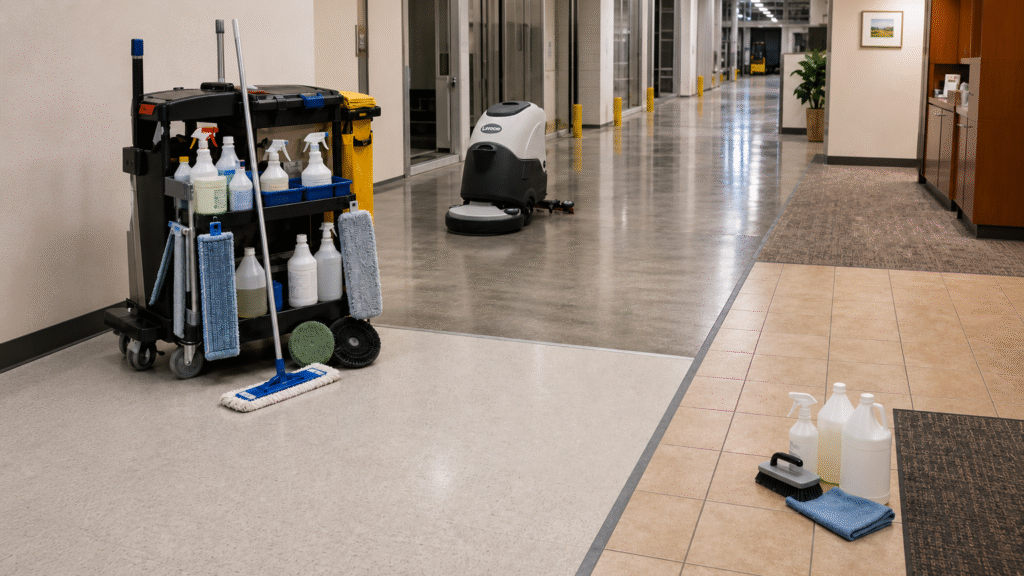
VCT and vinyl carry the highest recurring maintenance burden among common large-facility surfaces. Stripping and recoating once or twice per year is standard, with daily dust mopping and neutral-pH scrubbing in between. Skipping the recoat shortens floor life.
Ceramic and porcelain tile demand grout-safe chemistry. Acidic cleaners erode cementitious grout, leading to staining and grout loss. Terrazzo behaves like polished concrete, with neutral chemistry, periodic honing on a wear-driven cycle, and resealing after honing.
Transition Zones and Specialty Settings Need More
Where carpet meets hard flooring in lobbies and corridors, transition zones collect the most soil and require the highest cleaning frequency. These bands also generate the most complaints, so attention here pays back fast.
Em healthcare cleaning, the same principle drives equipment choice toward machines with strictly separated clean and recovery tanks. Contamination crossover undercuts infection control, no matter how good the chemistry is.
Pre-treatment with a degreaser before scrubbing is standard practice for factory floor cleaning where coolant or hydraulic oil accumulates. Skipping pre-treatment leaves residue that recoats the floor on subsequent passes.
Equipment Sizing Drives Productivity
Machines and methods carry equal weight on a large floor. Underpowered or undersized equipment leaves surfaces underserved, no matter how often cleaning happens.
Consumer-grade hardware does not survive commercial duty cycles, and oversized machines burn capital that could go elsewhere.
Productivity Numbers Need Real-World Adjustment
Productivity figures on equipment spec sheets describe theoretical square meters per hour on an open floor at full pace. Real-world output usually lands at 60 to 75 percent of that figure once turning, refilling, and operator pace are factored in. Plan against the realistic value, not the spec.
A facility with 8,000 m² of single-shift cleanable area and a 65 percent real-world factor needs a machine rated near 5,500 m²/h theoretical to finish in three hours. That math, repeated for every shift, drives equipment class selection.
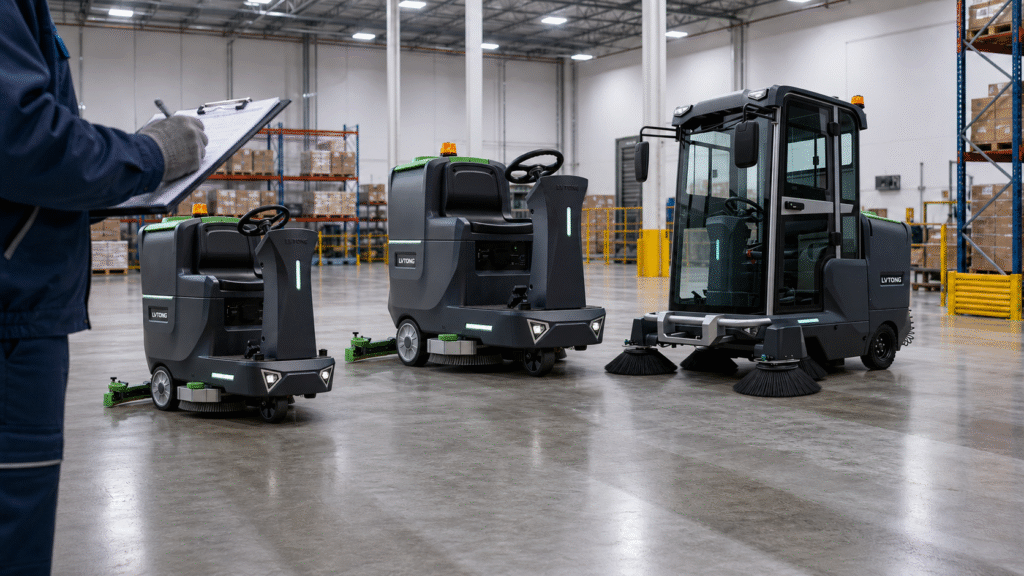
Using the table below to choose the right machine types.
| Machine Class | Path Width | Tank or Hopper | Theoretical Output | Typical Use Case |
| Compact ride-on scrubber | 560 mm | 85 L | 4,400 m²/h | Workshops, supermarkets, warehouses |
| Mid-size ride-on scrubber | 860 mm | 130 L | 6,800 m²/h | Large warehouses, factories, and hospitals |
| Ride-on sweeper | 1,350 mm | 100 L | 10,000 m²/h | Outdoor zones, parking, debris-heavy floors |
| Industrial ride-on sweeper | 2,050 mm | 150 L | 20,000 m²/h | Logistics yards, large plants, transit terminals |
Sweeping Comes Before Scrubbing
Wet scrubbing over loose grit drags abrasive material across the floor and cuts both pad life and finish life. Any site with significant dry debris should run a sweeper first, then bring in the scrubber. The order is non-negotiable in warehouses, manufacturing plants, and outdoor-adjacent transit hubs.
Foot Traffic Drives the Maintenance Schedule
Traffic is not uniform inside any large facility. Lobbies, dock entries, and main corridors carry most of the wear. Storage rooms, perimeter offices, and rarely-used spaces carry almost none. Mapping cleaning effort to traffic, rather than to square footage, is what keeps both budgets and finish quality in control.
Each Traffic Tier Has Its Own Cadence
High-traffic zones need daily scrubbing plus quarterly deep treatment. Mid-traffic zones need weekly scrubbing plus semi-annual treatment. Low-traffic zones need periodic, inspection-driven service only.
The biggest mistake at scale is applying a single daily-cleaning standard to the entire floor plan. A 100,000 m² warehouse running uniform daily scrubbing wastes most of its labor on areas that do not need it.
Tasks Map to Each Tier
| Zone | Diário | Semanalmente | Periodic |
| High traffic | Scrub, spot clean, inspect mats | Edge detail, equipment service check | Quarterly deep clean or restoration |
| Mid traffic | Spot clean, dust-mop | Scrub | Semi-annual deep clean |
| Low traffic | Inspect | Dust-mop or vacuum | Annual deep clean |
A zoned program reallocates labor to where the finish degrades fastest. The same total labor budget produces visibly better results under this allocation.
High-Traffic Zones Drive Most of the Wear
Dock entries are the single highest-wear zones in most warehouses and distribution centers. Tracked-in moisture, abrasive grit, and pallet jack wheels combine to grind down finishes within months. Daily double-scrubbing of these areas, or a dedicated sweeper pass ahead of the scrubber, is standard practice.
Main aisles and corridors come next. They concentrate on foot traffic and rolling equipment. A mid-size ride-on scrubber typically handles them on a daily cycle, with deep cleaning monthly.
Off-Hours Cleaning Avoids Disruption
In hospitals, supermarkets, and 24-hour distribution centers, cleaning has to fit around operations. Night shifts handle deep scrubbing while daytime spot cleaning relies on quieter walk-behind machines or autonomous units that work around traffic.
Scheduling also affects equipment choice. Battery-powered ride-ons enable cleaning during business hours without exhaust or cable hazards, while heavier industrial sweepers usually stay on off-hours rotations.
Preventive Controls Slow Floor Wear
Daily cleaning removes soil already on the floor. Preventive controls keep it from arriving in the first place. Every gram of grit stopped at the entrance is a gram that never has to be scrubbed off later, which is why prevention almost always wins on cost.
Entrance Matting Stops Soil at the Door
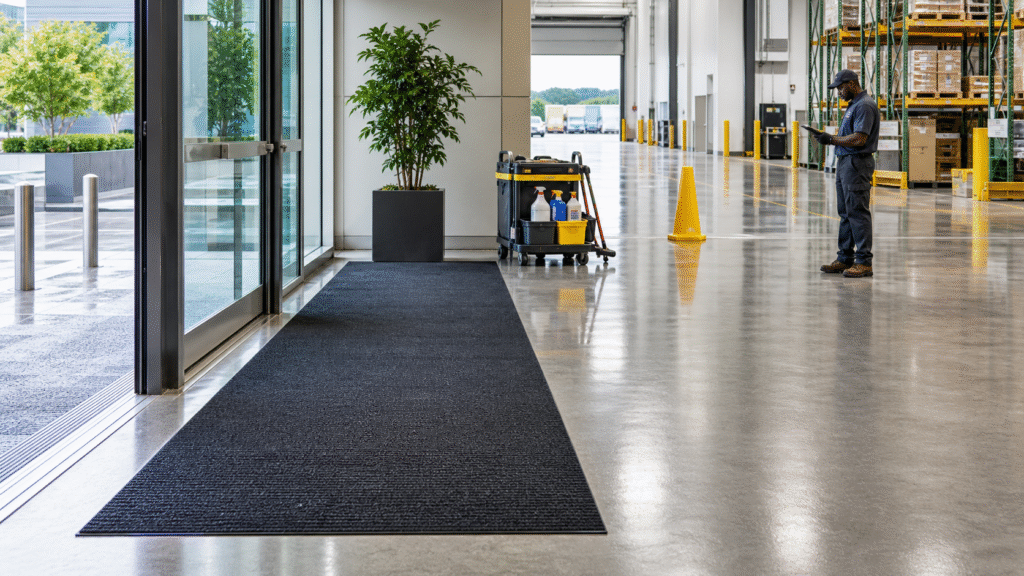
Entrance matting at every building entry captures most of the soil before it spreads onto the finished floor. Commercial-grade matting should extend at least six feet from each door, and the matting itself needs scheduled cleaning to stay effective.
In buildings with multiple entrances and uncovered loading docks, the matting program often pays for itself within one finish cycle.
Furniture Pads, Inspections, and Spill Response
Furniture pads under chairs, tables, and equipment feet prevent scratches on hard floors. Routine inspections catch cracks, chips, loose grout, and finish breakdown before they require capital repair. Prompt spill response keeps stains from setting and slip hazards from persisting.
Specialist Contractors Handle Out-of-Scope Work
Some floor care tasks exceed what an in-house team can do safely or economically. Attempting them without the right equipment or chemistry often causes more damage than the original problem.
Floor Restoration Belongs to Specialists
Stripping and recoating VCT, honing terrazzo, polishing concrete, resealing concrete, and repairing epoxy systems all need specialized equipment, chemistry, and operator certification. These jobs run on lots of time and call for facility downtime that in-house teams cannot easily accommodate.
Repair and One-Off Work Need Specialty Crews
Post-construction cleanup, move-in and move-out cleans, and major contamination events such as chemical spills or biohazard incidents all need certified specialty crews. These jobs combine compressed timelines, regulatory documentation, and specialized PPE requirements.
Damage repair sits in the same category. Cracked or chipped tile, failed grout joints, gouged VCT, and damaged epoxy patches all require materials and techniques outside routine cleaning.
Perguntas frequentes
How often should commercial floors be deep-cleaned in a large facility?
High-traffic zones typically need deep scrubbing every 1 to 3 months and full restorative treatment once or twice per year. Frequency depends on floor type, traffic volume, and contaminants. Carpet usually needs quarterly hot-water extraction. VCT needs an annual or semi-annual strip-and-recoat cycle.
What is the best floor cleaning equipment for a 10,000 m² warehouse?
A ride-on scrubber with at least an 800 mm path width and a ride-on sweeper with a path width of around 1,350 to 2,050 mm form the practical baseline for a 10,000 m² warehouse. Run the sweeper first, then the scrubber behind it. This combination supports single-shift cleaning of that floor area.
How does commercial floor care reduce slip-and-fall risk?
Daily soil and moisture removal, fast spill response, slip-resistant matting at least six feet long, wet-floor signage, and documented inspections form the core controls.
Should commercial floor care be handled in-house or outsourced?
Daily routine cleaning is usually faster and cheaper in-house once equipment is purchased and operators are trained. Periodic restorative work, such as terrazzo honing and epoxy recoating, is typically outsourced. Mixed programs are the most common arrangement in large facilities.
Which floor type has the lowest commercial floor care cost over its life?
Polished concrete and sealed concrete typically carry the lowest lifetime cost in large facilities because they avoid stripping, waxing, and recoating cycles. Vinyl composition tile carries the highest recurring maintenance cost.
Do robotic scrubbers replace ride-on equipment in commercial floor care?
Autonomous scrubbers handle repetitive open-floor cleaning well in retail, airports, and supermarkets, and they free operators for detail work. They work alongside ride-on equipment in most large facilities. Edges, ramps, and obstacle-dense zones still need operator-driven machines.
Conclusão
Effective commercial floor care for a large facility comes down to a consistent formula. Match the cleaning method to the floor type, size equipment to the actual cleaning area, schedule by traffic intensity, prevent soil at the door, and bring in specialists for work that exceeds routine capacity. Facilities that follow that formula spend less on reactive repairs, reduce slip-and-fall exposure, and extend every floor system well past its industry-average service life.
