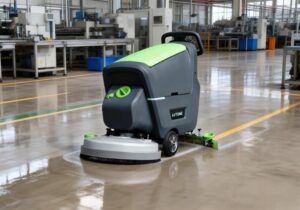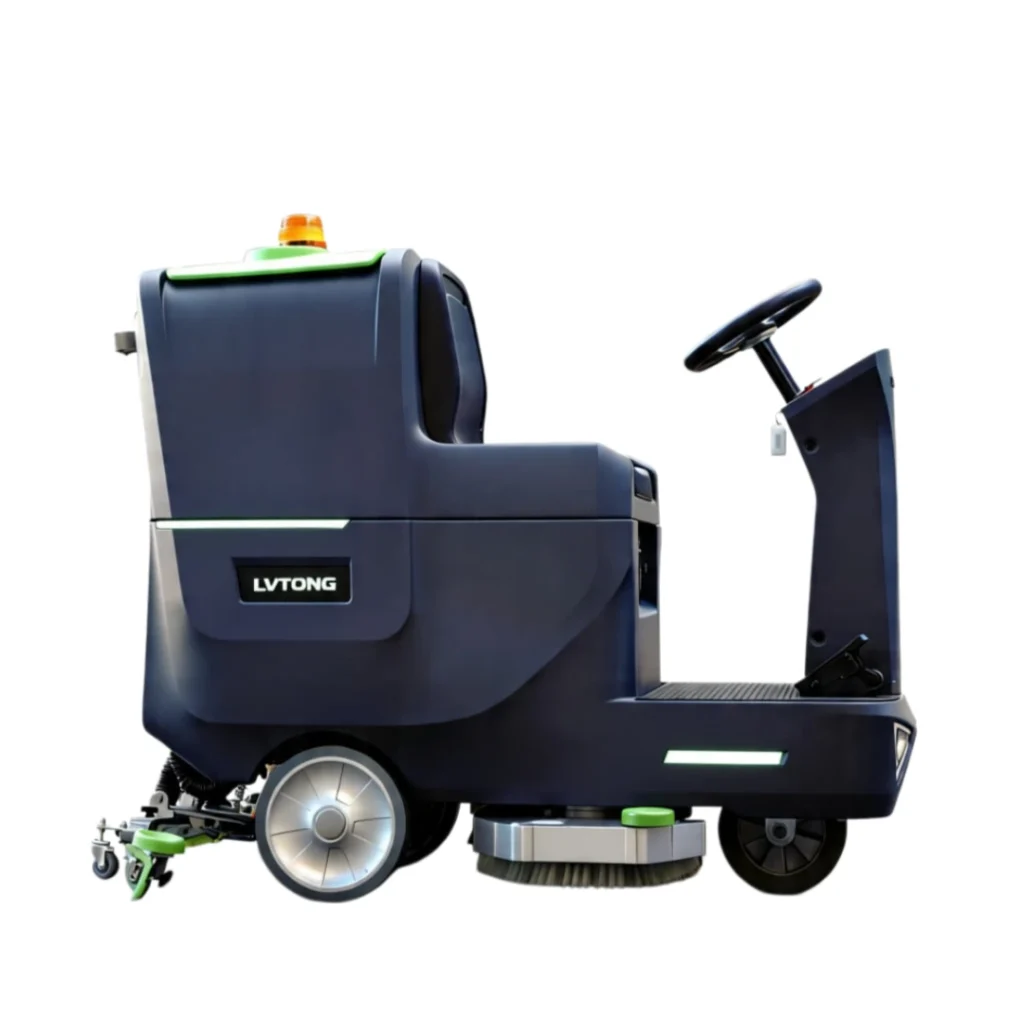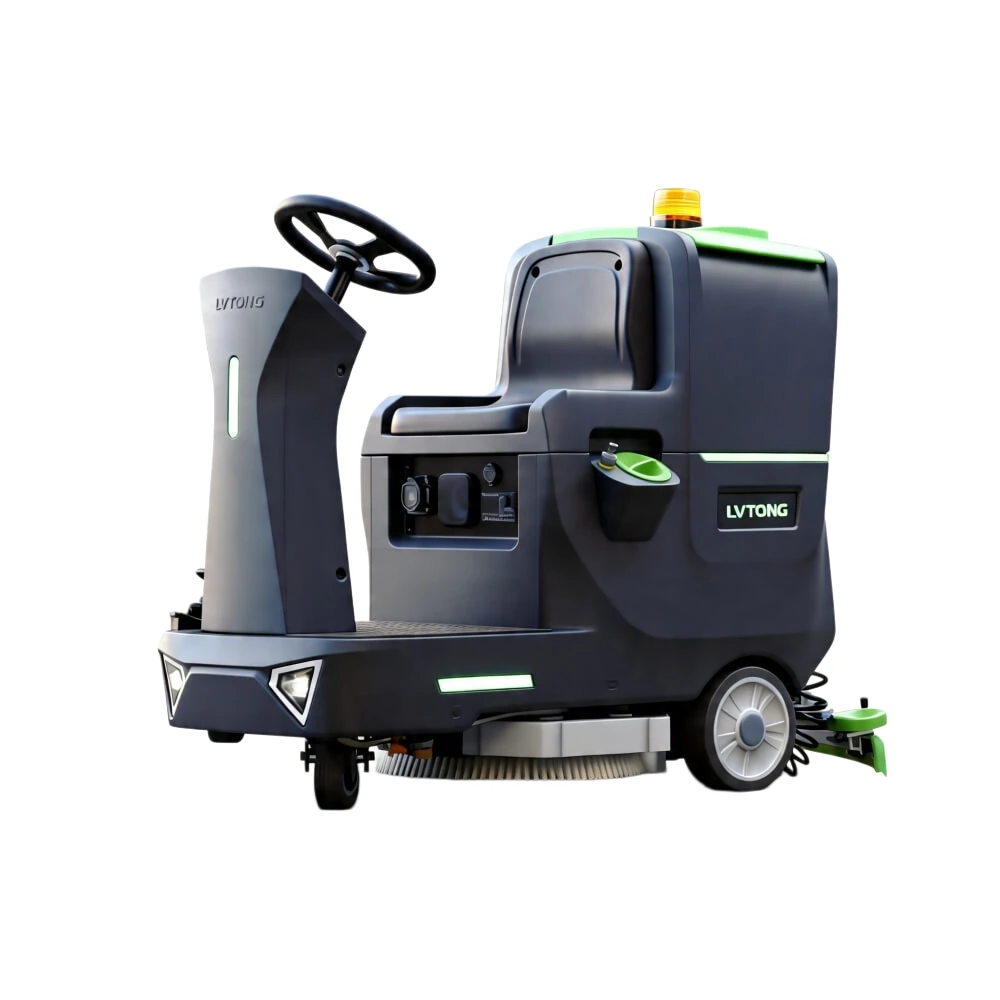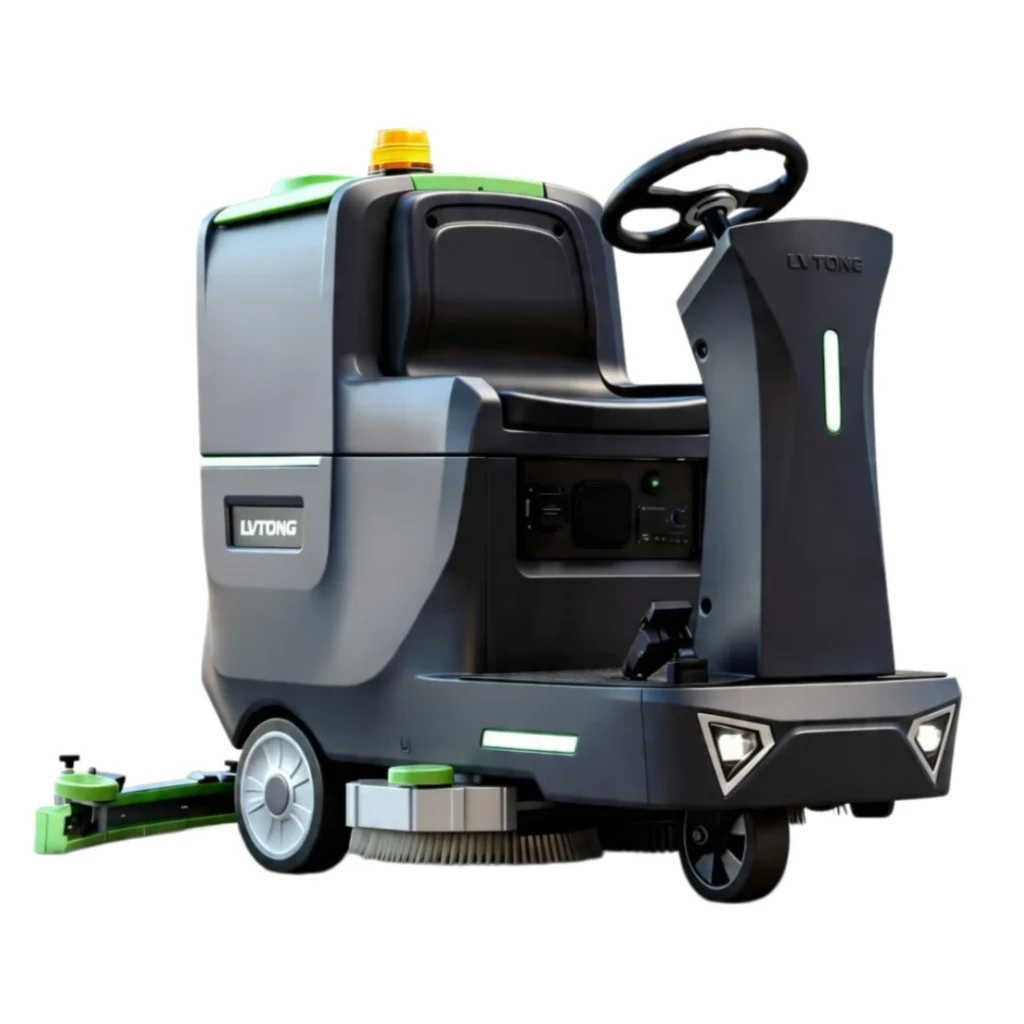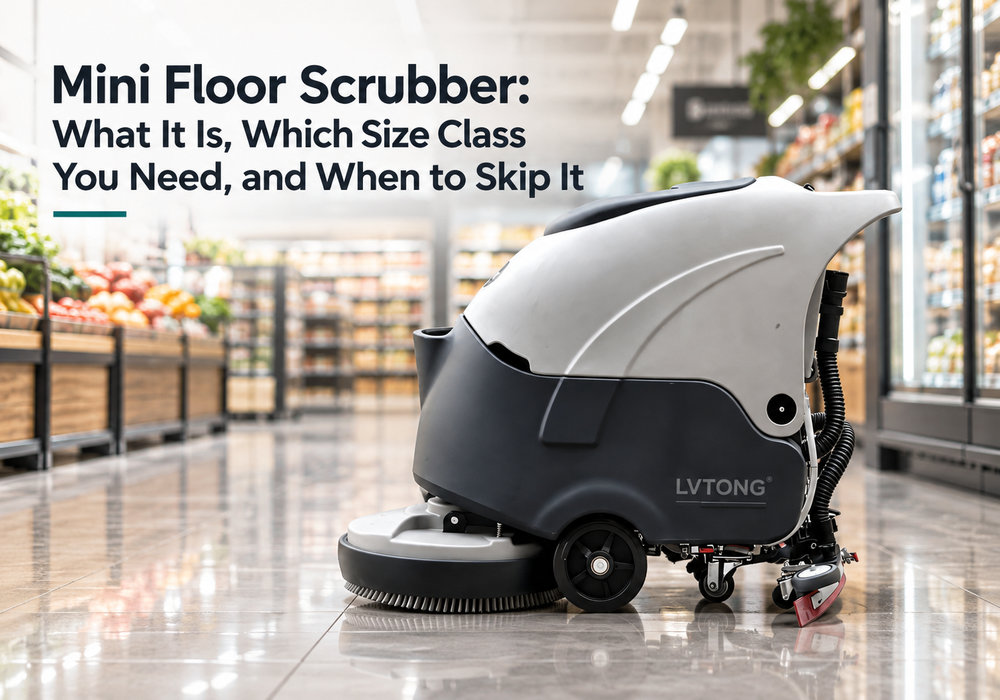
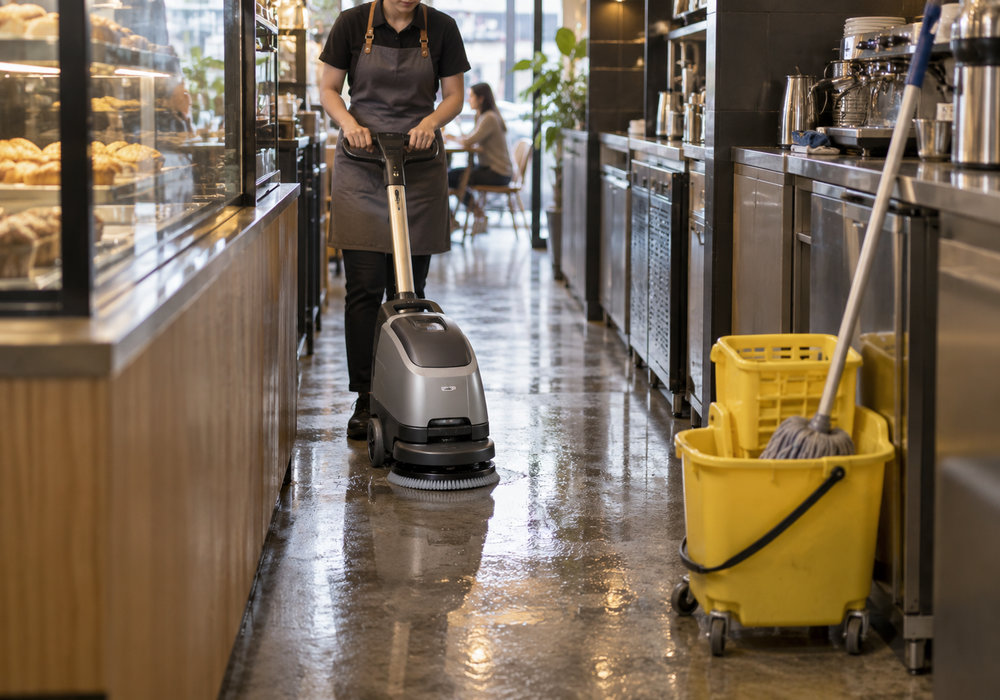
A mini floor scrubber is a walk-behind or push-along machine built for floors under roughly 500 m², typically with a scrub path between 250 and 400 mm, tanks of 8–15 liters, and either a cord, a small battery pack, or a lithium pack. It exists to replace the mop in spaces where a full-size walk-behind machine is physically or economically oversized.
That definition matters because “small” covers three machine classes buyers routinely mix up — and picking the wrong class is the most common way a mini floor scrubber purchase turns into a shelf ornament. This guide defines each class, shows where a mini beats a mop, and when to skip it for a compact machine.
QUICK ANSWER
A mini floor scrubber fits floors up to about 500 m² with narrow, fragmented areas; below that threshold a micro scrubber works, above it you need a compact walk-behind machine.
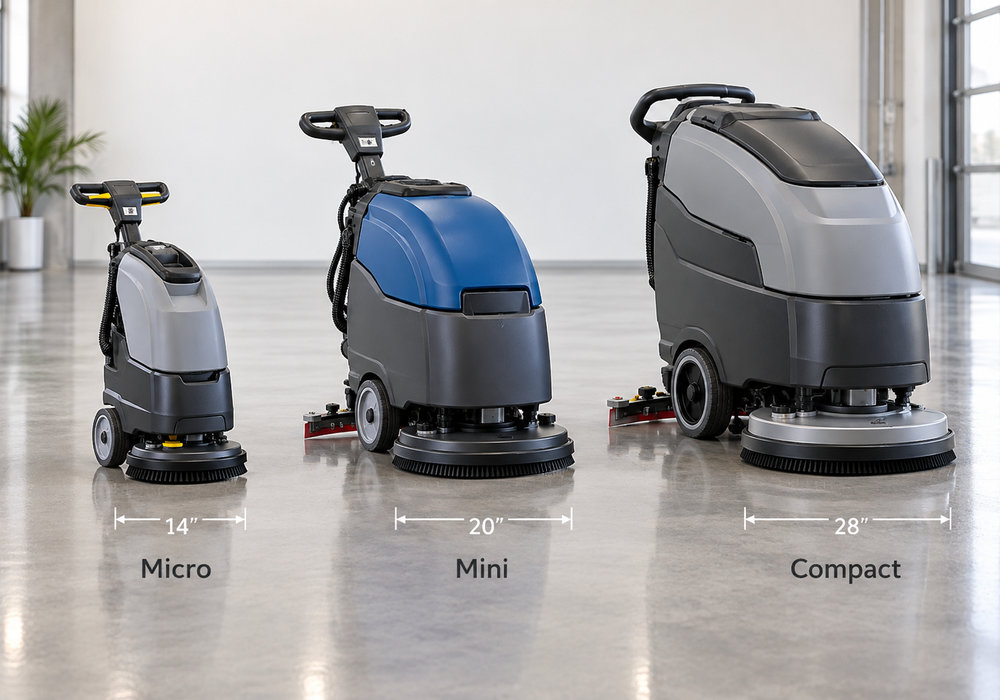
- Size class first: micro (<250 mm, hand-guided), mini (250–400 mm, walk-behind), compact (400–530+ mm, full walk-behind). Class, not brand, decides the outcome.
- Beats a mop when: soil is daily and wet-recoverable — cafés, retail aisles, clinics, classrooms.
- Skip it when: area exceeds ~800 m², debris is bulky, or you need one-pass drying — go compact, such as the Q5 walk-behind scrubber.
- Before buying: run a 2×2 m trial on your worst floor section and check recovery tank fit for your shift length.
The full class comparison is in the next section.
What Is a Mini Floor Scrubber Machine?
A mini floor scrubber machine is defined by its scrub path (250–400 mm), tank volume (8–15 L), and walk-behind or push-along format — not by marketing labels.
Three hardware traits separate a mini from everything above and below it. The scrub path stays between roughly 250 and 400 mm — wide enough for a café aisle, narrow enough to turn in a restroom or between gondolas. Tanks hold around 8–15 liters combined — small enough to fill from a tap and dump into a janitor sink.
Power is the third trait: corded models, sealed lead-acid packs, or increasingly small lithium packs. A mini floor scrubber machine is not a shrunk-down industrial scrubber — its pressure, water flow, and airflow are engineered around short shifts and light-to-medium soil.
Mini vs Micro vs Compact: Which Scrubber Class Fits Your Floor?
Micro covers under ~150 m², mini covers roughly 150–500 m², and compact machines start where minis stop — around 500–800 m² of open, continuous floor.
Manufacturers draw the lines slightly differently, but the thresholds below hold across most commercial catalogs. Use them as a first filter, then confirm against your floor plan.
| Class | Typical scrub path | Tanks | Practical area limit | Typical settings |
|---|---|---|---|---|
| Micro scrubber | < 250 mm, often hand-guided or corded | 2–8 L | < ~150 m² | Restrooms, elevators, kiosks, small cafés |
| Mini floor scrubber (walk-behind) | 250–400 mm | 8–15 L | ~150–500 m² | Retail aisles, clinics, classrooms, small lobbies |
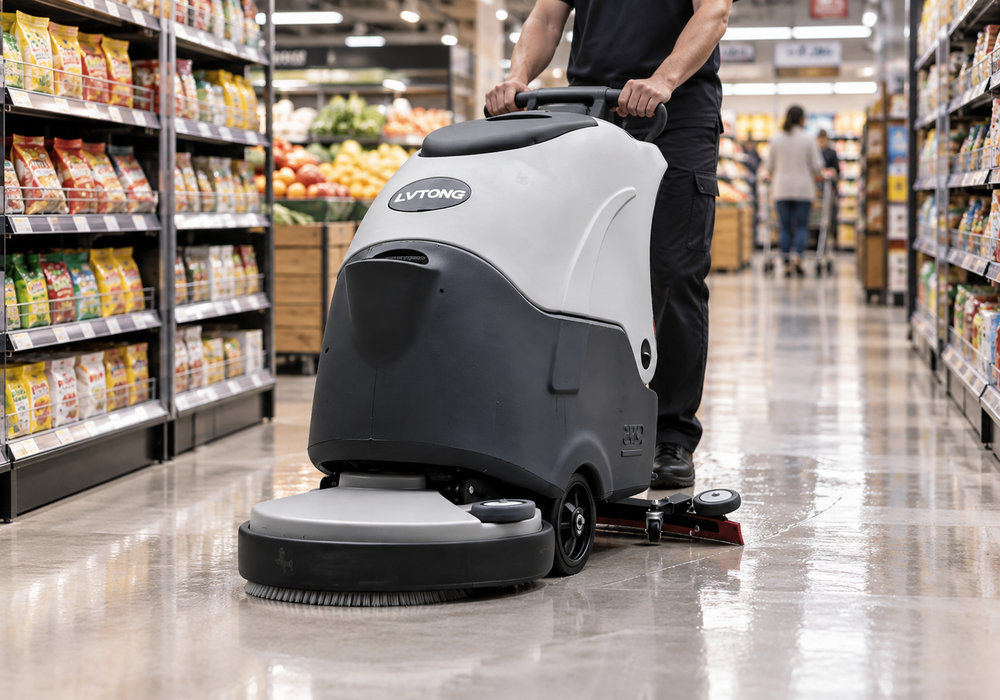
| Compact walk-behind | 400–530+ mm | 30–130 L | 500 m² and up, continuous | Supermarkets, warehouses aisles, school halls, garages |
The mini–compact boundary is where most budgets are decided. A micro mini floor scrubber combination in one handheld-size unit sounds convenient, but it inherits the micro class’s area ceiling — the “mini” in the name does not raise the coverage limit. On an open plane above about 800 m², no mini-class machine clears the floor inside a shift.
When a Mini Scrubber Is the Right Choice for Small Businesses
Choose a mini scrubber when daily soil is wet-recoverable, the floor is fragmented into small zones, and total cleanable area stays under about 500 m².
The mini class earns its keep in specific layouts, not industries. The pattern that works: several small zones separated by thresholds or fixtures; soil that is drinks, dust, and foot-traffic grime rather than chips or shavings; and an operator who already walks the floor with a mop today. A 200 m² café, a 400 m² clinic with treatment rooms, a convenience store with narrow gondola aisles — all fit.
The economic logic is the mop comparison: a mini scrubber lays down clean solution, agitates, and vacuums it back in one pass, leaving the floor dry enough to walk on. Mopping spreads soil around in dirty water and leaves a wet film — the slip exposure that OSHA’s walking-working surfaces rules are partly written around. On daily-soil floors the machine cuts both time and the wet-floor window, which is why it replaces the mop rather than supplementing it.
When a Mini Is Not Enough — and What to Step Up To
Skip the mini class when area exceeds ~800 m² per shift, debris is bulky or gritty, or the floor must be dry immediately after one pass over wide runs.
Three failure modes push buyers out of the mini class. Tank math: an 8–15 L recovery tank fills in minutes on a dirty 800 m² floor, and the operator spends more time dumping than scrubbing. Debris: sand, cardboard fibers, and production grit overwhelm a small brush and squeegee line. Runtime: at mini-class coverage rates an 800 m² floor takes most of a shift — a compact machine finishes it in under two hours.
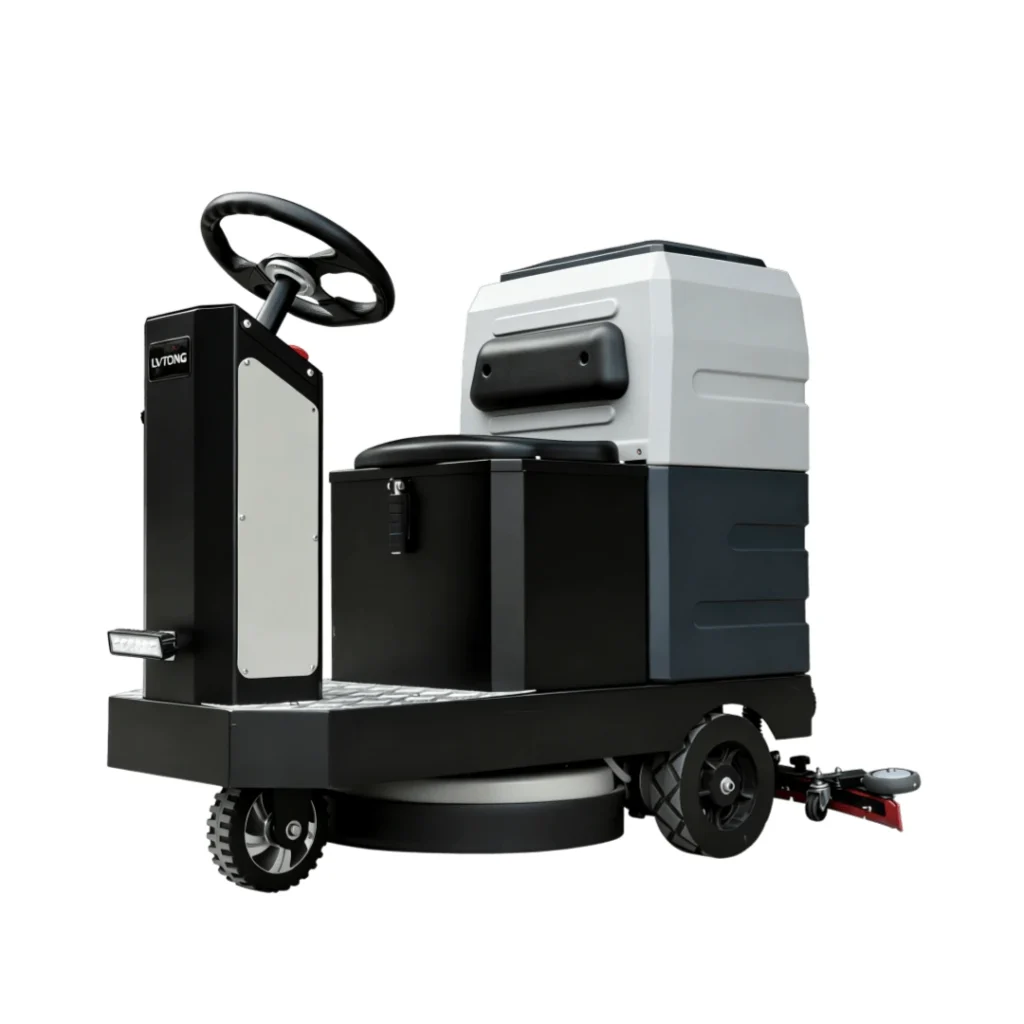
The step-up path is a compact walk-behind machine. LVTONG’s range starts exactly at this class — honestly above the mini segment — because that is where commercial payback begins. The Q5 industrial walk-behind scrubber carries a 500 mm scrub path and about 2,100 m²/h of coverage on lithium power, and the LT-S530X extends the same format to a 530 mm path with 62+65 L tanks and a 24V 100Ah battery for longer shifts. Both are documented with full spec tables on the cleaning equipment range page.
Mini Floor Scrubber vs Mop: Where the Math Actually Works
A mini scrubber beats a mop on daily-soil floors within a year in most cases; it never beats a mop where soil is a few spot spills a day.
Count the daily wet-cleanable area first. If a mop-and-bucket routine covers more than roughly 150–200 m² per day, a mini scrubber typically repays the difference in labor hours and water use within the first year — and the recovered water goes into a tank instead of onto the floor. Below that threshold, the mop is genuinely adequate.
This is also the honest boundary against aggressive reseller claims: a mini is a mop replacement for a specific area band, not a universal upgrade. For the labor and hygiene math at facility scale, see our guide to moving beyond the mop; for the 500–2,000 m² band, the walk-behind scrubber guide for small and medium facilities covers the compact class in depth.
Micro scrubber: when the smallest class is the right one
A micro scrubber — scrub path under 250 mm, tanks under 8 L — is the right tool for restrooms, elevator cabins, and single-room retail units where even a mini cannot physically turn. Buy micro for the corners and rooms, not for the floor a mini already covers.
Specs That Matter Most on a Mini Floor Scrubber
Judge a mini on four specs — scrub path, recovery tank, squeegee pickup quality, and brush pressure adjustability — before comparing price.
- Scrub path vs turn radius. A 350 mm path is useless in a store where the tightest turn is 900 mm. Measure your narrowest aisle first.
- Recovery tank, not solution tank. Recovery volume determines dump frequency — ask for that number specifically.
- Squeegee and vacuum pickup. On small machines this decides between dry-after-one-pass and a follow-up mop wipe — check that pickup width exceeds scrub width.
- Adjustable brush pressure. Sealed surfaces need low pressure and soft brushes — check that pressure can be turned down, which many mini listings omit.
- Battery chemistry. Lithium charges faster and holds capacity across daily cycles; sealed lead-acid costs less upfront but fades in year two.
Battery vs Corded Mini Scrubbers
Battery wins for multi-zone floors and daily use; corded wins only for single small rooms near outlets.
A walk behind micro scrubber on a cord is the cheapest entry into the class and suits one-room operations, but the cord constrains the fragmented-zone layouts that justify the class. Battery models free the operator to move zone to zone — the actual working pattern of a mini’s target facility. The trade is charging discipline: lithium packs want a nightly cycle and a defined storage charge for weekends and holidays.
Facilities discharging scrubber water to exterior drains should confirm local wastewater rules; in the United States, industrial stormwater discharges fall under EPA NPDES permits. Most mini-class dumping goes to sanitary drains, but the check costs one phone call.
First-Pass Testing Protocol Before You Buy
Test any mini scrubber on a 2×2 m section of your worst floor, check dryness after five minutes, and inspect the recovery water — it shows what the mop was leaving behind.
Run the trial where soil is heaviest. Scrub the 2×2 m section at default settings, then check three things: whether the floor is dry within five minutes, whether the squeegee line streaked at the turns, and what the recovery water looks like against a fresh mop bucket. Light-gray recovery water on your dirtiest section means the machine is under-specified for your soil load — step up a class rather than doubling passes.
Repeat across two shift patterns if possible; tank fill and battery sag show up in the second hour. A confident supplier will hand over a demo unit for exactly this purpose, and the protocol doubles as the acceptance script we recommend to distributors and rental fleets.
Buying Checklist: Mini Floor Scrubber Procurement, Simplified
Lock five decisions before comparing quotes: class per your floor plan, battery chemistry, recovery tank per shift length, spare-parts terms, and local voltage certification.
- Confirm the class against the thresholds in section 2 — mini only if area is 150–500 m² and fragmented.
- Choose chemistry: lithium for daily multi-zone use, sealed lead-acid for tight budgets and light duty.
- Size the recovery tank to your shift, not to the marketing sheet.
- Get spare-parts and brush/pad supply terms in writing — consumable availability ends more mini-class careers than hardware failure does.
- Confirm destination-market requirements (voltage, plug, certification) with the supplier before ordering, especially cross-border.
If the checklist lands you above the mini class, compare compact machines directly — the LT-S530X specification page publishes the numbers that mini-class quotes should be measured against, and our team supports OEM, private-label, and fleet specification for buyers consolidating small-format sites.
FAQ: Mini Floor Scrubber Questions Buyers Actually Ask
What is the difference between a mini floor scrubber and a micro scrubber?
Scrub path and area ceiling. A mini runs 250–400 mm and covers up to roughly 500 m²; a micro scrubber stays under 250 mm and under about 150 m². Micro is for restrooms and single rooms; mini is for full small-facility floors.
Can a mini floor scrubber replace a mop completely?
On daily wet-cleanable soil within its area band, yes — that is the class’s design intent. On floors above ~800 m² per shift, no mini-class machine replaces the mop’s coverage; that requires a compact walk-behind.
Is a micro mini floor scrubber combination a good buy?
Only if your real need is the micro class. Combination naming does not raise the coverage ceiling — check the actual scrub path and tank volume before paying for the label.
How long does a mini floor scrubber battery last per charge?
Typically 1.5–3 hours of running time — roughly 200–400 m² of real cleaning including turns and dumping. Lithium packs hold this range better across daily cycles than sealed lead-acid.
Does LVTONG sell mini floor scrubbers?
No. LVTONG’s range starts at the compact walk-behind class — the Q5 (500 mm) and LT-S530X (530 mm) — because commercial payback concentrates there. This guide covers the mini class so buyers can verify the fit before upsizing; when the fit fails, our compact machines are the direct step up.