QUICK ANSWER
A shop floor cleaner is specified by the residue the process leaves behind — swarf, coolant or settling dust — because each fails a machine differently. Floor area sets the size; the process decides which machine survives there.
- Machining floors produce swarf and cutting fluid together; scrubbing before dry collection turns chips into slurry that clogs recovery systems.
- Assembly and electronics floors fight fine dust and static, not oil — dry collection leads and wet cleaning stays in defined zones.
- Foundry, welding and grinding areas generate heavy settleable dust; sweepers carry the load and scrubbing follows.
- Food, medical and precision areas add washdown, drainage and documented hygiene requirements — confirm them with the manufacturer.
Below: three residue types, four shop floor profiles, the dry-before-wet rule, and a six-line specification.
Why a Shop Floor Is Not Just a Dirty Floor
A production floor carries the by-products of a process, not random dirt — and process residue has a chemistry and a particle size that dictate the cleaning method before any machine is compared.
Most cleaning advice treats industrial floors as one category and ranks machines by size. In a plant that breaks early: a machining cell is coated in cutting fluid mist and metal fines, an assembly line in packaging dust, a foundry in settleable sand and casting dust. A shop floor scrubber machine that performs well in the first can be the wrong tool in the second and a hazard in the third. Sorting the residue first makes the rest mechanical rather than opinionated. Our overview of common industrial floor cleaning problems catalogues the symptoms; this guide works backwards from the process.
The Three Things a Process Leaves on the Floor
Every shop floor residue falls into one of three physical states — solid, liquid or airborne — and each state constrains a different part of the machine.
| Residue type | Typical sources | What it does to equipment | Cleaning implication |
|---|---|---|---|
| Solid particles (swarf, chips, sand, offcuts) | Turning, milling, grinding, casting, sawing | Packs brush tufts, scratches pads, blocks recovery filters and squeegee channels | Must be collected dry and removed before any water touches the floor |
| Liquid films (coolant, hydraulic oil, release agents) | Machining centres, presses, moulding, maintenance drips | Foams in the recovery tank, kills vacuum, makes squeegee rubber hydroplane, leaves a film that re-soils fast | Needs defoaming discipline, firmer squeegee pressure and a legal disposal route |
| Airborne dust (fine particulate, metal oxide, flour, cement) | Grinding, welding, sanding, bulk handling, casting shakeout | Loads filters within hours, redeposits behind the machine, becomes airborne again if swept dry with the wrong tool | Requires dust-controlled collection and a route planned from clean to dirty |
A shop floor cleaning machine is therefore selected for the dominant state first and the secondary second. Where both arrive together — machining floors being the standard case — sequence matters more than the spec sheet.
Four Shop Floor Profiles and the Configuration Each One Needs
Machining, assembly, heavy-dust and hygiene-critical shops need four different configurations, and the differences are structural rather than cosmetic.
| Profile | Dominant residue | Configuration that holds up | The constraint that decides it |
|---|---|---|---|
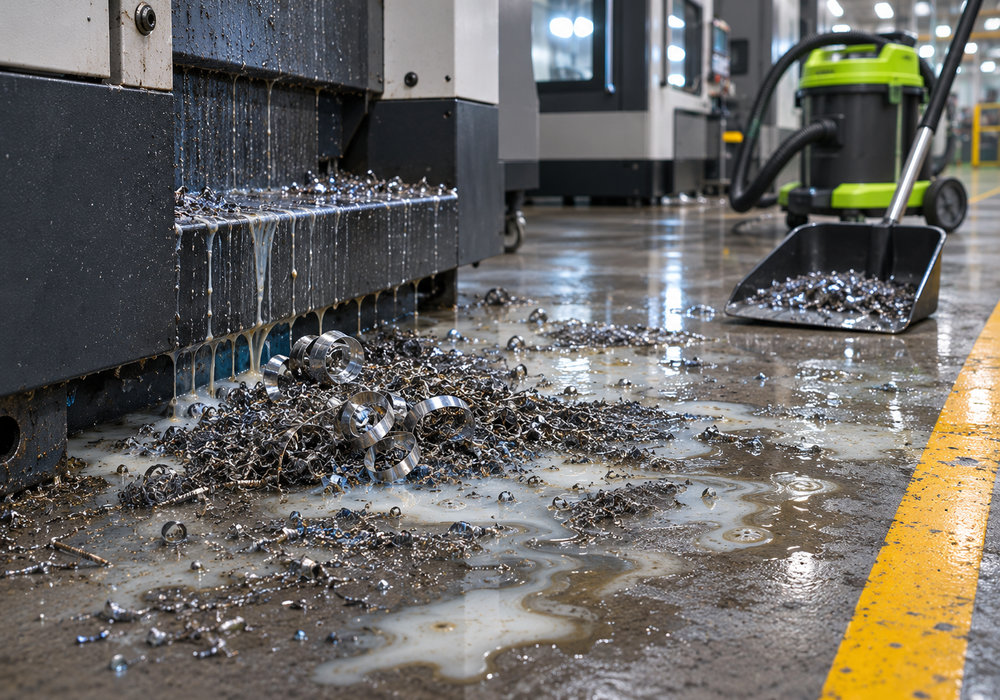
| Machining and CNC cells | Swarf plus cutting fluid, wet and sticky | Dry collection first, then a scrubber with abrasion-tolerant squeegee, defoaming and oil-tolerant recovery | Slurry management: chips must never enter the recovery tank |
| Assembly, electronics, light mechanical | Fine dust, packaging fibre, small components | Compact walk-behind with high filtration, low water use, static-aware accessories | Access between benches and the risk of driving water into electrics |
| Foundry, welding, grinding, sanding | Heavy settleable dust over large footprints | Sweeper-led programme with a scrubber for the wet zones only | Volume of dust: dry capacity, not cleaning width, becomes the limit |
| Food, medical and precision manufacturing | Organic soil, washdown water, controlled contamination | Washdown-capable scrubber with documented tank and material specifications | Documented hygiene and drainage requirements — confirm with the manufacturer |
The best shop floor cleaner for a plant is the one whose weak point sits outside its dominant residue: strong water recovery with a fine-particle filter suits a bottling line and fails in a grinding hall.
Dry Before Wet: the Sequence That Decides Whether the Job Works
On any floor carrying solid chips, dry collection must come first — once water reaches metal fines they become a slurry that no squeegee can recover cleanly.
This rule separates shops that clean well from shops that clean constantly. Aluminium or cast iron fines behave like grit under a brush: they abrade the floor finish, score painted lines and wear the brush skirt in weeks. Add water and the same fines become a paste that smears across the aisle, dries into a bonded film and loads the recovery filter until suction drops. Crews respond by scrubbing harder, driving more slurry into corners and drains. The correct order is unglamorous: dry collection, then wet scrubbing, then a dry pass on any zone carrying foot traffic immediately. That is why mixed-residue plants usually run two machines — a factory floor scrubber bought first is often joined by a sweeper within a year. The test for needing both is mapped in our guide to choosing between sweeping and scrubbing.
What Coolant and Oil Do to a Scrubber
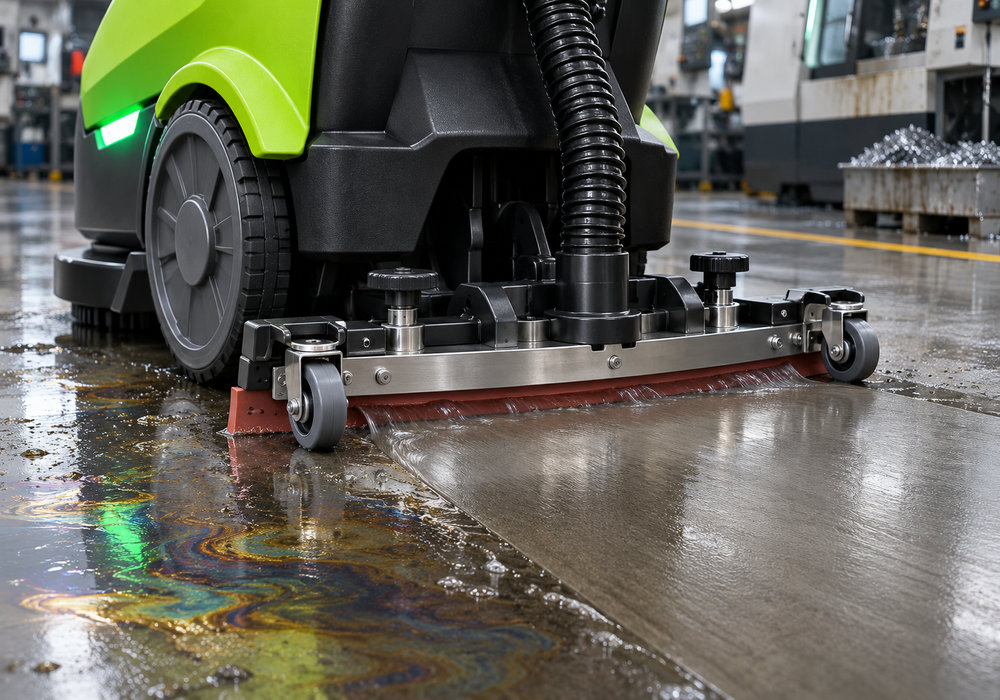
Cutting fluid attacks three parts of the cleaning system — foam in the recovery tank, the squeegee’s grip, and the legality of what you pour away.
Coolant carries surfactants that foam violently in the recovery tank. Foam reaches the float switch, the vacuum cuts out, and the operator sees a machine that has “stopped sucking” when the fault is chemistry. Defoamer and lower solution concentration solve most of it — one of the few places where the chemical supplier, not the machine supplier, owns the answer. The second is mechanical: oil film between squeegee rubber and floor lubricates the blade, so it rides over the liquid and leaves a residue that re-soils within hours. Firmer pressure, a sharper edge and the right compound recover most of it, as covered in our squeegee and brush selection guide. The third failure is regulatory. Wash water carrying oil and metal fines is process wastewater, not trade effluent for a storm drain; US-bound operations reference programmes such as EPA’s NPDES for discharge routes, and many sites need settling before disposal. Budget that before ordering the machine — a scrubber without a legal drain will not be run.
Cleaning Around the Production Clock
Shop floor cleaning is scheduled by the production plan, not by the cleaning team — the usable window sits between the last part and the first, and it is usually shorter than the area suggests.
Three windows exist: the changeover gap between shifts, the maintenance window when machines are stopped, and the weekend shutdown. Changeover gaps suit localized work — one cell, one aisle — with a compact machine that enters and leaves without blocking a walkway. Maintenance windows allow the heavier pass, since equipment is already stopped. The weekend carries the deep work: full-floor scrubbing, tank and filter service, floor marking restoration. The planning error is expecting the changeover gap to carry the whole plant. Where cleaning must run during production, the choice narrows to a quiet compact machine crews can route around active cells — daytime acoustics are covered in our low-noise scrubber guide. A shop floor cleaning plan that assumes a three-hour window usually collapses in month two, when overtime absorbs the shortfall.
The Safety Case: Oil Film, Chips and Forklift Traffic
A machined floor combines three slip mechanisms — oil film, loose chips and steel-wheeled traffic — and one pass that removes all three beats any safety policy.
Slip resistance is a property of the floor surface, not the cleaning method, and it degrades the moment oil sits on top. Wet-film contamination is the dominant cause of shop floor falls; programmes such as the National Floor Safety Institute document how treated surfaces are measured and maintained. General industrial walking surfaces fall under walking-working-surface rules, with 29 CFR 1910 Subpart D as the US reference point. Chips add a second mechanism: a metal curl behaves like a roller under a boot and a projectile under a forklift wheel. Traffic adds the third: steel wheels polish an oily film into a glaze that signage does not counteract. For a shop floor cleaner machine, the safety case supports three choices — recovery strong enough to leave the floor dry, a route that reaches under benches and around machine bases, and a schedule that clears oil before the shift change. Electrical safety for this class sits in the IEC 60335-2-72 family, worth naming when you request documentation.
What a Shop Floor Cleaner Cannot Do
Some shop floors need equipment this category does not include, and knowing the limits early prevents an expensive mismatch.
Three limits matter. First, explosive atmospheres: areas classified for combustible dust or solvent vapour need certified explosion-protected equipment, and no standard industrial scrubber qualifies — specify separately and confirm certification before purchase. Second, combined sweeping and scrubbing: single-pass machines exist, but this manufacturer builds dedicated scrubbers and sweepers, so mixed-debris shops should plan a two-machine route. Third, ultra-fine or hazardous particulate: sub-micron dust and any material with an exposure limit needs extraction at source or HEPA-class collection, a different category. Where a plant sits outside all three, an ordinary lithium-battery scrubber is usually right; where it sits inside one, solve that constraint first.
A Six-Line Specification for Shop Floor Equipment
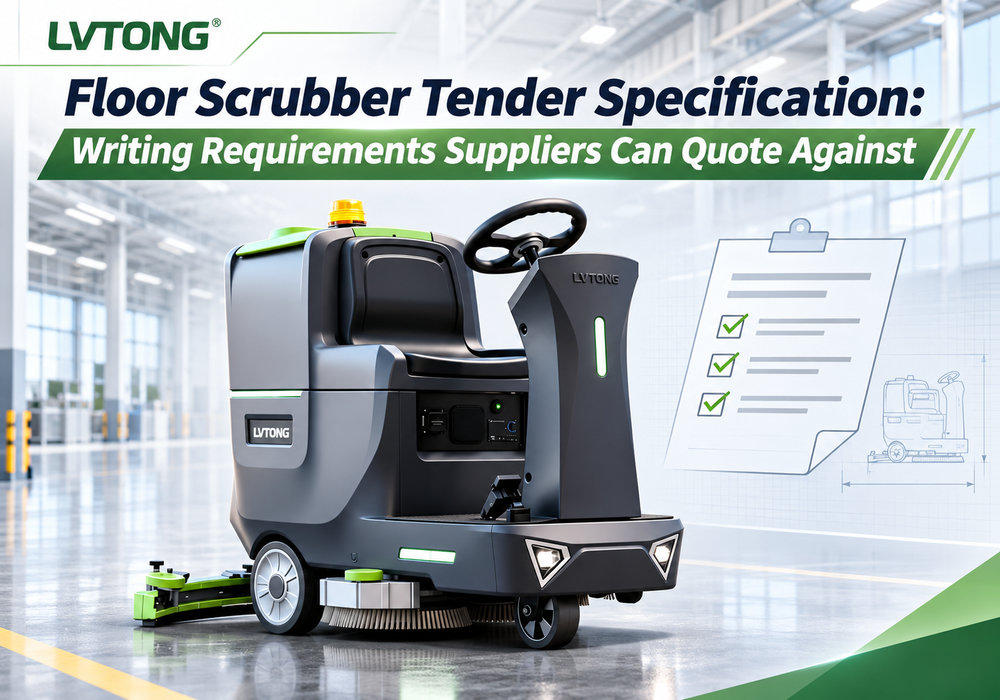
Six lines, written plainly and sent to suppliers, expose whether they understand production cleaning or are quoting from a catalogue.
| # | Line | What to state |
|---|---|---|
| 1 | Process and residue | Process type; dominant residue, wet or dry |
| 2 | Area and route | Total m², cells or zones, narrowest access, ramps |
| 3 | Cleaning window | Changeover, maintenance or shutdown; minutes per pass |
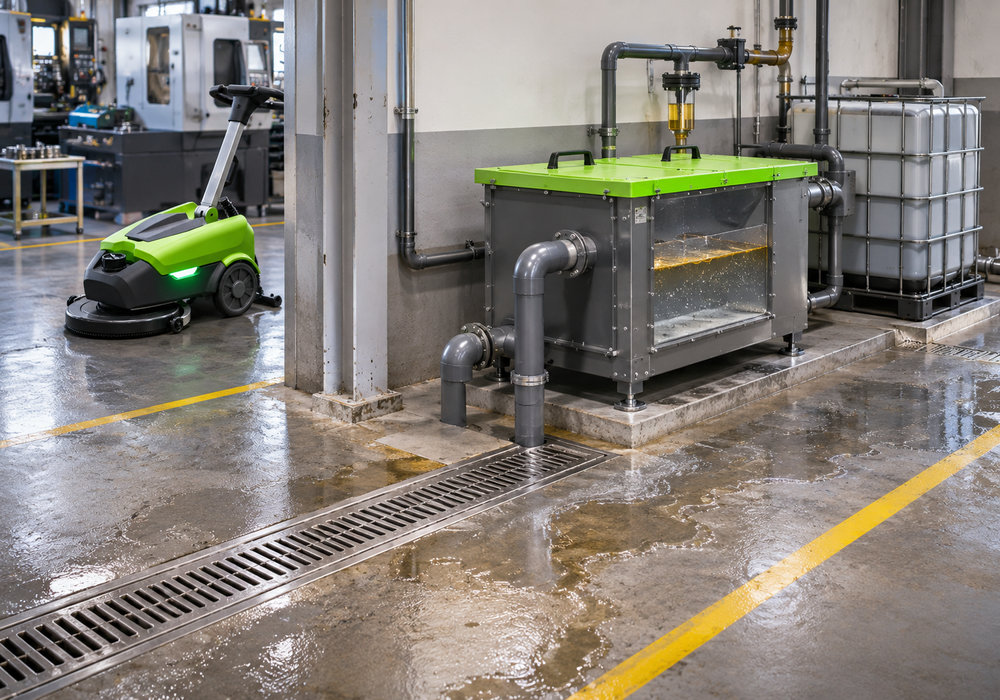
| 4 | Water and drainage | Refill point, drain location, oil separation |
| 5 | Atmosphere and certification | Any classified zone, dust class or hygiene standard |
| 6 | Consumables and support | Brush and squeegee life, spare lead time, training |
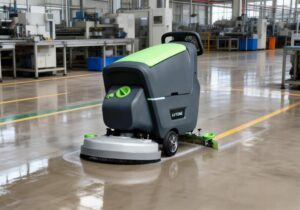
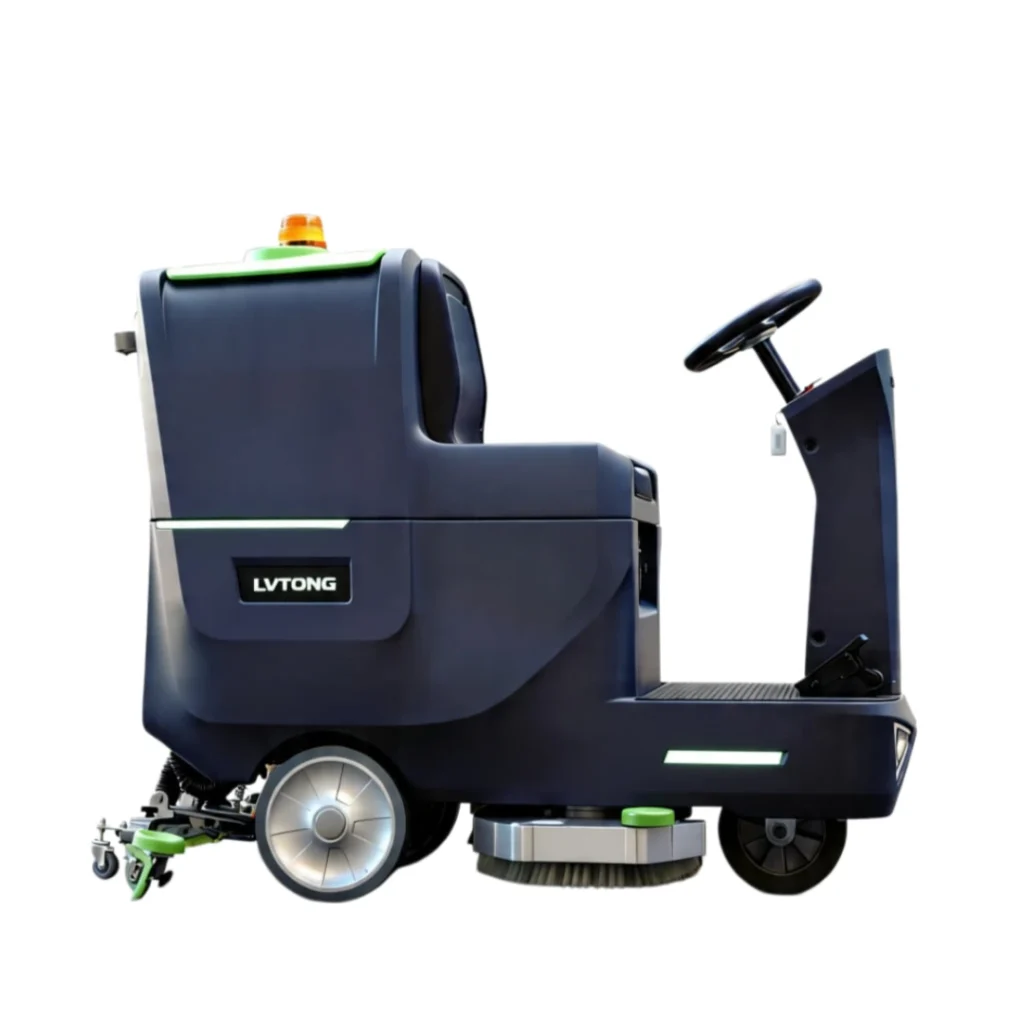
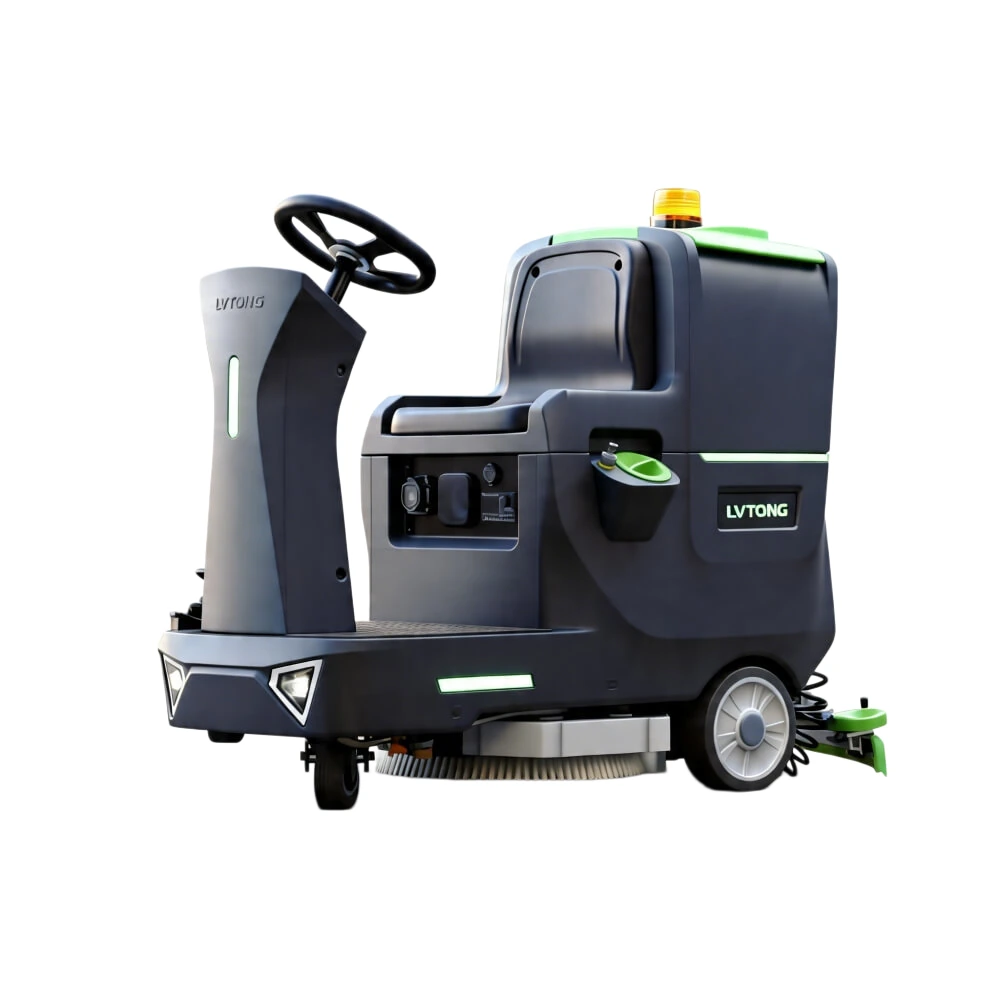
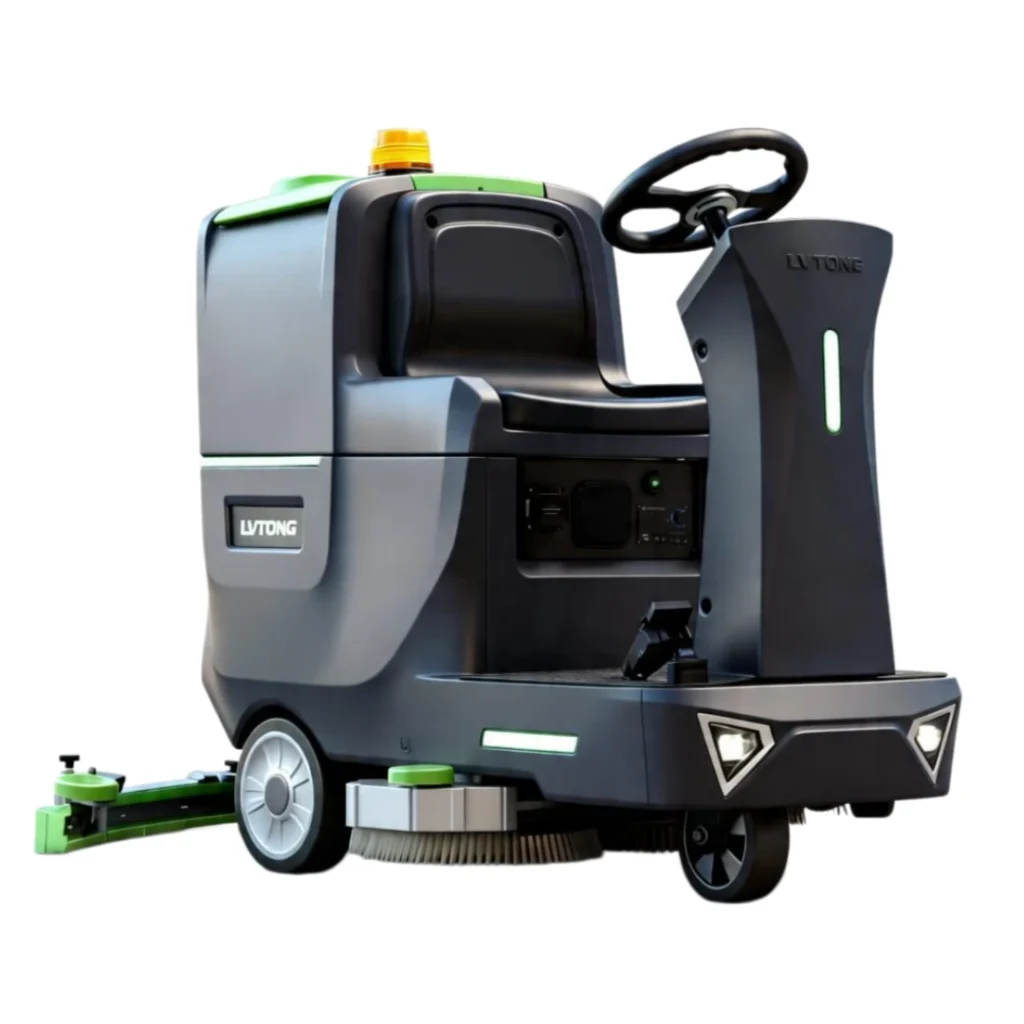
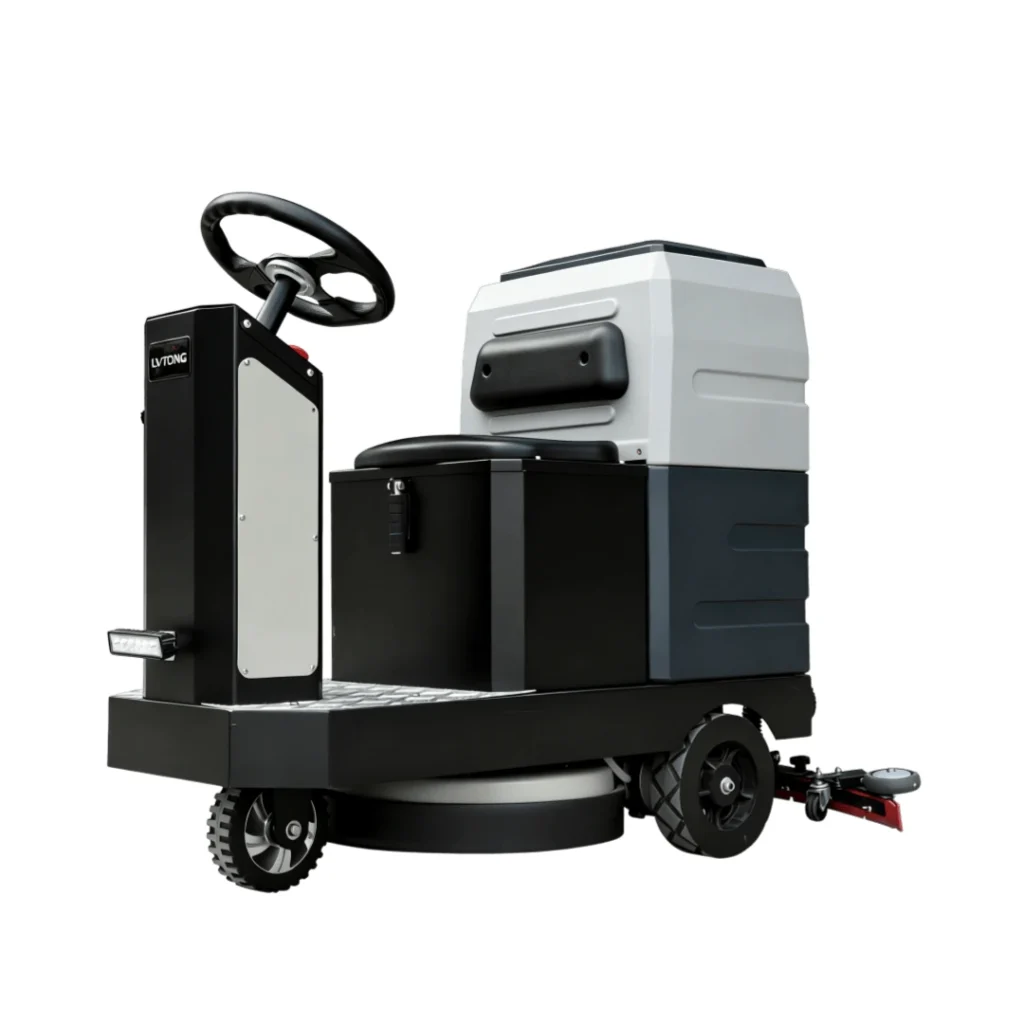
A supplier who answers with a configuration and asks about the two lines that matter most is worth shortlisting. Most shop floor cleaners are quoted by cleaning width; a reply with only that has not read line one. To have these six lines checked against a floor plan, send the profile to our team and we will return a machine and consumable plan for the process you run — for a compact plant, a walk-behind unit such as the LVTONG LT-S530X shop floor cleaning machine (50 cm body width, 2,100 m²/h rated output); for larger footprints, the ride-on class takes over.
Frequently Asked Questions
What is the best shop floor cleaner for a machining workshop?
A two-pass setup works best: dry collection for swarf, then a scrubber with an abrasion-tolerant squeegee and defoaming for the coolant film. The best shop floor cleaner here is the one that never lets chips reach the recovery tank.
Can a floor scrubber handle metal chips?
Not as a first pass. Chips abrade brushes and block recovery systems, and once wet they form a slurry that smears rather than lifts. Collect dry first, then scrub — that sequence is what makes a shop floor cleaning machine last.
How do I stop a scrubber from foaming with cutting fluid?
Reduce solution concentration, add a defoamer, and clean the recovery tank’s float switch. Foam reaching the float mimics a vacuum failure, and operators replace parts when the fix is chemical.
Do I need explosion-proof equipment on a shop floor?
Only where the area is formally classified for combustible dust or solvent vapour. Standard industrial scrubbers are not rated for classified zones, so that call belongs with your process safety assessment.
How often should a factory floor scrubber be run?
Match frequency to shift pattern and residue: machining cells usually need a daily localized pass plus a weekly full scrub, while assembly areas tolerate a lighter cadence. Let floor condition, not the calendar, set the interval.