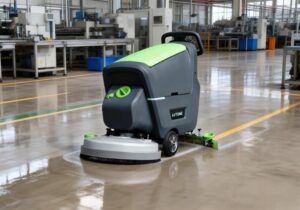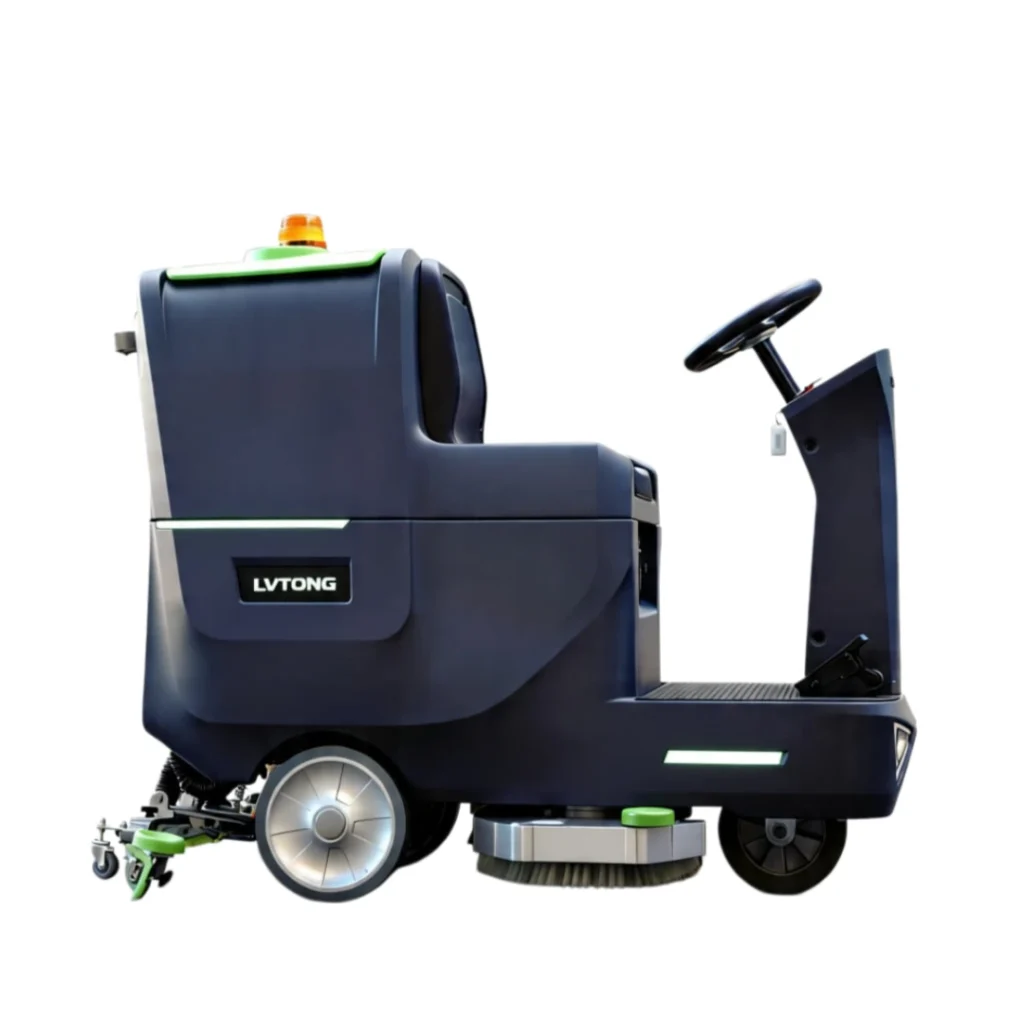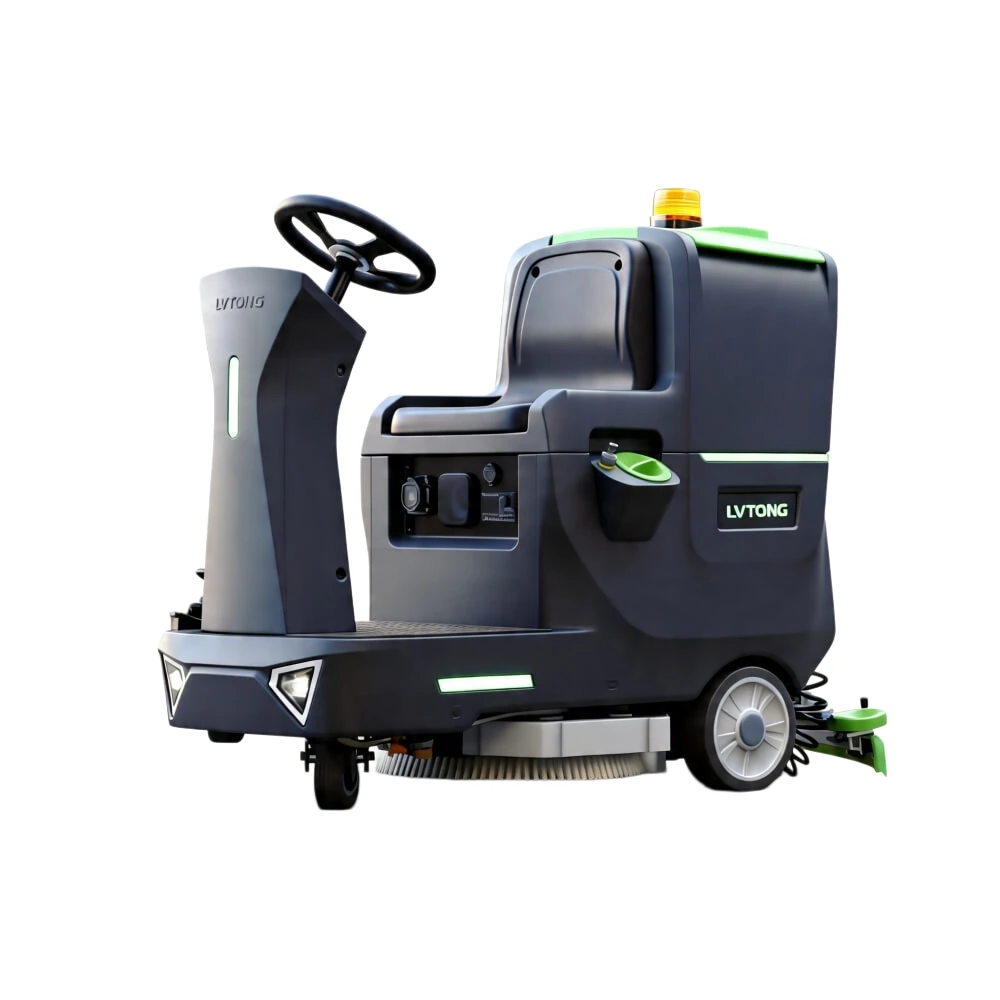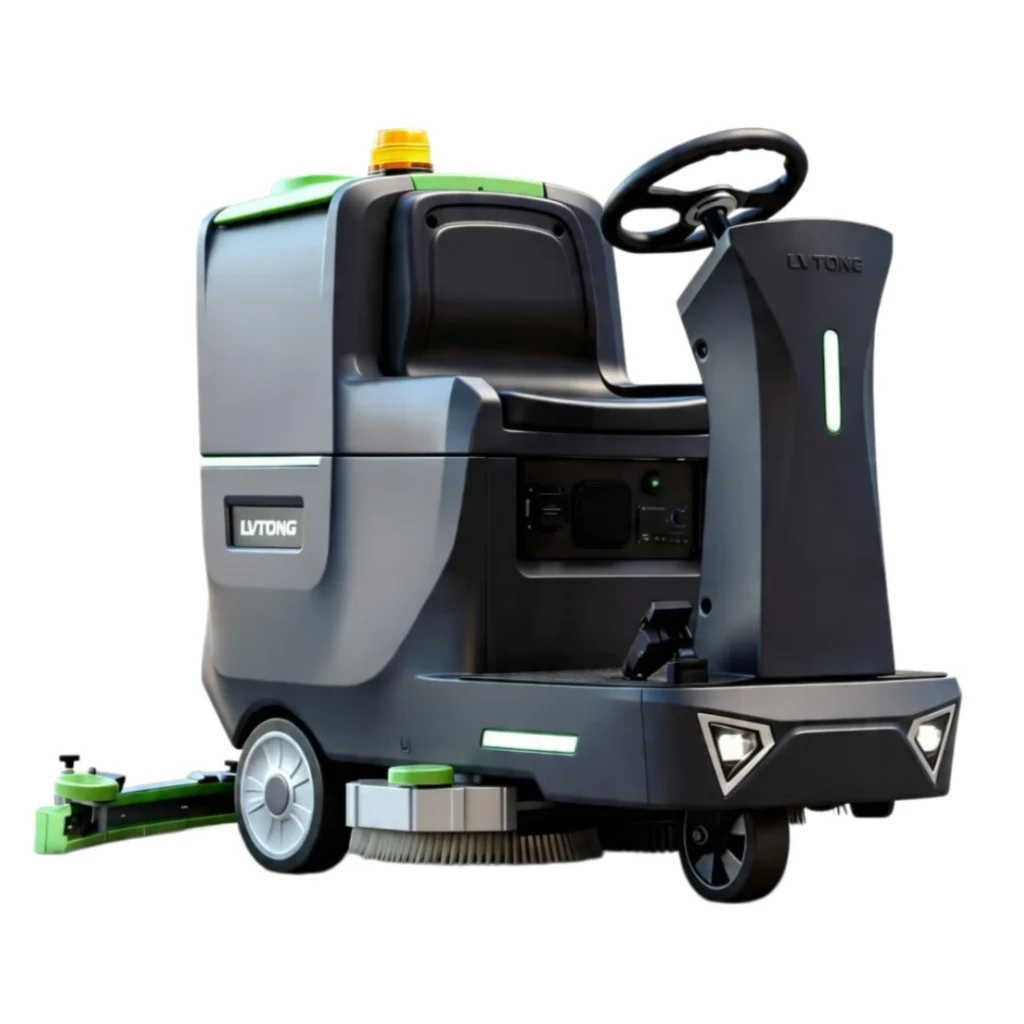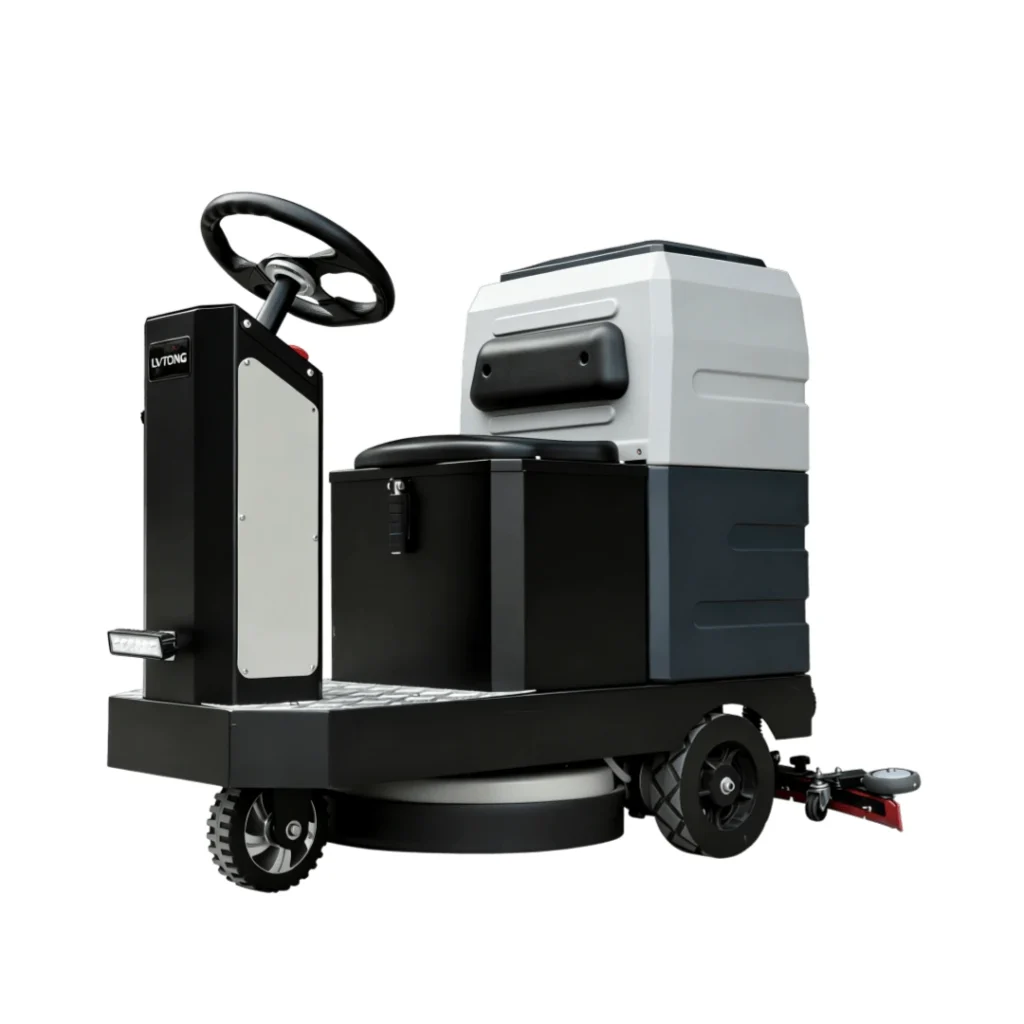
Choosing the right warehouse floor scrubber depends on facility size, aisle width, floor type, debris level, cleaning frequency, and practical coverage rate. A small warehouse with narrow aisles may need a compact walk-behind scrubber, while a large distribution center or open warehouse floor usually needs a ride-on warehouse floor scrubber for higher productivity.
A good warehouse floor scrubber should not only clean the floor, but also reduce operator fatigue, improve water recovery, control cleaning time, and lower total operating cost over the machine’s service life.
This guide explains how to choose a warehouse floor scrubber by warehouse size, aisle width, floor type, debris level, brush system, tank capacity, coverage rate, and total cost of ownership. It also compares walk-behind and ride-on warehouse scrubbers so facility managers can make a more practical buying decision.
Quick Answer
A warehouse floor scrubber should be chosen based on facility size, aisle width, floor type, debris level, and practical coverage rate. Walk-behind scrubbers are better for small warehouses and narrow aisles, while ride-on warehouse floor scrubbers are more efficient for large open areas above 20,000 sq ft.
Warehouse Floor Scrubber Decision Framework
This guide should be used as a practical decision framework for warehouse managers, factory maintenance teams, logistics operators and procurement buyers.
Before comparing models, first define the actual cleaning route, not only the total building size. Buyers should confirm cleanable floor area, aisle width, floor material, debris level, forklift traffic, daily cleaning frequency, water recovery requirements and available cleaning time.
A warehouse floor scrubber should be selected based on whether it can complete the real cleaning route safely, consistently and with acceptable labor cost, maintenance cost and downtime.
What Is a Warehouse Floor Scrubber?
A warehouse floor scrubber is a floor cleaning machine designed to wash and dry warehouse floors using brushes or pads, water, detergent, and a recovery system. It is commonly used to remove forklift tire marks, dust, grime, spills, and sticky dirt from concrete, epoxy, and other industrial floor surfaces.
Unlike dry sweeping equipment, a warehouse floor scrubber is used when the floor needs wet cleaning, scrubbing pressure, and wastewater recovery. This makes it useful for facilities that need cleaner, drier, and safer floors during daily operations.
Warehouse Floor Scrubber vs General Commercial Floor Scrubber
A warehouse floor scrubber is a more application-specific cleaning solution than a general commercial floor scrubber.
General commercial floor scrubbers are commonly used in schools, hospitals, supermarkets, offices and public buildings. Warehouse floor scrubbers must usually handle larger open areas, forklift tire marks, dust, packaging debris, concrete or epoxy floors, long cleaning routes and frequent daily use.
For this reason, warehouse buyers should pay more attention to practical coverage rate, tank capacity, water recovery, brush pressure, turning radius, battery runtime, serviceability and total cost of ownership.
How to Choose a Warehouse Floor Scrubber by Size, Aisle Width, and Floor Type
The first factor is warehouse size. Facilities between 5,000 and 20,000 sq ft usually work well with walk-behind warehouse floor scrubbers because they are flexible in tight aisles and compact areas. Facilities above 20,000 sq ft usually benefit more from ride-on warehouse floor scrubbers because they offer higher practical coverage rates, larger tanks, and lower operator fatigue.
Aisle width is equally important. Narrow aisles, congested storage zones, and perimeter areas need compact machines with a small turning radius. Wide open spaces, shipping zones, and large distribution centers need wider cleaning paths and larger solution and recovery tanks.
Choose by Warehouse Floor Type and Debris Level
| Warehouse Floor Condition | Recommended Scrubber Type | Why It Works |
|---|---|---|
| Smooth concrete floors | Disk warehouse floor scrubber | Higher brush pressure for flat surfaces |
| Epoxy floors | Disk scrubber with suitable pad or soft brush | Cleans without excessive surface damage |
| High-debris warehouse floors | Cylindrical scrubber | Sweeps small debris before scrubbing |
| Rough or uneven concrete | Disk scrubber with grit brush or flexible pad driver | Better contact with uneven surfaces |
| Narrow warehouse aisles | Walk-behind or compact scrubber | Easier turning and better access |
| Wide open warehouse floors | Ride-on warehouse floor scrubber | Higher coverage rate and lower operator fatigue |
Factory and Workshop Application Scenarios
Warehouse floor scrubbers are also commonly used in factories, production workshops and logistics-related industrial facilities.
Different factory areas may require different cleaning configurations.
Production workshops often need strong brush pressure and reliable water recovery for dust, oil, coolant residue, footprints and tire marks.
Loading areas and material-handling zones usually require higher practical coverage rate, larger tanks and durable construction because cleaning routes are longer and traffic is more frequent.
Food, medical or precision manufacturing areas may require better drying performance, cleaner water recovery and easier machine maintenance to support workplace hygiene and operational safety.
For factories and workshops, the best scrubber should match the floor material, contamination type, cleaning frequency, operator skill level and available service support.
3 Factors That Determine Warehouse Floor Scrubber Efficiency
A warehouse floor scrubber should be evaluated by three practical factors:
- Practical coverage rate: The real area cleaned per hour after turns, overlaps, tank refills, and obstacles.
- Maneuverability and access: The machine’s ability to clean narrow aisles, perimeter areas, loading zones, and congested warehouse layouts.
- Total cost of ownership: The full cost of the machine, including purchase price, labor, maintenance, consumables, and service life.
Walk-Behind vs Ride-On Warehouse Floor Scrubber: Which Should You Choose?
For smaller warehouses, narrow aisles, and congested storage areas, walk-behind warehouse floor scrubbers are usually easier to maneuver. For large warehouses, distribution centers, and wide open spaces, ride-on warehouse floor scrubbers usually provide higher productivity and lower operator fatigue.
For narrow aisles, compact storage zones, and congested warehouse layouts, walk-behind warehouse floor scrubbers are usually easier to maneuver and more practical for daily floor cleaning.
| Feature | Walk-Behind Warehouse Floor Scrubber | Ride-On Warehouse Floor Scrubber |
|---|---|---|
| Cleaning Width | 17 – 32 inches (43-81 cm) | 28 – 48 inches (71-122 cm) |
| Theoretical Coverage Rate | 18,000 – 35,000 sq ft/hr | 30,000 – 96,800 sq ft/hr |
| Practical Coverage Rate (ISSA Est.) | Approx. 10,000 – 20,000 sq ft/hr | Approx. 22,000 – 65,000 sq ft/hr |
| Solution/Recovery Tank Capacity | 10 – 25 gallons | 30 – 70+ gallons |
| Down Pressure Range | 50 -150 lbs (manual or actuator) | 150 – 400+ lbs (machine weight) |
| Ideal Facility Size | 5,000 – 20,000 sq ft | 20,000 – 200,000+ sq ft |
| Acquisition Cost (Est.) | $8,000 – $15,000 | $20,000 – $50,000+ |
| Operator Fatigue | Moderate to High | Low |
| Maneuverability | Excellent in tight, congested areas | Superior in open spaces, limited in narrow aisles (< 6 ft) |
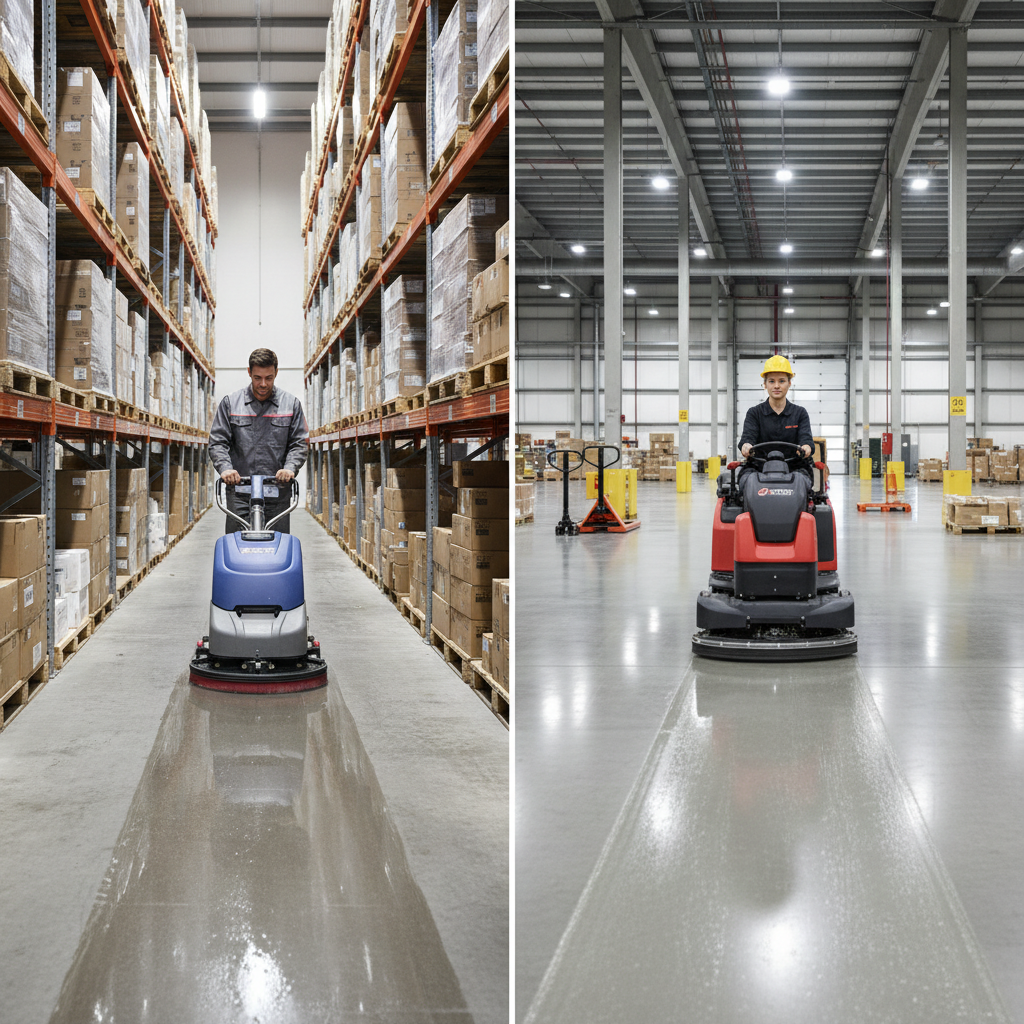
To compare real product options, you can review compact walk-behind warehouse floor scrubbers for narrow aisles and ride-on warehouse floor scrubbers for larger open areas. The best choice depends on your floor area, aisle layout, tank capacity, and required cleaning time.
How Much Brush Pressure Does a Warehouse Floor Scrubber Need?
Brush pressure should match the floor type and dirt level. Light dust on smooth warehouse floors usually requires moderate brush pressure. Forklift tire marks, oily grime, and heavily soiled zones may need higher brush pressure, suitable detergent, and slower cleaning speed.
Walk-behind scrubbers usually apply lower pressure and are better for compact areas. Ride-on warehouse floor scrubbers use machine weight and larger brush systems to provide stronger scrubbing performance in high-traffic warehouse zones.
How to Calculate Warehouse Floor Scrubber Coverage Rate
A warehouse floor scrubber’s real productivity should be measured by practical coverage rate, not only theoretical coverage rate. Theoretical coverage rate shows the maximum possible cleaning output, but actual warehouse floor scrubbing is affected by aisle layout, turns, obstacles, overlapping paths, tank refills, wastewater dumping, and operator speed.
1. Theoretical Coverage Rate
Theoretical coverage rate estimates the maximum area a warehouse floor scrubber can clean in one hour under ideal conditions.
Formula:
Theoretical Coverage Rate = Cleaning Width (in) × Operating Speed (mph) × 440
In this formula, 440 is a conversion factor that changes cleaning width and machine speed into square feet per hour.
For example, if a ride-on warehouse floor scrubber has a 36-inch cleaning width and operates at 3.5 mph:
Theoretical Coverage Rate = 36 × 3.5 × 440 = 55,440 sq ft/hr
This number is useful for comparing machines, but it should not be used as the final estimate for real warehouse cleaning time.
2. Practical Coverage Rate
Practical coverage rate is the more useful number for warehouse cleaning planning. It estimates the real area a floor scrubber can clean after accounting for turns, overlaps, refilling, dumping, and layout restrictions.
Formula:
Practical Coverage Rate = Theoretical Coverage Rate × Efficiency Factor
For many warehouse layouts, an efficiency factor of 0.45–0.65 is more realistic than the theoretical maximum.
| Warehouse Layout | Suggested Efficiency Factor | Reason |
|---|---|---|
| Highly congested warehouse | 0.45 | More turns, obstacles, and interrupted cleaning paths |
| Standard racked warehouse | 0.55 | Normal aisle turns, overlaps, and tank refill time |
| Open warehouse or distribution center | 0.65 | Fewer turns and longer straight cleaning paths |
Using the same 36-inch ride-on warehouse floor scrubber example:
Practical Coverage Rate = 55,440 × 0.55 = 30,492 sq ft/hr
This practical coverage rate is the number facility managers should use when estimating cleaning time, labor cost, and machine productivity.
3. How to Use Coverage Rate When Choosing a Warehouse Floor Scrubber
To choose the right warehouse floor scrubber, compare the machine’s practical coverage rate with your actual cleaning area and cleaning schedule.
For example, if your warehouse needs to clean 100,000 sq ft per day and the scrubber’s practical coverage rate is about 30,000 sq ft/hr, the cleaning task will take about 3.3 hours before adding time for inspection, refilling, dumping, and machine care.
For wide open warehouse spaces, a higher practical coverage rate usually matters more than the lowest purchase price. For narrow aisles or congested storage zones, maneuverability and turning radius may be more important than maximum cleaning width.
Tank Capacity, Uptime, and Refill Frequency
For warehouse floor scrubbing, larger solution and recovery tanks reduce non-productive time. This is especially important in large facilities where the operator may need to travel a long distance to refill clean water or empty wastewater.
Tank capacity directly affects uptime. A warehouse floor scrubber with a larger solution tank can clean for a longer period before refilling, while a larger recovery tank helps collect more wastewater before dumping. This reduces interruptions and improves practical cleaning productivity.
Typical tank capacity ranges include:
- Compact walk-behind scrubbers: 10–15 gallons
- Large walk-behind scrubbers: 20–30 gallons
- Ride-on warehouse floor scrubbers: 40–70+ gallons
You can estimate refill frequency with this formula:
Time Between Refills = Solution Tank Capacity ÷ Solution Flow Rate
For example, a warehouse floor scrubber with a 40-gallon solution tank using 0.75 gallons per minute can run for about 53 minutes before refilling:
40 ÷ 0.75 = 53.3 minutes
A smaller scrubber with a 10-gallon tank using 0.5 gallons per minute needs a refill after about 20 minutes:
10 ÷ 0.5 = 20 minutes
This difference matters in large warehouses because every refill or wastewater dumping trip reduces productive cleaning time. For small warehouses or narrow aisles, a compact tank may be enough. For large warehouses, distribution centers, and wide open spaces, larger tanks usually improve uptime and reduce labor waste.
When comparing warehouse floor scrubbers, tank capacity should be evaluated together with cleaning width, practical coverage rate, water recovery performance, and daily cleaning schedule.
What Professional Buyers Should Check Before Ordering
Professional buyers should evaluate more than machine price and maximum productivity before ordering a warehouse floor scrubber.
Key factors include battery runtime, charging time, water recovery performance, brush or pad compatibility, squeegee quality, spare parts availability, warranty coverage, operator training, remote technical support and expected maintenance cost.
For European, North American and other professional B2B buyers, long-term operating cost is often more important than the lowest purchase price. A machine with better reliability, easier maintenance and faster parts support can reduce downtime and improve total value over the machine’s service life.
Essential Features for High-Traffic Warehouse Floor Scrubbing
Brush Systems
- Disk scrubbers: Suitable for smooth concrete and epoxy floors where higher brush pressure is needed.
- Cylindrical scrubbers: Suitable for high-debris warehouse floors because they can collect small debris before scrubbing.
- Synthetic brushes: Useful when chemical resistance is required.
- Scrubber pads: Useful for tire marks, grime, and moderate stains on smooth floors.
Water Recovery
A strong water recovery system helps reduce slip risks and drying time. In warehouses with forklift traffic, loading zones, and continuous operations, fast water recovery is important because wet floors can delay work and create safety risks.
Brushes and Squeegees
Brush and squeegee replacement typically follows this schedule:
- High-traffic areas: Monthly evaluation
- Standard use: Quarterly replacement
- Light duty: Semi-annual inspection
Which Warehouse Floor Scrubber Should You Choose by Facility Size?
| Warehouse Size or Layout | Recommended Scrubber | Why |
|---|---|---|
| 5,000–20,000 sq ft | Walk-behind warehouse floor scrubber | Better for tight aisles and compact spaces |
| 20,000–50,000 sq ft | Large walk-behind or compact ride-on scrubber | Balances maneuverability and productivity |
| 50,000–200,000+ sq ft | Ride-on warehouse floor scrubber | Higher coverage rate and lower operator fatigue |
| Wide open spaces | Ride-on scrubber | Better practical coverage rate |
| Narrow aisles under 6 ft | Walk-behind or compact scrubber | Better turning and access |
Small Warehouses (5,000-20,000 sq ft)
For small warehouses between 5,000 and 20,000 sq ft, a walk-behind warehouse floor scrubber is usually practical because it is easier to control in narrow aisles, storage zones, loading corners, and congested areas. A compact model with a narrower cleaning path can clean around racks and obstacles without requiring a large turning radius.
For example, a compact walk-behind scrubber can be suitable for warehouses with limited aisle width and frequent layout changes.
Mid-Size Facilities (20,000-50,000 sq ft)
For mid-size warehouses between 20,000 and 50,000 sq ft, facility managers can compare a large walk-behind scrubber with a compact ride-on warehouse floor scrubber. The decision should depend on aisle width, cleaning frequency, operator workload, and how much open floor area needs to be cleaned each day.
Large Operations (50,000+ sq ft)
For large warehouses above 50,000 sq ft, a ride-on warehouse floor scrubber is usually more efficient because it provides a wider cleaning path, larger solution and recovery tanks, higher practical coverage rate, and lower operator fatigue. These machines are especially useful in distribution centers, freight terminals, and warehouses with wide open floor areas.
Is a Single Brush Floor Scrubber Suitable for Warehouses?
A single brush floor scrubber can be suitable for small warehouses, narrow aisles, and light-to-moderate floor dirt. It is usually easier to operate and more compact than larger machines. For large warehouses, distribution centers, and wide open floor areas, ride-on warehouse floor scrubbers usually provide higher practical coverage rate, larger tank capacity, and lower operator fatigue.
Warehouse Scrubber vs Sweeper: Which One Do You Need?
A warehouse floor scrubber uses water, detergent, brushes, and a recovery system to wash and dry the floor. It is better for tire marks, grime, sticky dirt, wet cleaning needs, and areas that require water recovery.
A warehouse sweeper is designed for dry debris such as dust, packaging waste, wood chips, and loose particles. If your warehouse has both dry debris and floor stains, sweeping first and then scrubbing usually delivers better results.
Example: How a Distribution Center Can Reduce Cleaning Time
A large distribution center with frequent forklift traffic often faces tire marks, dust, and wet floor risks. When the cleaning area is too large for small walk-behind scrubbers, switching to a ride-on warehouse floor scrubber can reduce cleaning time, improve water recovery, and lower operator fatigue.
In this type of facility, the key comparison should include practical coverage rate, tank capacity, brush pressure, water recovery performance, and total labor hours per cleaning cycle.
Warehouse Floor Scrubber TCO: How to Compare Long-Term Cost
A strategic purchase should focus on the total cost of ownership, not only the purchase price. A lower-priced warehouse floor scrubber may cost more over time if it requires more labor hours, more maintenance, frequent brush replacement, or longer cleaning cycles.
TCO Formula:
TCO = Acquisition Cost + [(Annual Labor Cost + Annual Maintenance Cost + Annual Consumables Cost) × Asset Lifespan]
Purchase price is only one part of warehouse floor scrubber cost. Labor time, maintenance, consumables, battery replacement, brush and squeegee wear, downtime, and service support can all affect the real long-term cost.
Annual labor cost is usually the largest factor. A more productive warehouse floor scrubber can reduce labor hours by increasing practical coverage rate, reducing refill time, improving water recovery, and lowering operator fatigue.
For example, if a warehouse needs to clean 100,000 sq ft every day at a labor rate of $20 per hour:
- A standard walk-behind scrubber with a practical coverage rate of 15,000 sq ft/hr may require about 6.7 hours per cleaning cycle.
- Annual labor cost: 6.7 hours × $20 × 260 working days = about $34,840 per year.
- A ride-on warehouse floor scrubber with a practical coverage rate of 30,000 sq ft/hr may require about 3.3 hours per cleaning cycle.
- Annual labor cost: 3.3 hours × $20 × 260 working days = about $17,160 per year.
In this example, the ride-on machine can save about $17,680 per year in labor cost. This is why warehouse floor scrubber TCO should include labor, maintenance, consumables, and service life instead of only the upfront purchase price.
When comparing machines, facility managers should evaluate purchase cost, practical coverage rate, tank capacity, brush and squeegee replacement, battery life, maintenance needs, and expected daily cleaning time.
New vs Used Warehouse Floor Scrubber: Which Should You Choose?
Some businesses may compare new and used warehouse floor scrubbers before purchasing.
A used floor scrubber may reduce upfront cost, but buyers should carefully check battery condition, brush deck wear, squeegee system, vacuum motor, charger, control system, service history and spare parts availability.
A new warehouse floor scrubber usually provides more predictable performance, updated configuration, warranty support, operator training and easier long-term maintenance planning.
For facilities with daily cleaning tasks, long operating hours, strict floor safety requirements or limited downtime tolerance, a new machine is usually the safer long-term option. For temporary projects or low-frequency cleaning, a used machine may be considered only after a full inspection.
What Information Should You Prepare Before Requesting a Warehouse Floor Scrubber Quote?
To receive a more accurate warehouse floor scrubber recommendation, prepare the following information before contacting LVTONG:
Cleanable floor area.
Aisle width and turning space.
Floor material, such as concrete, epoxy, tile or coated floor.
Main contamination, such as dust, forklift tire marks, oil, grime, packaging debris or sticky dirt.
Daily or weekly cleaning frequency.
Available cleaning time during working hours, night shifts or shutdown periods.
Required water recovery and drying performance.
Preferred machine type, such as walk-behind, ride-on or compact scrubber.
Battery runtime and charging conditions.
Budget range, delivery country and expected after-sales support.
You can review LVTONG’s commercial floor scrubber dryers to compare walk-behind and ride-on scrubber dryer options before requesting a custom recommendation.
Conclusion: Making Data-Driven Scrubber Selection Decisions
Choosing the right warehouse floor scrubber requires more than comparing machine size or purchase price. Facility managers should evaluate floor area, aisle width, floor type, debris level, cleaning frequency, practical coverage rate, tank capacity, water recovery, operator fatigue, and total cost of ownership.
Walk-behind warehouse floor scrubbers are usually better for smaller warehouses, narrow aisles, and congested areas. Ride-on warehouse floor scrubbers are usually more efficient for large facilities, distribution centers, and wide open spaces.
A data-based selection process helps warehouses improve cleaning productivity, reduce downtime, control labor cost, and maintain safer floor conditions.
Need help choosing the right warehouse floor scrubber? Contact LVTONG to compare suitable models based on your warehouse size, aisle width, floor type, debris level, tank capacity, and cleaning schedule.
As a cleaning machine supplier in China, LVTONG can help warehouses, factories, and logistics facilities choose practical floor cleaning equipment for daily operations.
Warehouse Floor Scrubber FAQs
What is the best floor scrubber for a warehouse?
The best warehouse floor scrubber depends on facility size, aisle width, floor type, debris level, cleaning frequency, and practical coverage rate.
For small warehouses, narrow aisles, and congested storage areas, a walk-behind warehouse floor scrubber is usually easier to maneuver.
For large warehouses, distribution centers, logistics centers, and wide open spaces, a ride-on warehouse floor scrubber is usually more efficient because it offers a wider cleaning path, larger tank capacity, higher practical coverage rate, and lower operator fatigue.
How do I choose a warehouse floor scrubber by facility size?
Choose a warehouse floor scrubber based on the actual cleanable floor area, not only the total building size.
For warehouses between 5,000 and 20,000 sq ft, a walk-behind scrubber is usually practical because it can clean narrow aisles, storage zones, and compact spaces.
For warehouses above 20,000 sq ft, a ride-on warehouse floor scrubber is usually a better starting point because it can reduce cleaning time and operator walking.
For very large facilities above 50,000 sq ft, buyers should compare ride-on scrubbers by practical coverage rate, tank capacity, battery runtime, water recovery, turning space, and maintenance support.
Is a walk-behind or ride-on floor scrubber better for warehouses?
A walk-behind floor scrubber is better for small warehouses, narrow aisles, divided rooms, loading corners, and areas with many obstacles.
A ride-on floor scrubber is better for large open warehouse floors, distribution centers, logistics parks, and facilities where operators need to clean long routes every day.
The right choice depends on aisle width, turning radius, cleaning frequency, tank capacity, operator fatigue, storage space, and the actual time available for cleaning.
What floor scrubber is best for concrete warehouse floors?
For smooth concrete warehouse floors, a disk floor scrubber with suitable brush pressure is usually a practical choice.
For rough or uneven concrete, buyers should evaluate brush contact, pad driver flexibility, water recovery, and whether the machine can maintain stable cleaning performance across the surface.
For concrete floors with forklift tire marks, oil, grime, or heavy soil, a stronger brush system, suitable detergent, slower cleaning speed, and reliable dirty-water recovery may be required.
Should I choose a disk or cylindrical warehouse floor scrubber?
A disk warehouse floor scrubber is usually suitable for smooth concrete, epoxy floors, and general hard-floor scrubbing where brush pressure is important.
A cylindrical floor scrubber may be better for high-debris warehouse floors because it can collect small debris before scrubbing.
If the warehouse has loose dust, packaging waste, small stones, wood chips, or production debris, sweeping before scrubbing can also improve cleaning results and protect the scrubber system.
How do I calculate warehouse floor scrubber productivity?
Warehouse floor scrubber productivity should be calculated by practical coverage rate, not only theoretical coverage rate.
Theoretical coverage rate can be estimated with this formula:
Theoretical Coverage Rate = Cleaning Width × Operating Speed × 440
However, actual productivity is usually lower because warehouse cleaning includes turns, overlaps, obstacles, refilling clean water, emptying recovery water, edge cleaning, and operator speed changes.
For most warehouses, practical coverage rate is more useful for estimating cleaning time, labor cost, and machine selection.
What is the difference between a warehouse floor scrubber and a warehouse sweeper?
A warehouse floor scrubber is used for wet cleaning. It applies water or cleaning solution, scrubs the floor with brushes or pads, and recovers dirty water through a squeegee and vacuum system.
A warehouse sweeper is used for dry debris collection. It removes dust, leaves, packaging waste, wood chips, and loose particles.
If your warehouse has both dry debris and floor stains, the best process is usually to sweep first and then scrub. This helps improve cleaning quality and reduce unnecessary wear on the scrubber.
What tank capacity do I need for a warehouse floor scrubber?
Tank capacity should match your warehouse size, cleaning route, and available cleaning time.
Small walk-behind scrubbers usually have smaller tanks and may be suitable for compact warehouses or narrow aisles.
Ride-on warehouse floor scrubbers usually have larger solution and recovery tanks, which reduce refill and wastewater dumping time in large facilities.
For large warehouses, tank capacity should be compared together with practical coverage rate, battery runtime, water flow, refill distance, and daily cleaning schedule.