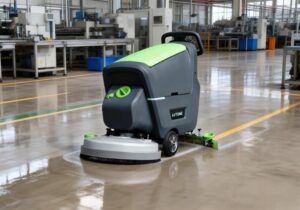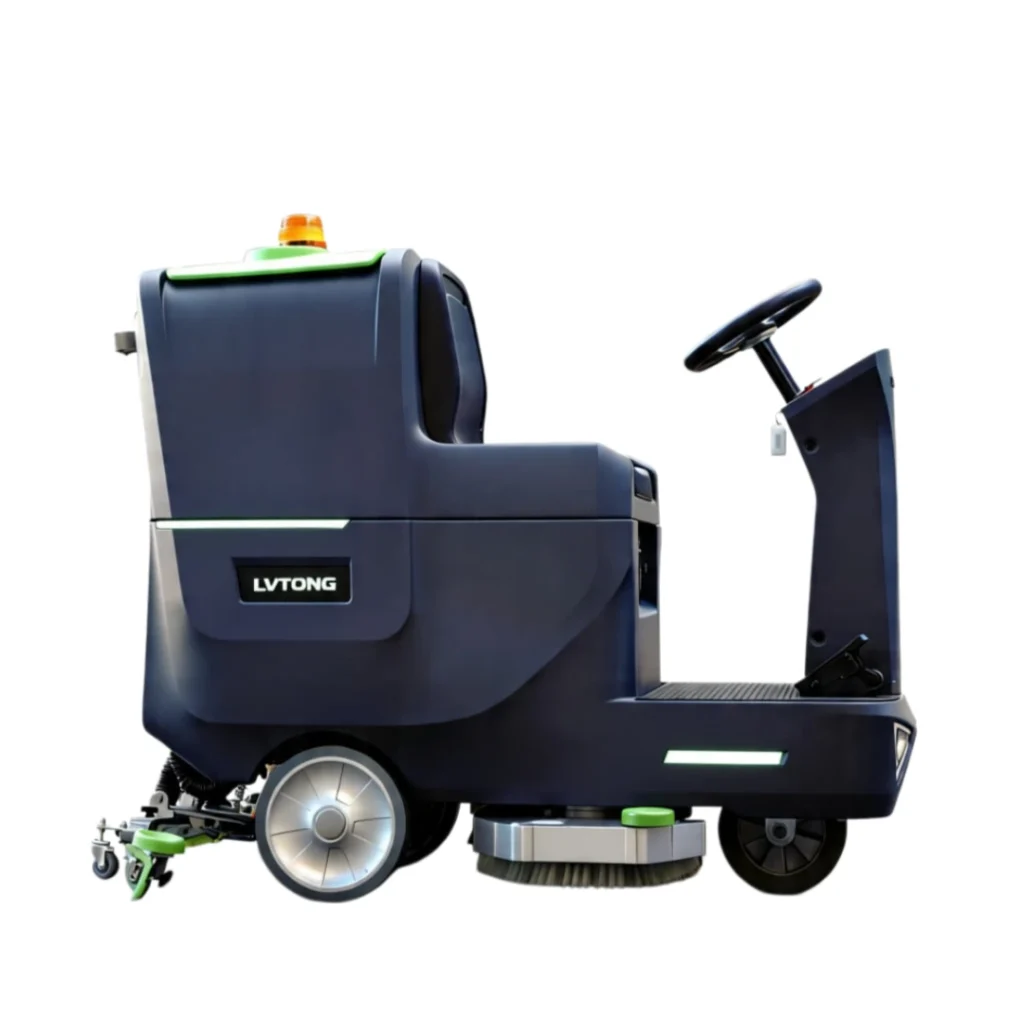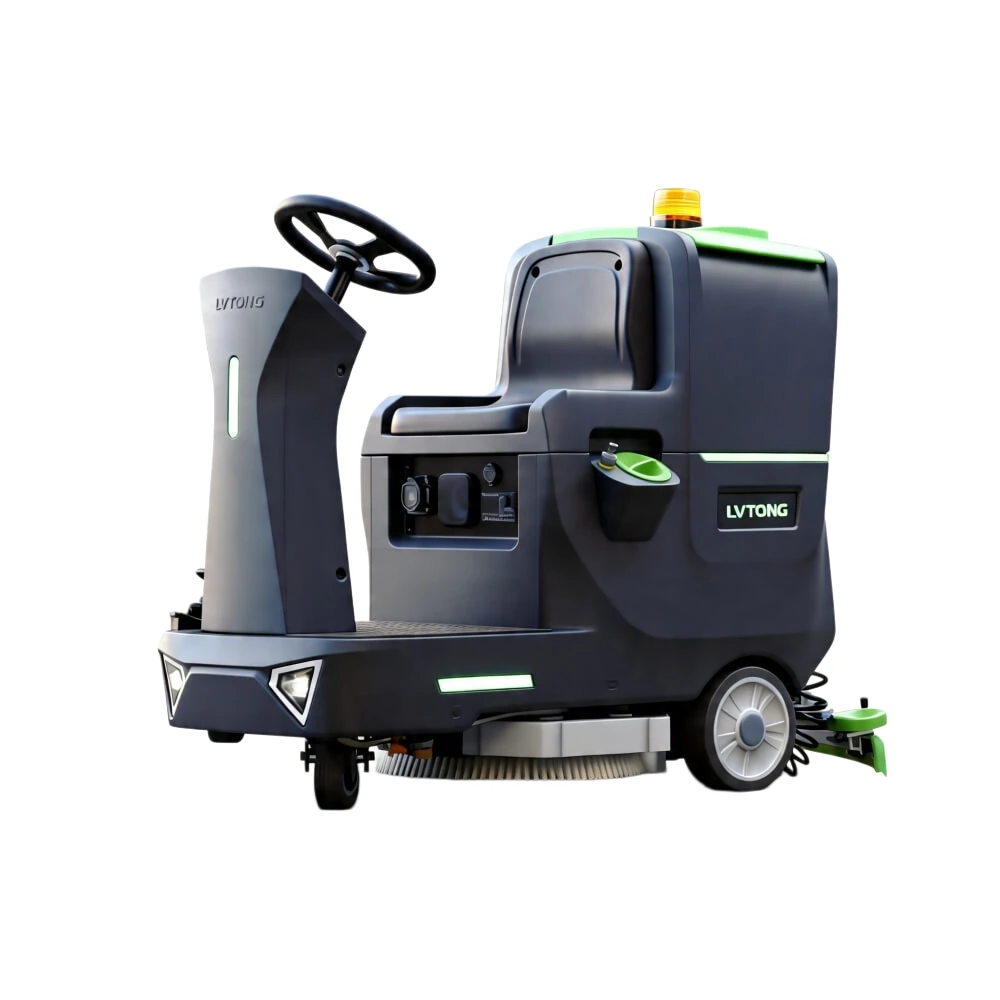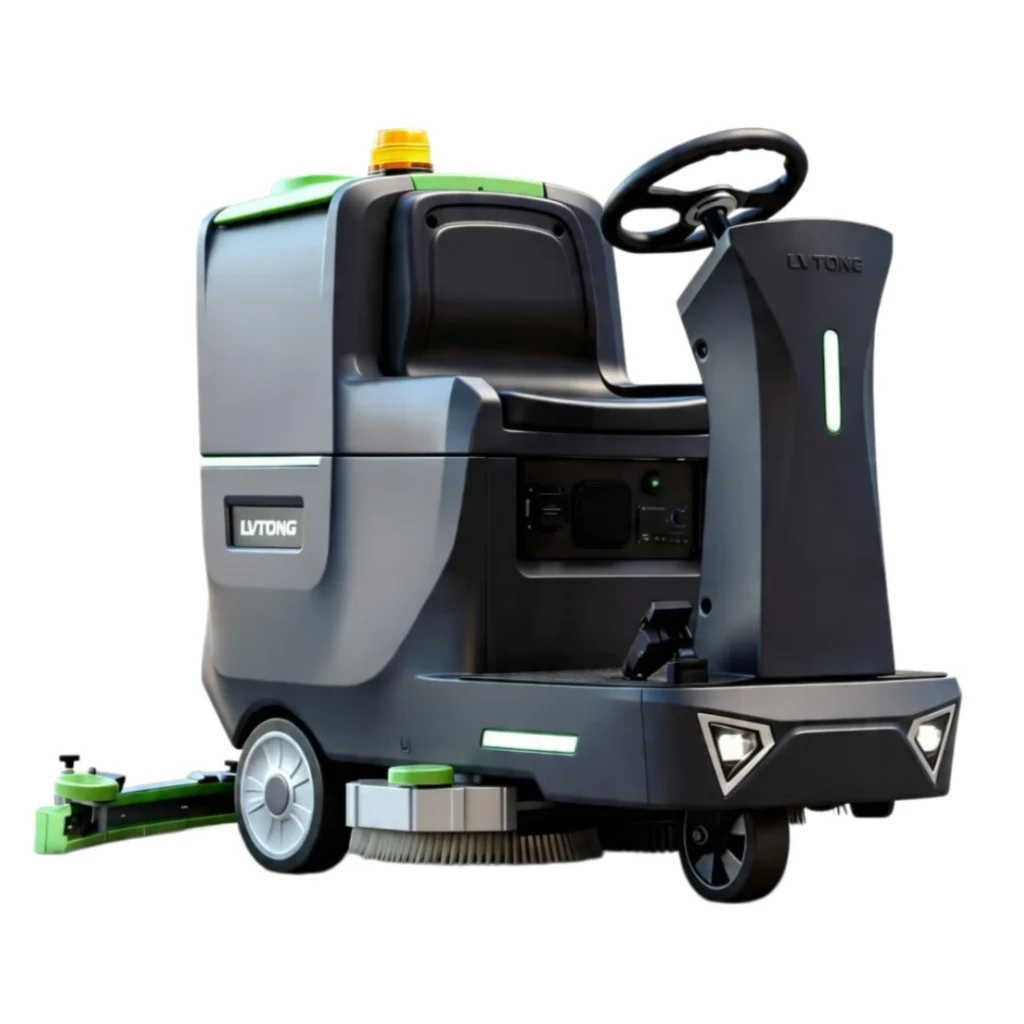

Choosing a heavy duty floor scrubber is not only about brush width, tank size, or advertised cleaning capacity. For factories, warehouses, shopping centers, parking facilities, and other busy sites, the machine must also fit the actual cleaning schedule.
A scrubber that performs well for occasional cleaning may not be suitable for daily operation, long cleaning routes, repeated shifts, or overnight work.
Before selecting a machine, facility managers should consider practical productivity, battery runtime, charging windows, tank capacity, water recovery, maneuverability, noise, operator requirements, and the amount of downtime the cleaning schedule can tolerate.
This guide explains how to evaluate these factors and determine whether a floor scrubber is suitable for daytime, nighttime, or daily heavy-duty cleaning.
Quick Answer: What Makes a Heavy Duty Floor Scrubber Suitable for Daily Use?
A heavy duty floor scrubber should be able to complete the required cleaning route reliably without excessive charging, refilling, wastewater dumping, or maintenance interruptions.
For daily or multi-shift cleaning, evaluate the machine based on:
- Actual cleaning area per shift
- Practical cleaning productivity
- Battery runtime
- Available charging time
- Solution and recovery tank capacity
- Brush or pad performance
- Water recovery and floor-drying performance
- Noise level
- Aisle width and maneuverability
- Operator comfort and ease of use
- Maintenance accessibility
- Spare-parts and technical support
The right machine is not necessarily the largest model. It is the machine whose working capacity matches the real workload of the facility.
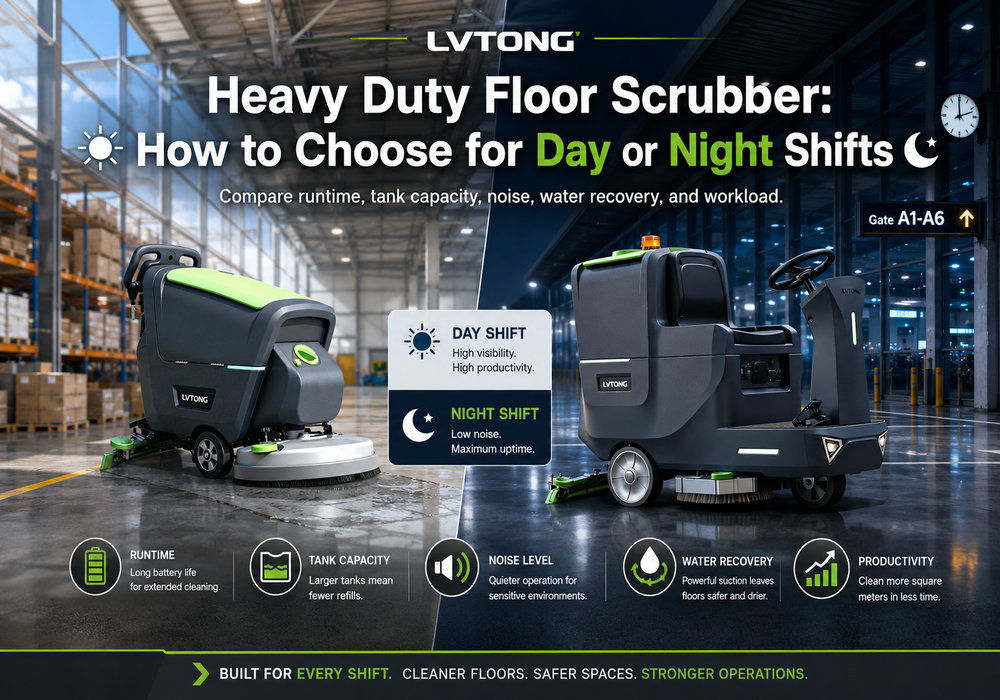
Heavy Duty Floor Scrubber Selection Checklist
Before comparing models, define the actual operating conditions.
| Factor | What to Check | Why It Matters |
|---|---|---|
| Cleaning area | Total area cleaned per shift | Determines required productivity |
| Shift length | Available cleaning hours | Helps calculate required runtime |
| Battery runtime | Working time per charge | Reduces mid-shift interruptions |
| Charging window | Time available between shifts | Important for daily and multi-shift use |
| Tank capacity | Solution and recovery volume | Affects refill and dumping frequency |
| Floor condition | Dust, grease, tire marks, spills | Influences brush, pad and pressure requirements |
| Water recovery | How quickly the floor is left dry | Important before traffic returns |
| Noise | Manufacturer-rated operating sound | Important in occupied or sensitive areas |
| Maneuverability | Aisles, turns, ramps and obstacles | Affects real cleaning efficiency |
| Serviceability | Access to squeegees, brushes and filters | Reduces routine downtime |
This checklist is more useful than selecting a scrubber based only on theoretical square-meter or square-foot productivity.
1. Match the Floor Scrubber to the Actual Daily Workload
The first question should not be:
“How large is the machine?”
A better question is:
“Can this machine complete our cleaning route within the available shift?”
A facility may have a large total floor area but only clean selected zones every day. Another site may be smaller but require several cleaning passes because of oil, dust, forklift traffic, or production residue.
Before choosing a machine, determine:
- Total area cleaned each shift
- Number of cleaning cycles per day
- Amount and type of soil
- Open floor area versus narrow aisles
- Number of turns and obstacles
- Distance to refill and wastewater disposal points
- Available cleaning time
- Number of operators
- Whether cleaning overlaps with production or customer traffic
A heavy duty floor scrubber should be sized around this real cleaning route rather than the total building area alone.
If you are deciding between compact, walk-behind, stand-on, ride-on, or robotic configurations, compare the main types of floor scrubbers before choosing a machine format.
Do not rely only on theoretical productivity
Manufacturer productivity figures are useful for comparing machines, but real facilities include turns, obstacles, traffic, tank refills, wastewater dumping, operator stops, and difficult sections that reduce actual cleaning output.
To understand how cleaning width, brush power, suction, battery capacity, and working efficiency affect real-world performance, see our guide to floor scrubber performance specifications.
For this reason, the machine should provide enough operating capacity with a reasonable margin rather than barely meeting the calculated cleaning requirement.

2. Check Floor Scrubber Runtime Against the Shift Length
Battery runtime becomes especially important when a floor scrubber is used every day.
Ask a simple question:
Can one charge complete the required cleaning route?
If the answer is no, determine whether the facility has a practical opportunity to recharge, exchange batteries, or divide cleaning into separate periods.
For a single daily shift, the available overnight charging window may make battery management relatively simple.
For two-shift or multi-shift facilities, charging time becomes a more important part of equipment selection.
When comparing machines, check:
- Manufacturer-rated operating runtime
- Actual expected runtime under your floor conditions
- Battery and charger compatibility
- Permitted charging method
- Available charging time between shifts
- Location of the charging area
- Whether charging interrupts the cleaning schedule
Battery chemistry should not be selected based on one universal rule. Different battery systems have different charging, maintenance, cost, and operating characteristics.
For a detailed comparison of lithium and lead-acid systems, charging requirements, cycle life, and long-term battery performance, read our floor scrubber battery life guide.
Compare the battery configuration supplied with the machine against your actual shift schedule.
3. Tank Capacity Can Determine Real Cleaning Productivity
A large cleaning path does not automatically mean high real-world productivity.
If the solution tank must be refilled frequently or the recovery tank fills before the cleaning route is complete, the operator spends more time away from the floor.
For long daily routes, compare:
- Solution tank capacity
- Recovery tank capacity
- Expected water consumption
- Distance to the nearest water source
- Distance to the approved wastewater disposal location
Large tanks can reduce interruptions in open factories, warehouses, airports, malls, and parking facilities.
However, bigger is not always better.
In facilities with elevators, narrow aisles, tight corners, ramps, or limited storage space, an oversized scrubber may lose more time maneuvering than it saves through larger tanks.
The best configuration balances capacity with accessibility.

4. Match the Scrubbing System to the Floor and Soil
A heavy-duty machine should not be judged only by its size.
Cleaning performance depends on whether the brush or pad system matches the floor surface and contamination.
Consider:
- Floor material
- Soil type
- Frequency of cleaning
- Brush or pad type
- Brush pressure
- Solution flow
- Required number of passes
A relatively clean commercial floor may require different cleaning action from a factory floor with oil, rubber marks, metal dust, or embedded industrial soil.
For difficult floors, stronger cleaning performance can reduce repeat passes and improve practical productivity.
However, excessive brush pressure is not automatically better. The cleaning configuration should be appropriate for the floor and remain within the manufacturer’s recommended operating settings.
5. Water Recovery Is Critical in Busy Facilities
Scrubbing is only one half of the cleaning process.
The machine must also recover dirty water effectively.
Poor water pickup can leave the floor wet, create streaks, increase slip risk, and delay the return of pedestrians, forklifts, carts, or production equipment.
When evaluating a floor scrubber for a busy facility, inspect or ask about:
- Squeegee design
- Squeegee floor contact
- Vacuum performance
- Recovery hose design
- Recovery tank sealing
- Water pickup during turns
- Drying performance on the actual floor surface
This becomes especially important when cleaning takes place shortly before employees, customers, vehicles, or production equipment return to the area.
6. Daytime Floor Scrubber Operation: Advantages and Limitations
Heavy duty floor scrubbers can operate during the day, but daytime cleaning requires more coordination.
Advantages of daytime cleaning
One advantage is easier supervision.
Facility managers, maintenance teams, and operators are normally available at the same time, allowing problems to be identified and corrected quickly.
Daytime cleaning can also work well for:
- Spill response
- Entrance areas
- High-traffic zones requiring repeated cleaning
- Small sections that cannot wait until night
- Facilities operating continuously
Cleaning tasks can be divided throughout the day rather than concentrated into one long cleaning period.
Limitations of daytime cleaning
The main challenge is traffic.
Operators may have to work around:
- Employees
- Customers
- Forklifts
- Pallet trucks
- Production equipment
- Delivery traffic
- Temporary obstacles
Frequent stopping and route changes can reduce practical cleaning productivity.
Wet-floor safety also becomes more important when people or vehicles return immediately after the scrubber passes.
For daytime use, maneuverability, rapid water recovery, clear warning systems, and appropriate noise performance may be more important than maximum machine size.
7. Night Shift Floor Scrubber Operation: Advantages and Limitations
Nighttime or off-peak cleaning is common in factories, warehouses, shopping centers, supermarkets, parking facilities, and other large sites.
Advantages of nighttime cleaning
Lower traffic allows operators to clean larger areas with fewer interruptions.
This can provide:
- More continuous cleaning routes
- Fewer conflicts with production
- Fewer pedestrians in the cleaning area
- Better access to aisles and open floors
- More predictable cleaning times
- More time before normal traffic returns
For large facilities, this can significantly improve practical productivity even when the same machine is used.
Limitations of nighttime cleaning
Night operations place different demands on the equipment and operator.
Consider:
- Working lights
- Warning lights or beacons
- Visibility around the machine
- Noise requirements
- Operator training
- Emergency procedures
- Access to technical support
- Battery runtime
- Water and wastewater access
A machine fault that is easy to resolve during the day may cause a longer interruption when maintenance staff are unavailable at night.
For this reason, reliability and simple routine maintenance are especially important for overnight cleaning.

8. Day Shift vs Night Shift Floor Scrubber Requirements
The best floor scrubber specification can change depending on when cleaning takes place.
| Requirement | Daytime Cleaning | Nighttime Cleaning |
|---|---|---|
| Low operating noise | High importance in occupied areas | Important near noise-sensitive areas |
| Maneuverability | Very important | Important |
| Traffic coordination | Very important | Usually less demanding |
| Warning visibility | Important | Very important |
| Water recovery | Very important | Very important |
| Battery runtime | Depends on route | Often important for long continuous routes |
| Tank capacity | Depends on facility | Often important for large overnight routes |
| Operator simplicity | Important | Very important |
| Technical support access | Usually easier | May be more limited |
| Route continuity | Often interrupted | Usually better |
There is no universal rule that daytime or nighttime cleaning is always better.
The correct choice depends on how the facility operates.
9. Heavy Duty vs Light Duty Floor Scrubber: What Is the Difference?
The term heavy duty floor scrubber should describe the workload the machine can reliably handle, not simply its physical appearance.
A light-duty machine can be appropriate for smaller or less demanding cleaning routes, while heavy-duty use involves longer operating periods, higher traffic, larger areas, more demanding soil, or repeated daily cleaning.
| Light-Duty Use | Heavy-Duty Use |
|---|---|
| Short cleaning routes | Long daily cleaning routes |
| Occasional operation | Daily operation |
| Low to moderate traffic | High-traffic environment |
| Light soil | Repeated or difficult contamination |
| Frequent access to refill points | Longer uninterrupted cleaning preferred |
| Short operating periods | Extended shift requirements |
| Lower emphasis on tank capacity | Larger capacity may reduce downtime |
| Limited daily utilization | High equipment utilization |
A machine does not need to be the largest available model to qualify for heavy-duty use.
Durability, runtime, tank capacity, cleaning performance, water recovery, serviceability, and compatibility with the actual duty cycle are more important.
10. Recommended Cleaning Times for Different Facilities
Different facilities have different traffic and production patterns.
| Application | Typical Cleaning Window | Key Consideration |
|---|---|---|
| Factory workshop | Off-peak or night shift | Avoid interrupting production |
| Warehouse / logistics center | Off-peak or night shift | Reduce conflicts with forklifts and picking |
| Shopping mall | Before opening or after closing | Minimize customer disruption |
| Supermarket | Low-traffic periods or after closing | Maintain access and floor safety |
| Underground parking facility | Low-traffic or nighttime | Reduce vehicle obstruction |
| Hospital | Scheduled low-traffic periods | Control noise and maintain safe access |
| School | Before classes, after classes, or low-traffic periods | Minimize disruption |
| 24-hour facility | Planned cleaning zones | Coordinate cleaning with ongoing operations |
These are general planning principles rather than fixed rules.
The best cleaning window should be based on actual traffic, staffing, safety requirements, and facility operating hours.
For warehouses and distribution centers, aisle width, forklift traffic, floor condition, and practical coverage rate require additional consideration. See our warehouse floor scrubber guide for a dedicated selection framework.

11. Can This Floor Scrubber Handle a Full Daily Shift?
Before purchasing a machine for a busy facility, use this practical test.
Step 1: Calculate the actual cleaning route
Determine how much floor must actually be cleaned during one shift.
Step 2: Estimate practical productivity
Allow for turns, obstacles, traffic, refilling, wastewater disposal, and other normal interruptions.
Step 3: Check battery runtime
Determine whether the cleaning route can be completed within the expected operating time.
Step 4: Check tank stops
Estimate how often the operator will need to refill clean water or empty the recovery tank.
Step 5: Evaluate water recovery
Confirm that the floor can be returned to traffic within the required time.
Step 6: Check maneuverability
Make sure the machine can pass through the narrowest aisle, doorway, turning area, elevator, or ramp in the cleaning route.
Step 7: Review the charging schedule
For daily or multi-shift operation, make sure charging can be completed without creating unacceptable downtime.
Step 8: Evaluate routine maintenance
Brushes, pads, squeegees, filters, tanks, and other daily service points should be easy for operators to inspect and clean.
If a machine performs well in all eight areas, it is much more likely to handle daily heavy use reliably.
12. What Should You Check for Night Shift Cleaning?
If the machine will primarily operate at night, focus on five areas.
Visibility
The operator should have adequate visibility for the planned environment. Appropriate work lights, warning lights, and reflective safety features can be important in low-light areas.
Noise
Compare the manufacturer’s measured sound-pressure rating when cleaning near offices, residences, hospitals, hotels, or other noise-sensitive areas.
If available, check whether the machine provides a quiet or ECO operating mode.
Runtime
The battery configuration should cover the planned overnight route or fit the available charging schedule.
Water recovery
Floors should be left appropriately dry before employees, customers, or vehicles return.
Operator independence
Night shift operators may have less immediate maintenance support, so routine inspection, brush replacement, squeegee cleaning, tank access, and basic troubleshooting should be straightforward.
13. What Matters Most for Daytime Cleaning?
For daytime operation, prioritize:
- Maneuverability around people and equipment
- Strong water recovery
- Safe turning and braking
- Clear warning systems
- Suitable operating noise
- Good operator visibility
- Easy route changes
- Compact dimensions where traffic is dense
The fastest machine on an empty floor may not be the most productive machine in an occupied building.
Real-world productivity depends on how efficiently the operator can move through the facility without interfering with normal operations.
14. Maintenance and Operator Training Still Matter
Even a correctly selected heavy-duty scrubber will perform poorly if daily inspection and operator training are neglected.
Before each shift, operators should follow the manufacturer’s recommended inspection procedure.
Typical checks may include:
- Brush or pad condition
- Squeegee condition
- Solution and recovery tanks
- Filters
- Vacuum and recovery components
- Battery status
- Warning and work lights
- Visible leaks or damage
For daily-use equipment, maintenance planning should be based on operating hours, machine condition, application, and manufacturer recommendations rather than one universal replacement interval.
For a structured daily, weekly, and periodic inspection routine, use our commercial floor scrubber maintenance checklist.
Operator training should cover normal operation, shutdown, tank cleaning, brush or pad inspection, squeegee care, charging procedures, basic troubleshooting, and safety practices.
Before Requesting a Floor Scrubber Recommendation
Professional buyers can improve machine selection by providing the supplier with specific operating information.
Prepare the following details:
| Information | Example |
|---|---|
| Facility type | Warehouse |
| Cleaning area per shift | 12,000 m² |
| Floor surface | Epoxy concrete |
| Soil type | Dust and forklift tire marks |
| Cleaning frequency | Daily |
| Shift length | 8 hours |
| Preferred cleaning time | Night |
| Available charging window | 4–8 hours |
| Narrowest aisle | 2.2 m |
| Traffic | Forklifts and pallet trucks |
| Special requirements | Low noise / ramp operation |
This information allows a supplier to recommend a machine based on the actual cleaning route rather than simply recommending a larger model.
Frequently Asked Questions
How can I tell if a floor scrubber can handle daily shifts in a busy facility?
Compare the actual cleaning route with practical productivity, battery runtime, tank capacity, charging time, maneuverability, and expected downtime.
A suitable machine should complete the required route consistently without excessive refilling, charging, or maintenance interruptions.
What should I look for in a heavy duty floor scrubber?
Focus on cleaning performance, practical productivity, runtime, tank capacity, water recovery, durability, maneuverability, serviceability, operator comfort, and supplier support.
The correct specification depends on the facility rather than one universal definition of “heavy duty.”
What is the difference between a heavy-duty and light-duty floor scrubber?
A light-duty scrubber is generally better suited to shorter or less demanding cleaning routes.
Heavy-duty applications involve longer daily use, high traffic, larger areas, repeated contamination, extended cleaning periods, or multi-shift operation.
Machine selection should therefore be based on duty cycle rather than size alone.
Can a heavy duty floor scrubber be used during the day?
Yes.
For daytime cleaning, prioritize low operating noise where necessary, maneuverability, rapid water recovery, good visibility, warning systems, and safe operation around pedestrians or vehicles.
What floor scrubber is suitable for night shift cleaning?
A floor scrubber for night shift cleaning should provide sufficient runtime, reliable water recovery, suitable lighting and warning features, manageable noise, and straightforward daily maintenance.
The exact configuration depends on the cleaning route and facility conditions.
How much floor scrubber runtime do I need?
The required runtime depends on how long it takes to complete the actual cleaning route.
Do not calculate runtime only from building size. Include turning, traffic, refilling, wastewater dumping, operator stops, and difficult cleaning areas.
Is a larger tank always better for heavy-duty cleaning?
No.
Larger tanks reduce refill and dumping stops, but they also increase machine size and weight.
In narrow aisles, elevators, congested facilities, or tight turning areas, maneuverability may be more valuable than maximum tank capacity.
Is lithium or lead-acid better for multi-shift cleaning?
There is no single answer for every application.
Compare the battery manufacturer’s rated runtime, charging time, maintenance requirements, permitted charging method, expected service life, and total operating requirements against your facility’s shift schedule.
What information should I give a floor scrubber supplier before requesting a quote?
Provide your cleaning area per shift, floor type, soil type, cleaning frequency, shift duration, available charging time, narrowest aisle, traffic conditions, and preferred cleaning window.
These details allow the supplier to recommend a configuration based on your actual workload.
Conclusion
A heavy duty floor scrubber should be selected around the way your facility actually operates.
For daily cleaning, the most important questions are whether the machine can complete the cleaning route, maintain sufficient runtime, minimize refill and dumping stops, recover water effectively, and remain reliable under repeated use.
Daytime operations usually require more attention to traffic, maneuverability, water recovery, safety, and noise. Nighttime operations often allow longer uninterrupted cleaning routes but place greater importance on runtime, visibility, operator independence, and reliable equipment performance.
Instead of choosing a machine based only on advertised productivity or physical size, evaluate the complete duty cycle:
cleaning area + shift length + runtime + tank capacity + floor condition + traffic + charging window + maintenance requirements.
This approach makes it easier to select a floor scrubber that can deliver consistent cleaning performance without unnecessary downtime.
Need Help Matching a Floor Scrber to Your Cleaning Shift?
If you are not sure which machine can handle your facility’s daily workload, send LVTONG your facility type, cleaning area per shift, floor surface, soil condition, operating hours, narrowest aisle, and available charging time.
LVTONG can help evaluate the working conditions and recommend a floor scrubber configuration based on your actual cleaning route, whether the machine will operate during the day, overnight, or across multiple shifts.