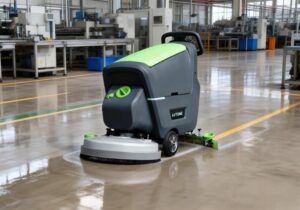


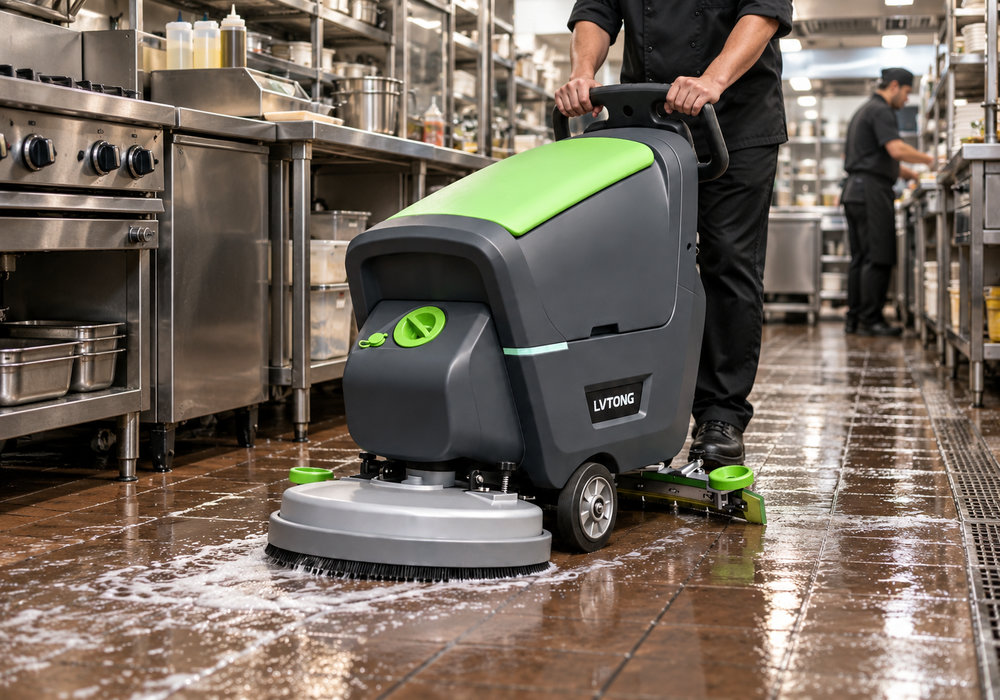
The kitchen line is not a dirtier version of the dining room — it is a different cleaning problem. Cooking sends grease into the air, where it condenses on every surface including the floor; fryer and dishwash areas keep standing water on the tile for hours at a time; and staff walk that floor carrying hot pans at speed. A commercial kitchen floor cleaner in this environment has three jobs at once: lift grease that has bonded to quarry tile, take water off the floor, and do both without leaving a slick film behind. A mop and bucket defeats itself here — it spreads the grease back across the tile and adds water.
QUICK ANSWER
The right commercial kitchen floor cleaner is a compact walk-behind scrubber-dryer with grout-scale agitation, degreaser-compatible dosing, and recovery that leaves the line walk-dry — run on an inter-shift deep cycle plus spot passes at the fryer and dish stations.
- Agitation does the work, not chemistry alone. Grease seated in quarry tile grout needs brush contact; a machine that only wets the surface leaves a film that reappears by mid-service.
- Recovery is the safety device. Squeegee pickup must beat the brush, because standing water on a kitchen floor is the slip hazard regulators care about most.
- Drains set the method. Water and grease must go to the right drain; discharge rules decide what the routine can and cannot do.
- Schedule beats intensity. One inter-shift deep pass plus targeted spot passes at fryer, dish, and prep stations holds far better than a weekly deep clean.
The sections below cover machine class, grease chemistry, floor types, drainage, the shift schedule, and the acceptance test worth running before you buy.
Why Kitchen Floors Need a Different Machine
Kitchen floors combine airborne grease, standing water, and constant foot traffic — a combination that defeats mopping and punishes under-specified machines.
Three conditions define back-of-house floors. Grease arrives airborne from fryers and grills, then bonds to whatever it lands on. Water is permanent rather than incidental — drip trays, dish spray, and wash-down keep tile wet. And the traffic is fast, loaded, and distracted, which turns any wet film into an incident waiting to happen.
Those conditions rule out the two cheapest approaches. Dry sweeping spreads grease across more area. Mopping lifts some soil into dirty water, redeposits it, and leaves the floor wet for the longest stretch of the shift. A scrubber-dryer reverses both: brush agitation plus recovery into a tank, leaving the floor dry within minutes — the labor and hygiene math is laid out in our guide to moving beyond the mop.
What “Clean” Means on a Kitchen Floor
On a kitchen line, clean means three measurable things: no grease film, no standing water, and no soil film left in the grout — appearance alone proves none of them.
Appearance is the weakest test: a freshly mopped floor can look even and still fail on touch and hygiene. The three checks that hold up are visual (a white cloth comes back clean), tactile (tile is not tacky when warm), and the water test (a splash beads or drains instead of spreading in an oily film).
Where the floor fails, the cause is usually mechanical rather than chemical: insufficient agitation, wrong dilution, no dwell time, or recovery that leaves water behind. Under-specified detergent is often better than a heavy dose: residue builds its own film and attracts soil back.
Which Machine Class Fits a Commercial Kitchen
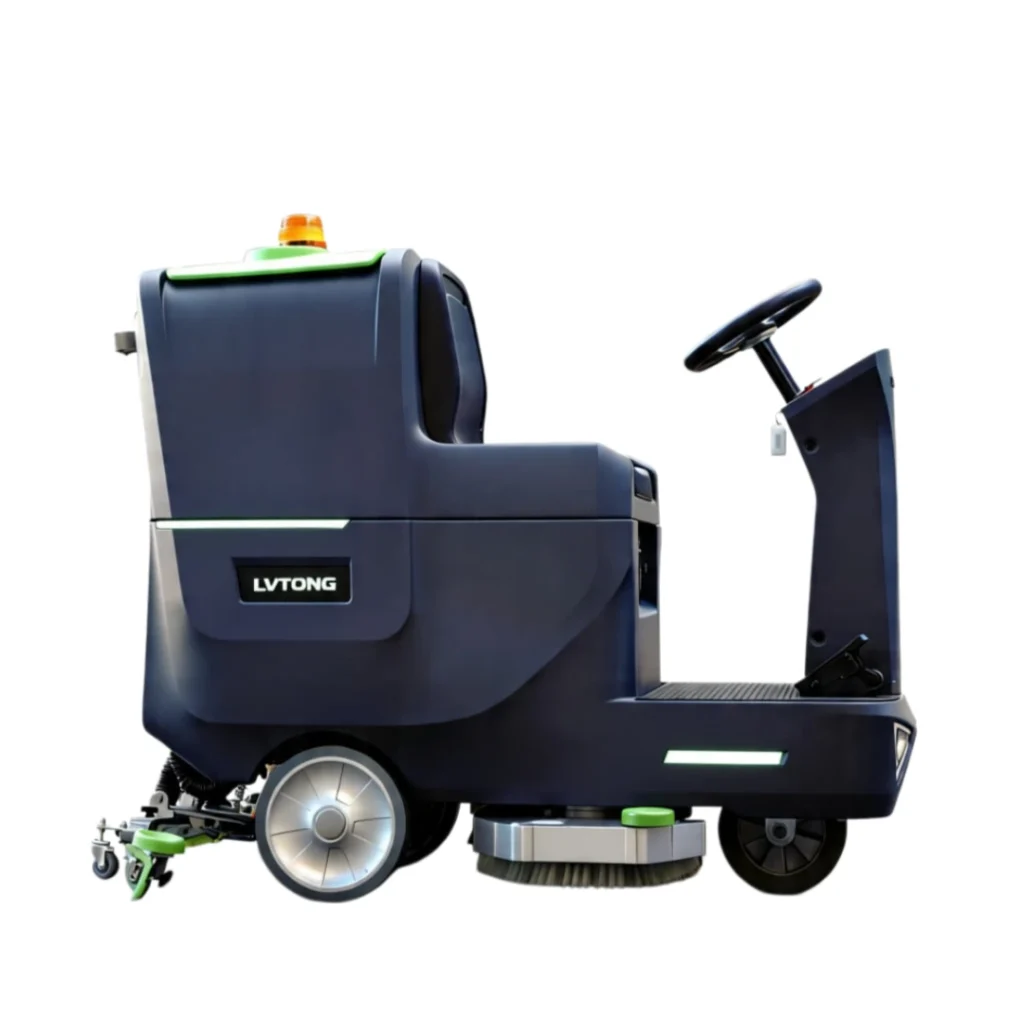
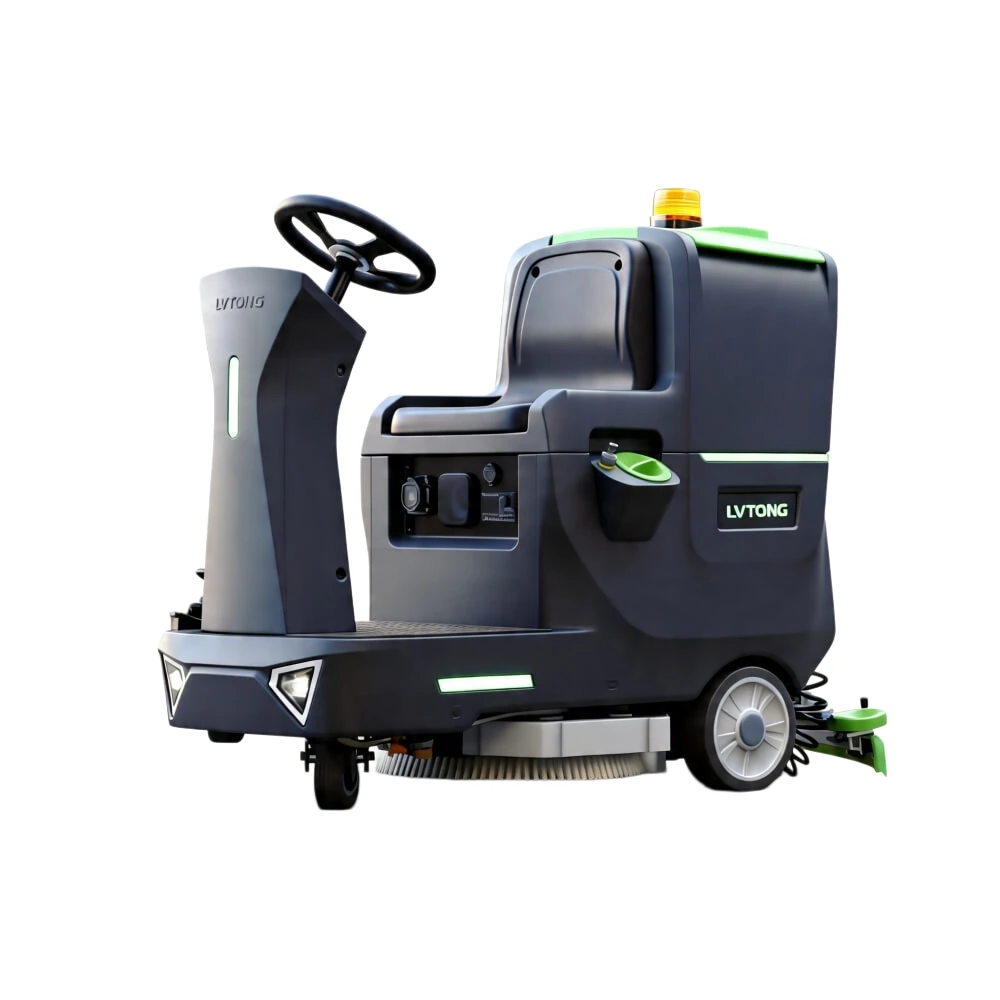
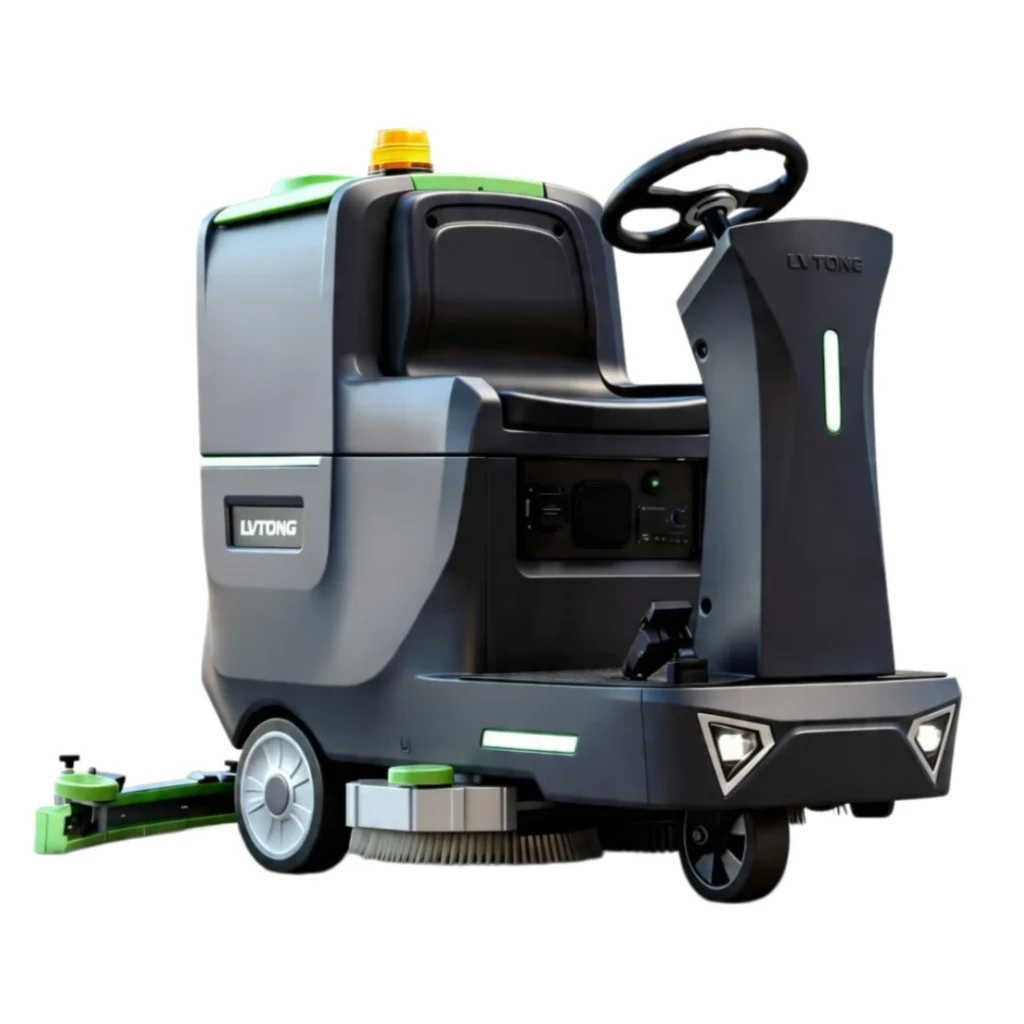
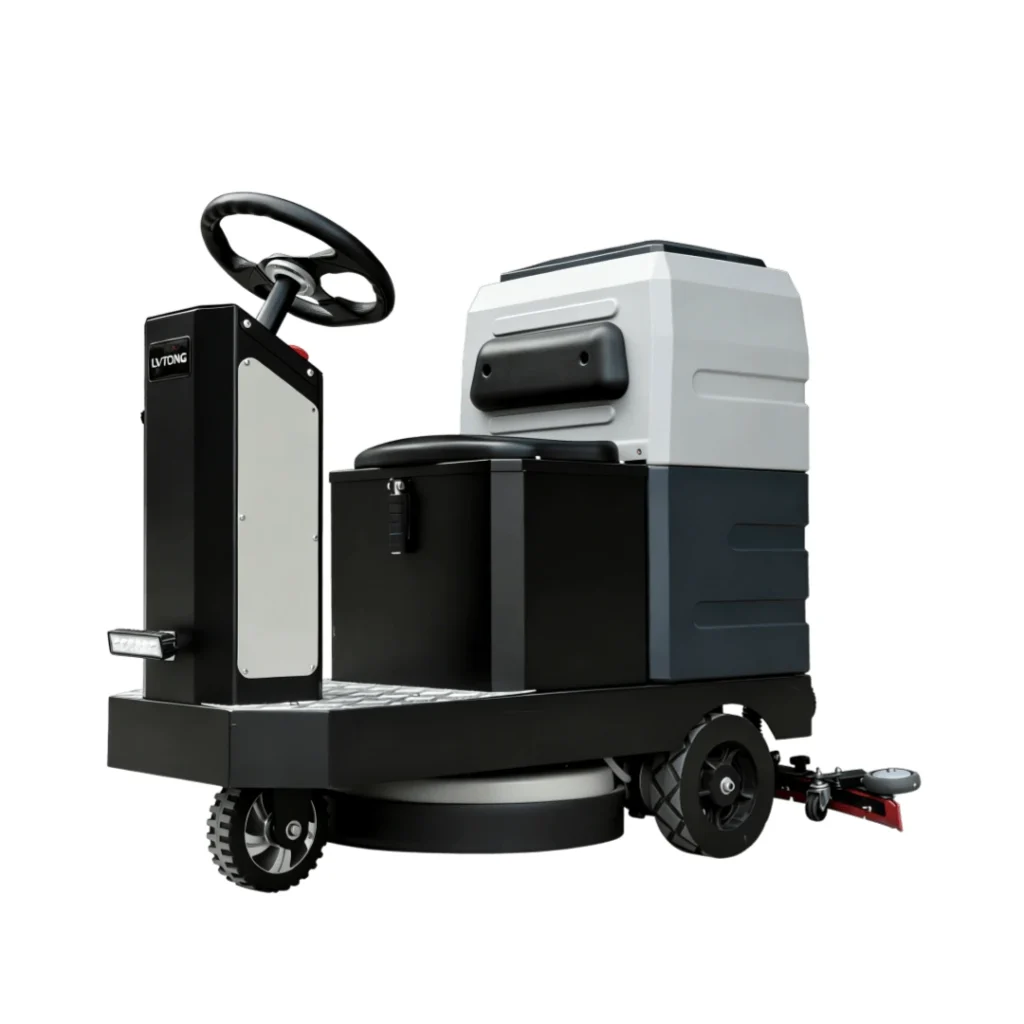
A compact walk-behind scrubber-dryer is the default answer for the kitchen line; micro units handle corners and walk-ins, and ride-on machines do not belong inside a working kitchen.
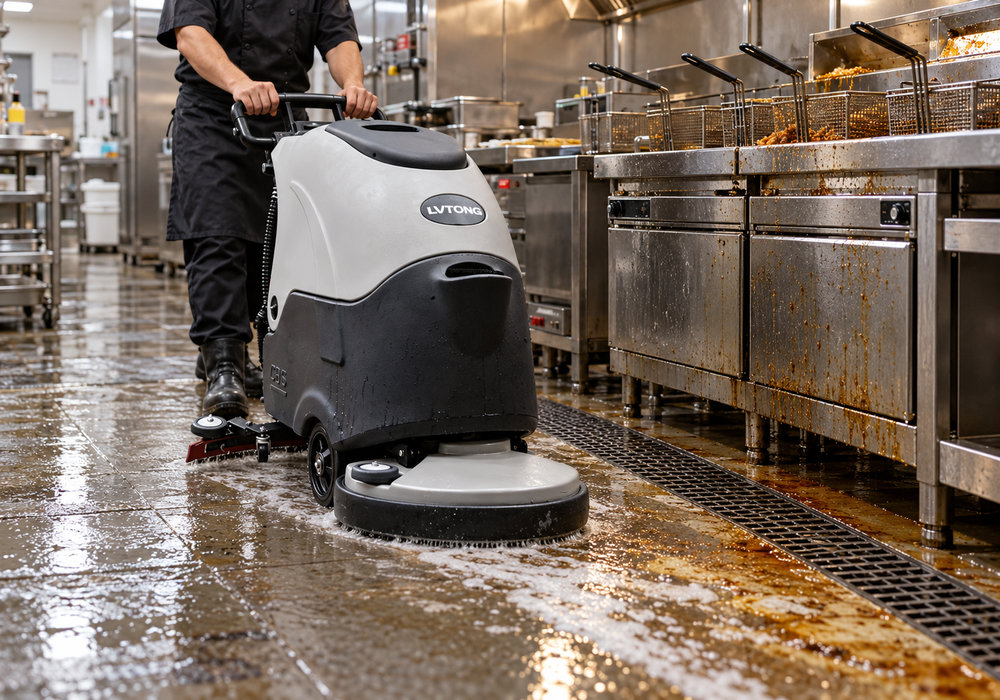
Kitchen geometry drives the choice. Lines are narrow, crowded with equipment, and continuous — a machine must turn in an aisle roughly a metre wide while an operator works around open doors and stacked pans. Machines in the compact 500–530 mm class fit that envelope: the Q5 industrial walk-behind scrubber runs a 500 mm scrub path at about 2,100 m²/h with adjustable brush angle and height, and the LT-S530X extends the format with a 530 mm path, 62+65 L tanks, and a 24V 100Ah battery — enough for a full line plus adjacent storage in one cycle. Full specifications sit on the cleaning equipment range page.
Queries for floor scrubber kitchens usually arrive from buyers considering micro machines for the whole room. That inverts the sizing: micro units suit walk-in corners and behind equipment, not a 200 m² line where recovery volume decides whether the job finishes. Ride-on equipment needs open runs, so inside a kitchen it is a liability. Venues between a café and an institutional line follow the sizing logic in our walk-behind scrubber guide for small and medium facilities.
Grease: Chemistry, Dilution, and Dwell Time
Grease removal is a sequence — scrape, agitate with correctly diluted degreaser, allow dwell time, then recover — and skipping any step leaves a film that returns within hours.
- Pre-scrape solids. Food debris in the scrubber’s path becomes a paste that the squeegee smears. Push solids to the drain basket or a dustpan first.
- Dilute per the label, not by feel. Over-concentrated degreaser leaves its own residue; under-diluted product never lifts polymerised oil. Mix to the label ratio and note it for the crew.
- Let it dwell. Bonded grease needs contact time before agitation. On heavy fryer zones, apply solution ahead of the machine’s own pass, then scrub.
- Respect water temperature limits. Manufacturer guidance on machine and floor trumps the instinct to use the hottest water available; excessive temperature stresses tank seals and can set some soil types harder.
This is also where kitchen cleaning overlaps with consumables the buyer selects separately: the machine is specified for compatibility with alkaline degreasers at label dilution, not for a specific brand. Our own range is built around that compatibility rather than around supplying chemistry.
Floor Types Behind the Line
Most commercial kitchens run quarry tile with grout; epoxy and sealed concrete appear in newer builds — each changes brush choice and pressure, not the machine class.
| Floor | Why it is used | Cleaning implication |
|---|---|---|
| Quarry / ceramic tile with grout | Slip resistance under grease and water | Grout needs agitation contact; acid-based products must be avoided on cementitious grout |
| Anti-slip / textured tile | Wet-zone safety on the line | Texture traps soil; higher brush speed and slower pass speed matter more than pressure |
| Sealed concrete | Utility and storage areas | Check seal compatibility with degreaser dilution before routine use |
| Epoxy / resin systems | Newer kitchens, joint-free finish | Softer brush or pad; confirm the resin system’s own cleaning guidance first |
Sealed concrete in adjacent corridors, loading bays, and dishwash exteriors follows the same method as any hard floor — our step-by-step concrete floor scrubbing guide covers the sequence in detail.
Drainage and Where the Water Goes
Every kitchen cleaning method depends on the drains available; recovery-tank dumping and wash-down water should be tied to the intended drainage path, not the nearest grate.
Kitchens are designed with floor drains and grease interceptors for a reason: grease that reaches a storm line is a reported discharge, not just a plumbing annoyance. Where a facility discharges industrial or process water to exterior drains, requirements vary by market and are usually framed through permits — in the United States, industrial stormwater discharges fall under EPA NPDES permits.
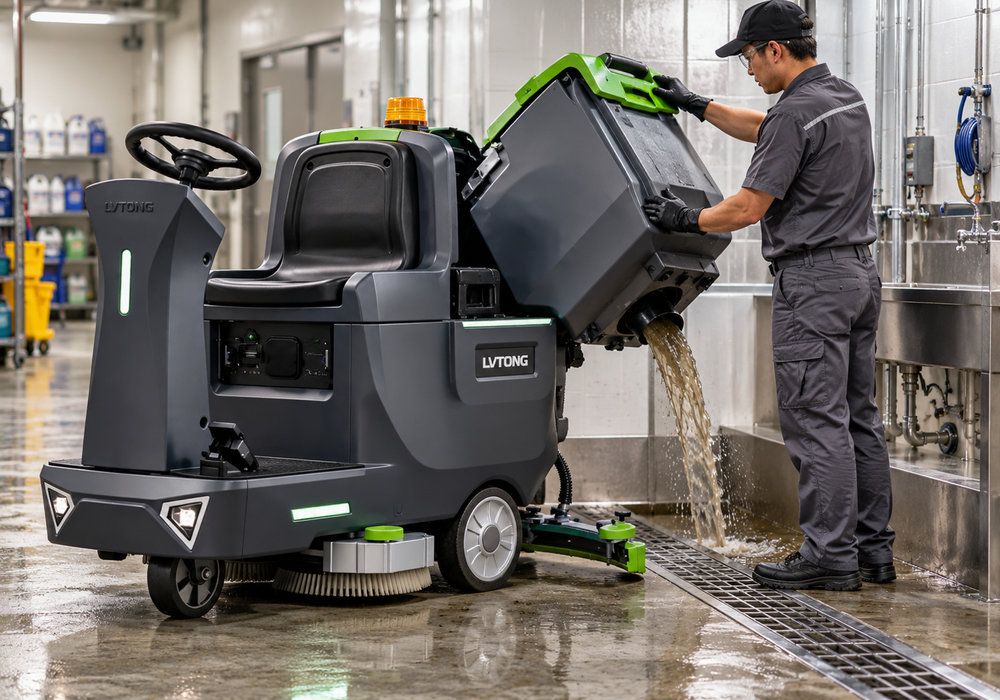
Practically, a scrubber-dryer reduces the problem: recovering water into a tank means less water on the floor and better control over where it goes. Dump into the intended sanitary or interceptor-connected sink, keep recovery tanks rinsed so grease does not rancidify, and confirm local food-establishment requirements before changing routine.
Slip Control and Crew Safety on the Line
Wet and greasy walking surfaces are the dominant kitchen hazard; specifying recovery-capable equipment and dry-pass behaviour is a safety measure, not a comfort feature.
Regulators treat walking surfaces as an employer responsibility: current US rules require working surfaces to be kept in a condition that reduces slip hazards, published in 29 CFR Part 1910 Subpart D. In a kitchen, that translates into prevention rather than signage: fewer wet minutes, no grease film, and a floor that is dry before the next shift’s traffic arrives.
Three habits support it: run the deep pass at inter-shift so water is off the floor before staff return; keep a squeegee routine around the dishwash machine, where water accumulates fastest; and treat streaks as a maintenance signal, since a worn blade reintroduces the hazard the machine exists to remove.
Inter-Shift, Mid-Shift, Deep: A Schedule That Holds
One inter-shift deep pass plus targeted mid-shift spot passes at fryer, dish, and prep stations does the work; weekly deep cycles handle grout and drainage.
| Frequency | Scope | Why it works |
|---|---|---|
| Mid-shift, as needed | Fryer zone, dishwash mouth, prep counters | Bound grease is easier to remove within the shift than after it sets |
| Inter-shift, daily | Full line, walk-in floors, dry storage | Water is off the floor before the next shift’s loaded traffic |
| Weekly | Slow double pass on grout-heavy zones; drain basket and tank deep rinse | Grout soil and tank biofilm are weekly problems |
| Monthly | Squeegee blade and brush inspection; drain and interceptor review | Worn consumables quietly recreate the wet-floor problem |
Buying Checklist for a Kitchen Floor Scrubber
Judge candidate machines on seven kitchen-specific points; general machine marketing rarely maps onto line conditions.
- Scrub path 500–530 mm, with brush height and angle adjustment for uneven tile beds.
- Recovery tank sized to your line, and dumpable without lifting machinery.
- Squeegee pickup wider than the scrub path, with a field-replaceable blade.
- Brush or pad system compatible with grout agitation and with softer epoxy surfaces.
- Tank, seals, and pump rated for alkaline degreasers at label dilution.
- Runtime covering the full line plus storage in one cycle on lithium power.
- Service, brushes, blades, and seals available in your market.
Acceptance Test Before You Commit
Test on the fryer zone and the dishwash mouth — the two sections that fail first — and refuse a demo that happens on a clean floor at midnight.
Run the candidate machine at your normal dilution, on the heaviest section, during a real shift. Four checks decide it: the floor is walk-dry within five minutes; the white-cloth test passes on tile and on grout; the squeegee leaves no streaks on turns; and the recovery water is dark rather than thinly grey. Repeat once at a second shift to expose tank and battery behaviour under real loading.
For multi-site operators standardizing a commercial kitchen floor cleaning machine across locations, the same script doubles as a scoring sheet. Suppliers confident in the class will support it; that support is itself part of the specification.
Frequently Asked Questions
What is the best kitchen floor scrubber for a commercial line?
A compact walk-behind scrubber-dryer in the 500–530 mm class with grout-capable agitation, degreaser-compatible tanks and seals, and recovery that leaves the line walk-dry. Size from line area and dump frequency, not from aisle width alone.
Can I use the same machine for the dining room and the kitchen?
Keep them separate. Kitchen soil reaches the fryer zone and drain areas where a dining-side machine should not go; a dedicated back-of-house unit keeps grease out of the front-of-house water path.
How often should a commercial kitchen floor be machine-scrubbed?
Inter-shift daily for the full line, with mid-shift spot passes at fryer and dishwash, plus a slower weekly grout-focused pass. Heavy frying operations often need a second full pass midweek.
Does hot water clean kitchen grease better?
Temperature helps to a point, but machine and floor manufacturer guidance sets the limit. Dilution discipline, dwell time, and agitation matter more than pushing water temperature.
What about floor drains and grease traps?
Route recovered water and wash-down to the drainage path the facility is built with, keep interceptor access clear, and confirm local requirements for food establishments before changing the routine.